Showing posts with label Stan Winston. Show all posts

Friday, March 3, 2023

Robot Revolution: The one where Kristin Stewart kills an alien with a piano


Title: Zathura aka Zathura: A Space Adventure

What Year?: 2005

Classification: Mashup/ Weird Sequel/ Anachronistic Outlier

Rating: That’s Good! (4/4)


With this review, I’m continuing my series/ feature on robots. An issue that has already come up is that while robots have figured regularly in science fiction films for about as long as the genre has existed, they have often been relegated to subordinate status, typically as servants/ minions to their good or evil creators. For the most part, I have used this to narrow down the field to the comparatively manageable number of films that make robots and other AI (which I have been planning to get to) truly central to the plot. For my fourth installment, however, I decided it was time to deal with an example of the “secondary” tradition, and that brought up a movie I have been looking for a chance to cover for a while. I present Zathura, a movie where the killer robot is the least strange thing about the film.

Our story begins with an introduction to a single dad and his two elementary-age sons, who habitually bicker while their teenage (step? half???) sister hovers at the periphery. When the father leaves on an urgent errand, the two kids try playing a Gernsback sci fi-themed game that’s really more like a mechanical toy. They discover that this is more than a board game, however, as perils like meteor showers and a malfunctioning robot become reality. The continuing misadventures leave the whole house adrift in space, threatened by a marauding reptilian race. Their best chance of returning home is a mysterious friendly astronaut who has played long enough to know the rules of the game- but the wrong choice may trap them in the game forever!

Zathura was a 2005 science fantasy film directed by Jon Favreau, based on the book of the same name by Chris Van Alsburg. The film was regarded as a thematic sequel to the 1995 film Jumanji, also based on a book by Van Alsburg. Favreau stated that the film was influenced by 1970s and 1980s films including Battle Beyond The Stars. The film starred Josh Hutcherson and Jonah Bobo as the brothers, with Dax Shepard of Idiocracy as the Astronaut and Tim Robbins as their father. Kristin Stewart appeared as the sister, and Frank Oz (see Dark Crystal, An American Werewolf In London) received credit as the voice of the Robot. Suits and practical effects for robot and aliens were created by Stan Winston Studios (see Invaders From Mars, Congo, etc, etc, etc.), as part of a blend of animatronic, miniature and CGI effects used for the film and often for the same sequences and characters. The film was a commercial disappointment despite favorable reviews, earning a $65 million box office roughly equal  to its budget. Its reputation has improved as both a “cult” SF/ fantasy film and family movie. The film is available for streaming on multiple platforms.

For my experiences, I really came to this film after seeing it mentioned by a reviewer I follow intermittently, as an example of a film I didn’t know was “supposed” to be a failure. That brings in certain further complaints that I have had with the likes of The Black Hole, The Blob and The Thing (see my video on the last): Yes, films that earn their budgets back can still lose a lot of money, but I have never cared for calling a movie a “bomb”, flop, etc. on that basis alone. With the present film, I can remember favorable reviews and a prompt viewing when it came out on home video. I was immediately impressed with it as a solid and creative genre film with the potential to turn into a “classic”, and from actual viewer feedback, I would say confidently that it has lived up to its potential. That, in itself, is exactly how films end up above my radar. For this feature, I finally felt I had a reason to comment on an excellent film.

Moving forward, all the obvious arguments, counter-arguments and counter-offensive arguments come down to the simple question of realistic expectations. Yes, there are things that can be off-putting for the adult viewer, especially the interminable bickering. But this is supposed to be a kids’ movie, and it can justify itself as portraying what kids deal with in real life through what becomes both a theme and a major element of the plot. The central science fictional elements are similarly framed as science fantasy in the vein of Starcrash and Flash Gordon, with a sounder suspension of disbelief than usual. It’s worth further note, with respect to my Anachronistic Outlier category, that this is all done with a fully modern visual vocabulary. To me, the one thing worth further argument is Stewart. On many levels, her character is one thing the film would have been as good or better without. I do feel that a major reason for the easily felt redundancy is that there is no confirmation of her exact relationship with the other family members. She does contribute as the actual “voice of reason”, and her completely justified reactions mitigate the question of whether the events on-screen are in any way “real”. Any further doubts are acquitted when she finally takes on an antagonist one on one, which (as alluded in the title) I am absolutely counting as an unambiguous combat kill.

Inevitably, I have to devote a section to the robot. I will point out, first, the technical facts: This is not a “practical” rig, as I recall a contemporary reviewer assuming, but a hybrid of a Winston suit with CGI effects that was itself an astonishing innovation. As for its on-screen appearance, there’s really just one sequence of the bot in action, which would have been the “one scene” by my usual format. It’s all set up with a fake-out scare involving a toy, which on consideration is perhaps the most clever hint that the movie’s “reality” is ambiguous. (I will get to that in a moment…) When the bot does appear, it is entirely and menacingly physical.  The ensuing mayhem quickly establish it as the most formidable of the movie’s antagonists. In the process, there are also established limitations. It’s fast, though not necessarily faster than the humans. On the other hand, it is seemingly clumsy, which might be in part because it is still figuring out which parts of the house it can simply tear through. The most disconcerting reveal comes when we see it repairing itself, establishing an ongoing threat that will be handled with another clever twist. When we get a look at its clockwork guts, it is ludicrously primitive, more like Tik Tok of Oz than a Golden Age bot. But then there is the bird-like self-repair appendage, which at certain points acts like a sentient entity all its own. There’s no direct answers to this and other questions; what works is that we don’t need them to enjoy the story.

Now for the “one scene”, I was as often happens most intrigued by an otherwise innocuous scene. Right around the first-act transition, the younger brother decides to cook some macaroni and cheese. The older brother says that there will be no running water while they are literally in space. Undeterred, the younger brother turns on the tap, and water comes out, filling the pan. When he goes to the stove, the elder brother reminds them that there “should” be no gas for the burners, either. (For that matter, the power should be long gone as well.) It’s no real surprise when the burner merrily turns on. It is a brief and minor moment, yet on analysis, it is the most mindboggling moment in a story that is already running on the willful suspension of disbelief. The simple and convenient explanation is that everything we are seeing is a product of the boys’ imaginations. The quite disconcerting alternative is that whatever rules and logic still apply in this assumed universe are a matter of what the kids would know and believe. It’s a hypothesis that could have been tested, if the older brother tried the same things himself, but the story is already moving on.

In closing, what I find myself coming back to is what makes a movie a “failure” in its own or any other time. As I have previously ranted, my own formula for actual disaster is whether a movie with a budget of at least seven figures can get half of it back, and dear Logos, I have covered enough that didn’t to prove that box office results are no measure of merit. There are ones now considered classics, like Return To Oz, though I have covered many more that didn’t actually do “that” badly. (Hell, Krull pulled through at about 60%.) There are ones that at least reached the level of “cult” fandom, like Deep Rising, and others that remain divisive even in those circles, like Memoirs Of An Invisible Man. Then there are the ones so mediocre and unmemorable that they don’t even live up to their own notoriety, like Adventures of Pluto Nash. What movies like Zathura prove is that there can be justice in the long and short term. In its own time, it did well enough just by earning as much as it cost. As it approaches 20 years from its release, it has endured the tests of time, above all as a film critics, fans and audiences still talk about.  It did what it set out to do, and by my regular refrain, that’s more than enough. Onward and upward…

Saturday, October 29, 2022

Movie Mania: Predator soundtracks!


It's Halloween weekend, and I still haven't gotten the nominal Thursday post up. This time, I have something I was waiting on. In the last month, I ordered the soundtracks for both Predator movies (see my Predator 2 review). Here's a rundown on how they compare. First up, here's a pic of the original soundtrack and insert.

Now, I really need to back up. I'm as much a soundtrack fan as I am a movie fan, and I can boast of knowing all the major guys from the 1970s through the '90s by both their names and their work. As a further consequence, I'm pretty good at recognizing composers without looking things up or waiting for the credits. The thing is, it's a trick whose results vary. Just for example, it's not hard to recognize James Horner (see the Krull soundtrack post), who had a certain vocabulary of cues he would usually work in. On the other hand, I've never pinned down Basil Poledouris (see the Conan the Destroyer and Starship Troopers soundtracks), the composer I've come to praise most often and highly. The composer I've had the highest success rate with is the one behind these soundtracks, Alan Silvestri, otherwise best known for the Back to the Future franchise. Just among the movies I've reviewed, I ID'ed him in Death Becomes Her, and I had already known he scored Mac And Me. Looking through my files, I found more that he composed that I hadn't remembered: Judge Dredd, The Wild (you really can't win them all), and The Mummy Returns. I still wondered if there were a few I had left unmentioned, so I checked his filmography. I was a little surprised not to find any more.

Moving forward, the disc I have here is actually the second release of the Predator soundtrack, put out in 2010 by Intrada. To my surprise, it has never been released as a digital album, so prices can be quite high. I got it by making an unopposed bid to a seller overseas. As a further reminder, I don't generally collect these things because I'm some techno-Luddite, but because it is far too often the only way to get what I'm looking for. There's really not a lot to say about the music itself. If you know the movie or the composer, it's everything you would expect. It's a little under an hour and 15 minutes, which is at least good background noise for the buck. The high points go with the build-up to the action sequences, capturing a sense of mischief that runs through the composer's work. If there's a downside, it's that there is little to remind you where in the film it would be. The nifty extra is the insert booklet, which has the feel of what they would have done if this had come out in the 1980s. Here's a couple pics of the contents.


Next up is the second album, which did get a "vintage" release by Varese Sarabande, an outfit that released the first version of the Predator soundtrack in 2003. It's 45 minutes long, so not quite as much return on the investment, though it's not as expensive as the original, either. As I commented when reviewing the movie, the music is improved as much as it could be improved, with a cool Afro-Caribbean vibe. If anything, it ramps up a bit for the finale, showing that the composer was getting better. Here's a few pics.


And that's really enough for me. I love movie soundtracks, and this is from a guy whom I would have expected to cover a lot sooner. (Also, Silvestri is still alive and active.) He may not be on anybody's best list (I would count him as about number 5 for his era, and Williams and Goldsmith were already tied for 1), but his music is distinctive and genuinely fun. It's exactly what you would expect from good movie music and good music period. That's all for now, more to come!

Thursday, October 6, 2022

The Franchise File: The one with a Predator vs. Bill Paxton


Title: Predator 2

What Year?: 1990

Classification: That’s Good! (4/4)


With this review, I’m back to Featured Creature, a feature that’s been in a gray area between active and retired, particularly since most of what I’ve done lately has been leftovers from features I retired (see Death Becomes Her). This time, I’m back with something I wanted to do all along. I’m doing a lineup of 1980s franchise movies that came out in the 1990s. I speak, of course, of sequels, the one area where franchises have always been fair game, and I intend to cover the ones that are actually/ arguably good. To start things off, I have my pick for the very best of them. Here’s Predator 2, among other things the one with Bill Paxton, and if you are wondering if he’s getting to the end of this one, you missed the genre’s biggest in-joke.

Our story begins with a dystopian version of LA in the not-too-distant year of 1997, where the police are outgunned by generic minority gang members. The day is saved by our hero, a cop/ black guy named Harrigan, but when he breaks in to the bad guys’ hideout, he finds them already slaughtered by an unknown attacker who apparently entered and left through a skylight. He also runs into a fed who keeps pulling rank as more tough guys turn up skinned and mutilated. Of course, the real culprit is a Predator, a creature that hunts less advanced species for sport, according to a code of fair play that apparently doesn’t exclude using a cloaking device and plasma bazooka. This time around, the agents of the military-industrial complex are ready to hunt and catch it. Harrigan is dragged in as the G-man’s plans go south. It all comes down to a one-on-one fight- with an opponent who can take out a good part of the city if he loses!

Predator 2 was the first sequel to the 1987 film Predator, and the only sequel to be made by the original team of producers Lawrence Gordon and Joel Silver, writers Jim and John Thomas, and effects demigod Stan Winston (see Invaders From Mars, Congo, etcetcetc, etc). The film starred Danny Glover as Lt. Harrigan and Gary Busey as the fed Keyes, both of whom had appeared in Silver’s production Lethal Weapon, with the late Bill Paxton as the cop Jerry. The late Kevin Peter Hall (see… Highway To Hell?) played the Predator, the only returning cast member of the original film. The score was again composed by Alan Silvestri (see… Mac And Me???). While events of the earlier movie were referenced, the film did not include Arnold Schwarzenegger’s character or give a canonic account of his fate. Paxton became known for playing characters killed in the Terminator, Alien and Predator franchises. The movie was a possible commercial disappointment, earning $57 million against a budget of up to $35M, and was controversial among critics and fans. The next authorized film to feature the Predator was Alien Vs. Predator in 2004, based loosely on the Dark Horse comics Aliens Vs. Predator. Hall died of complications from HIV/ AIDS in 1991. Winston died of cancer in 2008. Paxton died in early 2017 of reported complications during surgery.

For my experiences, I looked up this movie pretty close to when I saw the first one, and it has ever since been stood as a definitive example of a sequel that is very possibly better than the original. What has really impressed me the most through the years is its simple audacity. Apart from anything else, having the very first sequel be about the monster without also  bringing back at least one recurring “hero” hadn’t really been done in the modern era outside the slasher genre (compare to Halloween 3). Beyond that, the movie surely drew on the further influence of Dark Horse comics, to the point that I have at times considered it for my finally retired Super Movies feature. Finally, I’ve been vaguely amused to see several Predator weapons introduced here become iconic in the franchise with little or no acknowledgment, especially the programmable murder frisbee (see also… Krull??!!). In these terms alone, this is at a minimum a sequel that knew how to build on its source material, and to me, that is just the start of why it’s awesome.

Moving in, I’m going to start with what’s good, particularly by further comparison with the first film. The central and easily overlooked reality is that this is definitely not the same Predator we saw before. In my “head canon”, what makes sense is that this is a younger specimen (partially validated at the very end), with correspondingly less finesse and far greater boldness. In an ironic twist that might or might not have been intentional, this one appears to adhere much more strictly to the implied code of fair play, to the extent that he (???) clearly favors close-range engagements with the claws and other edged weapons over sniping with the bazooka. There’s a certain further sense of vulnerability, egregiously during the semi-improvised first aid in a civilian’s bathroom. On the other side, we have a more relatable and likeable lead from Glover, who offers a true everyman that can voice what we’re all thinking, while Busey offers an authority figure whose actions are at least comprehensible. One more note in order is Silvestri’s soundtrack. As with the Predator itself, this is the same elements yet not the same, with a lively and authentic tribal flare added to an already archetypally effective score.

That, unfortunately, brings us to the parts that are not so good. To put it bluntly, the gang members are like cliches of other cliches. Only King Willy, bonkers even here, and perhaps the ill-fated Scorpio of the beginning rise to the level of discrete characters, let alone developed and interesting ones. In further hindsight, even Harrigan is matter-of-factly conformed to law-and-order stereotypes that would be far more uncomfortable if a “white” actor was portraying him, further validating implicit “war on drugs” politics that aged worse than usual. (It doesn’t exactly help that he effectively trades the murder frisbee and half a wrist nuke for a muzzleloader.) Finally, I will be the first and saddest to admit that they don’t do that much with Paxton. It’s as if they expected him to replicate his performance in Aliens (see my post on the novel) without the improvisational freedom that was allowed and effectively managed on James Cameron’s set. The result is a pleasant performance that checks the right boxes, redeemed by a last stand that was definitely in the running for the “one scene”.

Now for that very thing, the “one scene” that has intrigued me the most is (as happens fairly frequently) around the middle. While Harrigan is visiting the grave of a colleague, we see a child playing with a typically inappropriate 1980s toy gun at the edge of the cemetery. He seems aware of but unimpressed by his surroundings as he goes through his war games, making his own sound effects. Meanwhile, of course, the Predator is watching. The kid stops on seeing the silhouette of the cloaked creature. That’s when we go to Predator vision, and see the targeting computer highlight the silhouette of the toy gun (which is triggering a fan theory that the first one couldn’t see Arnold because their tech stinks). It’s every bit as horrifying as it sounds, except, I have never felt real doubt of the outcome. The Predator holds its fire, then the kid offers candy to the apparition with a line that is obviously going to be repeated. I find a certain ambiguity. It’s really a given that a race of sportsmen wouldn’t kill kids on purpose, no matter how fuzzy their alleged code gets. At the same time, there’s a sense of evil or at any rate amorality encountering innocence, and finding each other too baffling for further attention.

In closing, the only thing I can add is that this is one time my usual nitpicking might seem harsher than the actual rating. What it really comes down to is that this franchise was made to run on pure adrenaline, and this first follow-up already knew how to stick to its strengths. The last thing that lingers in my mind is how much the people involved here shaped my life and pop culture experience from childhood to early adulthood, whether or not I knew it at the time, and how many of them are gone. (While I’m at it, why not links for parts 1, 2, and 3 of my Lanard Predator posts?) I could go long on the melancholy, but it’s enough to say that they will stay with me as long as I’m still here. Rage against the dying of the light, and while you’re at it, watch something good!

Thursday, June 23, 2022

Really Good Movies! The one that's a remake that got a remake


Title: The Thing

What Year?: 1982

Classification: Improbable Experiment/ Weird Sequel

Rating: Classic! (2/3)


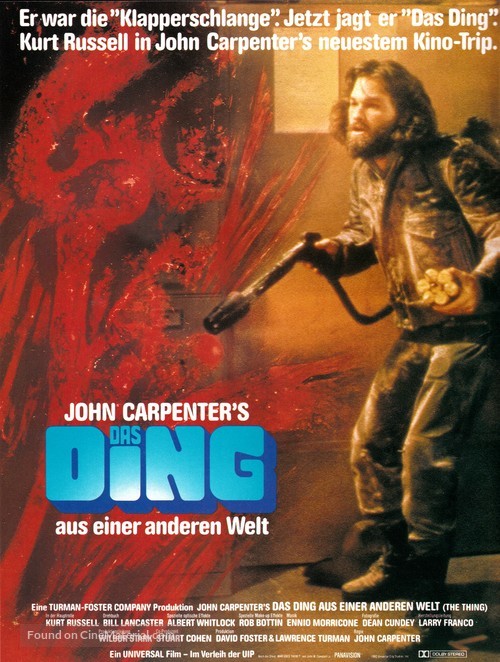
In the course of my reviews up to creating this feature, the recurring common denominator has been outright random. With the present review, I have an example more egregious than usual, as I had already considered not one but two promising films that weren’t even bad. Then, by total happenstance, I discovered that a local theater was going to show an all-time favorite film that’s been well-known and liked. I took the shot, and once I did, I knew I had to go back in while things were fresh. With that, I introduce The Thing, a movie that kind of made its own legend.

Our story begins with a flying saucer hurtling towards Earth, in what’s revealed to be ca. 98,000 BC. Flash forward to the present, and we come to the barren landscape of Antarctica, where a small American research station is threatened by two seemingly crazed foreigners out to kill a dog. The encounter ends with the dog alive and its pursuers dead, so the expedition’s animal lover takes in the animal while the doctor Blair and the goofy pilot Macready try to figure out what happened at the foreign base. Soon, the dog transforms into a hideous alien creature that attacks and assimilates several of the expedition’s animals before it is destroyed. The horror isn’t over, as it becomes clear that at leas one of the human expedition members is already infected. The fate of the Earth depends on finding the Thing among them- and it’s up to Mac to do it!

The Thing was a 1982 film by John Carpenter (see Dark Star, They Live), based on the 1938 novella “Who Goes There?” by John Campbell and the 1951 film The Thing From Another World. The film starred Kurt Russell (see… Sky High?) as Macready and Wilford Brimley (see… Battle For Endor???) as Blair, with Keith David as Childs. The creatures and other practical effects were created by Rob Bottin. Additional effects for the transformed dog were provided by Stan Winston (see Invaders From Mars). The soundtrack was scored by Ennio Morricone, otherwise best known for The Good, The Bad And The Ugly. The film was considered a commercial disappointment, earning a box office of under $20 million against a $15M budget. It attracted further controversy over its effects, gore, and typically unfavorable comparisons with the 1951 film. Peter Nicholls writing in 1984 commented favorably on the reintroduction of the “shape-shifting” element of the original story, and further praised the film as “an object lesson in building tension and atmosphere economically”. The film gained in popularity on home video, culminating in a 2011 prequel/ remake. It remains available on multiple formats and platforms.

For my experiences, this is one movie where I truly feel like I was “there”, despite it coming out barely within my own lifetime. I was aware of it quite early, mostly because it incomprehensibly turned up on TV, and I believe I may have seen the very end once or twice. What was pivotal for me was that I read and loved Campbell’s story at a fairly early age in the middling 1990s. After hearing a little more about it, including plot points I recognized from Campbell, I watched it and honestly wasn’t that impressed until I gave it a couple viewings. By the early 2000s, I was a full-blown convert, showing my own tape to quite a few friends who as far as I knew hadn’t seen it or heard much about it. (Right, and I used it for an Exotroopers adventure I never finished proofreading...) What really stands out is that even then, many of the books I consulted were critical at best, usually repeating the refrain that the ‘50s film was so much better. It was surely quite a bit later, therefore, that the present film reached the heights of fame praise it had now, and I can’t avoid the feeling that my experiences are a microcosm of a reality people are already forgetting.

Moving forward, the one thing I have to say by way of comparison is that this is one time a movie actually improves on the literary source material. (The ‘50s film is a cluster rant I won’t even try to fit in here…) Campbell wrote for a time when characters were subordinate to concepts and the exposition dump was an unquestioned convention. He also dragged into his writing and subsequent editing a notorious “pro-human” bias that would help cement the happy-ending formula of the alien invasion genre. Carpenter belatedly completed the long, slow revolt by offering a version of Campbell’s own tale where there’s never any question the Earthlings can lose, and (spoiler) do lose on a certain level. There is still plenty that’s conventional or cliched, which accounts for most of the “cons”. The heroic tough guy is really glorified comic relief. The conflict and paranoia of the middle act (still not quite up to the level of the story) is mostly interchangeable melodrama. The resolution hinges on a good idea that arrives when it is needed rather than naturally evolved. On the pro side, there is a postmodern sensibility that leads to several scenes that are more unnerving if you already know who is Thinged, inviting analysis and speculation where the real moral may simply be that the alien cannot be understood by human minds.

That leads to two things, one obvious and one easily missed. The obvious is the astonishing effects, perhaps the closest there will ever be to creature design as abstract art. What really stood out watching this on the big screen is that the effects are done in quite brief glimpses, in which even things you are looking for are easy to miss, yet you can also notice something new. My personal favorite is the behavior of Thing tissue carried over from Campbell, modestly described in print, but here so extreme Mac himself is completely unprepared for what he’s expecting. The less obvious element is the grungy, rickety base, whose defects and lived-in charm are all the more prominent on a theater screen. It makes even the Nostromo look sleek and clean by comparison. At the same time, I find the same symbolic significance played even more effectively. This isn’t just a place, but a man-made ecosystem essential to keeping both the humans and the alien alive. In a fitting symbol of both ecological interdependence and Cold War politics, the only way to achieve certain and total victory is to destroy your own life support, a price that the self-reliant male ultimately accepts with psychotic ease.

Now for the “one scene”, I’m going with a creature sequence, something I do very rarely. Here, my pick for the flat-out best is the sequence in the kennel. The commotion starts soon after the well-meaning animal lover leaves the mutt survivor to make friends with the other dogs. It’s when Mac and the others arrive that we see the full extent of the transformation. At this point, I’ll mention that I noticed people laughing during the screening that led to this review. It is a sight I will admit I found just weird on my very first viewing. The transformed dog-Thing is hairless, slimy and almost crusty, like a piece of orange chicken. (Oh yeah, going to an all-you-can-eat buffet after this one might be a bad idea…) The extra touch that makes this nightmare fuel is the bizarrely asymmetrical shape of the head, most visible in the skewed eyes, all while we witness the already horrific fate of the dogs. As Childs/ Keith David (more underused than one tends to remember, possibly to unavoidable circumstances) arrives with a flamethrower, it finally sprouts a couple appendages for an escape. Then there’s the detail embedded in my mind, a not-quite-circular fan of anemone-like tentacles that unfurls as the Thing tries to break out, and next to that, I just noticed, is an extra eye. What the Hell is it, and what would it do? We’ll never know, because that’s when the flame finally takes light…

In closing, I come back to the rating on a still very new scale. Make no mistake, this film is as good as any I’m remotely likely to review, and a favorite of mine. (They Live would probably still pull out ahead on my “best” list.) The real reason I have given it less than the highest rating is a “narrative” that I have finally decided to challenge. In retellings, the “story” that has emerged is on the same template as the martyrdom of a saint: Carpenter made a great film that bombed at the box office and was hated by critics, but we now recognize it as a classic. I can attest better than anyone that this is a part of the truth, not the whole. The movie probably lost money, but it earned a gross better than its budget. It faired poorly with critics, but that was after the studio invited comparisons with an already popular film that Carpenter in particular didn’t want. Above all, while it wasn’t immediately accepted by genre critics or fans, it certainly was not ignored or forgotten. Plenty of us knew about it, and there are plenty of films (see Lily CAT and Godzilla Vs. Biollante) that show its influence from a very early date. On the balance, it got what it deserves, and certainly better than might have been expected. The final verdict is, not bad for a remake.

Image credit Cinematerial.

Friday, March 18, 2022

No Good Very Bad Movies 23: The one by Oliver Stone


Title: The Hand

What Year?: 1981

Classification: Unnatural Experiment

Rating: Dear God WHY??!! (1/3)


As I write this, I’ve been developing ideas for either wrapping up this feature, spinning it off, or both. I got the idea to do a run with a theme: Very weird films by famous or notorious directors. That immediately brought up one film which I’d had in mind all along, and another I had definitely meant to look up sooner or later. The present selection is the odd one, a movie I saw not long after I started doing reviews but never had a use for anytime since, until I thought of doing this. I’m doing it first because it’s the one I had to get on a tight time table, and the one that really makes me mad, in no small part because it’s easily the most polished and professional movie to come up in this feature. I present The Hand, a movie with the talents of Oliver Stone, Michael Caine, and the best practical effects guys who ever lived, and it is… just… stupid.

Our story begins with a quick introduction to an artist named Jonathan Landsdale who does a Conan-like comic strip, and his wife and daughter. The marriage is clearly strained, as the couple get into an argument that ends in an automobile accident. In the aftermath, he is left with his drawing hand severed and never found. As he struggles with his new disability and worsening personal and professional life, he begins to have visions of his missing hand wandering with a life of its own. Soon, strange accidents begin to befall those he believes have wronged him. Meanwhile, he takes a teaching position that comes with a cabin, and soon strikes up romance with a college girl, yet the disturbances soon follow. Is the hand really come to life, is it all in his head, or is it his own subconscious revenge? Can he salvage his old life or the new one? Spoiler- even the people making this movie don’t really care!

The Hand was a 1981 film directed by Oliver Stone from his own screenplay, based on the novel The Lizard’s Tail by Marc Brandel. The film was produced Edward R. Pressman, evidently as a Canadian-American project as the budget was reported as 6.5 million Canadian dollars. It was Stone’s only feature-length directorial credit between his 1974 debut with Seizure and 1986, when he made his mainstream breakthrough with Platoon. The film starred Michael Caine as Jonathan Landsdale, with Andrea Marcovicci as Mrs. Landsdale and Annie McEnroe as his student Stella. Effects for the hand were provided by a team that included Carlo Rambaldi (see Conan The Destroyer, ET), Thomas Burman (Cat People) and Stan Winston (see Invaders From Mars, Leviathan, etc,etc). the soundtrack was composed by James Horner. The film had a reported box office of $2.4 million, less than half its budget. It was also poorly received by critics, with Peter Nicholls describing the film as “deeply confused”. The film was somewhat more successful on home video, and is currently available in digital form. Pressman and McEnroe married, and have a son born in 1987.

For my experiences, I suppose what made me vaguely interested going in was how iconic the premise of the disembodied hand is, compared to how few films really use it, especially on “straight” terms. The definitive treatment was and remains the late-Gothic 1919 horror story “The Beast With Five Fingers” and its 1946 cinematic treatment with Peter Lorre (which I still haven’t seen). Since then, it’s become fairly routine to have undead (not to mention aliens, robots, etc.) whose bits keep coming when dismembered, as in Splinter.  To make the self-driven hand a main antagonist remains far more novel and most obvious in the realm of parody/ comedy, as in Evil Dead 2 and Idle Hands.  With that context, the present film stood out even sight unseen as both earlier than many it could be compared to and seemingly completely serious. With further hindsight, this was all a very strong indication of the problems to come.

Moving forward, the central reality of the film is simply that there is indeed little if anything that can be considered funny, intentionally otherwise. Caine and most of the rest of the cast play their roles very seriously, which brings out a sense of domestic awkwardness in the film’s better moments. The story told is likewise very much in the tragic form as the protagonist goes from troubled to abusive, even if there isn’t much effort to make us like the protagonist or anyone else. In certain lights, this is a big part of the problem, as Caine’s character never pushes the emotional gauge far past neutral. He isn’t sympathetic enough to be a “fallen hero”, not entertaining enough to be a lovable rogue, and without a trace of the gleefully over-the-top villain who would keep us watching just to see his comeuppance. It doesn’t help that he never seems distressed or even disoriented by his supposedly worsening blackouts and dissociations. On that front, I cut off a longer rant just to compare to Bruce Campbell as Ash. He’s obviously no equal to Caine, but the one thing he’s good at is making you like his character and absolutely believe he is in a terrible and terrifying situation.  Here, the vibe is a classy actor trying to play a character who can barely pretend to care, and the result is that we don’t either.

Then what really tugs at my mind is the effects, and this aspect of the film that first got me to its strange vibe: This is not simply a movie that could have been better, but one that could have been more effective if it was worse. The hand looks every bit as good as it should, yet it’s oddly unimpressive. The obvious issue is with the concept; the hand succeeds so well that it looks like any other hand, and it was already clear that it’s hard to make this scary, especially with the surprisingly low body count. What gets strange is comparing it to movies that are by any standard inferior, like the stop-motion finger spider in Bride Of Re-Animator or Winston’s own loose arm in Dead And Buried. The most egregious yet instructive comparison is with Dead Alive, where virtually everything looks like kaka on purpose. What that very odd film succeeds in is creating a sense of the surreal, to go with an already psychotic level of energy. By comparison, the effects here simply feed into a dull linear realism that directly undermines the movie’s already thin pretenses. Then this is as good a point as any to rant about the ending, which is no more or less than a cop-out interrupted by another cop-out.

That leaves the “one scene”, and I really couldn’t come up with anything better than the set-up sequence. A few minutes into the film, Jonathan and his spouse are arguing during a drive through the countryside. In the midst of the quarrel, the lady speeds up and tries to pass a slow-moving truck. Suddenly, they find themselves hemmed in between an oncoming truck and a big brick of a car crowding in from behind. In the most amusing touch, Jonathan tries to wave back the other driver back, and of course he’s having none of it. Naturally, a gruesome collision follows, in which we don’t really see anything though the chain of events is quite clear. The emphasis is on the aftermath, as Jonathan/ Caine rushes out. It’s as grisly, cynical and sleazy as the movie is supposed to be, and in my usual refrain, what follows does not live up to it.

In closing, what I find worth commenting on is my background as a self-advocate, which is certainly a major reason I have gone as I have on this movie. As I keep saying, I have enough problems that I can get the stoned-out-of-your-mind experience going off my meds. Throughout my time doing reviews, I have regularly dealt with movies that try to imply themes of mental illness and sheer unreality by doing weird and random for its own sake. What’s really noteworthy is that the ones that come anywhere close to succeeding wouldn’t really change if  the subtexts were explicit. If The DayTime Ended, House or Death Bed were framed as a schizophrenoid episode or a bad acid trip, they would still be every bit as weird and disconcerting as they already are. These movies may not be that good in their own right, but they have the authenticity that keeps eluding polished mainstream fair. And with that I’m calling this one done.

Sunday, February 20, 2022

The Legion Of Silly Dinosaurs: Winston the Uintathere and friends!


It's time for the weekend dino post, and if there's one thing I've made clear, it's that my definition of "dino" isn't limited to dinosaurs even when I'm ranting that they aren't dinosaurs. For the purposes of this feature, the toy dino isn't about the creature but the nature of the toy: cheap, usually small, often outdated, and of course silly AWESOME (the gag I always wanted to do). This time around, I have one that I've had for a while now, and just maybe brought me through some hard times in my life. Here is Winston, the uintathere.


This little guy has a backstory in two parts. The toy is based on Uintatherium, a creature that lived in present-day Utah between 50 and 40 million years ago. It was the first mammal to reach megafauna size, probably about the size of a hippo. While it looks vaguely like a rhino, it was really a separate lineage called Dinocerata that lived and died while the actual ancestors of the rhinoceroses were still the size of pigs. Under further scrutiny, it had a number of features that were unusual for animals of its size, particularly a pair of large teeth with chin flanges to protect them. Even the iconic "horns" were stranger than they look, more like the knobs of a giraffe (of course, I know they're called ossicones) than anything else. It's presumed that they were vegetarians, though omnivory isn't out of the question. Here's a few more pics of Winston.


Now for the toy, I found this little guy at a rock show right at the beginning of 2015, right when I was starting my first job after almost 3 and a half years of searching (see my stalking post). I got him for maybe 50 cents, from a seller who as I recall had a bin of paleo toys. The only identifying mark was an infamous name Jaru, which I'm sure I've featured before. I then decided to take him to my job, which in hindsight was ludicrously tolerant (see the tale of the CVS giant robot). In pretty short order, I set up a little diorama that also included a Diatryma, which lived in about the same time and place, and an anachronistic plesiosaur. Here's a reconstruction of what it would have looked like. Aw, look at the little tree!
"Meat eater, plant eater, can't we all just chill?"

A little later, I got another uintathere as part of a patchisaur set. It was a sculpt I'm sure I had sighted before, bigger than Winston but a lot cruder in appearance. I came up with the name Winnie, which didn't help generate any further affection. Here's a couple pics.


And here's a detail that makes this one semi-traceable, a fairly pointless hollow space in the belly. I suppose it saved a fraction of a penny on plastic, but it's still just odd. I know I've seen the same detail in pics from other collectors, some of which I believe were said to date back to the 1970s. It certainly could have happened...

Then, just a couple months back, I picked up this with most of a gift card. It's from a manufacturer called CollectA, marked year 2017. It's probably the most impressive example yet, which might not be saying much. It's obviously fanciful and a bit wonky, but it certainly gets away from the rhino-with-extra-horns mold. Here's a few pics.


If it seems like I'm not giving the detail I usually do, it's because I'm having to work around the detail. It turns out this thing is anatomically correct, and definitely male, and there are places I don't go. Here's a few more closeups of as much as I care to show.

Frankly, I wasn't comfortable holding it in the places I am here.

And here's a couple pics of the tag.

Not shown: "Small parts, choking hazard." (CHOKE.)

And with that, I'm wrapping this up. It may seem random as usual, but this is one of the things that means a lot more to me than might usually come across. Maybe, just maybe, what I do will make a little more sense. That's all for now, more to come!

Thursday, February 10, 2022

Movie Mania: Top 10/ 20 best movies reviewed!


As I write this, I’m just about to his 200 movie reviews, without doing anything to monetize my work, and I decided to do something different, that is, what everybody else who does what I do does sooner or later: Assemble a list of the best movies I’ve reviewed.  This might seem either Herculean or moot, given the quality of the movies I usually review. In fact, a good part of the list that’s been emerging in my mind are ones I knew would be here as soon as I reviewed them, usually because I normally wouldn’t have reviewed them. The rest have tended to follow naturally by reputation as much as quality, though parts of this are still fuzzy. So, here comes the top 10 list, not necessarily in order but definitely by tier.


1.     They Live- A movie so good and successful I reviewed it on the technicality that there was a comic book. Two guys discover that aliens have secretly conquered the world and fight back. It’s a bona fide cult classic that’s become a mainstream success. Top of the line.

2.     Galaxy Quest- Another cult movie that went mainstream. The washed-up cast of a science fiction show are recruited for a real war by aliens who think their adventures are history. High-level snark turns into an effective tribute to Trek and the serials and B-movies that influenced it. Good fun, with lots of laughs and real heart.

3.     Sinbad and the Eye of the Tiger- An old personal favorite, the swansong of the great Ray Harryhausen. The titular sailor goes on a voyage to a polar lost world to cure a prince transformed into a baboon. It’s Harryhausen at the top of his game with the baboon prince, a troglodyte and an assortment of monsters. A good and beautiful thing.

4.     Deep Rising- Really tied for three, another all-time favorite of mine. Mercenaries hired by a mysterious employer must fight their way out of a cruise ship infested by swarms of man-eating tentacle-worms. It’s a perfect blend of monster movie, action and comedy, with ILM-assisted CGI monsters and a Jerry Goldsmith soundtrack so awesome it got its own review first.

5.     Flash Gordon- My only top 5 substitution, one of the movies that got me doing this in the first place. Flash Gordon must save the Earth and Dale Arden from the over-the-top villainy of Ming the Merciless… actually, everything is over the top, including the theme song by Queen. It’s a genuinely clever tribute/ send-up and the most egregiously ‘70s thing on this list, though it happened to come out in 1980. “Flash…”

6.     Sole Survivor- One more favorite, a criminally neglected zombie movie from the director of Night of the Comet. The only survivor of a plane crash is stalked by undead assassins so stealthy only a nosey coroner notices them. It’s a polarizing movie among those who have seen it at all, worth a look wherever you can get it.

7.     The Hidden- Another bona fide cult movie. A mind-controlling alien goes on a crime spree in a series of hosts, just ahead of a cop and a federal agent with his own secret. It’s half sci fi, half police procedural, all action, with a surprising satirical bite.

8.     Krull- One more “favorite” that I spent years finding. When world of swords and sorcery is invaded by the sentient fortress of the Beast and his biomechanoid warriors, a prince leads a motley band on a quest to rescue his bride. It’s a fine piece of 1980s fantasy, with another awesome soundtrack.

9.     Terrorvision- My only other substitution on this list, a classic from the Band Crew. A kid fights an alien that climbed out of a satellite TV box, while his parents are more concerned with their swinger party. It’s dumb but fun with an edge, greatly improved by a very creepy monster, tongue-in-cheek performances from Mary Woronov and Gerrit Graham, and a bonkers theme song. Whoop, whoop…

10.  The Last Starfighter- Maybe the most iconic movie I’ve reviewed. A teenage guy discovers that his favorite video game is really a test for an interstellar Federation analog, and ends up flying their prototype fighter in the counterattack. It’s the definitive ‘80s movie, spiced up by Daniel O’Herlihy and Robert Preston.


An immediate word in order on this list is that there are certain movies I’ve excluded. First, I’ve chosen to look only at live-action theatrical films, so there’s no animation and no TV movies. Second, I haven’t adjusted the list for my most recent reviews, so I passed over Dragonslayer and a few others. Third, I set aside several films that I reviewed under very special circumstances, several of which I declined to give a rating. With all these adjustments, it still came out with the lineup I would have expected. 


The depressing lesson from this list is that my first and most extensive feature, Space 1979, barely got into the top 5, though I had no trouble filling out the rest of the list with these entries. There also aren’t any movies that are that obscure. What intrigued me more was that there weren’t that many that I gave the highest rating, either 4 or 5 depending on the feature. I suppose this is because I’m more critical of higher-profile of movies. It also reflects that these are movies that took more real risks, which in turn meant flaws in both concept and execution. The lesson is that ambition matters.


Now, because I really don’t know when to quit, here’s more to make this a top 20 list.


11.  Hancock- Possibly the only movie that I made a feature for. A disgruntled superhero prone to doing more damage than the bad guys saves a PR agent who teaches him to relate to ordinary humanity. It’s an underrated satire that still came out ahead of much of the modern superhero movie wave.

12.  Highway To Hell- The most egregious cult movie to come on my radar. A pizza deliveryman must rescue his fiancĂ©e from the devil in a post-apocalyptic Hellscape. It’s a surrealist fantasy that didn’t have an audience in its own time, very cool and it knows it.

13.  Duel- Narrowly removed for the top 10, the greatest TV movie ever. An unseen trucker chases everyman David Mann in the directorial debut of Steven Spielberg. It’s pure adrenaline with a side of social commentary, and that’s all it needs to be.

14.  Night of the Creeps- Classic 1980s zombie movie. Brain slugs reanimate the dead to wreak havoc on a college campus. Another action/ sci fi/ police procedural mashup, with Tom Atkins taking charge and stomping scenery.

15.  Island of Dr. Moreau (1996)- Absolutely serious. A shipwrecked UN negotiator discovers an island where animals have been uplifted into intelligent humanoids. It’s the best adaptation of a classic science fiction novel, with superb effects from Stan Winston and the embarrassingly high entertainment value of Val Kilmer being a jerk, i.e. by all indications Val Kilmer.

16.  Two Evil Eyes- Another zombie entry, the most actually obscure movie I’ve reviewed. A trophy wife and her lover hypnotize her husband to change his will and then hide his body in the freezer, but he still talks to them; followed by another tale of madness and murder allegedly based on Edgar Allen Poe. It’s included as a stand-in for several otherwise worthier works of the late, great George Romero, which is more than fair given its inexplicably overlooked status.

17.  The Wild, Wild Planet- A substitution for a well-known mainstream film, included as a twofer for films before 1970 and Italian movies. An international lawman and sexist idiot  faces a madder-than-usual scientist whose plan to perfect the human race includes fusing himself with a feisty damsel. It’s a very, very odd film I was definitely too hard on the first time around, entertaining enough for “so bad it’s good” viewing with moments that are surreal or completely unsettling.

18.  Splinter- Another very good zombie movie, and best non-animated entry from the current millennium. Carjackers and their victims are trapped in a gas station by a parasitic lifeform that reanimates humans, animals and pieces thereof. It’s body horror at its most brutal, with top-notch effects and a good cast.

19.  The Dungeonmaster- Another representative offense from the Band crew, barely bumped for Terrorvision. A hotshot computer programmer is challenged by a sorcerer, leading to a series of barely connected episodes that span time, space and genres. It’s one big pile of random from seven different directors, yet better than the sum of its parts.

20.  The Phantom Tollbooth- One from the animation category. A boy travels through a fantasy land divided between the kingdoms of numbers and words, on a quest to save the princesses of Rhyme and Reason from the demons of ignorance. It’s egregious psychedelic Sixties animation allegedly for kids, and the final effort from MGM animation.


With that, I’m wrapping this up. I haven’t gotten in everything I hoped, and I’m already pleading with myself to get in just one more really significant film, but I know if I keep at this, the list is going to be 200. So, I’m going to wrap this up, call it a night, and figure out what I’m going to do for my actual 200th review. That’s all for now, more to come!