Showing posts with label Italian movies. Show all posts

Monday, December 19, 2022

The Kong File 2: The one with zombie Kong and Linda Hamilton


Title: King Kong Lives aka King Kong 2

What Year?: 1986

Classification: Weird Sequel

Rating: For Crying Out Loud!!! (1/4)


With this review, I’m continuing my Kong lineup. As often happens, I have had the first and last entries settled in my mind all along, yet the middle installment has required further thought. That in turn required me to look through a fair amount of material that I, even I, had not gotten around to watch. I finally gave one particular film a try, with a solid alternate already in hand. When I was done, I knew that it was the one I had to do, so of course, I waited until the last moment to try writing a review. I present King Kong Lives, the sequel to the first Kong remake, because that always goes over well!

Our story begins at the climax of the previous film, as Kong takes a swan dive off a certain building that became a whole other set of baggage. But it turns out that a big company has hired a lady scientist with the tech to revive Kong as a sort of Frankenstein’s monster, because in this kind of movie, corporations never make a mistake that they can’t repeat with exponentially worse results the second time around. Meanwhile, an adventure manages to capture a female of whatever the Hell this species is. The Kongette (there’s no way this crew was coming up with the name on their own) provides a source for a transfusion that fully revives the original. Once Kong is up and awake, he pines for the female in what is definitely not a Platonic way. When the sponsors try to keep the pair apart against their own interests, the star-crossed lovers break free with no significant assistance from the lady scientist who is still being treated as the lead. With company bounty hunters and the military out for Kong, this Romeo and Juliet story just might end in tragedy!

King Kong Lives was a 1986 film by Dino DeLaurentiis (see Flash Gordon, Conan The Destroyer, etc, etc.), produced as a sequel to the 1976 remake of King Kong.  The film was directed by John Guillermin from a script by Ron Shusett (see Dead and Buried) and Steven Pressfield. The Kong suits and other effects were created by the late Carlo Rambaldi (see… Twitch of The Death Nerve?). Linda Hamilton of Terminator starred as Dr. Franklin, with Peter Elliott making a credited appearance as Kong. A tie-in video game was released only in Japan, under the alternate title King Kong 2. While the film earned $48 million worldwide against an $18M budget, it earned only $4M in the US and was reported as a failure for the De Laurentiis organization. A legal confrontation arose when Siskel and Ebert were warned not to broadcast clips of the film to national audiences, leading Siskel to comment that the De Laurentiis Group “couldn’t find a single scene that it wanted you to see”.  The film has a 0% score on Rotten Tomatoes (see Mac And Me, Terrorvision). It is currently available for digital purchase and rental, including free streaming from the Shout! Factory platform.

For my experiences, my one tangential encounter with this one is that I can recall sighting it on the video stores. What really came to my mind with this review was my own reappraisal of Dino De Laurentiis. I grew up on second-hand accounts that treated the filmmaker as a butt of jokes, albeit often in a semblance of good-natured humor. I went along with it to the point of making him the basis of a (likeable!) comic-relief character in my fiction. It was only when I started doing my own reviews that I started to come to terms with Dino as a significant and, at least in intention, serious filmmaker. What I found was that many other people have been making the same journey. What became ominously clear was that the present film has been left out of the De Laurentiis renaissance. Once I watched this movie, the impression I came out with was in many ways an “honest” effort, without the pretensions that built up around De Laurentiis’ most polarizing film. The corollary is, it is absolutely bonkers in ways I have spent the last few days trying to think of ways to convey.

Moving forward, the central and counterintuitive reality of this film and to some extent De Laurentiis’ work as a whole is that there is very little that is intentionally or at least obviously trying to be funny. This is something that I have for my own part come to see as part of the character of the Italian cinema he came out of. To be sure, there are actual gags, the funniest being the total annihilation of a very ‘80s sportscar. Yet, these are not really part of the De Laurentiis brand of surrealism. If anything, there are moments that feel all the more odd for being played straight. The quite lengthy resurrection of the first act is especially telling. It’s every bit as strange as it sounds in cold blood. At the same time, it’s the closest we get to anything resembling realism; there is a clinical feel here that conveys a further sense of real effort. (Alas, this is also the only point where Hamilton is anything but wasted.) The strange tone continues with Kong’s first escape attempt, where the guards and military vehicles descend into Wile E. Coyote slapstick that barely requires a response from the ape. Once the apes meet up, any humor very quickly drains away, generally to the film’s detriment. This shows especially in Kong’s battle with the military and the following birth of his son. There’s raw power in the ape’s Pyrrhic victory, but the new-born ape is just one more moment that’s weird without being interesting, all the more so as it is clearly just a grown human in a regular gorilla suit without magnification.

That leads straight to by far the biggest problem: The effects here are absolutely, inexplicably and inexcusably awful.  There were already plenty of problems with the 1976 remake, which in hindsight was just a little too early for practical effects to match the fine art of stop-motion. Here, at the height of the 1980s effects revolution, everything looks cheap, rushed, poorly thought-out or all of the above. The worst and most persistent problems come from the direction and camerawork, which repeatedly fail to provide either a scale to impress us or a context to know what if anything is going on. But I also cannot avoid a certain frustration with Rambaldi, all the more so after all the completely deserved praise I have given his work. This was the guy who turned H.R. Giger’s concepts into the Alien suit. (See Forbidden World and Deep Space for what could go wrong when people tried to replicate it…) The people who in his league during his lifetime could probably be counted on one hand. But this movie proves his tendency to be either very, very good or bafflingly bad. The apes here don’t match his so-so E.T. rig, never mind the Alien or Dagoth suits. It takes a lot to make me disappointed with a genuine effects hero, and I am well and truly mad.

Now for the “one scene”, I’m going with the one that really got my attention. As the finale approaches, Kong is being hunted by a band of company-backed bounty hunters. These aren’t just incompetents, but drunken, obnoxious louts who would presumably be even more unpleasant if there were women around. Surprisingly, they manage to trap Kong with a man-made avalanche that buries him up to the shoulders. It’s a perfect opportunity to throw a few of the gas bombs that have been established as Kong’s weakness in every incarnation, so of course, they laugh, take pictures and fire guns into the air while the ape snarls in indignation. They poke the ape with sticks and torches over the objections of one of their own, until Kong bursts free, burying the majority under their own rocks. There’s an unusually impressive shot as Kong pursues the 2 survivors, actually moving with something close to an actual gorilla’s knuckle walk. When the goons try to climb to safety, he grabs one and literally breaks him in half. He triggers another rockslide to bring down the other, whom he catches and swallows with no visible gore. We only see Kong chew, swallow, and after a moment, pull the ruffian’s hat from between his teeth. It’s a strange moment in a very strange film, but one of the last that really lives up to his potential.

In closing, all I can say is that after watching this, I have no problem with calling it the worst Kong movie. That comes with a few qualifiers. I’m not going to try to count foreign knockoffs, loosely inspired “tributes” and actual parodies. (I claim responsibility for the worst parody, even if it doesn’t technically exist.) I’m also not really considering what makes a film “technically” bad, a distinction that definitely goes to the 1960s incarnations of the character. (I’m definitely getting to that…) But on the Venn diagram of muddled story, poor effects and production values and pure wasted potential, this one hits the exact center of total failure. What’s really of note is that for all its failings, it’s still entertaining enough to be counted as underrated. The real lesson is just how elemental the appeal of the character and story have always been. If a franchise can remain relevant after 90 years, it can survive a lot worse than this. With that, I am ready to call it a night.

Monday, November 7, 2022

The Horrible Horror Vault: The one that's the best horror reboot


Title: Halloween

What Year?: 2018

Classification: Weird Sequel

Rating: That’s Good! (4/4)


As I write this, it’s the end of a week off, and I’ve been going through leftovers from Halloween. That happened to bring me back to something I had considered during my informal survey of the slasher genre. It’s one of the more recent entries in the long list of genre film remakes, which for once was both good and well-received at the time. It also happened to be quite possibly the one film that got me interested enough to look into slashers far enough to lay the groundwork for this feature. I present Halloween, 2018 edition, the horror reboot that people liked.

Our story begins with a couple reporters investigating the tale of Michael Myers and Laurie Stroud, 40 years after their fateful encounter. It turns out that Michael is back in the asylum (which really should have been closed around the time he was eclipsed by Jason and Freddy), still not saying a word, while Laurie has become a survivalist shut-in on the outs with her adult daughter. Right when she is trying to reach out to her only grandchild, Michael escapes during a transfer between facilities. His new doctor teams up with an old lawman who witnessed his first rampage for a manhunt as Michael ramps up his mayhem. But what he’s really after is a rematch with the woman who bested him, and Laurie has had 40 years to prepare. It all comes down to a showdown at her new place- if she can get her family together first!

Halloween was a 2018 film by Miramax, produced as both a direct sequel and franchise reboot to the 1978 film of the same name. It was at least the second remake/ reboot, following the 2007 film by Rob Zombie. The film was directed by David Gordon Green, from a script cowritten with Danny McBride and Jeff Bradley. Jamie Lee Curtis (see Terror Train, Everything Everywhere All At Once) returned as Laurie Strode, with Judy Greer and Andi Matchak as her daughter and granddaughter. The role of Michael Myers was given to James Jude Courtney. Nick Castle, the actor/ stuntman who played the villain in the original film, also briefly appeared in the role. John Carpenter (Dark Star, They Live, The Thing, etc) received credit for the film’s music. The movie was well-received by fans and critics. It received two sequels, Halloween Kills and Halloween Ends, in 2021 and 2022.

For my experiences, I already pretty well recounted my arc reviewing Halloween 3. (See also Sleepaway Camp while you're at it...) Up to 2018, I was aware of the franchise but had respectfully declined to look into it. When the reboot came out, I decided to watch it and the original film. The curious thing is, even with my usual world’s-worst-superpower memory, I can’t say for sure which I saw first. What I do remember with striking clarity is that there were several points where I recognized references to the original film (and for that matter the second one) while watching the reboot in the theater. That in itself is a striking testimony to the groundwork that those involved were building on. Whether or not you ever saw the first film, even whether or not you knew if you saw it, you knew of it. The foundation of the present film was that the filmmakers took that for granted and built it into a shared inside joke. The vaguely embarrassing part is that, as the quasi-parody of Twitch of the Death Nerve, the results compare startlingly well with its “straight” predecessors.

Moving forward, what is established from the opening scenes is a post-modern feel that was arguably there all along. The elemental strength of Carpenter’s original lay in a story that was theoretically cliched even then, in fact seemingly drawn from “urban legends” at least as it was from “proto-slasher” films up to that point. The present film builds on the secular implications with “meta” commentary on the media and the vastly changed “real-life” landscape; the horrors of Michael’s night out are now almost quaint, a point driven home early and explicitly in the kids’ dialogue. It’s debatable whether it is a matter of irony or merely conceding to trends that the body count is raised accordingly, resulting in more deaths by the time Michael gets his mask back than there were in the whole first film. Even then, there is an implicit contrast between his up-close methods and the randomized mayhem of more recent events. A good deal of further effort goes into making the slasher scenario relevant in the age of the internet and smart phones. There is indeed believability and tension in the many foul-ups and near-misses as Laurie and the authorities try to track both Michael and errant family members.

The real new ground is Laurie, simultaneously traumatized and hardened. It needs to be said that this isn’t that “unique”. Still, this is certainly a raw and believable take on the aftermath of trauma. Laurie was never a simple damsel in distress. By now, she has hardened herself to the point of becoming in some lights more of a cliché than she would have been if she had been written that way in the first place. The nuance lies in our glimpses of her everyday life. She jabs back at anyone who challenges the more obvious problems of her skewed worldview, and the story does not downplay that the doubters have a point. Yet, she still shows clear concern and moments of tenderness, especially with the granddaughter, and even a kind of maternal tone when addressing Michael. To me, it would have been more interesting to have her shown as a functional community activist, which is what I would consider the norm for the self-advocates I have met. As it is, there is a deeper mutual illogic. On one hand, barring certain lore that is downplayed if not quite rejected here, the idea that Michael would come after her again is just a wild guess. On the other, if it took almost 20 years for Michael to escape the first time, there’s no downside to living a normal life.

That brings me back around to Michael, and I have space to go a little longer. To me, slasher villains tend to be a weak link under ideal circumstances. As I have already repeatedly ranted, it was established with the giallo genre that the identity and motives of a killer were an interchangeable parts. In the Halloween series, I find that there is a tendency to acknowledge the conceit without quite freeing themselves from it. Michael is the perfect rejoinder to the fixation on the killer: He has no motive, no backstory that would change the story, and no perceptible human weaknesses, all because he is simply the vessel of a unspecified, potentially supernatural force of evil. The strange thing, which gets more frustrating when the franchise is considered as a whole, is that it has repeatedly been broadcast that he might be replaced, which would fit the implied philosophical and theological themes. In fact, of all the entries in the franchise (including the most recent), this is after Halloween 3 the one that comes closest to meaning it. When a certain character goes off the rails (someone recently pointed out to me I don’t do spoilers, but then I don’t really do much with movies that need them), we get a villain as intriguing as Michael. In the process, we get certain further questions about how Michael got loose in the first place. Ultimately, however, he’s only in the mix long enough to stop anyone from trying to dispatch the real star with some point-blank head trauma.

That leaves the “one scene”, and I’m going with the opening. It starts with the reporters entering the asylum, and the surprising part is that there is no effort to make it look gloomy or authoritarian. It’s just a well-lit, clean, clinical environment. They’re met by the doctor, who gives much of the exposition as he talks about Michael’s treatment. Most intriguingly, he insists that Michael can talk (though he “should” still be stuck around age 6), but “chooses not to”. They finally get to the central courtyard, which is possibly the most intriguing environment in the film, open, bright and even fairly colorful thanks to a red-and-white checkerboard. Michael is waiting in a delineated center square, which nobody is trying to keep him in and the doctor warns the visitors not to enter. The guy reporter approaches right to the edge and gets out the iconic mask, now grayed and grungy with age. There’s just a hint of a reaction as he calls out to the villain, finally saying fatefully, “Say something, Michael.” The only further response comes from the other inmates as they become agitated. Their reactions and sounds are mixed, as those with the right experience would expect, some unnerving, some just as disconcertingly incongruous, particularly one who sings “Figaro”. It’s a very effective sequence, and perhaps the perfect illustration of the seductive and almost always false attraction of madness.

In closing, I come back to a question I have been working my way around: Is there a “best” slasher movie? I would honestly say, by any technical measure, this one is the winner hands down, if only because its budget and talent rise far above anything that was being made in the timeframe of the original. With the field narrowed down to “vintage” films, I would choose Halloween 2, which gets its own asterisk for being effectively the second half of the same story as the first film. Again, what lingers in my mind is what might have been if people had simply left well enough alone and let things end with Michael emphatically and canonically dead. As already noted, it wouldn’t have stopped the slasher juggernaut, but it would have kept the present franchise different from the rest. With that, I can call my project done and bid the genre a less-than-fond farewell for a while. Rest in pieces…

Monday, October 24, 2022

The Horrible Horror Vault: The one where everybody's the killer


Title: Twitch of the Death Nerve aka Bay of Blood

What Year?: 1971

Classification: Parody/ Anachronistic Outlier

Rating: What The Hell??? (2/4)


When I started this feature, one thing I was planning all along was to cover the giallo genre, something I’ve ranted about regularly without actually reviewing, and it’s crossed my mind that some might doubt if I really know about it at all. In fact, I surveyed the field some time ago with a semi-random selection that included several of the most praised or notorious examples, but came out with nothing I could use except Phenomena (which I keep getting the title of wrong), a late and definitely odd example. Once I set out for a rematch, I knew the choice was one I don’t believe I got to until well after my initial dive, perhaps the most egregious and influential. It’s incredibly bloody, absolutely pointless and kind of fun. I speak, of course, of Twitch of the Death Nerve, aka A Bay of Blood, and you should be able to tell right off the bat that character development was not a selling point.

Our story begins with the murder of a crippled old woman, staged as a suicide by a guy who is himself promptly done in. It’s revealed that Casualty Zero was the heiress who held title to a beachfront property sought after by developers. With her death, interested parties are coming out of the woodwork, including her possible illegitimate son, a businessman and his mistress, a clueless amateur fortune teller and her equally distractable entomologist husband, and a husband-and-wife pair who brought their kids along for some reason. They all want the property, most of them will kill to get it, and very soon they are rubbing out each other as well as a handful of intruding teenagers. It’s kill or be killed, with an assortment of deadly hardware, and the parents just might be the ones with the drive to win. But the only thing more questionable than not bringing your gun to a knife fight is leaving it where your kids can find it!

Twitch of the Death Nerve was a 1971 giallo/ horror film directed and co-written by Mario Bava, a filmmaker known for horror and crime films such as Black Sabbath and Danger: Diabolik. The film was based on a story by Dardano Sacchetti, with the eventual plot reportedly being developed around various violent death sequences already conceived by Sacchetti and Bava. The film was shot in early 1971 at the vacation home of the film’s producer, Giuseppi Zaccariarello. The cast included Bond girl Claudine Auger as the protagonist Renata and Luigi Pistilli as her husband, with Laura Betti, an actress who had previously worked with Bava, as the fortune teller Anna. Gore effects were provided by Carlo Rambaldi (see Conan The Destroyer, ET). The film was first released in Italy under the title Ecologia del Delitto (Ecology of Crime) and later under the title Bahia De Sangre (Bay of Blood) in Spain. It was released in the US under its given title as well as Carnage, with a reported R rating. The film benefited from multiple re-releases through the 1970s, and became an influence on American slasher films such as the Friday the 13th franchise. Bava died in 1980 at age 65. Auger died in late 2019. It is currently available under the Bay of Blood title for digital streaming on platforms such as Shudder, but is not offered for purchase or rental.

For my experiences, I freely admit to hearing of this one from Brandon’s Cult Movie Reviews. What interested me from the start was that, from reviews and synopses alone, it clearly qualifies as a parody, not necessarily in the sense of intentional comedy (then again, we’re dealing with the Italians, so I’m not going to say no…) but certainly in the sense of satirizing and deconstructing the genres it is a part of. The entirely disconcerting part is just how damn early it is. Gialli had been around for a while by the time this came along, yet they certainly were not dying out as a “straight” form the way the old-school “whodunit” had been in the US (compare to Picture Mommy Dead). Even so, this film came along to skewer their conceits and cliches, under the direction of one of the filmmakers who did the most to establish the genre in the first place. It should have been the unkindest cut of all to fans and peers alike, except, it became one of the more popular and well-regarded entries in the genre.

Moving forward, if there is one thing where I might dissent with other reviewers, it is that I do find plenty to differentiate the characters. The most interesting character and on paper the closest we get to a sympathetic one is the heiress’s son, who is in turn the only party to be personally wronged by the others. However, per the official score card, he also accounts for most of the collateral casualties among actually uninvolved bystanders, albeit trespassers in his own house. By comparison, the one you would definitely root against is the businessman, whom I honestly thought committed many more of the killings. By the time we get to the nominal protagonists (whom I had no idea are actually part of the family), they really are the nearest thing to “good” guys. Sure, they knock off the most harmless of the lot for no particularly good reason, but they are the ones who have to deal with the contenders who already provided most of the body count. The core irony among many is that if they kept their heads down or just left, they would probably have come out on top anyway. The real head scratcher is that they seem to be the only ones to bring a firearm to the proceedings, which of course only comes into play when an ironic twist demands it.

All of this is really worked around the central reality that this is all literally and willfully meaningless. Up to a point, this is of course the point, and it is impressively successful in skewering targets well before their most currently familiar examples. Among other things, it offers a striking counterpoint to the “tragic villain” archetype now familiar as part of the superhero genre. The characters all have their motives and backstories that they think justify their actions in some way, but the glaring reality is that they are almost all after the same thing for the same reasons. By my assessment, it all runs into two glaring problems. First, for all the pretensions of sophistication, there are realities that the satire must ignore rather than merely work around. The real reasons the rich don’t slaughter each other like Hunger Games contestants have everything to do with systems developed and evolved by and for them. Second, despite its deconstructions, there is still at least one unnecessary diversion to establish several characters’ motives as a plot point. This can in itself be granted as part of the satire, yet the fact remains that it is far too long to be amusing or effective in any other way.

That leaves the “one scene”, and I’m going with one that I’m still not satisfied with the usual explanations for. A ways in, Renata is looking around the house (or one of them), before she has really done anything herself. She discovers a room with three bodies, all from a group of teens who wandered in. She is genuinely shocked and justifiably terrified. That’s when she sees the businessman, who promptly tries to kill her. Now this is where I find some doubt in certain summaries that say someone else murdered the bystanders. The businessman is certainly all in for killing her, as she would certainly be a threat to his schemes already. She runs, and manages to get a door between her and her attacker, which happens to be an awful lot like a certain horror movie a few years ahead. She manages to grab a clearly inadequate weapon before pushing against the door, which is made in large part of glass. Just when you would be thinking how long it will take for one of them to figure this out, she takes a swing and puts her nominal weapon right through the glass. It’s one of the more creative and effective moments of a well-executed film. It leaves the further question open if this is the moment she flat-out snaps.

In closing, what I come back to are my own suspicions about the real course and nature of the slasher genre. Back when I reviewed Sleepaway Camp, I pointed out that the whole genre was devolving into self-parody even in the early 1980s, a reality further demonstrated by John Carpenter’s valiant efforts to do something, anything else with Halloween 3. In that context, the present film feels like an eerie memento mori, made and released at virtually the same time Silent Night, Bloody Night was fumbling its way through a rudimentary outline of the slasher movie as an American phenomenon. My conclusion is that the slasher movie and the giallo before it were always on the verge of either intentional or unintentional or unintentional comedy. What this movie demonstrates is that a clever satire/ parody can not only overcome the limitations of its source material but actually improve on its better points. That’s just enough to put this one far enough on my good side to get to the middle of the ratings scale. Make no mistake, it’s absolute trash, but it’s the kind of trash that knows not to pretend to be anything else. For someone who knowingly wrote the Exotroopers series, that’s enough for a little mutual respect.

Sunday, October 23, 2022

Movie special: Revenant Review ebook publication announcement!


It's the last day to post for the off-week, and I used the time to forge ahead on a long-term project. The upshot is, I finally published an ebook based on my Revenant Review feature. It's not yet clear if the ebook will be available for purchase bfore I need to get this post up. Update 10/26: The ebook is live, link here.

For now, here's the movie poster I used for the cover. The movie is titled Don't Go In The House, at least in U.S. release. I still have no idea what it is actually about, not do I particularly care. With my luck, though, I'll probably end up reviewing it sooner or later.


And here's something I thought of using, a foreign poster of The Incredible Melting Man, which I actually reviewed under Space 1979. It's really quite impressive, so of course it has almost nothing to do with the movie.


And while I'm at it, here's the link for my Space 1979 ebook!

With that, I'm going to post this page. I will update this as links become available. That's all for now, more to come!

Tuesday, October 11, 2022

The Horrible Horror Vault: The one with Mary Woronov


Title: Silent Night, Bloody Night aka Night of the Full Dark Moon

What Year?: 1972

Classification: Prototype

Rating: For Crying Out Loud!!! (1/4)


If there’s one thing that might be surprising about my reviews, it’s that it’s not uncommon for me to start a feature for just one movie. The truly counterintuitive part is that often, the one that starts things rolling isn’t even the one I get to first. With this new feature, I have another case and point, a film that had interested me for a moderate amount of time, and it only made sense to wait for Halloween. As a bonus, it came to my attention because of an actress who has greatly impressed me through just a small part of her work. I present Silent Night, Bloody Night, a movie that has been nominated as one of the first slasher movies, and features Mary Woronov.

Our story begins with a woman narrating her life story. We then jump back in time to the gruesome death of an old man in ca 1950, which sets up a legal non-drama about the ownership of a house in the present/ early 1970s. It turns out that our narrator is Diane, the daughter of the mayor, and friendly with Jeffrey, the descendant who has inherited the house. When a couple assigned to prepare the house for sale are brutally murdered, it starts to look like the family has a darker past. That’s when we learn that the house was a mental institution before the death of the patriarch. It’s secrets and more secrets, revealed about as fast as the persons implicated end up dead anyway, all while Christmas approaches. But the real surprise is, our heroine is barely even in this movie!

Silent Night, Bloody Night was a 1972 horror film written and directed by Theodore Gershuny. The film was reportedly filmed in late 1970, and taken up for post-production distribution by Cannon Films, later the Cannon Group. (Fine, here’s the joke links.) The film featured Mary Woronov (see Terrorvision, Night of the Comet) as Diane and James Patterson as Jeffrey, with the late John Carradine as one of the victims. Woronov and several other cast members were previously best known for work with Andy Warhol. Patterson died of cancer in August 1972, several months before the film’s limited US theatrical release. The film became known as an early slasher movie and possibly the first Christmas-themed horror film, notably being released the same year as Tales From The Crypt and  2 years before Black Christmas. It gained popularity through television including annual Christmas broadcasts on certain stations, but remained poorly regarded by critics. Gershuny went on to direct several more films, including the 1973 film Sugar Cookies also featuring Woronov.  The film is considered to be in the public domain based on an invalid copyright notice.

For my experiences, I have always been vocal in my disinterest in slasher movies (see Sleepaway Camp, Phenomena and for that matter High Tension). I have been coming to admit, however, that this has been largely independent of the examples I have actually watched. To me, the “best” examples I have encountered are either early enough to predate the “boom” that defined the genre or sufficiently atypical that I would put them outside it. (I’ll say this once: Texas Chainsaw Massacre is a “slasher”, Nightmare On Elm Street is not.) Beyond that, the root problem with how the genre was perceived by the 1980s is much the same as the spy movie in the 1970s (see Moonraker): By the time it reached peak popularity, the most visible examples were already either going in other directions or actually parodying the genre itself. (This is extending the benefit of a doubt to at least one 1980s “tentpole” entry.) With all that in mind, I was especially curious about this especially early artifact. After watching it, I must say that my foremost conclusion is that the “bad” elements and trends of the genre were there all along.

Moving forward, one thing I will freely admit that I made absolutely no effort to figure out this movie while I was actually watching it. On top of that, I ended up having to quit the movie and finish later, so I didn’t really view it according to my usual obsessive “rules”. I will say in my defense, however, that watching this under these non-ideal circumstances made it that much easier to notice certain flaws. First, the Christmas tie-in never goes anywhere, which really wouldn’t be a problem if the filmmaker didn’t keep trying to play it up. The bottom line on this front is that films which do this “right” can offer social commentary, actual religious symbolism or at least a sense of irony (see Night of the Comet and its predecessor Sole Survivor), which are rarely if ever in evidence here. Second, this movie is jarringly tame, to the point that I am baffled why it came out R instead of ‘70s PG (compare to, dear Logos, Tourist Trap). Even factoring in my strong suspicion that the version I viewed was censored at certain points, what we see is mild and strangely stilted. The very choice of weapons is oddly unambitious. Sure, there’s some action with an axe, but the most extensive kill sequence is strictly blunt instruments, conspicuously lacking the visceral brutality that other movies achieve with far less time and detail. The one really shocking moment comes when the damsel’s would-be rescuers meet each other with friendly fire.

Meanwhile, the central and very fundamental problem is that the movie relies far too much on its convoluted yet ultimately unambitious plot. The obvious drawback is that there’s no way in Hell the civilian viewer going to keep track of the characters and events long enough to know what they are even talking about when the biggest and most breathlessly dramatized revelations are made. (I honestly thought it was supposed to be about Diane’s own parentage, but nope…) The still deeper problem beneath that is that this film seems to misunderstand its game in ways that others did not, even at a time when everyone was still trying to settle the rules. In the most awful of the roughly contemporary giallo films (I’ll name-drop Don’t Torture A Duckling, because I know I’m never getting anything out of it), there was already enough self-awareness to understand the difference between a genre’s conceits and what is actually appealing. The identity and motives of the killer (or killers) and how it was revealed didn’t matter any more than the villain’s choice of superweapons in a Bond movie, yet this film seems to think that will be enough to impress the viewer. Worse, it still manages to make both the details and the presentation far less interesting than movies that are no better in absolutely any other respect.

That gets me far enough for the “one scene”, and I’m going with the one sequence that does something interesting enough to be memorable. Very close to the end of the movie, we get one more flashback through the diary of the patriarch. He recounts the transformation of his estate into an insane asylum, and his eventual decision to let the inmates go. He intones ominously, “I knew what they would do… but still, I let them go.” The sepia-tone flashback shows the inmates emerging to the recurring droning of a Christmas hymn, slow and, like many things here, jarringly subdued. Soon, they close in on a gathering of the wealthy donors and staff, most of whom appear too inebriated or overfed to notice as the inmates enter. What’s striking is that this is vastly more effective than the shenanigans so far. It’s heightened by the ambiguous expressions of the inmates. Some might just be confused and disoriented, others look wary and calculating, and the evident leader has a clearly focused and malign expression. Finally, he breaks a cocktail glass, while the fattest of the patrons still sleeps, and if you know giallo films, you know this isn’t going anywhere good. Per my usual refrain, this is the kind of “good” scene that makes a bad film all the more frustrating. In this case, however, I don’t think there was ever an answer except to make this the movie.

In closing, what I come back to is the origins of the slasher genre. If one insists on having a “first” example of the genre, at least independent of the giallo film, then this is as good a contender as one could hope to find. It further embodies what is good, bad and weird in  film this far ahead of the genre trends it represents. It’s so primitive and underfunded that it’s all rough edges, yet it is also free of many/ most of the actual and alleged cliches that would make slashers a subject of ridicule in another decade. As usual, even the lowest rating on the scale I use here denotes a film worth watching at least once. Just don’t expect a forgotten classic, because this is not it. With that, I am moving on.

Wednesday, August 10, 2022

Really Good Movies! The one with the vampire apocalypse


Title: The Last Man On Earth

What Year?: 1964

Classification: Prototype/ Anachronistic Outlier

Rating: Awesome!!! (3/3)


As I write this, I am just getting around to looking at further use for my most forcefully retired feature, The Revenant Review. The main thing this led me to was looking at alternatives to the quite labor-intensive review format I use on my blog. That, in turn, has led me to reconsider some movies I had passed over for that feature. In many of these cases, I have decided to cover them another way. For a few, on the other hand, I have decided that a full review was indeed in order. The first of these was Day of the Dead, which I covered in the last installment of this still new feature. This time, I’m back with the other, a film that is highly influential and widely available, yet still easily underestimated in both importance and quality. I present The Last Man On Earth, the archetype of the zombie apocalypse, and that’s just the beginning of its impact.

Our story begins with an introduction to Robert Morgan, who narrates his own situation with brief, almost emotionless comments as he patrols a city seemingly devoid of human life. He disposes of many of the bodies of the dead, which he remarks are “the weak ones”, but sometimes, he runs them through with wooden stakes first. He hurries to get home by dark, when we finally see what he is afraid of: A host of blood-sucking undead, brought to life by the same plague that has wiped out civilization, led by his one-time friend and coworker Ben Cortman. The story is filled out by a succession of flashbacks to the onslaught of the plague, in which our protagonist lost his daughter and his wife, and had to redeanimate the latter. In the present, Morgan is the only uninfected survivor, still looking for a cure to the plague but mostly destroying the undead and the living infected. Things change when he discovers someone else is killing the undead. Then he finds a mysterious survivor who soon reveals the truth: Some of the infected have learned to reverse the effects of the plague- and they consider Morgan their enemy!

The Last Man On Earth was a 1964 post-apocalyptic film starring Vincent Price (see… Dead Heat?), based on the horror/ science fiction novel I Am Legend by Richard Matheson (see Duel… and Jaws 3???). The film was made by AIP, from a script written by Matheson and previously offered to Hammer Films. Matheson reportedly declined credit for the script after significant revisions. The movie was filmed in Italy, with Sydney Salkow and Ubaldo Ragona sharing directorial credit. The film received a US theatrical release in early 1964; it was not considered commercially successful. It gained influence over time, notably being acknowledged as a major influence on Night of the Living Dead (see the remake review). Matheson’s novel was adapted far more loosely as The Omega Man in 1971 and I Am Legend in 2007. The film is in the public domain.

For my experiences, this is another case where I read the novel before I saw any of the movies. I was impressed enough to reference the book in my own work, but I’ve had a lot of trouble when I’ve tried to come back to it. The problem I found from the beginning was that Matheson tried much too hard to remove the supernatural from his tale. It was all well and good to skewer the Christian pretexts of Victorian literature and later Hollywood (possibly the most surreal passage of the very odd book is a musing on a Muslim vampire!), but the lengthy (pseudo) scientific “explanations” aged no better than the source material he was making fun of. On still further consideration, the best thing Hollywood could have done with it was what we already got from Romero: Let the rationalizations go, whether scientific or religious, and focus on the sheer terror and despair of civilizational collapse and the further fear of the unknown and unknowable.

With that all said, the present film is a singularly impressive effort, capturing and at times arguably amplifying the isolation and paranoia of the novel. As often happens, many of the strongest moments come early on as we see the protagonist’s clearly well-practiced routines. The story gets a boost from the flashbacks of the middle act, as we see the military destroying the infected. We get a further sense of the protagonist’s transformation, as his struggle to give his loved ones a dignified burial ends in his reanimated wife trying to do him in. It’s enhanced throughout by the singular undead. These are truly the missing link between the cinematic vampire and the zombie. They’re pale, vaguely grungy, and decidedly slow-moving. They almost always appear emotionless, with no sign of pleasure at making a kill. Most intriguingly, there’s some fairly detailed exploration of their intelligence, albeit mostly from the protagonist’s conjectures. They can talk and use tools, though Morgan maintains that he would be dead if they were his equals. He further compares them to starving and diseased animals, implying that they may have deteriorated mentally. Certain weaknesses, especially an aversion to mirrors, are taken to be psychological “blocks” possibly shaped by pre-existing superstitions about vampires. One thing not directly commented on is that the gang gathered at his door don’t seem to number more than 10 or 20, implying either that they are solitary or that their numbers are thinned indeed.

The quite typical “con” here is that things get dodgier in the final act. The meeting of Morgan and a survivor is played up as drama, when in reality, it’s a certainly intriguing but not “game-changing” development. After all, we already know that there are several varieties of living and undead in play, so one more doesn’t necessarily reframe Morgan’s predicament. Things do get interesting as they interact, with Morgan still suspicious. At the peak of his psychotic detachment, he speaks freely of his intent to kill his nemesis Cortman. The best moment comes when he is confronted for killing the living infected along with the undead, which he really knew all along despite his protests. My favorite part is when she remarks that he knows even less than she already did. It’s some truly great moments, despite significant flaws. What follows, however, is merely routine, made all the more problematic by Morgan’s unrepentance as he freely decimates those justifiably sent to kill him.

And since these reviews have already been going long, what I have found most intriguing is that it all feels like it “should” have been made far earlier than it was, what I have called the Anachronistic Outlier. Of course, I have said this often enough to start doubting my own judgment on such things. Yet, this is truly one of the clearest, most definitive and most egregious examples, complete with black-and-white cinematography at a time when even junk like Hercules Against The Moon Men was being shot in color. I can’t be entirely alone in this, because I repeatedly had to recheck the date of release due to sources that incorrectly list it as 1960, which is still later than it really looks. To me, it is the sense of being unmoored in time that has come to define the experience of the film. It looks like it could have been shot in the 1950s or even earlier, but the sophistication of its themes and presentation still compare favorably to much later films.

That leaves the “one scene”, and what stood out for my purposes is the return of Mrs. Morgan. After burying his wife rather than burning her, our protagonist is back at home, more surreally calm than usual as he pours himself a drink; a case could be made that he knows perfectly well what’s coming. (Ah, yes… why couldn’t they just call him Neville???) He looks merely puzzled at a very faint voice repeating, “Let me in.” He calls out as he approaches the door, seemingly unable to recognize the voice or at least unsure. By the time he reaches the door, the voice has stopped. Instead, the door knob is wiggling, shown with a closeup and very audible sound effects. Finally, he opens the door, which is evidently locked from inside but not bolted. Of course, the revenant is right there, looking disheveled and simply spaced out. Only then does she say as she advances, “Robert.” The funny thing is, for once, I’m not cutting things off, as this is truly as much as we see of the incident. It ends simply with Robert staring back, and in my “head canon”, I picture him debating whether to fight back or join the undead voluntarily. The lesson remains, there are times when we’ve already seen enough.

In closing, what I come back to is a question I already ranted on with my review (and follow-up video) of The Thing: What really constitutes a movie that is “underrated”, and how far does it have to go to cross over into an accepted “classic”? This is a film that, on top of everything else, falls on the borderline. It’s clear that it was successful enough in its own time to have an immediate impact on genre films. In the long term, it has been so widely proliferated that a good number of people who would claim familiarity with it simply because it’s in a public-domain boxed set they may or may not have watched. In a sense, it has gone through the “classic” treatment and out the other end, in the process creating quite a few things that might now be casually dismissed as cliches. That, ultimately, is why I rate it as highly as I have, in some ways higher than I now would the novel. (I will give one more shout-out for the graphic novel treatment by Steve Niles and Elman Brown, which is truly everything you could hope for.) For everything that is dated and overly familiar, there are still things that can take you off-guard, whether you’re watching it the first time or the twentieth. That is what makes a movie a classic and even more, and that’s enough for me to call it a day.

Thursday, July 7, 2022

Movie Mania: Dawn of the Dead and Day of the Dead soundtrack CDs


In the last month, I've been trying to expand my range from just blogging to video. In the process, I came back to what was already my wheelhouse, zombie movies. In the process, I was reminded of a few loose ends from previous posts, so I decided to make a couple new acquisitions. What I got were soundtrack CDs for the greatest zombie movies of all time, Dawn of the Dead and Day of the Dead. (See my videos here and here.) To kick things off, here's the Day of the Dead disc.


This one was a supposedly limited edition release from 2013, which I still had no trouble obtaining for under $20. After I ordered the disc, I found out that several digital albums are available from Amazon, one of which seems to have the same contents. (Another has a bonus track with Bub.) Technically, the CD album is two separate compilations, one with the full film score, the other with a version of the soundtrack previously released on LP. About half the second disc is a single track called "The Dead Suite".  There's also a vocal track "The World Inside Your Eyes" played in the end credits that I only noticed recently; if you have a choice, I would say skip it. The CD also comes with a booklet on the making of the movie, with notes on the scenes for each track. (John's monologue is marked, "What Hell Is Like".) Here's a couple pics of the booklet.


Meanwhile, the one that really interested me was the Dawn of the Dead album, dated from 2004. We had releases before and since of the "official" soundtrack by Goblin, but a great deal more had come from a music library freely used by Romero. The most famous of these was "The Gonk" by Herb Chappell, played in the lead-in to Stephen's zombification and again in the final credits. Other tracks remained notorious and often mysterious, particularly the "hero" music used for Peter's escape. With this album, we got many though not all of them. Here's more pics.


With this album, we have "The Gonk" and several other tracks. The most intriguing to me were "Figment" by one Simon Park, used for the airfield segment in the film. I had never dealt with this in my previous commentary on the film, but I would nominate this as easily the most frightening sequence of the movie. Here, for once, the zombie menace isn't dependent on the overwhelming numbers of the horde. Instead, we have a complex environment where the living and undead are on something like equal terms, and still other threats emerge for both sides. The Park track is the perfect opening, mysterious and menacing without being melodramatic. In much the same spirit, we also have "Dark Earth", credited to Jack Trombey, used in the midst of the middle-act trucking scenes. Unfortunately, this isn't notated in the album. We do, however, get an insert with commentary by the mastermind of the album, Joel Martin, and publisher Jonny Trunk. Here's one more pic.


Alas, that still left one big hole with the "hero" music. The most irritating part was that I had always felt I had heard it even before seeing the movie, to the point I thought of it as the "football" music. That finally brought me back to a resource I had looked at before, a massive video compiling all the music tracks with stills and clips from the movie. Going through this, something I noted quickly was another track by Chappell, "Deserted Vaults", played when zombie Stephen comes through the door to the living area. I also realized the main reason I hadn't worked this out back when I reviewed the movie was that I had lost patience and tried skipping around without success. Listening through it, I finally pegged the track, at 3:25:09 (!!!) in the video... only, it turned out to be four. The infamous music when Peter abandons his plan to kill himself is "Action Pack", credited to Simon Haseley, per discogs one and the same as Simon Park. When he loses his gun to what I call the NRA zombie, the music switches to "Kadath" by Pierre Arvay, and the music tracks as he climbs into the helicopter are "Waiting For The Man" and "Proud Action", both by Trombey. Aaand, if you've seen the movie, you will already know this is all put together quite seamlessly!

That still left one more loose end for me, had I really heard the football hero music before? With a little more searching, I found it listed independently as music for Super Bowl X in 1976, so I may well have heard it reused for sports broadcasts. Then I looked just a little further, and found one more thing: The very first traceable appearance of the track was a De Wolfe called World Power, with music composed mainly by Haseley and Trombey. It proved to contain "Proud Action" and yet another Trombey track from the film called "On His Own". This intrigued me enough to check if there was a way to obtain or listen to the album with the tracks in their original order and context. Alas, it has only been released on LP, and it didn't turn up in the usual online channels either, though it can be bought for prices in the mid- to high double digits.

That finishes this tale, and another mystery. If there's anything I would add, it's that I myself have gone along with those who make fun of the music for Dawn of the Dead.  I think the "hero" music remains the encapsulation of the whole. It was cliched at best, ridiculous at worst, but it shows how things get to be cliches. I, for one, will always be cheering for Peter. That's all for now, more to come!

Thursday, June 23, 2022

Really Good Movies! The one that's a remake that got a remake


Title: The Thing

What Year?: 1982

Classification: Improbable Experiment/ Weird Sequel

Rating: Classic! (2/3)


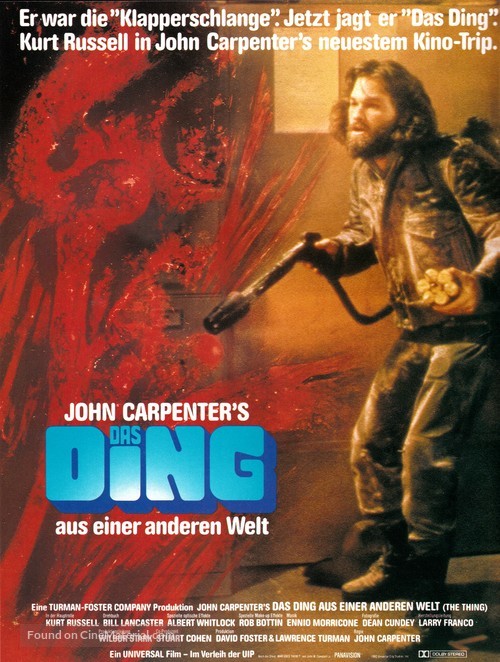
In the course of my reviews up to creating this feature, the recurring common denominator has been outright random. With the present review, I have an example more egregious than usual, as I had already considered not one but two promising films that weren’t even bad. Then, by total happenstance, I discovered that a local theater was going to show an all-time favorite film that’s been well-known and liked. I took the shot, and once I did, I knew I had to go back in while things were fresh. With that, I introduce The Thing, a movie that kind of made its own legend.

Our story begins with a flying saucer hurtling towards Earth, in what’s revealed to be ca. 98,000 BC. Flash forward to the present, and we come to the barren landscape of Antarctica, where a small American research station is threatened by two seemingly crazed foreigners out to kill a dog. The encounter ends with the dog alive and its pursuers dead, so the expedition’s animal lover takes in the animal while the doctor Blair and the goofy pilot Macready try to figure out what happened at the foreign base. Soon, the dog transforms into a hideous alien creature that attacks and assimilates several of the expedition’s animals before it is destroyed. The horror isn’t over, as it becomes clear that at leas one of the human expedition members is already infected. The fate of the Earth depends on finding the Thing among them- and it’s up to Mac to do it!

The Thing was a 1982 film by John Carpenter (see Dark Star, They Live), based on the 1938 novella “Who Goes There?” by John Campbell and the 1951 film The Thing From Another World. The film starred Kurt Russell (see… Sky High?) as Macready and Wilford Brimley (see… Battle For Endor???) as Blair, with Keith David as Childs. The creatures and other practical effects were created by Rob Bottin. Additional effects for the transformed dog were provided by Stan Winston (see Invaders From Mars). The soundtrack was scored by Ennio Morricone, otherwise best known for The Good, The Bad And The Ugly. The film was considered a commercial disappointment, earning a box office of under $20 million against a $15M budget. It attracted further controversy over its effects, gore, and typically unfavorable comparisons with the 1951 film. Peter Nicholls writing in 1984 commented favorably on the reintroduction of the “shape-shifting” element of the original story, and further praised the film as “an object lesson in building tension and atmosphere economically”. The film gained in popularity on home video, culminating in a 2011 prequel/ remake. It remains available on multiple formats and platforms.

For my experiences, this is one movie where I truly feel like I was “there”, despite it coming out barely within my own lifetime. I was aware of it quite early, mostly because it incomprehensibly turned up on TV, and I believe I may have seen the very end once or twice. What was pivotal for me was that I read and loved Campbell’s story at a fairly early age in the middling 1990s. After hearing a little more about it, including plot points I recognized from Campbell, I watched it and honestly wasn’t that impressed until I gave it a couple viewings. By the early 2000s, I was a full-blown convert, showing my own tape to quite a few friends who as far as I knew hadn’t seen it or heard much about it. (Right, and I used it for an Exotroopers adventure I never finished proofreading...) What really stands out is that even then, many of the books I consulted were critical at best, usually repeating the refrain that the ‘50s film was so much better. It was surely quite a bit later, therefore, that the present film reached the heights of fame praise it had now, and I can’t avoid the feeling that my experiences are a microcosm of a reality people are already forgetting.

Moving forward, the one thing I have to say by way of comparison is that this is one time a movie actually improves on the literary source material. (The ‘50s film is a cluster rant I won’t even try to fit in here…) Campbell wrote for a time when characters were subordinate to concepts and the exposition dump was an unquestioned convention. He also dragged into his writing and subsequent editing a notorious “pro-human” bias that would help cement the happy-ending formula of the alien invasion genre. Carpenter belatedly completed the long, slow revolt by offering a version of Campbell’s own tale where there’s never any question the Earthlings can lose, and (spoiler) do lose on a certain level. There is still plenty that’s conventional or cliched, which accounts for most of the “cons”. The heroic tough guy is really glorified comic relief. The conflict and paranoia of the middle act (still not quite up to the level of the story) is mostly interchangeable melodrama. The resolution hinges on a good idea that arrives when it is needed rather than naturally evolved. On the pro side, there is a postmodern sensibility that leads to several scenes that are more unnerving if you already know who is Thinged, inviting analysis and speculation where the real moral may simply be that the alien cannot be understood by human minds.

That leads to two things, one obvious and one easily missed. The obvious is the astonishing effects, perhaps the closest there will ever be to creature design as abstract art. What really stood out watching this on the big screen is that the effects are done in quite brief glimpses, in which even things you are looking for are easy to miss, yet you can also notice something new. My personal favorite is the behavior of Thing tissue carried over from Campbell, modestly described in print, but here so extreme Mac himself is completely unprepared for what he’s expecting. The less obvious element is the grungy, rickety base, whose defects and lived-in charm are all the more prominent on a theater screen. It makes even the Nostromo look sleek and clean by comparison. At the same time, I find the same symbolic significance played even more effectively. This isn’t just a place, but a man-made ecosystem essential to keeping both the humans and the alien alive. In a fitting symbol of both ecological interdependence and Cold War politics, the only way to achieve certain and total victory is to destroy your own life support, a price that the self-reliant male ultimately accepts with psychotic ease.

Now for the “one scene”, I’m going with a creature sequence, something I do very rarely. Here, my pick for the flat-out best is the sequence in the kennel. The commotion starts soon after the well-meaning animal lover leaves the mutt survivor to make friends with the other dogs. It’s when Mac and the others arrive that we see the full extent of the transformation. At this point, I’ll mention that I noticed people laughing during the screening that led to this review. It is a sight I will admit I found just weird on my very first viewing. The transformed dog-Thing is hairless, slimy and almost crusty, like a piece of orange chicken. (Oh yeah, going to an all-you-can-eat buffet after this one might be a bad idea…) The extra touch that makes this nightmare fuel is the bizarrely asymmetrical shape of the head, most visible in the skewed eyes, all while we witness the already horrific fate of the dogs. As Childs/ Keith David (more underused than one tends to remember, possibly to unavoidable circumstances) arrives with a flamethrower, it finally sprouts a couple appendages for an escape. Then there’s the detail embedded in my mind, a not-quite-circular fan of anemone-like tentacles that unfurls as the Thing tries to break out, and next to that, I just noticed, is an extra eye. What the Hell is it, and what would it do? We’ll never know, because that’s when the flame finally takes light…

In closing, I come back to the rating on a still very new scale. Make no mistake, this film is as good as any I’m remotely likely to review, and a favorite of mine. (They Live would probably still pull out ahead on my “best” list.) The real reason I have given it less than the highest rating is a “narrative” that I have finally decided to challenge. In retellings, the “story” that has emerged is on the same template as the martyrdom of a saint: Carpenter made a great film that bombed at the box office and was hated by critics, but we now recognize it as a classic. I can attest better than anyone that this is a part of the truth, not the whole. The movie probably lost money, but it earned a gross better than its budget. It faired poorly with critics, but that was after the studio invited comparisons with an already popular film that Carpenter in particular didn’t want. Above all, while it wasn’t immediately accepted by genre critics or fans, it certainly was not ignored or forgotten. Plenty of us knew about it, and there are plenty of films (see Lily CAT and Godzilla Vs. Biollante) that show its influence from a very early date. On the balance, it got what it deserves, and certainly better than might have been expected. The final verdict is, not bad for a remake.

Image credit Cinematerial.