Showing posts with label Arizona. Show all posts

Tuesday, October 31, 2023

The Legion of Silly Dinosaurs Halloween special: Scary cute stego!


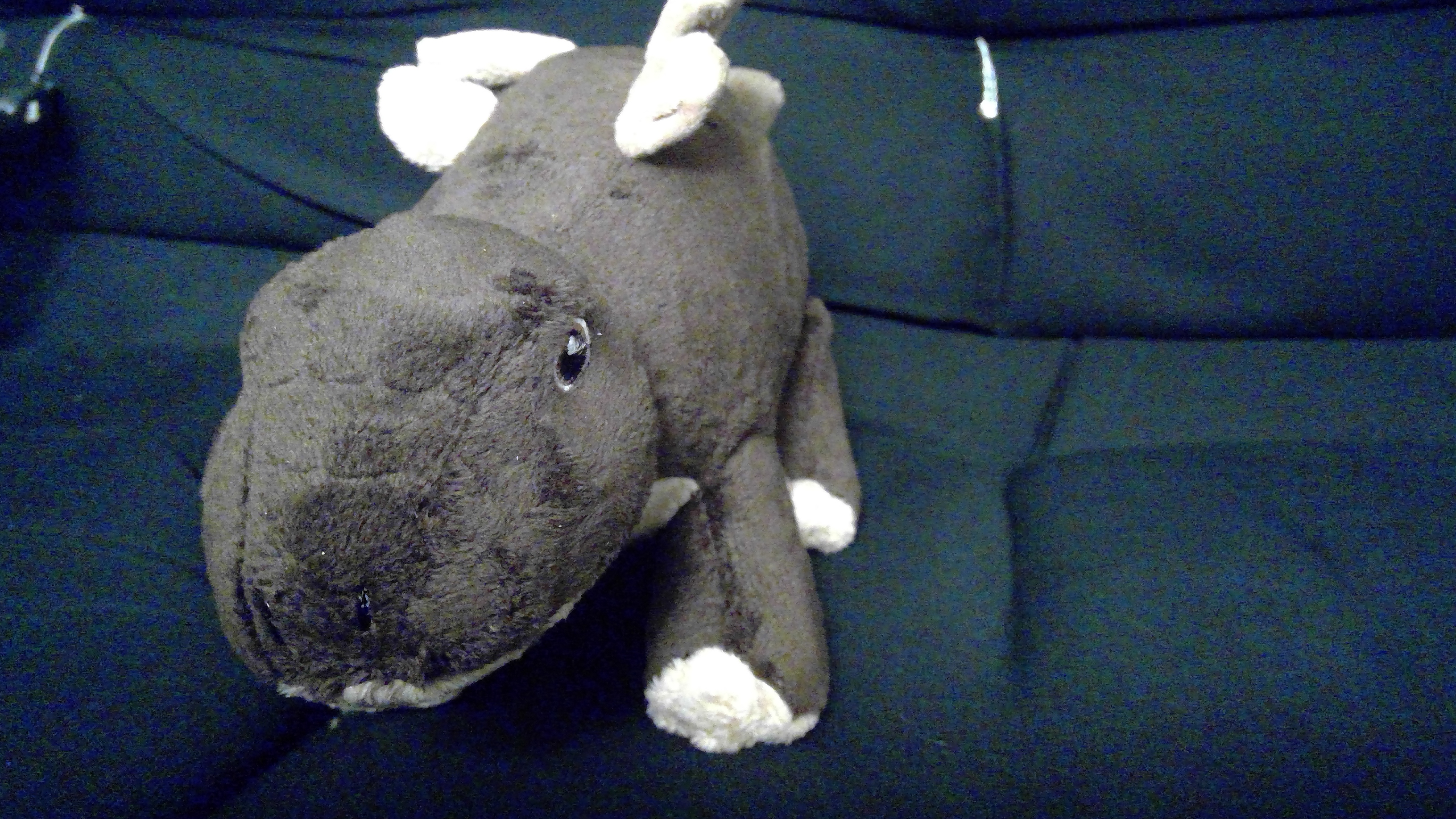
It's Halloween night and I've done a lot less than I used to but a lot more than I have in a while. To round things out, I obviously had to do a dino post. It happened I already had a perfect specimen for a quick post from a trip to an old stomping ground. Here he is in full glory on The Couch Mark 2.


Now for the story, I made this acquisition late last month at the Arizona Museum of Natural History, which I volunteered at back when it had the much cooler name Mesa Southwest Museum. Of course, I had a long history here. This is where I picked up the actually good Prehistoric Panorama Cambrian creatures, an okay pachycephalosaur I can't confirm I featured before, and my second worst dinobot. This little guy was part of a lot that appears to have flooded the shop, with several whole boxes discretely positioned under shelves and tables. His tag identifies him as made by the prolific company Aurora (maker of my first and only Valentine's Day gift), per the data entirely from recycled bottles. He's obviously a cute little guy, and pretty soft. Here's a few closeups.


"I'm innocent and adorable. But I'm still judging you."

So that's enough for a quick post. As usual, this feature is always worth the time, and finds like this make things easy when I'm in a hurry. I definitely expect a longer installment soon. And here's some more pics from the trip...


"Resistance is futile..."

Spinosaur flashback!

The Schleich vs Safari war is heating up.

"We will have our revenge when the school bully sees you with the pack..."


And why not one more in the bag?


Thursday, November 10, 2022

The Classics File 2: The one with Humphrey Bogart


Title: Petrified Forest

What Year?: 1936

Classification: Prototype

Rating: It’s Okay! (3/3)


As I write this, I am once again thinking about bringing my No Good Very Bad Movies feature to an end. For this lineup in particular, I have been proceeding slowly because I’ve really been working this out as I go. I really started with one particular film I have meant to get to last, and will still need a little more time to obtain and examine. For the actual opening, I got in Dracula, which I was satisfied to be deserving even sight unseen. That still left the middle opening, and the real problem was that “classics”, overrated or otherwise, aren’t really what I do. If there’s anything I don’t like to do, it’s talking about movies everyone else is already talking about, and the thing about “classics” is that even the haters are unlikely to say anything that hasn’t been said many times before. So I let several promising candidates slide while I waited to see if something different crossed my path. Sure enough, I got one that was truly the kind of film I would take on. I present Petrified Forest, the most classic film you may never have heard of.

Our story begins in a café in the deserts of the southwest, where nobody seems to live except colorful characters such as a would-be football hero and an old-timer who insists he was shot at by Billy the Kid. In the midst of it, the lovely waitress Gabrielle reads great books and dreams of a better life, notwithstanding the best efforts of the football player to woo her. Her hopes are rekindled by the arrival of Alan, a very British literati/ proto-Beatnik who wavers between wooing her and admitting his own dashed hopes. Unfortunately, another new arrival is Duke, a criminal whose gang takes the patrons and staff hostage. As the authorities close in, the prisoners try to bond with their captors. But Alan already has a plan to be a hero and make Gabrielle rich- even if he has to die doing it!

Petrified Forest was a 1936 drama by Warner Bros, directed by Archie Mayo. The film was based on a 1935 play of the same name by Robert E. Sherwood, previously adapted for Lux Radio Theatre. The movie starred the English actor Leslie Howard as Alan and Bette Davis as Gabrielle, with Humphrey Bogart in his first major role as the criminal Duke Mantee. Howard reportedly insisted on working with Bogart after they performed the same roles together in stage productions of the play. The film was successful enough to be credited with launching Bogart’s career, though it received mixed reviews from contemporary and later critics. Howard died in 1943 at age 50, in the midst of promoting the Allied cause in World War 2. Davis continued with a successful career that arguably peaked with the 1962 film Whatever Happened To Baby Jane? The film has remained available and generally known, notably being referenced and/ or parodied in media such as Merry Melodies/ Looney Tunes and The Carol Burnett Show. It is available for digital rental or purchase on multiple platforms.

For my experiences, my main frame of reference for this one is that I grew up on a fair diet of Bogart movies. My favorite was Treasure of the Sierra Madre, in hindsight a good candidate for the first “anti-Western”. I also saw at an early date the likes of Casa Blanca, The Maltese Falcon and Key Largo, I’m sure among others. (And I’ll give you one guess which one I really don’t like…) At any rate, I heard of the present film not long ago from a close friend who follows old-time radio. It interested me enough to land in my snail-Netflix rental queue, along with a certain other film I have plans for. I checked to see if anyone wanted to watch it with me, then watched it all on my own. I mostly just found it odd, all the more so for being largely unremarkable.

Moving forward, the description that best fits this film is “mannered”, if not entirely stilted. The cast of characters are a little too developed to be called cliches, yet the things that differentiate them from “stock” are predictable in their own way. Gabrielle, by far the most likeable character, wants to get out in the wider world while clearly lacking any frame of reference for it. Her would-be boyfriend is obviously going nowhere, whether or not he knows it. Alan is simply a mess, which I will get back to. Most curiously, Bogart is strikingly uncomplicated. We don’t learn anything about his backstory except a possible weakness for women with no qualms about turning on him. As far as his on-screen behavior, he isn’t charismatic enough to work as a “Robin Hood” type, nor is he sadistic enough to indulge in evil for its own sake. Finally, we aren’t given any reason to think better of him by the end, beyond the fact that he makes his last stand in front of the diner rather than hiding behind the civilians. Ultimately, he is simply a stock villain who by all indications was never meant to be anything else, which would certainly have been making a statement at a time when outlaws were being elevated to folk heroes.

Beyond these considerations, the simple fact is that this is far more talk than action, albeit with very good dialogue. The fundamental “problem” is that out of all the characters, the focus falls on Alan and Gabrielle. By any realistic or reasonable appraisal, Alan has even fewer evident redeeming qualities than Duke, and the fact that he freely admits his faults and failings just exposes him as self-centered. His nominal romance with Gabrielle is farcically short even by Hollywood standards, which they both clearly know. Where I call foul is his emerging fixation on sacrificing himself for Gabrielle’s benefit, long after it is clear that neither of them are in danger apart from stray bullets. His eventual scheme is, at best, subjecting her to a traumatic experience for limited financial benefit, and at worst, a bid to place her psychologically in his debt indefinitely without making any commitment to take care of her. This is literally psychotic, and on top of that, it’s emotional blackmail. If he wasn’t bent on self-inflicted martyrdom, this could easily turn far, far uglier if the relationship went on for any length of time.

That leaves the “one scene”, and I’m going to have to go from memory. Early on, Gabrielle is outside reading when the football hero arrives; that would be Dick Foran, a stage, film and TV actor who was also an accomplished singer. When she gets up, he follows her and goes for a kiss with no encouragement from her. It’s even more uncomfortable than might be expected in a more enlightened time. Still, the lady does talk to him, and he backs off enough to count as conceding to her wishes. As things continue, we get a sense of somewhat dysfunctional familiarity that I doubt I could describe even if I could find the clip. It’s a low-key example of good dialogue and character development for its own or any other time. I have to say I find it to be the most natural interaction in the entire film.

In closing, I come back to the simple question of what makes an “overrated” film. This film is the kind that approaches that description without quite getting there, for better or worse. Its fame is too modest to be called undeserved, while still clearly owing far more to the later fame of its stars than its own merits. Yet, it equally clearly remains watchable and generally entertaining, which is certainly more than can be said for many far younger films. Ultimately, it’s the kind of movie where praising it as a “great” movie would be more of a disservice than calling it a bad one, because it is that kind of hype that sets viewers up for disappointment. If it is instead approached as an interesting film, especially as an early sample of the stars involved, then it could easily prove a pleasant surprise. That is the kind of “classic” I can get behind.

Thursday, May 19, 2022

Featured Creature Special: The one that didn't have Kevin Bacon


Title: Tremors 2: Aftershocks

What Year?: 1996

Classification: Weird Sequel/ Mashup

Rating: It’s Okay! (3/4)


As I write this, I’ve been working on bringing more of my features either to an end or in the direction I have planned. For this feature in particular, that has meant doing more to organize my reviews by subject and theme rather than pure random. In the midst of this, however, something came up that sent me back to some material I had already had under consideration for a long time, and I knew it was time to do something with it. Following my more usual form, I decided that the one to cover was a sequel within the franchise, especially as it did the most with a particular actor and character. I present Tremors 2, the first sequel in a long and frequently convoluted franchise, and the one that truly made a star of the late Fred Ward.

Our story begins with a reintroduction to our hero Earl, living with a series of failed business schemes and possible PTSD after triumphing over the whale-sized subterranean graboids in the previous adventure. He gets a chance for one more comeback from an oil company whose Mexican refinery is threatened by dozens of the monsters. He quickly reduces the infestation using remote control cars with explosives as graboid bait, with a little help from the survivalist Burt Gummer, and gets the attention of an attractive lady geologist. But their best plans don’t prepare them for a new phase of the graboid lifecycle, a swarm of little dinosaur-analogs that multiply as they eat. They’re soon besieged by a horde of the pint-sized monsters in the oil company shanty town- and Burt is completely out of ammo!

Tremors 2 was a direct-to-video film from Universal/ MCA, the first sequel to the1990 cult hit Tremors. The film was directed by S.S. Wilson, the screenwriter of the original film, with its director Ron Underwood as producer. The film starred Fred Ward and Michael Gross, reprising their roles as Earl and Burt Gummer respectively, with Helen Shaver as the geologist Kate Reilly and Christopher Garth as Grady Hoover.  The graboid creatures were created with practical effects by Amalgamated Dynamics, returning from the first film, and CGI by Phil Tippett Studios (all hail Phil). The film was reportedly finished in 1994, but not released until 1996 in part because of delayed decisions on whether it would receive a US theatrical release. While it was released directly to VHS, the film was shown in a limited number of theaters. It received generally favorable reviews, and became the first of several sequels in the franchise. The film remains available on disc and digital platforms. Fred Ward died on May 8th, 2022.

For my experiences, this film was nothing less than my introduction to the Tremors franchise, thanks to a botched recording from 1990s network television. By then, I had already had the original recommended to me a number of times, and I was familiar with certain works that I suspect may have influenced it, such as the Gernsback-era tale “The Worm” by David Keller. I probably finally got to the original a few months after that, and it became an immediate favorite. I continued to watch the movie and everything that came from its rather motley franchise (including the damn cable TV show) well into the 2000s. At some point, however, it started to slip without me noticing. I went longer and longer without watching the original movie, I politely passed on several of the sequels, and once I started doing movie reviews, I found myself dealing with other, usually older material. It was when I heard of Mr. Ward’s passing that I found my way back, and for me, it was only fitting that I went to this movie first. Once I watched it, I still thought this over long enough that I’m doing this a day later after an extra viewing.

Moving forward, what I find striking about this movie is that I never felt like I had missed anything by not seeing the original. The graboids and their abilities and weaknesses are laid out with only a few references to the first film. (My favorite is the mention of Chang the shopkeeper: “He named them… they ate him.”) The old and new characters have similarly self-evident relationships and chemistry, with an introspective running theme of missed opportunities and “happy endings” gone awry. The more obvious problems lie in the conceptual developments. In the original, we didn’t know or need to know where the graboids came from and what they were doing before the events of the movie. (I'm partial to the scenario that they were dormant for a few centuries, on the vein of Keller's tale.) The sequel seems to second-guess this, and in the process introduces certain questionable conventions, especially the improbably accelerated lifecycle and convenient weaknesses of the shriekers. What’s most problematic is that there’s no explanation of the biggest differences, the much larger number of graboids and the lack of any of the problem-solving behavior shown previously. My own fan theory, notwithstanding the further sequels, is that the shriekers aren’t really baby graboids at all, but a presumably related parasitoid that has altered its host’s behavior, which doesn’t really change the actual story.

That leaves the story to consider on its own merits. Once the shriekers appear, the story gets in gear and sustains it’s momentum well. The overall feel is like a more upbeat version of a Romero zombie movie (why not see my Zombi/ Dawn of the Dead review?). The good guys can make mistakes, and sometimes do more harm than good; the monsters repeatedly outsmart them, though they aren’t that smart themselves; and the final outcome makes the original quest moot. Along the way, however, we get smart humor, well-paced action that never quite defies common sense, and characters we really care about, including one or two whose arcs remain off-screen. If anything brings it down, it’s the finale, which follows the get-them-all-with-one-boom formula (albeit before several of the more egregious examples) without the monsters really putting up a fight. That’s still made up for by the race for safety, which surely sends up the action-movie formula (still ahead of certain obvious offenders) as the guy who actually knows explosives remains in a panic.

That leaves the “one scene”, and I have to give honorable mentions go to the sick graboid and to Gross recounting his character’s Pyrrhic victory over the shrieker horde. What I’m going with is the first appearance of the little monsters. As we approach the hour mark, Earl and Grady find evidence of the new creatures’ rampage, including a destroyed radio transmitter. While they try to figure out this seemingly calculated behavior, they make their way to a vehicle that’s still intact. Before they can start the car, there is an eerie cry. Then they hear loud footsteps from behind a building, which shake a pile of pipes or rebar that is in view. There’s real tension as the pair raise their weapons, and then aim higher. It becomes a comical anticlimax as the shrieker comes into view… until the thing charges.

In closing, what I come back to is Ward’s contribution to the franchise. I freely admit I still haven’t seen him outside of the Tremors movies, but I like to think it gives a good sample of his talents. He was a very big part of what made the original movie great. He was among the best actors in the original film, with a real sense of maturity and emotional depth to his character that didn’t stop him from getting in some of the movie’s best jokes in the bargain. Making him the focus of the sequel was a fine idea that turned out good enough in execution, and a major reason it still stands above the generally entertaining and sometimes clever Burt-centered installments that followed. To me, once Ward left, the series simply and perhaps literally wasn’t the same. That should be tribute enough to his talent, and the right note to end another meandering recollection. Rest in peace.

Monday, January 10, 2022

No Good Very Bad Movies 13: The one that's NOT a Disney movie


Title: Frozen

What Year?: 2010

Classification: Anachronistic Outlier

Rating: It’s Okay! (3/3)


I’m back with the first review of a new year, and I decided it was time for another installment of the Very Bad. It’s crossed my mind that, for anyone following this blog impartially, what’s here as opposed to my other features might seem just random. In making these calls, there’s three considerations that usually push a movie over the edge. One is certainly egregiously low quality, particularly in terms of production values. Another is notoriety, deserved or otherwise. The third and most intangible yet often decisive factor is pure strangeness (see Phenomena), especially on the level that makes a movie not just weird in itself but very difficult to classify. With this review, I have a movie that definitely falls within the latter two categories, a film that is either a modern cult classic or a critical bomb depending on your sources, and is even more problematic in terms of genre. Here is Frozen, a film that’s part thriller, part horror and part monster movie, and you better believe it came out before the Disney movie.

Our story begins with a guy, his girlfriend and his old buddy at an alleged New England ski resort, contemplating life and commitment. After a lot of griping about who is the third wheel, the trio cajole one of the staff into letting them on the ski lift as the staff are trying to shut down. Naturally, the lift is turned off for the full week, leaving the klutzes stranded high in the air with a snow storm incoming and a pack of wolves below. Our group must choose between biding their time or taking near-suicidal chances to escape, and it’s already clear this lot is bad at assessing risks and probability. Will any of them survive the night- and do we really want them to?

Frozen was a 2010 horror/ survival film written and directed by Adam Green. The plot of the film was highly similar to a 1969 short story “The Ski Lift” by one Diane Buttenshaw, published in the 10th volume of the controversial Pan Book of Horror Stories series. The film starred Emma Bell, Shawn Ashmore and Kevin Zegers. While the script and dialogue portray a New England location, filming took place at Snowbasin in northern Utah, with many shots and scenes filmed with both the actors and crew on a ski lift. Scenes featuring wolves were filmed with trained animals, which one reviewer reportedly criticized as poor CGI. The film received many negative reviews and further criticism regarding the realism of its scenario, but has remained well-regarded among horror fans. Aspects of the movie were tested on Mythbusters, including a 2008 episode predating the film. The movie remains available on disc and streaming.

For my experiences, I have been collecting my thoughts ahead of the viewing or review, which included a quick reread of the short story, a savage little thing I remembered and eventually hunted down through its sole reprinting. With regard to the infamous coincidental title, the one thing that I found interesting is what might have been if the release dates and resulting situation had been reversed. (Oh, and by the way, I like Hans, while he's a real character!) What really caught my attention, long before I watched the movie, was the very striking similarities with the story, which can sufficiently described as marginally readable, then mainly for its compact prose and matter-of-fact brutality. I have been more suspicious about this than I normally would be, but what’s really of note is that the underlying idea clearly had an independent life that might long predate even the story. It’s worth further note that the story’s rationale is a real or imagined love triangle where the female party is absent except as a lure for the lunkheads.

Moving on to the movie itself, it is part of a trend I find particularly annoying: Rather than just making  bad decisions in an already difficult situation, like going into the cursed house on a stormy night or picking up a hitchhiker in the midst of the zombie apocalypse, the protagonists willfully go into obvious and avoidable danger in cold blood. In my judgment, this only ever really worked when played as very dark comedy (about the spirit of the story) or an archetypal Greek tragedy. In those terms, this movie is a case of too much and not enough; the characters are too likable to laugh at their fate, but not dignified enough to evoke true hubris. What keeps it more effective than it has a right to be is a scenario that covers most of the objections. For my nitpicking, my only real objection is that this would have worked much better set in the 1970s or earlier, when the legal as well as technological landscape was different enough that incidents like what we see might well have happened. (Amusingly, in the story, the protagonists are ingenuitive enough to climb onto the ski lift entirely unassisted.) I have also been tempted to “head cannon” the setting as where this was actually shot, which is in my back yard comparatively speaking t and still way out there even by our standards.

With all that out of the way, the film’s obvious strengths lie in its utterly grueling scenario and execution, which I find almost pointless to try to convey. The easy complaint is that would have been better as a short or an episode of an old-school anthology show, and further comparison with the short story definitely bears out the point. Given the risk taken, however, there’s no arguing with the result. There’s a lot of dead-air dialogue, amusingly arguing over many of the same Macgyver solutions brought up by reviewers, but there’s also poignance, vulnerability and growing despair. It’s all framed in the contrast between the intimate framing of the chair and frequent shots of the vast, bleak landscape. In the midst of the crushing indifference of nature, even the wolves are a brief, somewhat offkey intrusion, acting more like the clean-up crew than actively malevolent villains. The real problem is that the final act goes a long way to second-guess its premise and atmosphere, all hinging on a series of developments improbable enough that one could easily second-guess again and take it as a dying hallucination. Still, it works on its own terms, still stopping well short of a clear-cut happy ending.

Now, I originally made another skip to the “one scene”. In the final act, the girl manages to survive a fall from the ski lift, and manages to make her way along, alternately walking, crawling or just sliding along. One of the guys is unaccounted for, and we know the token carnivores are still around. This is another point of nitpicking, where my charitable reading is that they could be either actual wolves, coyotes, or some hybridized, feralized canid mix, of which the latter are more unpredictable and often flatly more aggressive. With this allowance, their behavior up to this point has been quite believable, especially if the lodge tourists and staff have treated them with the carelessness and insensitivity already in evidence. As she makes her way along, she sees blood in the snow, and we see gruesome proof of the fate of another character. Then her eye meet that of a single canine. It doesn’t attack, or even bare its teeth, but only gives a low growl and stares. I have said occasionally (see my Green Slime review from way back) that the most unnerving thing a “monster” can do is ignore potential prey, and this is my definitive case and point. It all passes in a moment, yet it’s as terrifying as anything we have seen in a harrowing film.

In closing, I still feel like I need to explain why I am covering this movie here. As already outlined, my deciding factor was jus how unusual and unclassifiable it really is; by comparison, I definitely decided against including it in Featured Creature or my other “genre” features. At the same time, it is definitely an example of an already problematic film that faired badly with the “mainstream”, on the whole probably an indication simply of the extent to which the filmmakers and distributors overestimated its potential. Fortunately, in the kind of circles where it was ever going to have a chance, it succeeded and still endures as a low-key, offbeat gem, and I for one quite freely concede that this is the reputation it always deserved. And with that, I’m done for another day.

Wednesday, June 30, 2021

Space 1979 Apocalypse How 2: The one with the animal apocalypse


Title: The Day of the Animals aka Something Is Out There

What Year?: 1977

Classification: Runnerup/ Anachronistic Outlier

Rating: Dear God WHY??!! (1/5)


For the next installment in the apocalypse lineup, I’m returning to a subgenre I’ve covered before, the “killer animal” movie. It’s a theme that can be traced to Medieval and Renaissance times, when artists like Hieronymus Bosch used vengeful animals as a symbol of divine wrath, outraged nature or just well-deserved comeuppance. It got an early start in modern horror and sci fi movies with The Birds, which was followed by ecological parables like The Frogs, Phase IV and Squirm. It all largely petered out with Jaws, which scaled the apocalyptic allegory back to the “straight” monster movie, as well as a resurgence of more conventional post-apocalyptic fare. But there was still one more egregious example from an offender we’ve met before. Here is The Day of the Animals, a film from the guy who gave us The Manitou.

Our story begins with a grim text crawl warning of the dangers of ozone depletion and what “could” happen. You might expect this to turn into a story about cancer or global warming, but in fact, we go straight to a party heading out on a nature hike. We’re quickly introduced to a cast of cliches and stereotypes, notably a newly divorced mother and her son, a bickering husband and wife, a wise Indian, and an ad man who’s already trying to act more macho than a Klingon gone native. As they make their way along, we get frequent shots of birds and beasts that seem to be trailing their party (of course including ominous “POV” camerawork). The party remains oblivious enough that they are completely unconcerned when they find an unoccupied campsite with coffee still brewing on the campfire. As the night passes, they find themselves under attack by wolves, cougars and other unpleasant creatures. Meanwhile, we learn that the world’s wildlife is going berserk and attacking people unprovoked, only at elevations over 5000 feet. As the new day dawns, the party must make their way back to civilization, now with a traumatized child in tow, but the ad man has decided he is in charge and would rather play by the law of the jungle. Will the party survive, or has man finally proved as deadly as the beasts?

The Day of the Animals was the second-to-last film by filmmaker William Girdler, who died in a helicopter crash shortly before the release of The Manitou in early 1978. The film was widely viewed as a followup to the 1976 film Grizzly, an arguable Jaws knockoff that proved profitable but entangled Girdler in legal battles for his share of the money. The cast included Christopher George and Richard Jaeckel (see The Green Slime) from Grizzly and The Manitou’s Michael Ansara (who played a Klingon on the original Star Trek), with Leslie Nielsen as the crazed Paul. The animal attack sequences were filmed mainly with live animals, including a trained bear, with optical compositing used for a sequence in which Mandy is killed by hawks. The movie made a very modest $2.8 million box office, which was still more than twice its $1.2M budget. The movie has long enjoyed a cult/ camp reputation, with a Rifftrax cut released in 2017.

For my experiences, I first heard of this one a long time ago. I finally watched it while working on the lineup for Repeat Offender week (originally slated to end with Prey). I went with other material, but was definitely interested. As I thought over the possibilities for the present list, it came right to the top, with only The Frogs really rivalling it. What kept this one more interesting is its deceptively late date, only five years after Silent Running and just one after Squirm, but beyond a canyon-sized gulf in terms of genre trends. This was literally the year when Star Wars was tearing up the box office, and a year before Dawn of the Dead started the late ‘70s-1980s zombie movie wave. After that double whammy, audiences wouldn’t come back to the grim ecological parable until well into the ‘80s (see The Nest). This movie was like the guy who doesn’t just come late to the party, but wanders in after the host has already gone to bed. With that disastrous timing in mind, it’s impressive enough this movie made twice its slim budget.

Moving to the movie itself, the unavoidable comparison is Planet of Dinosaurs, another movie from the same banner year that was a relic by the time it hit theaters. The formula is effectively the same, a group in a life-threatening environment who are all cliched, all dumb, and almost all devoid of any likeable qualities. Here, at least, the unqualified macho idiot who tries to take charge is cast as a villain, though the storyline still doesn’t really show the realistic and predictable consequences of his stupidity. Even so, this movie somehow falls short of that mindboggling low bar, perhaps all the more so with a cast and crew who clearly know what they’re doing. Planet of Dinosaurs was at least unintentionally amusing (not far from Maximum Overdrive), but this borders on willfully irritating. Anything of quality comes from Ansara, who keeps the same unaccountable dignity as a typecast non-Indian Indian that he did in The Manitou, and the completely surreal casting of Nielsen. The latter should have offered a good turn as a villain, especially considering his inspired performance in Creepshow just 5 years later, but this feels like finding out Frank Dreben is an alcoholic who murders call girls on the side, except that we could actually believe he had a dark side we don’t know about.

That leaves us with the animals, and that is where the movie fails at almost every turn. The pseudoscience about the ozone layer is obvious nonsense, and renders the movie far less effective than predecessors like The Birds (which still wasn’t nearly as good as the short story). What stands out to me is that any metaphors that could be drawn are wasted. Actual wolves and cougars are willy and elusive (and in the case of the cat almost entirely solitary), a potent analog for anything from the Apaches to the Viet Cong, but here, they practically come out and say howdy whether it’s the dead of night or broad daylight. An action sequence where wolves and at least two cougars seem to attack in unison is simply strange and oddly tame if you really know anything about the animals. It’s still not as bad as the ludicrous demise of Mandy, in which the woman has to be practically pulled aloft to appear to be in any danger, or an even lamer rat attack. The  one vaguely inspired moment is Leslie Nielsen’s last stand against a bear, who seems merely perplexed as he pummels it in rage while the survivors in his group run away. (Why they didn’t run away before is a whole other can of “cringe”.)

Now, it’s time for the “one scene”, and there was truly one that stood out all along. As the middle act meanders to a close, we catch up with a guy in the group who has been trying to take care of a nearly mute child. They finally reach an already deserted town, and the adult tries to find help. He senselessly leaves the child in the middle of a sidewalk with absolutely no cover or protection, and gets angry when she becomes distressed. He quickly repents, and takes her to a potentially secure vehicle where he locks her inside and promises to return. Of course, we know where this is going. He barely gets a few steps before the beasts are on his trail, and then tries to take cover where they are obviously waiting. He lasts long enough to scream for help, while the girl only stares.

In closing, this is a movie that left me conflicted. Judged on its own flaws and occasional strengths, it would get no more or less than a 2, and I came very close to leaving it about that. But there is something here that makes it far lower than the sum of its parts. It’s not as bad as plenty of movies I have viewed or reviewed (including, dear Logos, Grizzly), yet the more I scrutinize it, the more I feel personally annoyed. I see it especially in comparison with The Manitou, which whatever its flaws at least told a unique story in an interesting way, according to a bonkers kind of internal logic, and made us care about its characters to boot. This movie, on the other hand, is nonsensical in concept, dull and often incomprehensible in execution, and unable to make us want anyone except Ansara’s character and maybe the girl end up as anything but kibble. The fact that it is made with a minimum standard of competence only shows that those involved could and should have done better. The standing principle for my ratings remains that it is one thing to be bad, and another to be inexcusably bad. This is a movie that is not the worst, but has far fewer excuses than most not to be “good”, and that is what makes a film with no right to exist.

Monday, June 7, 2021

Mystery Monday: Unidentified Hong Kong terrible cowboys and Indians set


For this month, I've been planning to return to my old, masochistic time table of a blog post every weekday, and to get things in gear, I decided it was time for another round of mysteries after not doing one since April. This time around, I decided it was time for yet another block of material I've had backlogged, as a further reminder that not being mysterious does not translate into merit. To start off, here's a closeup of a few of the group with the Timmee battle mountain, which has been a little neglected itself.

For the backstory on this one, I inherited this set from family who are long gone. I remember playing with them occasionally as a kid myself, mostly as targets for a dart gun set that was included. (More on that momentarily...) For provenance, my best guesstimate is that they date from the 1960s, almost certainly not later than the early 1970s. Whatever their original date, the figures, the guns and the darts were all packed together for as long as I knew of them in a repurposed candy box I'm sure is from the 1980s or later. By the time I started this blog, they were already long since packed away and half-forgotten. I suppose they really came back to mind after I posted about the 6-inch Marx wild west figures, starting with the giant Indian I had forever. (See also the gunfighters and weird Ukrainian pioneers.) After a while, I decided to break the old set out; I never doubted I still had them, and I knew I had found them as soon as I saw that damn box. I was genuinely excited when I opened the box. The could have been Marx figures, or copies thereof. They could have been Timmee/ Processed Plastic figures I barely remembered having myself. They could have been MPC, Lido, or some other brand I had only heard of. What they actually were is absolute kaka. Here's a lineup to show just what I mean.
"We must repel the white men, or our sacred Battle Mountain will be turned into plastic Mount Rushmore!"

On inspection, the one consequential thing I discovered is that their only manufacturer's mark was "Hong Kong", which as I commented with the cartoon animals is only somewhat more specific than Planet Earth. It was also all too clear that they were appallingly awful, to a degree I'm not sure I can capture in these pics. Here's a lineup of the cowboys, which are represented by half as many sculpts. This is possibly because they were meant to be outnumbered, or it may just be that more of them got broken or thrown away.

And because it was driving me nuts, I've gone back and added a pic of the cowboys with the Galaxy Laser Team commander. As previously discussed, he's a bit smaller than most "army man" figures at exactly two inches, but still taller than these guys. And the guy on the left is actually shorter, not much bigger than the original/ mini astronaut. And what the Hell is on the end of the green guy's gun is anybody's guess.


Finally, here's a small grouping of horses and riders. These are all that I found, without any extra horses or riders on their own. As you can see, there was one sculpt of a cowboy and one of the Indians, though there are two of the latter to one of the former. If you looked at just these, you might think the set is okay, but I still have more to show you.

At this point, I'm backing up. Of course, I have tried looking these guys up. I got as far as finding some pics from online listings that I'm sure are from the same set of molds, including at least one additional cowboy sculpt. The one really interesting discovery was a group that were painted, but not enough to break my usual policy against copying from or linking to sales pages. I did make somewhat more headway, however, with the dart guns. Here they are, in full glory and indifferent lighting.

The markings on the guns identify them as from Placo, a manufacturer evidently prolific enough that a search or two for information produced an auto complete for "dart guns". They were making these and similar guns from the 1950s to the 1970s, which in itself is no help at all. The darts, however, are marginally helpful: Where the earliest sets  would have had suction cups on plastic shafts, these are all rubber, so probably from the 1960s. As a further curiosity, a single gun of apparently the same design was included in a Spider Man dart gun set from 1981, which I'm absolutely satisfied is of later manufacture than these. Here's a closeup of a gun with the manufacturer's mark.

Now to bring this to some kind of conclusion, here's a few closeups, starting with a gunslinger. Not bad, but why is his hat over his face? And why do his revolvers look more like ray guns? And speaking of, it's still not obvious how little detail is in the face, basically eyes and sort of a nose, no more.

And it's still better than this guy, a gunfighter even more unthreatening than the Lido draft dodger. It looks like he's holding something in the other hand, but that's just "flash", which I found in exactly the same place on another figure. Is he supposed to be surrendering? Or a "casualty" figure??? The people making these clearly didn't care. 

Then there's the rifleman, here with a defect that actually makes his weapon look more modern. Here you just might be able to see how little went into the detailing. I tried to convince myself he was supposed to have a bandana over his face, but I just don't see it. Then there's the thing sticking out at his hip; it's clearly supposed to be a holster, but just try working that out from the shape. I can further confirm, other copies of the sculpt are no better.

Finally, here's one of the Indians. The pose is very similar to ones I have seen in Marx sculpts. What I can't work out is the thing under his right foot. It's definitely supposed to be vegetation, and to me it looks like nothing so much as a prickly pear cactus, but again, just try working that out.
"Of course I'm rushing forward screaming! There's a cactus on my foot!"

With that, I'm wrapping this up. These guys are just the kind of awful that can be amusing for a while, but I've been at this longer than I planned on and the fun factor is already wearing thin. The one thing I'm still tempted to do is chamber a round and see if the dart guns still work, except as an adult, I don't want to have to check where an errant dart might go. So, I'm quitting this trip down memory lane while I'm ahead. As always, more to come, and hopefully better!


Monday, November 30, 2020

Space 1979: The one where an evil medicine man is reincarnated from a tumor


Title: The Manitou

What Year?: 1978

Classification: Irreproducible Oddity/ Mashup

Rating: What The Hell??? (3/5)


In working on this feature, some of the biggest surprises have been the ones I didn’t think of. There were some I decided didn’t suit my needs at the start, and most of those have remained outside consideration. There were some I included because I got hold of them around the time I needed a review, like The Andromeda Strain. There were even a few I hadn’t heard of until they were either suggested to me or mentioned in the course of reading, like Space Mutiny. But then there have been some well within the parameters of the feature that I certainly knew about, but still didn’t think of until I was very far along. This review is for one of those movies, and it happens to be one of the strangest and most unclassifiable movies from the period under consideration.

Our story begins with a woman named Karen who reports a strange growth on her neck. Her doctors soon realize that it has the characteristics of a fetus. For no  obvious reason, she seeks the help of an old boyfriend Harry, who works as a shady psychic. He is observant enough to notice she has started speaking an unknown language in her sleep. Meanwhile, the men of science prove helpless to remove the growth, in part because their equipment keeps failing or seemingly turning against them. After consulting with various colleagues and an apparently knowledgeable scholar, Harry concludes she is under the influence of the spirit of an evil medicine man, intent on being reborn through her. Their best hope is a present-day elder named John Singing Rock, who is convinced the spirit is an old enemy named Misqamacus. But by the time the friendly shaman arrives, Karen has already given birth to a malevolent-looking midget. The halls of the hospital shake, burn and freeze as the medicine man fights to contain the reincarnated spirit and its demonic allies. With the powers of benevolent magic failing, it’s up to Harry to join science with the supernatural in the final battle with evil.

The Manitou was produced by the company of Melvin Simon, a real estate developer who also financed Porky’s among other movies in the 1970s and early 1980s, based on a novel by Graham Masterton. The film was directed by William Girdler, previously best known for a string of “blaxploitation” movies, and distributed by chronic offender AVCO Embassy Pictures (which I just realized I haven’t included before). The cast was led by Tony Curtis as Harry, with Michael Ansara as Singing Rock and Burgess Meredith in a small role as an anthropologist. Karen was played by Susan Strasberg, one of several children of Lee Strasberg, a distinguished theater director and acting coach. The movie was rated PG, despite a sequence in which Strasberg appears nude; some sources report it rated R, which may have been given in later distribution. The movie received very hostile critical reviews and was listed in the book The Golden Turkey Awards, though how well it did at the box office is less clear. By coincidence, Meredith was known for playing The Penguin on the 1960s Batman TV series, while Ansara was the voice of Mr. Freeze on Batman The Animated Series. A case cited at the end of the film of a Japanese boy found with a “fetus” may refer to a case of a parasitic twin or a dermoid cyst.

This one is by almost any standard a total mess, though partisans will still debate whether that is entirely a “bad” thing. It mixes horror, fantasy and science fiction, with just the kind of brazenness that makes many entries in this feature worthwhile (see especially Krull and Adventuresof Hercules). Unfortunately, it is difficult to make the case that it does this particularly well, and far too easy to argue the reverse. For well into the first hour, it remains a quite routine horror movie, readily inviting the critics’ frequent and unfavorable comparisons with The Exorcist. Even the horror is quite tame, outside of a sequence where a possessed surgical laser routs the hospital staff. What is missing throughout is a sense of pain and debilitation from Karen, who usually shows as much concern as would be expected for a bad pimple. Things start to get lively when John Singing Rock comes in, then it goes from 0 to 600 when Misqamacus arrives.

Almost everything memorable comes from the last 40 minutes or so, apart from Burgess Meredith’s appearance as a fractured intellectual. (Amusingly, he welcomes meeting the resurrected medicine man as a research opportunity, which would be an intriguing viewpoint if his character had any more screen time.) This is where the critics usually have a field day making fun of the effects, including Misqamacus himself. Yet, the visuals certainly “work” in context. The lighting and camerawork usually discourage close examination of the makeup and creatures, while greatly enhancing an effective “old school” atmosphere. Then there are genuinely eerie touches, particularly the desolate scene of the frozen corridor and a doorway that seems to open onto an empty starscape. The centerpiece is the “birth” of Misqamacus, who clambers right out of the cocoon of the growth. It’s not “’good”, even by the production’s uneven standards, but the pacing and the grim appearance of the being prevent it from breaking the mood if it has taken hold at all.

The one thing that will make or break the movie is Ansara’s performance. Time and evolving sensibilities has certainly been against it on this point: While the actor had played Indian characters a number of times, he was in fact of Lebanese descent, the kind of typecasting that was getting dicey even in the ‘70s. The script and story don’t help matters, painting the character in broad strokes that don’t hold up for anyone with experience dealing with actual natives. (Among other things, many/ most native Americans claim to follow some form of Christianity.) But this allows a boldness and honesty that goes beyond the sum of his lines and screen time, freely criticizing Christianity, science and western civilization in general. In his most hypnotic monologue, he pronounces, “Your God won’t help you… not prayer, not holy water, not the weight of a thousand of your churches…” That his own magic doesn’t really do much better just makes the proceedings that much more interesting.

For the “one scene”, I really couldn’t avoid the finale, which I have already mentioned several times. The final minutes find Harry and Singing Rock trying to hold the door of a hospital room against Misqamacus. The whole room has disappeared, leaving the medicine man and Karen’s hospital bed seemingly floating in space; Singing Rock declares it an “illusion”, without seeming to convince himself or anyone else. Behind the gloating dwarf, a much larger and clearly more powerful entity comes into view, in the likeness of a dull orange sun that looks like a giant eye. Harry tries to harness the electricity and technology of the hospital as a spirit with its own force, a notion that actually follows from the concepts of animism. That revives Karen, who sits up; while she is clearly unclothed, there really isn’t a lot to see if you aren’t really looking for it. In the finest nuance of her performance, Strasberg smiles gleefully as she releases volley after volley of lightning at the medicine man and the entity he has summoned. It’s like a cross between Star Wars and The Sword And The Stone, and 49 reviews in, it’s still easily one of the most surreal sequences of any movie I’ve covered here. The only real problem is, it took all the preceding running time to get here.

With all I’ve already said, the one thing I can add is that this movie truly defines what I meant when I came up with “Irreproducible Oddity” as a category. There’s a lot of things that wouldn’t be accepted or allowed in more recent times, and plenty more that would easily be dismissed or ridiculed. But all those involved still clearly gave it their best, and the result is still worth watching. You might not like it, or understand it, but you will not forget it.

Thursday, September 17, 2020

Space 1979: The one where Rob Lowe’s brother rescues Buffy the Vampire Slayer from Hell in a 1940 Ford


Title: Highway To Hell

What Year?: 1991 (completed)/ 1992 (limited theatrical release)

Classification: Irreproducible Oddity/ Mashup

Rating: Pretty Good! (5/5)


As outlined at the very beginning (even before the Introduction), this feature was conceived as an overview of 1970s and 1980s sci fi with a focus on the period from 1975-1985. At the same time, I always meant for this among other “rules” to have at least a few exceptions. With this review, I’ve finally gotten to the big one that I’ve been planning on, a 1990s movie. In the process, I have considered a fair number of movies, but as usual, there was one that was never in doubt. It is in fact the most egregious example of a 1990s release that still feels like an “Eighties” movie. It also happens to be one of the most mistreated, neglected, unclassifiable and flat-out bizarre movies to reach the light of day in the “modern” era. I present Highway To Hell, and the first thing to know is that it does not at any point use the AC/ DC song.

Our story begins with two youngsters named Charlie and Rachel trying to elope in a Ford Pinto. When they take a wrong turn on a desert background, they are suddenly pulled over by a literal cop from Hell, who grabs Rachel and drives away in a patrol car fit for Mad Max. Charlie seeks the help of an old man, who gives him a semi-antique shotgun and a souped-up hotrod for the trip to Hell and back. With his new ride, Charlie finds the Hellcop’s portal to Hell, which proves to be a desert landscape where the sun never sets and the damned souls roam the same desolate roads as the demons. He chases the Hellcop to an infernal city, with the aid of a repairman named Beezle and his adopted son. At his destination, he discovers that Rachel has been offered a chance to be no less than the bride of Satan himself. The damsel must make her choice, and then the pair must make their way home, with Hellcop in pursuit.

Highway to Hell was made by Hemdale, a low/ medium budget studio previously responsible for The Terminator and Return of the Living Dead, on a budget of $9 million. The company was then in a convoluted web of financial troubles and internal intrigues that undoubtedly contributed to the questionable handling of the film, which had its release delayed for over a year and then was consigned to a limited release for a gross of about $30,000. Filming was completed in Arizona and Utah, with outdoor shots of the desert serving as the Hellscape. Chad Lowe and Kristy Swanson of Buffy the Vampire Slayer (the movie) were cast as the hero and damsel, with Patrick Bergin as Beezle and C.J. Graham of the Friday the 13th franchise as the Hellcop. An extensive supporting cast included Kevin Peter Hall of Predator, Ben Stiller and his family members Jerry Stiller, Amy Stiller and Ann Meara. Its theatrical run was followed by a comparatively successful VHS release, but the film then fell “out of print” until its release on DVD and Blu Ray in 2016.

For this one, things are going to get complicated. To start with, I decided some time ago that I believed in the Semitic archetype of Tiamat far more than the conventional figure of Satan, the rebel angel and pet enemy of God; while I can’t say this movie contributed to this, it certainly has a role in my appreciation of it. As for my direct experiences with the film, I can remember seeing a favorable review of it in the local Arizona paper at the time it (barely) came out. Many years later, I ran across it in Netflix streaming, which it was dropped from soon after. I kept an eye out for it for several years after that. When I saw that it finally got out on disk, I immediately ordered the Blu Ray and finally set up a Blu Ray player that had been sitting in the box for a few months.

With all of that in the background, I still have trouble deciding what to make of this movie. In style, themes and implied theology, it feels like a cross between Dante’s Inferno and that of Larry Niven, with touches of C.S. Lewis’s The Great Divorce. The film’s vision of Satan is pretty close to that of the Book of Job, unquestionably evil but potentially a necessary evil, while Hellcop is as inscrutably inhuman as the chthonic god-demons of the Greek netherworld. By comparison, the lesser demons and the damned are mostly indistinguishable from each other in their meanness and banality, like inmates and jailers who have reduced each other to noise-level apathy. The concepts are greatly improved on by the sets, makeup and effects, particularly a stop-motion Cerberus, as well as the aggressively cool soundtrack. Then there are the gags and visual puns, usually awkward but rarely without a measure of weight, notably a scene where the least fortunate souls are reduced to asphalt.

Perhaps inevitably, the story of the hero and the damsel almost fades into the background. Charlie is likeable without being especially virtuous (particularly in a debate whether to consummate a marriage in the Pinto), while Rachel is evidently kind with a touch of spunk that keeps her from being too absorbed in pleasing her man. The devil’s temptations become a moderately effective allegory for the tensions of their relationship. Then, again, there is Hellcop, sometimes called Sgt. Bedlam, so uniquely implacable that it is easy to picture him someday trying to take out his boss. Finally, I have also not even tried to cover the side story of Royce, the one character who seems able to make a bargain with the Sergeant; that is one story best appreciated in the context of the movie.

For the “one scene”, the choice far and away is an incidental stop by the Hellcop at a diner. He is met outside by a Ben Stiller as a ghoulish cook frying eggs and bacon on the pavement. Inside, the diner is filled entirely by the souls of damned policemen, presumably punished for varying combinations of corruption and incompetence. The zombie-like patrons literally groan for donuts and coffee, in a clear homage to Return of the Living Dead, while the only waitress (played by Meara) chatters inanely behind the counter. When Hellcop enters, he chains Rachel to the counter with handcuffs that are actual hands, and is promptly served donuts and visibly boiling coffee. One of the desperate customers, if I’m not mistaken played by the late Jerry Stiller, finally grabs one of Hellcop’s donuts. The rest of the damned cops promptly scatter as Hellcop turns to deal with the interloper, allowing Rachel to make her move. It’s a scene that’s surreal, awkward and not really that important, yet it perfectly encapsulates the movie’s post-modern vision of damnation.

Once again, my closing comment is on the rating. This movie is the second for which I have been tempted to introduce an “unrated” category (which I’m probably going to get to if/ when I start doing animation), the other being Zardoz. As with that film, I literally felt that I had to go with the present rating or none at all. Of course, there are plenty of things that can be said to counter this: The story is strange and often doesn’t make sense; the jokes are usually awkward at best; the production values are even more dated than the time the film was actually made; and it failed in large part because the strange concepts and marginal execution directly alienated audiences as well as those responsible for distributing and marketing it. But to count all these things against it is like condemning Zardoz simply for being a freaky, semi-pornographic 1970s flick; whether or not you like it, it clearly is what its creators meant it to be, and this time, I for one like it.