Friday, March 10, 2023

Robot Revolution: The one that's the killer elevator movie


Title: De Lift aka The Lift

What Year?: 1983

Classification: Improbable Experiment

Rating: What The Hell??? (2/4)


With this review, I’m continuing my survey of robot movies and particularly the unconventional edges of the subgenre. I decided representation was in order for movies that deal with robotics and AI without what could be considered an actual robot. That brought up its own field for consideration, particularly on the “evil computer” vein, including one mentioned in my correspondences. I wasn’t prepared to cover the ones that came up, but it set off a line of thinking that brought me back to a movie I have wanted to do for a very long time, one which is indeed legendary in the select circles I come in contact with. I present De Lift, the actual movie about an actual killer elevator, and it shouldn’t come as a surprise that the last time I thought about it was for my "bad" movie feature.

Our story begins with a shot of the inside of an elevator shaft that is clearly intended to be ominous, and in fairness succeeds. We then cut to four 1980s Eurotrash specimens who are trapped in an elevator that nearly roasts them before the staff extract them. We then meet our protagonist, a mechanic whose seemingly happy marriage won’t have that much to do with the plot. Naturally, he is sent to investigate what went wrong with the three elevators in an office building. He becomes a witness to a series of close calls, mishaps and finally gruesome deaths, usually though not always involving the center elevator. With help from a possibly flirty lady journalist, he uncovers a contractor involved in developing artificial intelligence that an unhelpful expert declares may become self-aware. When his superiors try to take him off the case and his wife walks out, he forges ahead to uncover the truth: The elevators are under the control of a seemingly half-organic computer ready to defend itself! But will this take a back seat to whether his marriage recovers???

De Lift was a 1983 Dutch horror film written and directed by Dick Maas, a filmmaker previously known for short films and music videos. The film starred Huub Stapel as Felix the repairman, with Willeke Van Amelrooy as the lady reporter. Special effects for the film were credited to Leo Cahn and Rene Stouthamer, the latter of whom had worked with Maas on a 1981 film titled Rigor Mortis. The film was released in 1983 in the Netherlands and the United States. Contemporary and later reviews were mixed to favorable. The film went on to “cult” status for its unusual concepts and cinematography. Maas continued to make both music videos and feature films. In 2001, he directed an English-language remake titled Down. The film was released on home video under the title The Shaft, after a limited US release.

For my experiences, this stands out as a movie that even I was not quite aware of it as such until I finally watched it. I am sure I heard of it a long, long time ago, but there were always things that obscured the trail. One of them was certainly the remake, sufficiently that there are still places I am sure I read about one or the other but not which. But that did not throw me off as much as the simple fact that there are a lot of horror, science fiction and “mainstream” movies that feature deadly elevators (including in promotional materials) without making it a central antagonist. (See, if anything, Dark Star.) In further hindsight, this makes it a puzzle and paradox that easily eclipses the movie itself. Did the movie draw on an existing trope, which certainly existed before? Or was it at least a popularizing influence on other films?  What brought me to it here is that it represents the egregious apex of an unusual variation on a decentralized, non-anthropomorphic AI, and as such is better than might be expected.

Moving forward, the comparison I have never been able to avoid is with Death Bed (see my “worst” list), I suppose the main reason I considered it previously for No Good Very Bad Movies. The counterintuitive part is that there are levels on which comparison does not weigh entirely in the present film’s favor.  Yes, it is comparatively pleasant to watch a film that has both conventional narrative, characters and dialogue and production values consistent with people who knew what they were doing. However, Death Bed’s shear audacity and “does this actually count as a movie???” vibe gave it certain redeeming or at least intriguing qualities that are definitely not replicated here. It doesn’t help that what we get instead is pretty much a cross between a 1970s “haunted house” movie (see, dear Logos, House) and an ‘80s slasher, albeit above average. The most interesting thing is that the melodramatic padding succeeds in making the protagonist sympathetic (which might be even more pronounced if genders were swapped with his partner), without supplying a convenient resolution by the end of the run time.

That leaves the elevator itself. At first, it seems more like a supernaturally possessed machine in the Maximum Overdrive vein than an actual AI. This leads to some especially memorable moments in the beginning and middle of the film. As alluded, almost all of the antics happen with the center elevator in a bank of three. At first, its behavior is merely capricious, perhaps genuinely random. The repairman and other human authority figures, in turn, are frustrated but not suspicious. The fine cinematography builds up the elevator as both a clear threat and a disconcertingly inhuman presence. After all the buildup, the quite limited number of kills really feel oddly anticlimactic both in concept and execution, with only the demise of a blind man giving much further effect. Part of this is surely that these are things a seasoned viewer is likely to have seen before in films that may well have ripped this one off. However, another factor is the self-limiting nature of the concept (also prominent in Death Bed). After all, there are only so many ways a sentient elevator can kill without making a story repetitive. Things finally take a turn into the surreal when we finally get a look at the literally oozing biomechanoid nerve center of the machinery. It all sets up the closest thing to a further explanation from its creator, “It was very sick.”

That leaves the “one scene”, and I’m going with the one that got all the way to the poster. Around the midpoint, an executive and his assistant are actively philandering, which their coworkers already know or guess. This is as good a point as any to mention, get this in Dutch with subtitles at all costs, because I swear to the Logos of the Universe, the dub I watched for the review is literally worse than a Gamera movie (and not a cool ‘90s one…). Meanwhile, we find a girl alone in front of the bank of elevators. It’s the elevator on the left that opens. The girl looks inside, and is surprised when it closes. When the elevator on the right opens, however, she only laughs. Soon, she is darting to one side and then the other as the doors open and shut, except the one in the middle. What stood out when I watched this part is that everything is well-lit and even colorful. There are even pink mood-lighting strips inside the elevators themselves. Yet, this merely proves the effectiveness of the film’s core hyper-functional aesthetic (in many ways akin to Sole Survivor). In all this, the central elevator remains shut, only heightening the sense that it is the seat of the malign intelligence in control. Finally, it does open, and as the girl approaches, the elevator rises enough for her to look underneath. We cut to the pair of adults as they hear a scream. Surely the true horror is that it becomes apparent that she is in fact related to one of these knuckleheads!

In closing, the question I find worth coming back to is whether there can be a fundamentally bad idea for a movie, especially an otherwise “straight” genre film. This film, even more than Death Bed, is as close as you can get to an archetypal example, precisely because it is done quite competently. It acquits itself well enough to present a counterpoint for the horror genre in particular: A killer elevator may be absurdly unthreatening, as long as you aren’t already inside it, but so is a shark if you aren’t in the water. The “point” of a good genre film is to embody and express the anxieties of its own and any other place and time. If anything, the present specimen has only grown more relevant as technology marches on. The real caveat is, some things are worth one treatment, not necessarily a whole niche genre. My final verdict is, it’s earned my respect. With that, I can call it a day.

Sunday, March 5, 2023

Fiction: The Space Guys Adventure, Part 19!

 I wanted to get in a post in the actual weekend, and I actually had two options for the Space Guys. One had stuff happening, the other was a backstory dump that does develop a few characters who are supposed to be important. Guess which one this is. As usual, a table of contents is at the end...


The trek to Uranus went on. Training with the equipment improved morale. There were further unexpected effects. Jax and Dr. Cahill began appearing together again, and acted more like real friends than lovers. Vasily emerged after a long self-imposed exile, often in the company of Sandra. Jackie simply stayed on his own, talking freely with men and women alike. A very few times, he kept company with Anastasia in her husband’s absence. That subsided, however, after the third time Jason saw Moxon watching her.

He also spent more time with the higher officers. Alek conversed regularly with or leastways at Mehmet, who was often with Tanya. Jason considered whether the two were having an affair, but his suspicions faded after the one time he did see Mehmet leave her quarters, following a half-heard argument that clearly ended in him being thrown out. He also grew more acquainted with the Americans Smith and Yates, officially their Ethnic Relations and Morale officers, evidently good friends. A time came when Jason, Alek and Jax joined them at the captain’s table. Smith brought out a map of the United States, divided into 54 states and 7 Trade And Commerce Authority zones. Jason pondered the largest of them, which ran from Louisiana to Montana. Its center of operations was Baton Rouge.

“So, here’s my home town, Philadelphia, PA,” Smith said. He pointed to a spot in the Upper Atlantic Trade Zone. He tapped another spot in a corridor that tapered down to a swath of coast east of Louisiana, in the east of a blocky state in the middle. “And this is where my counterpart is from, Franklin, Tennessee. We both represent the United States Office of Ethnic Relations. Our mission since the War has been to identify and integrate non-Anglo citizens.”

By then, Donald and Anastasia had wandered in. “Yeah,” Donald said. “In case you think that sounds nice, they started as a wing of the Draft Board. It was all because there were people trying to get in to the all-moreno units.”

Jason nodded, disregarding Donald as usual. “So, what, were your folks on opposite sides of the Civil War?”

“Uh-uh,” Yates said. “I came from east Tennessee, where there isn’t enough flat land for the plantations. People say we were never really in the South, but we’re further south than Virginia. It was one of the places the Rebs couldn’t control. One of my ancestors fought on the Union side. My own family organized for Integration. I went door to door taking donations.”

The captain spoke up then. “It is like Thuringia,” he said, either wistful or sad. “We are at the meeting of West, East and South, of every part and no part. We were not many or powerful, yet even the Reich knew better than to tell us our business.”

After a moment of silence, he regathered himself. “I am given to understand that there have been discussions among the crew about the history of the Americas,” he said. “Officers Smith and Yates have provided a list of films that might better address any questions. We were interested in getting a Martian’s opinion.”

Jason looked at Jax. “Sure,” he said. “Why not?”

A monitor was set up. The first few videos were a propaganda reels featuring either Tweel the Martian a costumed character named Captain Patriot. Jason had seen others, but these were the first that was in color. The reels with Captain were always idealistic, always ending with the vindication of non-Anglo war heroes and gallant workers misunderstood by society. Those with Tweel were sadder and more mature, as the ostrich creature talked openly about prejudice, persecution, enslavement and worse, grimly illustrated from history. Then they got to a reel with the Captain that was different. This time, it was a young veteran and his bride and groom arrested at the altar by a doddering yet devious Race Registrar. He presented an affidavit that one of her great-grandfathers’ great-grandfathers, supposedly unknown, had in fact been an enslaved African. On those grounds, he held that they not only could not marry, but had committed a knowing felony by listing her race as “white”.

The ensuing drama was longer and more elaborate than usual. The couple admitted that they knew of rumors of that a distant ancestor of the bride had had an affair with a freed Creole, but insisted that while none denied it might be true, he had died years before the birth of her only son. However, the record of the Creole’s death could not be found. The Captain went in search of a duplicate in Federal records, suspecting an intrigue by the bride’s distant family. Meanwhile, two friendly morenos debated a movement to repeal laws against intermarriage, which they emphasized was led by Anglos who had been denied marriages to each other over minute or entirely speculated degrees of mixed ancestry. Of course, the Captain captured a lackey sent to destroy the records that proved the bride’s story. He arrived in the court room with proof that the Registrar was part of a plot against her, and a Reich sympathizer to boot. The judge prepared to marry the couple as the villain was led away, until the Captain gave his own objection. He called on the young man’s father, who confessed that he had hidden proof that his own grandfather was moreno.

“It’s a good propo,” Donald mused. “It couldn’t have happened that way, of course. All the penalties were down to fines and misdemeanors by the end of the War. And they couldn’t mess with church marriages. And  if Anglos just put their race as colored, the States had to go along with it or wait 18 months for a review by the Draft admin. By then, people were putting anything they wanted, just to scraw with the Registrars.”

“It wasn’t that simple,” Jax said. “The States hadn’t all repealed felony penalties, they just couldn’t enforce them while the Draft was active. All the Fed cared about was giving the Selective Service branch time to create a standard for their own Registry. They actually stopped suits that could have overturned the laws. It hurt a lot of people.”

Yates showed them another reel, evidently for the Office’s own staff. It led into a case of an Anglo caught trying to hide the body of an Anglita child in a field on commune land.  “Jill helped her mother with a book on the trial,” Jax said. “The girl was really half-Mexican. They had been looking for the guy a while. The Fed was close to getting involved. He probably thought leaving a body on commune land would convince them they were looking for a moreno.”

The trial followed. With utmost delicacy and fairness, the petitioner for the commune presented the case to moreno jury and an Anglo judge, in a court in Baton Rouge.The man was found guilty of abduction leading to death. The jury foreman earnestly requested that he be committed as unsound in mind. The judge instead sentenced him to hang. “He didn’t have the authority to do that,” Jax said. “It would have gone to Federal review, anyway.

“Authority, Hell,” Donald said. “I read someone had to tell him the State had outlawed hanging 20 years earlier.”

“It was all a misunderstanding. Really,” Yates said. “The Office sent a statement explaining the facts to every news paper in the country. There were editors who printed it that still had the headline that blacks had sent a white man to his death.”

“They said what they wanted to believe,” Jax said. The reel already showed what followed. It froze on a shot from above of flames that seemed to stretch without limit from east to west.

“And that was it?” Jason said, baffled. “That was what they needed an Intervention for?”

“Sometimes, the forest just wants to burn,” Donald said.

Jason started at Moxon’s words, which he had never admitted overhearing. Fortunately, Jax spoke first. “Wait,” he said. “Where did you hear that?”

“I don’t know,” the engineer said. “I guess it’s supposed to be an Indian saying, or something.”

Jason saw one record left, with the markings of restricted material. Yates reluctantly agreed to play it. “It was a propaganda film from a faction called the Nordicist Party,” he said. “We placed their materials on a Restricted list just before the Intervention.”

“I want to see it,” Jason said. At a nod from the captain, Yates put on the disc.

It was an animated film, little more than still images that showed in sequence as the dialogue and narration played. Its vignettes were on a Biblical vein that meant little to Jason, with the evident intent of an allegory for the sophisticated. Even he recognized it from the start as an escalating chain of heretical deviations. It started with the Creator making men from baked mud, each colored according to the clay from which they came. Some were a deep, burnt brown. Some were glazed white. Some were brick red. Then the creator tried to mix another race from remnants of half-baked clay. The result was small and malformed dwarfs of ugly yellow that crumbled in the Maker’s hands. It was decreed that the men should be scattered on the Earth so that they would not mingle.

Then came the central story, of a chief named Adam who called himself made by God’s own hands. He had two wives, one brown and one snow white with golden hair. The first was named Eve, the other Lilith. Some said that the latter was not a woman, but a goddess, angel or demon who had defied heaven to consort with a mortal man. It happened that Eve had born two sons, Abel and Seth, one brown and the other tan like olive, where Lilith bore a son and a daughter, Cain and Aclima, each as white as herself. Cain guarded his sister from any man, some said out of love, others out of a lust that Adam declared could not be fulfilled. A time came when Adam declared that Aclima should be given to Abel. When Cain tried to hide her, Abel abducted her. Cain struck down Abel in vengeance, only to find his sister already with child. Fearing a war between his sons, Adam called on Heaven to send a curse, that all should know by Cain’s white skin that he was mighty and terrible as Death, and so flee him or serve at his feet. Cain called down his own curse, that his sons would ever after do as they willed with the daughters of Abel, but any son of Abel who but touched a daughter of Cain would be made a eunuch in their house.

Finally, there was a tale of Babel, founded by the descendants of Seth in the land south of Eden. Their king Nimrod was nearly white. He decreed that he would make his Tower, a great ziggurat to ascend to Heaven and meet the gods or God that made Heaven and Earth. To secure workers for his great monument, he married a dark queen from beyond the western sea. But the slaves and servants she brought with him could not or would not learn the speech of his overseers, nor would they obey the clearest direction. Soon, they ran riot, looting the city and seizing women who would not be willing consorts with them. When the queen bore a son of pure black skin, the king knew he himself was made a cuckold. He took her to the platform atop the Tower and hurled her down with his own hands. But the bricks were already weathered and crumbling, and the earth beneath was sand. As the queen tumbled down, she  called a curse that split the ground. The ziggurat collapsed, crushing the king and queen and their followers together.

“What the Hell?” Jason said at the end. “I mean, really, what the Hell? Who believed this? Did anyone believe any of it?”

That was when Anastasia spoke up. “You can tell them what they teach us,” she said.

“That’s… different,” Jason said with a frown.

Alek looked at him, her expression halfway between empathy and amusement. “You never talk about religion, even to me,” she said. “What do they teach the farmboys?”

“Well, it’s only for the families that don’t have their own church,” Jason said. “People like Jax’s folks and Jill’s know about it, but we don’t preach at each other. So, anyway, they teach us prayers to the old gods, like Mars and Venus and Jupiter. It’s not to worship them or say we believe in them, but to honor what they stood for and everything they gave us.”

He crossed his arms with a scowl. There was a silence. It broke when Alek started laughing. “Sorry, sorry, it is not how it looks,” she said. “It is just, when we are alone, he calls me Venus. Sometime, he has me call him Vulcan!” She covered her mouth as she continued to giggle. Jason managed a smile. The captain himself did the same, quite kindly.

Jason finally looked to the captain. “You came from Deutschland,” he said. “What do they really say about what happened there?”

“I don’t suppose we could understand,” he said. “One thing you must understand, we do not speak the names of the Leaders or of their deeds, if we can avoid it. Why should we, when even the historian cannot say who gave the last commands? In Thuringia, we look at them differently than others. Even now, there are men and women who will say what it was like to see them come. It was from the south that they came, Austrians, Catholics, alehouse trash, faugh!”

He looked down at the map, a frown on his face. “We did not understand them, we could not,” he said. “The elders say they laughed at them. Why not? They said that Germany had forgotten how to be German. Perhaps it was true, in Munich or Berlin, but not in Erfurt! And who were they, to tell us or anyone else how to be German again? It is a proverb now, if it was not then, a Bavarian is to a Thuringian what a frog is to a fish!” He thumped his chest. “We were the living heart of Deutschland. Our ways were as they had always been. We were happy, we were free, we minded our business and let others mind their own!”

He shook his head. “But the old ones will confess that they knew even then, the men of the Reich were evil, and if they were not consumed by their own evil, it would be by a greater evil they drew on themselves and many more. We thought that if we minded our business as we always had, we need only wait for their end. But that came from the south, too. The old men say the hills shook long before they could be seen or heard, a thousand tanks and a million men who had seen and suffered the worst the Reich could do.”

Again, it was Anastasia who spoke. “Our leaders were against it, even the ones we do not talk about,” she said. “The commanders said we could still break out of Poland. The Englishman only said that Munich was to the Reich what Leningrad was to the Party.”

She turned to Jason. “What do you think, Farmboy?” she said. “Do you want more history? Here it is. People are terrible. They always have been, they probably always will be. Just be glad we’re out here.”

She turned to leave. As Donald rose to follow, he turned back to Jason. “I’m just glad,” he said, “I already married a Russian.”

That made Anastasia freeze in her tracks. “Russian?” she said. It was a hiss like a snake. “We have been married almost a year, and you think I am Russian?” She ran out, and Jason and Jax ran after her.


By the time they got to her cabin, she had already locked Donald out.


Table of contents

Part 1. The demo!

Part 2. The villain!

Part 3. The world-building!

Part 4. The romance!

Part 5. The killer robot!

Part 6: The shuttle ride!

Part 7: Alternate universe pop culture!

Part 8: The launch!

Part 9: The girl talk!

Part 10: The domestic disturbance!!!

Part 11: The Space Nazis!!!

Part 12: The inevitable geography lesson!

Part 13: The wedding!!!

Part 14:  The spicy chapter!

Part 15: The bad guy backstory!

Part 16: The Dinner!

Part 17: The alternate history!

Part 18: The weapons exposition!


Friday, March 3, 2023

Robot Revolution: The one where Kristin Stewart kills an alien with a piano


Title: Zathura aka Zathura: A Space Adventure

What Year?: 2005

Classification: Mashup/ Weird Sequel/ Anachronistic Outlier

Rating: That’s Good! (4/4)


With this review, I’m continuing my series/ feature on robots. An issue that has already come up is that while robots have figured regularly in science fiction films for about as long as the genre has existed, they have often been relegated to subordinate status, typically as servants/ minions to their good or evil creators. For the most part, I have used this to narrow down the field to the comparatively manageable number of films that make robots and other AI (which I have been planning to get to) truly central to the plot. For my fourth installment, however, I decided it was time to deal with an example of the “secondary” tradition, and that brought up a movie I have been looking for a chance to cover for a while. I present Zathura, a movie where the killer robot is the least strange thing about the film.

Our story begins with an introduction to a single dad and his two elementary-age sons, who habitually bicker while their teenage (step? half???) sister hovers at the periphery. When the father leaves on an urgent errand, the two kids try playing a Gernsback sci fi-themed game that’s really more like a mechanical toy. They discover that this is more than a board game, however, as perils like meteor showers and a malfunctioning robot become reality. The continuing misadventures leave the whole house adrift in space, threatened by a marauding reptilian race. Their best chance of returning home is a mysterious friendly astronaut who has played long enough to know the rules of the game- but the wrong choice may trap them in the game forever!

Zathura was a 2005 science fantasy film directed by Jon Favreau, based on the book of the same name by Chris Van Alsburg. The film was regarded as a thematic sequel to the 1995 film Jumanji, also based on a book by Van Alsburg. Favreau stated that the film was influenced by 1970s and 1980s films including Battle Beyond The Stars. The film starred Josh Hutcherson and Jonah Bobo as the brothers, with Dax Shepard of Idiocracy as the Astronaut and Tim Robbins as their father. Kristin Stewart appeared as the sister, and Frank Oz (see Dark Crystal, An American Werewolf In London) received credit as the voice of the Robot. Suits and practical effects for robot and aliens were created by Stan Winston Studios (see Invaders From Mars, Congo, etc, etc, etc.), as part of a blend of animatronic, miniature and CGI effects used for the film and often for the same sequences and characters. The film was a commercial disappointment despite favorable reviews, earning a $65 million box office roughly equal  to its budget. Its reputation has improved as both a “cult” SF/ fantasy film and family movie. The film is available for streaming on multiple platforms.

For my experiences, I really came to this film after seeing it mentioned by a reviewer I follow intermittently, as an example of a film I didn’t know was “supposed” to be a failure. That brings in certain further complaints that I have had with the likes of The Black Hole, The Blob and The Thing (see my video on the last): Yes, films that earn their budgets back can still lose a lot of money, but I have never cared for calling a movie a “bomb”, flop, etc. on that basis alone. With the present film, I can remember favorable reviews and a prompt viewing when it came out on home video. I was immediately impressed with it as a solid and creative genre film with the potential to turn into a “classic”, and from actual viewer feedback, I would say confidently that it has lived up to its potential. That, in itself, is exactly how films end up above my radar. For this feature, I finally felt I had a reason to comment on an excellent film.

Moving forward, all the obvious arguments, counter-arguments and counter-offensive arguments come down to the simple question of realistic expectations. Yes, there are things that can be off-putting for the adult viewer, especially the interminable bickering. But this is supposed to be a kids’ movie, and it can justify itself as portraying what kids deal with in real life through what becomes both a theme and a major element of the plot. The central science fictional elements are similarly framed as science fantasy in the vein of Starcrash and Flash Gordon, with a sounder suspension of disbelief than usual. It’s worth further note, with respect to my Anachronistic Outlier category, that this is all done with a fully modern visual vocabulary. To me, the one thing worth further argument is Stewart. On many levels, her character is one thing the film would have been as good or better without. I do feel that a major reason for the easily felt redundancy is that there is no confirmation of her exact relationship with the other family members. She does contribute as the actual “voice of reason”, and her completely justified reactions mitigate the question of whether the events on-screen are in any way “real”. Any further doubts are acquitted when she finally takes on an antagonist one on one, which (as alluded in the title) I am absolutely counting as an unambiguous combat kill.

Inevitably, I have to devote a section to the robot. I will point out, first, the technical facts: This is not a “practical” rig, as I recall a contemporary reviewer assuming, but a hybrid of a Winston suit with CGI effects that was itself an astonishing innovation. As for its on-screen appearance, there’s really just one sequence of the bot in action, which would have been the “one scene” by my usual format. It’s all set up with a fake-out scare involving a toy, which on consideration is perhaps the most clever hint that the movie’s “reality” is ambiguous. (I will get to that in a moment…) When the bot does appear, it is entirely and menacingly physical.  The ensuing mayhem quickly establish it as the most formidable of the movie’s antagonists. In the process, there are also established limitations. It’s fast, though not necessarily faster than the humans. On the other hand, it is seemingly clumsy, which might be in part because it is still figuring out which parts of the house it can simply tear through. The most disconcerting reveal comes when we see it repairing itself, establishing an ongoing threat that will be handled with another clever twist. When we get a look at its clockwork guts, it is ludicrously primitive, more like Tik Tok of Oz than a Golden Age bot. But then there is the bird-like self-repair appendage, which at certain points acts like a sentient entity all its own. There’s no direct answers to this and other questions; what works is that we don’t need them to enjoy the story.

Now for the “one scene”, I was as often happens most intrigued by an otherwise innocuous scene. Right around the first-act transition, the younger brother decides to cook some macaroni and cheese. The older brother says that there will be no running water while they are literally in space. Undeterred, the younger brother turns on the tap, and water comes out, filling the pan. When he goes to the stove, the elder brother reminds them that there “should” be no gas for the burners, either. (For that matter, the power should be long gone as well.) It’s no real surprise when the burner merrily turns on. It is a brief and minor moment, yet on analysis, it is the most mindboggling moment in a story that is already running on the willful suspension of disbelief. The simple and convenient explanation is that everything we are seeing is a product of the boys’ imaginations. The quite disconcerting alternative is that whatever rules and logic still apply in this assumed universe are a matter of what the kids would know and believe. It’s a hypothesis that could have been tested, if the older brother tried the same things himself, but the story is already moving on.

In closing, what I find myself coming back to is what makes a movie a “failure” in its own or any other time. As I have previously ranted, my own formula for actual disaster is whether a movie with a budget of at least seven figures can get half of it back, and dear Logos, I have covered enough that didn’t to prove that box office results are no measure of merit. There are ones now considered classics, like Return To Oz, though I have covered many more that didn’t actually do “that” badly. (Hell, Krull pulled through at about 60%.) There are ones that at least reached the level of “cult” fandom, like Deep Rising, and others that remain divisive even in those circles, like Memoirs Of An Invisible Man. Then there are the ones so mediocre and unmemorable that they don’t even live up to their own notoriety, like Adventures of Pluto Nash. What movies like Zathura prove is that there can be justice in the long and short term. In its own time, it did well enough just by earning as much as it cost. As it approaches 20 years from its release, it has endured the tests of time, above all as a film critics, fans and audiences still talk about.  It did what it set out to do, and by my regular refrain, that’s more than enough. Onward and upward…

Tuesday, February 28, 2023

The Legion of Silly Dinosaurs: Dinobots Part 3???


It's the last day of the month, and I remembered that I had for the very first time missed an installment of this feature last month. So, I thought over what I had backlogged for a post. That brought me to the "dinobot" category, which got its own post a while back, plus a follow-up for quite possibly the worst toy I have reviewed in the entire history of this feature that I bought new. (And as a reminder, I started with the patchisaurs...) I still had to think over how much I had that I hadn't covered before, which still left me with the two items I usually aim for as a minimum. As a bonus, they had something more in common: They are both incarnations of an authorized Transformers subline, specifically a bot who had the distinction of being possibly the most annoying character in the (animated) Transformers movie. Without further ado, here's Grimlock!

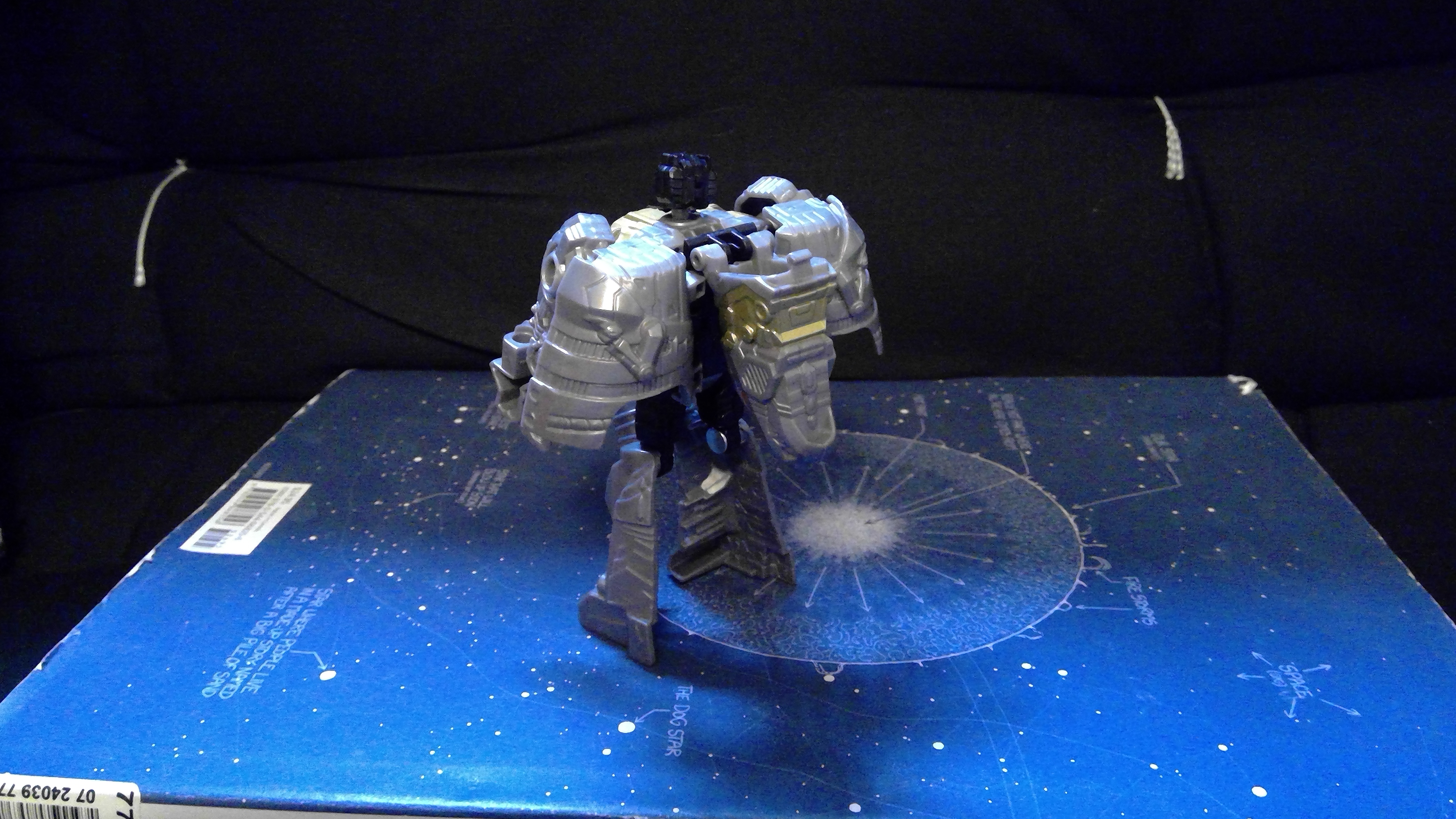
Now this is, to my best recollection, the more recent acquisition of the pair featured here. It's one of a number of specimens I have sighted in the last two or three years that seem to form their own line. The unifying features are that they are all based on G1 characters (or versions thereof), and are all quite large despite a low price for an authorized Transformer. I finally bought this guy at a sale price to see if it was worth buying more. Here's a couple pics to give an idea of what we're dealing with.

"I may look like I'm only a T. rex made of metal, but I'm really also... a far less threatening humanoid?"


So, the first thing I have to say is that I actually like the underlying idea here. The very plastic they're made of screams cheap, and close examination and handling will show them to be even more so than they might appear in my pics. The upside is, they are much sturdier and more robust than their new or old counterparts of any size or price. As a bonus, they actually do a good job covering both the collectible and actual toy markets. If you want 1980s nostalgia, it's a good return for the money. If you want something to give to a kid, it won't be in pieces within a day. The real problem is, it demonstrates all the worst qualities that a G1 Transformer could have. It's awkward, overcomplicated and just plain clunky,  especially in the alt mode that is supposed to be the selling point. Here's one more closeup to show what I mean, with the second specimen for comparison.

Now for the second dino/ bot, I got him as another already cheap item at a reduced price, in a $5-10 range not much lower than what I got the big one for. What I got is in hindsight more streamlined and attractive than the one I got later. A few pics will show, however, that it shares most if not all of the same underlying problems.
"Small legs, smaller arms, what could possibly go wrong?"


What will be especially conspicuous are the stumpy legs of the dino mode. It is of further note that both designs have the tail of the dino folding back to form the legs of the humanoid bot, which is far from the most ungainly transformation step (at least the head isn't literally coming out of the pelvis...), but still a complication for both modes. A unique problem is that there is a very strange joint connecting the rib cage and head of the dino to the rest of the body (visible as the black panel on the back), which has repeatedly separated entirely when I do this. Here's a sequence to show this is supposed to work.
Hup, hup...

So far, so good...

Ta da!!!

Hmm...

Okay, this is not optimal.

Of course, the underlying problem is, what does a dino bot really do? In terms of camouflage, this is perhaps the single most egregious case of the transformer concept defeating itself. (Then again, there's also the one "disguised" as a flying saucer.) An obviously metal dino isn't really disguised as anything, which the authorized Dinobots did effectively admit. If you did make it look like an organic dinosaur (the simplest explanation for whatever the Hell the Walmart cyborg dino was), then it's still something regular humans will know is "supposed" to have been extinct for many millions of years. By comparison, even the Changeables disguised as things people eat make marginally more sense. (And, as I ranted in the Gobots movie review, looking like actual rocks would be close to ideal.) Then, even with disguise out of the picture, there's still the question of how the transformation improves on what you already have with the dinosaur, especially an already bipedal one like a tyrannosaur. A carnosaur has massive jaws, two arms and two legs that can all be further modified in size and functions. A humanoid robot has two arms and two legs. The real answer is that robot dinosaurs were both of the things '80s kids loved, and a Transformer that doesn't transform would have been admitting the jig was up.

And that brings us back around to the big bot. If you were wondering why I didn't show the humanoid bot before, the simple answer is, he's just too big to shoot without reorienting the camera. So, I waited till the end to try a pic, which required further experimentation with lighting on the Couch Mark 2. Here's the big guy with mini Grimlock, the reissue stego bot, the Marx Japanese officer and the Truckstop Queen. Behold, ye mighty, and despair!


That's all for now, more to come!

Wednesday, February 22, 2023

Robot Revolution: The one where the robot stomps Mexico


Title: Kronos

What Year?: 1957

Classification: Prototype/ Mashup

Rating: That’s Good! (4/4)


With this review, I’m back for more robot mayhem. After sacrilegiously starting with a movie still in theaters, I decided it was time to go the other way and look at an entry earlier than my usual 1970s-‘80s timeframe. That presented me with a wealth of material, but also some strange blind spots, especially when it came to the “killer robot” theme. That brought me to one particular film that has all the hallmarks that would usually draw my attention: Obscure, strange, difficult to classify and as it happens, quite good. I present Kronos, the definitive killer robot film of the B-movie era that very few seem to have actually heard of.

Our story begins with a mysterious object descending to Earth, observed by two scientists. When the object lands in Mexico, the proper authorities send them to investigate, unaware that one of them has been possessed by the energies of the strange object. Our hero, the younger and handsomer doctor Leslie Gaskell, goes south of the border with his spunky lady friend and a couple assistants who do the actual work. They discover a Godzilla-sized robot that is disconcertingly uninterested in the usual death and destruction. Instead, it mostly sits there, ignoring any attack and occasionally and incidentally flattening small swaths of civilization when it lurches from place to place.  In fact, it is a probe sent by an unknown civilization to absorb Earth’s energy supply by passive accumulation. To stop it, the doctor and his love interest must overcome the robot and the enemy within. But the Earth may already be doomed when the military feeds the enemy with an atomic bomb!

Kronos was a 1957 film by German director Kurt Neumann, produced by Regal Films, a company affiliated with B-movie produce Robert Lippert. The film’s story was credited to Irving Block, who also contributed to the film’s visual effects. Filming was reportedly completed within 3 weeks in early 1957. The film starred B-movie regular Jeff Morrow as Dr. Gaskell and Barbara Lawrence as the love interest Vera, with John Emery as the double agent Dr. Culver. The film received favorable reviews from contemporary critics as a superior low-budget science fiction film, and gained a following as one of the best genre films of the 1950s. Neumann followed the film with The Fly, released shortly before his death in 1958.

For the broader context, what really intrigued me going into this review was the counterintuitive role of the robot in 1950s science fiction films. On consideration, the subject of robotics and AI at this time offer an unusual case of cinema matching or even getting ahead of printed genre works. By the mid-‘50s, rebellious or purposefully warlike robots were no longer the rule or even necessarily a “norm”. In their place came the likes of Robby the Robot, who was if not entirely non-threatening at least clearly devoted to serving and defending his owners. The downside to this was that these robots usually got no further than supporting cast in their own stories. Like the zombie of the previous decades (see I Walked With A Zombie and for that matter my Revenant Review ebook), the robot was literally subordinate to its master/ creator, rarely if ever granted autonomy or motivation beyond killing the villain for the hero’s convenience. With all that in mind, the present film stood out very strongly, and as I have been saying, it had already been on my radar as an exceptionally good film for its own or any other time.

Moving forward, the obvious points to get out of the way all come down to the fact that this is a “formulaic” film that shows why the formula worked in the first place. Everything here is what you would expect to find, done anywhere between average and unusually good: The stoic/ generic authority-figure hero; the technobabble; the plans that either succeed immediately or fail never to be tried again; and the love interest who gets into just enough trouble to need rescuing. It is in the lady where the film comes closest to finding its own path. Sure, she doesn’t do much beyond setting up a confrontation between the hero and the possessed traitor. (Sorry, the statute of limitations on spoiler warnings expires at 50 years…) Still, there’s certainly no overt condescension in how she is treated or portrayed. If it comes to that, she does get through most of the film without falling into any more or less peril than the rest of the cast. Most intriguingly, the romance arc does show her willing and able to say what she wants, which I will get back to.

Meanwhile, what certainly is unique is the utterly implacable “monster”. Whether classified as bot, alien invader or kaiju, this antagonist earns its place in the highest ranks of B-movie creations. On paper, it’s so non-threatening that a case can be made that it would go away if simply left alone (intriguing enough in itself). When the giant is on-screen, however, any objections become moot. This truly looks as huge and menacing as it is meant to be. That it tends to ignore humanity quickly becomes unnerving in its own right, with a further note of indignity often missing in more conventional alien invasion spectacles. When the damn thing does move, there is no doubt that it is truly unstoppable. What gets the bonus is a slowly revealed cunning, which builds to a real payoff when it turns the usual nuclear counterattack to its own advantage. The movie never really resolves if this is by its own intelligence or the direction of its unseen masters. The difference from the usual subordinate killbot is that there are no easy or certain answers, only the blank wall of the unknown and unknowable. Of course, one more honorable mention is in order for the double agent, every bit as inscrutable as his master.

That leaves the “one scene”, and there was one I was definitely going to come back to. A little past the 30-minute mark, we find the hero and his lady friend running ashore at the end of a romp in the surf. They settle down to kiss. Things get really interesting when the lady says, “Dr. Gaskell, will you marry me?” What I went back to sort out was the doctor’s reply, which turned out to be, “Can you cook?” Of course, it’s clearly supposed to be obvious that they are both joking, which on consideration makes the entire exchange all the more intriguing. They go on with a playful yet thoughtful exchange about gender roles. Just when everything is settling down to above-average routine, the doctor quite casually admits making the “biggest boner” in science. Before one can try to sort out the etymology and nuance on that one, a light mercifully appears on the horizon. In the midst of that, the two lesser scientists race in, clearly indicating that they have been within sight and hearing. It’s everything you would expect from a “good” B-movie: It’s dated, it’s horrifying, and it’s smart enough to know it.

In closing, what I come back to is how I really feel about 1950s science fiction films. In the course of my reviews, I’ve been very sparing with the “B movie” era and genre(s). It’s been easy to say that they have simply been outside my areas of interest. (See my Plan 9 review way back when, which is also in an ebook.) But the underlying reality is that these were never a big part of my formative pop culture experiences. Sure, I had heard of the major ones, and I saw several of the very best and worst at a fairly early date. For me, however, I just didn’t get interested enough to put in the time and money it would have cost  to undertake a proper exploration in the days before online shopping and streaming, and to a significant extent, I never caught up. I would like to think that the upside is that I was able to go in with a truly neutral  perspective. I’m not nostalgic about the era, and I wasn’t one of the ones laughing at the low budgets and “outdated” effects (which, suppressed rant, were usually outmoded or rock-bottom cheap at the time) either. It’s the right perspective to appreciate the ones that truly rise above the rest. In those terms, the present film is a clever and creative offering that can hold its own against “classics” with actual budgets (see When Worlds Collide). That’s tribute enough for a film that had to wait a long time to get its due. With that, I can finish with a salute. Not bad, for a human.

Sunday, February 19, 2023

Fiction: The Space Guys Adventure, Part 18!


It's the end of the weekend, and all I had is more Space Guys. This part is the kind of thing that usually overloads my stories. As usual, the table of contents is at the end.


The voyage continued. Uranus grew larger in the portholes, without a perceptible drift to the left or right. The grim feeling of the sideways planet and its rings mounted. The crew grew all the more restless, including the married couples. Arguments could be heard from behind partitions that were as often as not left open. Sometimes, they were quite audible even when the partitions were closed. Donald and Anatasia were the loudest and most frequent offenders. Alek remained happy with her math, and Jason was happy enough with his books except when Donald became unusually annoying.  He grew especially irritated when the engineer would begin repeating a strange pronunciation the planet’s name as if it was a joke in itself, usually at least once a day. A time came when Jason finally opened a partition he had pointedly shut. “It’s simple,” he said. “Yurr-ah-nuss. Is that so hard?” Donald just laughed as he closed the partition again.

“You are sweet,” Alek said.


A ceremonial occasion came when the captain announced a change among the pilots. “Command has decided that there is a need for additional leadership among the pilots,” he said. “To that end, they have approved the field commission of 2 new officers. In light of the promotion, we will issue two additional sidearms, strictly as a reflection of rank, of course.” Everyone laughed; only the captain looked amused. Jason smiled as Jax accepted his sidearm. He was less pleased when the second was given to Jackie, whom the captain called by his legal name of Jonathan Fitzhugh.

“You slipped a bit, farmboy,” Moxon said in a stage whisper. “Don’t worry; you’re still the genius’s favorite. That counts for something.” He stepped to the front, followed by Harrison and the decidedly reserved Sergeant Lazarevic. He held up a survival carbine from the ship’s hold. “Just so nobody else feels left out, we’re starting weapons training!”

Moxon started with a demonstration of his sidearm. The only thing new came when he connected a paddle-like charging holster as a stock for rapid fire. He promptly drilled Sparky the Squirrel between the eyes with a three-shot burst. He then unlimbered a larger weapon that looked vaguely like a Wild West rifle. “This is a Tesla carbine based on the same technology,” he said. “We have approval from Command to issue them to pilots, senior crew, and unescorted personnel on the basis of need. They have three settings. The first is a stun charge. The second is a cutting beam, effective to 400 meters. The third is a plasma bolt, like ball lightning. We don’t mess with that.” Of course, the gathered crew clamored for a demonstration of the third setting. They were given a video of a fist-sized bolt blowing a hole in an airlock.

Lazarevic and two of her troopers came forward to demonstrate their primary weapon, a rifle that could be fitted with a bayonet or a grenade launcher cup. “This is a Carl Gustaf Hero Sniper 8mm medium rifle, the most powerful semi-automatic firearm in the world,” she said. She handed the captain a specimen that had been stripped of a firing pin, which was soon passed around. “It is manufactured in Sweden to the specifications of the Patriotic Army. It generates a muzzle energy of up to 4400 kilojoules. It would be light for an elephant. Against any other target, it is lethal at 600 meters range. Of course, we expect to do more with that 3.7cm projector. It will fire all standard 2-gauge pyrotechnics, demolition and gas shells. With further modifications, it can launch an over-caliber 5cm engineering rocket. That can carry a cable, a heavy demolition charge or an anti-tank warhead. I don’t think we brought one of those along.” That drew laughs, some nervous.

Finally, she drew a revolver, clearly not for sharing. “Now this is a Nagant 95 revolver, over 100 years old and kicking,” she said. She held up a cartridge that looked like a blank. She turned it, revealing a slug seated deep in the casing. “It’s the first vacuum-sealed sidearm. The cylinder holds seven shots. They offered me a sidearm. I went with tradition.”

Donald raised a hand. “Excuse me, maybe I don’t understand,” he said. “It was a big deal when they thought they found protobacteria on Titan. So what do they expect you to use this stuff on? Heinz Himmelmann?”

The sergeant smiled. “They said we were to be prepared for the unknown,” she said. “If anyone did know, I suppose it would be classified.”

Harrison presented their more potentially lethal survival gear, starting with an assortment of knives. The largest looked like a sawed-off machete, with a leaf-shaped blade that swept forward.  Another looked less like a knife than an axe head repurposed as a knuckleduster. “The Martian crew may recognize these,” Harrison said. “This is a K20 survival knife. In the Corps, we called it a half-kukri, or of course, half-cocked for short.” He pointed to the knuckleduster. “And this is a Wusthof Esquimaux multi-purpose tool, based on the native ulu blade. A lot of people don’t know it wasn’t standard issue. They finally changed that for this mission. I understand this one was made on Mars. The manufacturer finally licensed it out, because Gaia couldn’t ship enough to meet demand.”

He got to the 2.6cm flare guns. They bore a range of attachments and modifications, including a version with a shoulder stock and what looked like a harpoon coming out of the muzzle. “These are 4-gauge survival projectors,” he said. “It’s partly interchangeable with the 3.7mm launcher, but it’s best not to fiddle either way. The standard rounds are flares and light percussive charges. There are shot cartridges available. Don’t worry about them. The carbine version will fire a range of over-caliber shells up to 7.5 cm, including the line-thrower you see here.”

Moxon stepped forward again. “I offered to do an extra demonstration,” he said. He picked up the half-K and the ulu. “Of course, these are issued to you for peaceful purposes as part of your duties as an exploration mission. However, there may be occasion to use them for other purposes. I have authorization to give lessons on their use in combat.” Donald raised his hand again, despite Anastasia's best efforts to discourage him. Moxon looked at him. “Are you volunteering?”

“Just another question,” the engineer said. “Before you teach us about knives, couldn’t you tell us something about that scar? Just, you know, to give us an idea of your qualifications?”

Moxon turned his head, bringing the scar on the left side of his face into stark relief. For the first time Jason could recall, he exposed his teeth as he smiled. “You should have seen the other guy,” he said. “So, would anyone like to take part in a demonstration.

“I will,” Jason said. “I use an ulu in the kitchen at home.”

Moxon smiled. “Experience never hurts,” he said. “Go ahead, show how you’d use it back home to start things off.” Jason stepped forward and accepted the native blade. He idly pictured driving the Eskimo blade into his mouth.

The demonstration proceeded without further comment. Jason used the ulu as the tool it was meant to be, chopping and dicing a radish and a piece of canned ham. When he was offered a block of ice, he carved it into the shape of a bear. That drew a cheer from Alek. “Oh, you are so coming to my bunk tonight,” she said. Moxon promptly chopped the same block in two with the half-K.

They took turns with the larger blade. Jason flayed a fish. Moxon split a piece of bamboo the long way. Jason used it to open a second tin of ham. Finally, the officer said, “Say, ever try combat moves?”

“On Mars, they teach us never to use a weapon on anyone,” Jason answered. “But we have a guy from Edo who teaches kukrijitsu. He said I was the best in his class.” Moxon handed him the knife and drew another.

They both practiced moves individually, then proceeded to sparring with sheathed blades. It became evident that Jason was faster, but not quite enough to outmatch Moxon’s skill. “The instructor who taught me said one thing before anything else,” Moxon said as he intercepted Jason’s blade a third time. “He said it was from Mark Twain. `The world’s best swordsman doesn’t fear the second best swordsman, he fears the worst, because he already knows what the second best is going to do…’”

Connecticut Yankee In King Arthur’s Court,” Jason said. “My instructor quoted it, too. `The person for him to be afraid of is some ignorant antagonist who has never had a sword in his hand before…’” He caught Moxon’s wrist with the trailing edge of his blade. “I only ever got about halfway through.”

Moxon gave his barking laugh. “It’s not exactly true, though,” he said to the onlookers. “People who don’t know anything about edged weapons usually try one or two, maybe three things before anything else. The real trouble is, they don’t know how to hide what they’re going to do, or make it look like they’re going to do something else. If they try it at all, they usually do it with their hands, when the real tells are in the eyes…” Jason thought of unsheathing the knife and driving it into his face. Instead, he swung at Moxon’s neck. He felt a surge of euphoric surprise as the blade connected… just before the point of the officer’s trench knife tapped his throat. Moxon grinned again. “Of course, Mr. Freeman is a long way from the worst.”


That very night, Jason and Alek had what they both agreed to be their most memorable encounter to that time and for some time after. A while later, Jason emerged from the partition around her cabin, leaving Alek lying face down with a sheet draped indifferently over her hips. By then, she had put on her lower undergarment, but any bystander would have seen only her completely bare upper back. Jason froze in mid-step at the sight of Moxon playing the target game. As the other man turned, he found that he felt much as he had the time he had got up in the night at home and discovered the airlock had vented while they slept.

“Sorry,” Jason said instinctively.

“Don’t be,” Moxon said. “I remembered I had left a few things here, so I came back.” Jason saw that the box from the closet was indeed at his feet. “I decided to give the game another go while I was here. As a matter of fact, I just broke my high score.”

“I’ll talk to the captain, I’m sure he will move the cabinet wherever you want,” Jason said. In his peripheral vision, he could see Alek squirm as she tried to look over her shoulder without exposing any more of herself.

“Oh, there’s no need for that,” Moxon said. “Anyway, we’re all friends here, aren’t we?”

“Jason,” Alek said. When he looked, he found her shaking her head almost violently. “I want him to go. Make him go.”

“I’m here with my wife,” Jason said. “She wants you to leave.”

“Oh, I won’t make any trouble,” Moxon said. “I’m not that kind. She knows that. I’m not the other kind, either.”

Alek finally spoke directly. “I don’t no care,” she said. “Go.”

The officer only smiled. “What, are you making that an order?”

“If you don’t, I can call my people back home,” Alek said in her flattest tone. “You would be surprised what they can do!”

Jason shut the partition. “Was there something you needed?” he said.

“As a matter of fact,” Moxon said, “I’ve been meaning to talk to you.”

“About what?” Jason asked cautiously.

“There was talk that you were talking about, let’s say, history,” Moxon said. “Especially with Mr. Fitzhugh.”

“Was I not supposed to?” Jason said.

“To be honest, there are rules, as far as what goes back to Gaia,” the officer said. “There are things the Union designates `sensitive’, and the press and the networks mostly set their own guidelines so the Fed and the Administration don’t need to get involved. The ones people know about are the morals codes; I gather a few people talked to you about that. There’s also ones for religious, racial and ethnic relations. They were modelled on rules from Jugoslavia. Those are the ones that are followed most strictly. It’s not that people can’t talk about things, of course, on the air or in print or anywhere else. It’s just a matter of doing it the right way at the right places. The same goes with talking about it. Always think about how you ask, who you’re talking to, and especially where you are. For now, I’d say it’s better to talk to me or Yates. Harrison could tell you quite a bit, at that.”

“Okay, thanks for telling me,” Jason said. “Is there anything you wanted to tell me?”

“I was in the Intervention,” Moxon said. “I wasn’t at Baton Rouge, my team was further north. It went a long way north. I know, your father was, too. Just so it’s understood, we aren’t the ones who talk.”

Jason looked at him with real respect. “I can understand that,” he said. “Now, please go.”

 “No problem,” Moxon said. “I know when youngsters need privacy.” He walked out, carrying the box with him. Jason untensed as the steps receded. He opened the cabinet, and froze again.

On the top shelf, just above the line of sight for anyone but him, lay the flame knife from Moxon’s box.