Tuesday, March 15, 2022

No Good Very Bad Movies 22: The one where everybody's an idiot


Title: Idiocracy

What Year?: 2006

Classification: Anachronistic Outlier

Rating: Who Cares? (2/3)


As I write this, I’m really getting pretty close to where I already planned to end this feature, or at least change out the format. In the process, I have been making some final decisions on what to include, and what’s been a bit counterintuitive is that most of them are ones I meant to cover all along. What really came as a surprise is that many of these are quite unremarkable at face value, neither notorious nor obscure in general pop culture, yet these are the kinds of movies that stay with me as either unsettling or irritating. In many ways, the most representative and egregious example was the present film, a quite recent one by my standards that’s actually fairly popular but has never sat well with me. I present Idiocracy, a film about a world where dumb people have taken over the world, and it’s a lot more awkward than it sounds.

Our story begins with a grim pronouncement that the human race of the late 20th- early 21st century has just now started rewarding the less intelligent to have more offspring, illustrated by an upper class couple’s faltering plans to have children and several generations of a redneck clan. Meanwhile, a slacker soldier and a sketchy lady of the night are frozen in a military experiment that is covered up and forgotten. Fast forward, and the soldier emerges to find himself in a world where seemingly the entire population has degenerated into debilitating idiocy, which actually doesn’t seem to leave them that badly off except that they can no longer dispose of trash or grow crops. The slacker makes his way from low-end housing and giant Costcos through hospitals, courts and a jail break before being accepted into the very macho president’s cabinet. There, he struggles to convince the government and the populace that their plants will grow better if irrigated with water instead of a sports drink. When his well-meaning interventions cause an economic meltdown, he is sentenced to effective execution in a gladiatorial monster truck rally. It's up to the lady of the 2000s to save him, but will she be too late?

Idiocracy was a 2006 film directed and cowritten by Mike Judge, following work including the film Office Space and the animated series King of the Hill. The movie was widely regarded as an unofficial adaptation of the 1951 story “The Marching Morons” by C.M. Kornbluth. The film starred Luke Wilson as Corporal Joe Bauers, with Maya Rudolph as Rita and Terry Crews as President Camacho. The production received a total budget of up to $4 million, but was only given a limited release by its distributor 20th Century Fox. Contemporary and later accounts noted poor test screenings and concerns that it would be considered anti-Republican. Crews later recounted that companies which had approved the use of their names had tried to withdraw because of the film’s satirical portrayal of advertising. The film became popular on home video, During and after the 2016 election, it was widely referenced by critics of Donald Trump. Judge has consistently denied political messaging in his works.

For my experiences, my central frame of reference is that I’m a virtually lifelong fan of Kornbluth, not so much of what is by far his most well-known story. The one thing that has kept me baffled and vaguely annoyed is how often I run across critics and sometimes fans who seem to take the tale as Kornbluth’s own take on heredity and class division. In reality, the author was first and foremost a satirist who often took on the cliches and conceits of the science fiction genre itself. If his work reads like a fan’s quasi-elitist wish-fulfillment fantasy, an issue that certainly isn’t unique to “Morons”, the very safe rule of thumb is that he recognized that the fantasy was there all along. With that context in mind, Idiocracy feels very much like a treatment that not only misses the point of the story but gets it exactly the wrong way round.

Moving forward, one further comment in order is that the “morons” of the original story don’t really act mentally handicapped so much as prejudiced, resentful, and mean. By comparison, the film offers a surprisingly nuanced vision of an egalitarian society where the simpletons seem to have solved many of our problems in their own way. Male and female sexuality and other biological functions are discussed openly without judgment. A non-white character leads the government (2 years before Obama’s election!) without anyone commenting on it. Citizens criticize the president and other leaders freely and publicly. Even ladies of ill repute face no legal or social consequences, unless they fail to hold up their end a bargain. The real problem is that it gets hard to judge how much of this is intentional irony or just liberal-leaning Hollywood types not thinking things through. As a further consequence, the film offers very little that’s truly political, which is just fine by me, but it pulls short of both its reputation and its full potential.

Meanwhile, the more obvious problems to argue with really distract from the story and characters, and in many ways, this is just as well. On the pro side, we have a likeable main character with a genuinely satisfying self-improvement/ redemption arc. On the con side, and it is definitely a con, he simply isn’t that smart. To start with, he’s shown to be strictly average by present-day standards. By implication, he’s not simply an intellectual type without “real world” experience. What gets problematic is that his social skills, emotional intelligence and overall judgment are still poor even compared to the simpletons.  Then it becomes entirely odd that he ends up becoming an unquestioned authority on farming, something he admits he has never done, and more importantly, something actual illiterate peasants have done well enough for thousands and thousands of years. The strangest part is that the story freely shows him to be gullible enough for the simpletons to take advantage of him, conspicuously in the whole subplot of a supposed “time machine”. This is the point where it would be one thing if he was “book-smart” but socially awkward, but what the story sets up is an artificial problem that exists solely for an artificial savior to solve.

That leaves me with the “one scene”, and there’s one scene that truly amazes me. After Joe is determined to be the smartest man in the world, the president delivers a speech to an assembled crowd. To me, the character is fascinating. He’s belligerently masculine yet also an exaggeratedly flashy dresser of the kind that was being dubbed “metrosexual” at the time the film was made. All of this is played up as he gives his speech. In the midst of it, the audience begins to heckle him, something they clearly believe they can do without repercussion, specifically pointing out that he and others have made the same promises before. He continues without apparently taking undue offence, until the hecklers actually threaten to drown him out. That’s when the mindboggling part starts: He breaks out a semi-futuristic firearm that he has by all appearances had at ready all along, and rather than directly threatening the crowd, he simply fires into the air until they shut up. The impression I get, whether or not it is intended, is a return to the near-tribal conditions of feudal society, complete with the flamboyant male dress that was really the “norm” before the combined forces of puritanism and gay stereotypes were applied. It’s intriguing and un-stereotyped, but it’s also the surest proof that this movie could have done so much more.

In closing, I come as usual to the rating, and if anything, it might seem like a surprise I haven’t given it a lower rating than I have. As with Looker, I was indeed very prepared to give the lowest rating, in no small part because it presents an inexplicably late revival of genre trends that were already scraping the bottom with 1970s trash like ZPG. Ultimately, however, it was this context that convinced me to spare this one. It doesn’t remove the odious racism and class bias that drove the overpopulation panic and eugenics before it, but it’s clever enough to offer terms for honest discussion. The final verdict is that the poor and uneducated have always had more children than the wealthy and learned, and the only real solution is to pay to educate them, and for that matter keep as many of their children as possible alive. The real moral of the present film is that being congenitally dumb still isn’t as bad as being ignorant, and that’s good enough to get a pardon from me.

Image credit IMP Awards.

Monday, March 14, 2022

Miniature Giants: Universal Monsters reissue figure


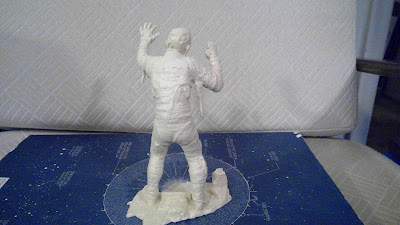
I'm getting a late start today, and I already had something planned that I could tell myself I can get you freely. It's been a while since I did a giant Marx figure post (apparently the last one was about this time last year), mostly because I haven't had any new acquisitions recently. As it happens, I finally got something around the start of the year that hadn't been on my radar until not long before I got one. Here's a few pics of the new guy.

"Why are you running away? They said you were here for an open house to sell the pyramid!"


Needless to say, this is a Marx figure based on the Universal monsters (see the Crestwood House post, if anything). There were 6 of them, the Mummy, figured here, Frankenstein, the Phantom of the Opera, the Hunchback of Notre Dame, the Wolfman and the Creature From The Black Lagoon, on consideration a rather random selection. (Was this an editorial about Bela Lugosi appearing in Ed Wood's movies?) The originals were made in orange and blue, followed by reissues that included green and glow-in-the-dark white. 

The present figure turned out to have a more complicated backstory. In the 1990s, a company called Uncle Milton made a reissue set that came with paints to add color. They can be recognized easily by the distinctive white, untextured plastic. From casual research, these account for many if not most on-line listings, and they still go for pretty high prices. I got this one with an uncontested ten-dollar bid, which is better than most of the offers I've seen. Here's a close-up detail pic. That really looks like Boris Karloff! (And why not see my Walking Dead review?)

Another thing you can see is that they messed up the hands on purpose. The obvious part is that the right hand is out of scale with the rest of the figure, presumably to make closeups like mine more dramatic. What's actually less apparent is the other hand, which you would assume is just broken. In fact, they're all like this. Yes, they molded this guy with fingers missing; hey, these are the guys who made the casualty figures. The funny thing is, a lot of Marx figures have unnecessarily delicate separate fingers, but the only original one I've gotten that had them broken off was the Daredevil figure. And here's another closeup. Forget the Mummy; this looks like the guy from Dawn of the Dead.

One more thing to talk about is the plastic, which is what's kept me obsessed with these things  If anything, the detail is sharper than on the originals, which I've seen before with the Mexican Japanese soldiers. Like the Mexican figures, it has a harder feel, though not quite as much, with a clicky sound when tapped. The bandages twang a bit, though again, not as noticeable as the officer's katana from the Mexican set. Now, here he is with the Truckstop Queen! I think she's taller, but not by much.

"Scared? Please, my boyfriend's a Wampa and my ex is King Kong..."

And here's a pic with the original Japanes soldier, who recently became the first one I had to fix. I don't think it was caused by bending the bayonet into a horseshoe, but I'll admit it probably didn't help.

"Just think this through, if the bullets don't stop me, what's the bayonet going to do!"

And how about a couple more pics just for fun?
"This town's only big enough for one Hollywood invention..."

"Yeah, fixing your own lawnmower is never worth it."

And with that, I'm calling it a night. That's all for now, more to come!

Saturday, March 12, 2022

Movie Mania: Space 1979 ebook announcement and movie poster artwork!


I'm due for a third post of an off week, and I decided to use the lead time for something I have planned for a ridiculous amount of time: I published an ebook compiling the first 50 reviews I posted for Space 1979. Here's the link for the ebook.

As a bonus, I decided to cover some movie poster artwork I used for the covers and interior art. My first idea was to use VHS art from The Falling, That led to the image featured above. To get to that quality, however, I had to find a download a new version of the same art, probably the source used by the site that I first got the image from. By then, I was already going in other directions, so I used it for an interior "gag" art.

Something I reviewed in the process was the legal ins and outs of movie poster art. On that front, the pervasive perception is that such things are "public domain", which is absolutely a myth. When it comes to the internet, however, it's pressy much a distinction without a difference. Inevitably, images get scanned, pasted, copied and reposted indefinitely, far too widely to run down all arguable violations. In further practice, a movie poster that continues to circulate online is fulfilling its intended purpose, and copyright holders don't normally object to literal free advertising. For my own part, I have tried to provide a confirmed link for the sources of the images I have used, unless it's from one of the massive sites anybody can find. That served me well enough until I started looking at using images for monetized content. I quickly decided that any "major" movies would be off-limits, both because they would be the ones connected to deep pockets and because they were very much the exception to the rule. I further decided that I would have a better defense using already wonky images from semi-obscure movies that didn't get good reviews, to emphasize the humorous intent. The contender that quickly emerged was the following poster, originally used for my Planet Of Dinosaurs review.


As I proceeded with setting up a cover to use this image, I did look into it further, and wasn't surprised to find plenty of further material (see here). Per the lore, the poster was created by an artist named Tino All, possibly for a distributor in Lebanon. It's noteworthy that this was clearly intended for theatrical showings, which for this particular film are so sketchily documented I had to address claims that it never had a theatrical release in the first place. What was clearly doubtful was whether the poster was in any way approved by the people who made the movie. Of course, this was just as well, since the poster offered ample grounds for a lawsuit by George Lucas et al. I considered trying to mitigate the issues somewhat by cutting out the gratuitous bottom half, which led to the following image.


Even with only the top part, this is baffling. Of course, it would be par for the course if the artist had no opportunity to see the movie before throwing the poster together. What throws it off is the image of the Millennium Falcon apparently in the water (and wildly out of scale), which actually corresponds pretty well to the crash in the movie (covered in a lot of detail in the review). By further comparison, the element of the muscled hero defending the damsel from the T. rex at least approximates the film, apart from making the characters look a lot more attractive than anyone in the cast. (There's a third figure in there, a kind of generic guy behind the other two; also, the lady is showing even more skin than you might notice.) But what are we to make of the foreground figure? He's certainly not eye candy, and he's portrayed in a lot more detail than needed. If anything, it looks like he's supposed to be a villain, in itself something the film doesn't have apart from the jerk boss. But then, why is he the one who looks either terrified or in absolute agony? As usual, this is clearly far more analysis than the artist ever bothered with.

Then there's this little exhibit, a late effort that didn't really fit in. I wouldn't have worried about referencing the movie, but using the Atari furniture was definitely pushing the limits. Plus, I didn't have a good match on the colors or the font size and format.

Finally, here's the centerpiece, my very first try, from a foreign poster for Dark Star. It came out absolutely beautifully, but alas, it was everything that I couldn't use. On top of the obvious problems of using material from an influential film, I was never satisfied with the provenance on the original image, which seemed to be associated with a re-release I couldn't conclusively date. Here it is in full glory.


And here's one more. It's pure gag, but the film absolutely deserved it.

With that, I'm calling it a night. That's all for now, more to come!

Wednesday, March 9, 2022

Really Good Movies! The one that was the first vampire movie


Title: Nosferatu

What Year?: 1922

Classification: Prototype

Rating: Classic! (2/3)


As I write this, I’ve been looking at finally getting my movie reviews into circles beyond my blog. In the process, I decided it was time to do something new and different enough for yet another feature, which really meant going in more conventional directions. As I have regularly pointed out, my whole approach to reviewing has been the roads less travelled, away from the usual “best” and “worst” movies that get discussed everywhere. I decided it was time to deal with the movies that have stayed above my radar, the kinds of movies that are influential, well-regarded and even successful in their own time. The one that will be first is also the one that convinced me it was time, a film that had enough of an impact to be remembered and celebrated on the 100th anniversary of its release. I present Nosferatu, the first vampire movie if not the first horror movie, and it’s the kind of movie where “classic” might not quite be a compliment.

Our story begins with a protagonist and his bride, celebrating a promising offer from a reclusive count to purchase a property in the city. The count proves to be a strange, goblin-like entity with  an even more eccentric servant, holed up in a castle that the locals fear to approach. While the young man stays with the count, he begins to feel strange, and discovers strange marks on his neck. Back home, his bride becomes distressed by premonitions of danger and approaching evil. Soon enough, the count arrives on a ship whose crew has been mysteriously wiped out, then moves in to a house near that of the couple. In short order, the city is devastating by a mysterious plague. With the aid of a convenient tome, the lady figures out that the count is one of the undead, feeding on the living. To save the town, she must lay a trap for the revenant- but it may cost her own life!

Nosferatu was a 1922 horror film by expressionist German filmmaker F.W. Murnau. The film was considered an unauthorized adaptation of Bram Stoker’s Dracula, though it differed from the novel both in its concept and portrayal of the vampire and a number of other points. The film starred an actor known as Max Schreck as the vampire, named Orlok, with Gustav von Wangenheim as the protagonist Hutter and Greta Schroder as his wife Ellen. Murnau and his production company were successfully sued by Stoker’s widow, resulting in a court order to destroy all copies of the film. Prints of the film survived in nominal public domain, allowing the film to grow in popularity. Certain rumors grew around the film and its cast, including unfounded claims that Schreck either never appeared in another film or was a wholly fabricated persona. In fact, Murnau and Schreck continued to make films up to the times of their deaths in 1931 and 1936 respectively. Wangenheim and Schroder survived World War 2 and continued making films, the former as an East German communist. Many prints of the film were altered to use the name Dracula and other Stoker characters. The most well-authenticated versions will be those with the recovered original score by Hans Erdmann.

For my experiences, what defines my frame of reference was my rejection of the cinematic vampire over “the” zombie, and my further research into the far more complex and befuddling entity of the vukodlak (see my misbegotten post on The Greek Vampire Hunt). With that admittedly eccentric but by all means well-grounded perspective, any interest in Dracula barely lasted past elementary school, when I can just remember reading a sort of comic book/ cassette treatment. In hindsight, it amuses me all the more that the Stoker estate successfully litigated any claim to ownership of the vampire concept, which was really an effective admission how much of the “lore” the author pulled out of his posterior. In any case, to this day, the only movie vampires I can take seriously are the present film and, of all things, From Dusk Till Dawn.

Moving to the movie itself, the foremost thing that must be admitted against its reputation is that the film as it would have been made is just plain gone. We can restore the prints, adjust speeds, add filters and put in the non-Anglicized dialogue cards, but it’s still just reconstructing what is long since lost. This shows especially with the music, where even the most thoroughly restored soundtracks appear to be subject to intense debate. In practice, anything you could readily cross-examine ranges between unconvincing and flat-out awful, to the point that I have literally preferred to watch the film in actual silence rather than put up with what others have done. In the viewing for this review, I finally got through the bulk of the movie with Berlioz’s Symphony Fantastique for accompaniment, which worked better than it really had any right to. And even if we could get everything exactly right, could we really feel or even understand its impact when it was released? The unfortunate answer is, probably not. Silent films were their own artform for their own time; we can only give our best estimation of what they meant to their audience.

With that out of the way, what remains is either unforgettable or just odd. There’s plenty here that’s just filler, like frivolous shots of a fly trap plant. There’s further hints of the passive protagonist/ antihero of modern horror, as the main character coasts through his own story with little evident awareness of what’s happening. Something else that can easily become distracting is how to classify the film and especially Murnau’s camerawork. It would be easy to take the film as surrealist fantasy more than horror, if not for the pervasive shots of quasi-Gothic buildings and streets that would have been as mundane to the Central Europeans as convenience stores and Walmarts. This is horror by way of the prosaic rather than the fantastic, and an impressive preview of things to come.

Since I’m already going over, there’s obviously plenty more to say about Schreck as Orlock, except he already speaks for himself. The design and makeup would be easy to dismiss as a goofy cliché, even factoring in its influence on later films, yet it unquestionably works. There’s further intrigue in seeing the count somehow navigate quite ordinary situations without arousing suspicion, not to mention the indignity of carrying his own coffin with him. The rest is all in the mannerisms and fine details that define silent film itself, at least up to the finale. Here, Schroder becomes the one who finally rises to Schreck’s level. On top of that, we have the genuine fantastical vision of the count’s approaching silhouette, and even that transposed on the shadow of the quite ordinary banister. (Then there’s a shot that could easily be ridiculed as lewd, but again, it works.) It all plays out as the allegory of doomed virtue against overconfident evil, culminating in the defeat of the vampire by the rising sun which nobody had actually done before.

That still leaves the “one scene”, and the one that has always stood out to me is the unaccountably long episode on the ship. Here, the count quickly and rather counterproductively picks off the crew, until the last two crewmen are left to throw their shipmate overboard. (This is the surest indication that the victims of this revenant don’t come back to life.) Finally, one of the pair rushes into the hold, intent on finding out what their cargo is. Of course, that brings him to the count’s coffin, which he tears open. Orlok promptly emerges in perhaps the most bizarre shot of the film, seemingly stiff as a board as he rises upright. It’s all too much for the sailor, who doesn’t stop running until he’s already overboard. On paper, it’s comically overdone at best, yet there’s enough subtlety that the full extent of the strangeness is easy to miss.

In closing, all that remains is the rating, which I will be going into further as a post script. This time around, there will be no “bad” rating, only degrees of good. On the scale I envision, this film truly embodies both the upsides and downsides of a “classic”. On one hand, it is without question a product of its time, with a further outsized influence that can make it seem overfamiliar even on first viewing. On the other, it has the proven worth to speak to generations of audiences, and provide key insights on the history of a genre. Take it or leave it, it commands respect, and that’s enough to get it on my roster. More to come, and this time, I look forward to it.


As a post script, here’s my latest rating scale, in ascending order.


Underrated (1/3): Important and underappreciated film, often unsuccessful at the time of release, due for further recognition. In other words, the kind of movie I would usually review…


Classic! (2/3): A recognized and influential film, successful both with its original audiences and later generations, arguably with dated or flawed elements.


Awesome!!! (3//3): A good film that’s popular and fun to watch, often regarded as “cult classic” or “so bad it’s good”, in some cases with underestimated quality and serious themes. So, also the kind of movie I would usually review.

Tuesday, March 8, 2022

Movie Mania: Dinosaur pop culture book of EVERYTHING!!!


It's the start of an off-week, and I decided it was time to cover something I've had backlogged a long time. It also happens to be one of the most unclassifiable artifacts in my book collections, and the nucleus of a great deal of my pop culture experience. I was finally driven to reference it in my review of The Crater Lake Monster, and I knew it was time to cover it for real. I present The Dinosaur Scrapbook, and to get things rolling, here's the original cover art, missing from my copy and every other I ever encountered.


For the background, this is something I feel like I've had with me my whole life, though any clear memories of it are from a much narrower window. I suspect I read or at least saw it in libraries when I was a kid, possibly in school libraries, which I now find moderately horrifying. I definitely read it a lot in college, where I found it along with Peter Nicholls' Fantastic Films. The actual copyright is 1980, so it is certainly possible I encountered it much earlier.

For the book itself, it's nothing less than a survey of dinosaurs in popular culture, going all the way back to the Victorian era. It's the kind of thing a proper scholarly treatment would need a whole shelf to cover. The author, otherwise best known for the novelization of The Empire Strikes Back (I'll think about it) and the 1996 film Dinosaur Valley Girls, keeps things very casual, telling the tale with a huge number of pictures. Incidentally, I had to use a little care what I took pics of, because there are a significant number of "adult" images, starting right inside the cover. Here's a sample of the first page I cared to picture here.

For the movie side of this, a large part of the book is dedicated to dinosaur movies, though not as much as one might expect. 4 of its 13 chapters cover the full range of dinosaur movie tech: stop-motion; "gagged up" live reptiles and other practical effects; Japanese suit monsters; and animation. More dinos in audiovisual media are covered in chapters on Edgar Rice Burroughs and dinosaur-related TV shows. Naturally, the quite comprehensive overview covers a number of movies I've reviewed: Planet of Dinosaurs, The People That Time Forgot, Robot Monster, Sinbad and the Eye of the Tiger, When Dinosaurs Ruled The Earth, Godzilla Vs the Smog Monster and even Allegro Non Troppo. Many/ most of theses were ones that I had already seen or heard of, but there were some that I learned of or at least got interested in because of this book, particularly Allegro Non Troppo, which I didn't even remember from previous reading before I bought my copy of the book. Then there are many more movies that are now notorious, like Reptilicus and At The Earth's Core, but others that remain inaccessible or wholly obscure, like Unknown Island and Monster On Campus. One I have personally investigated is a 1923 silent short called "Monsters Of The Past", featured in the book under the title of a separate compilation. The book mentions the footage in connection with a rumor that it was animated by Willis O'Brien, which Glut dismissed. In fact, the only identified party is Virginia May, shown in the film as a sculptor, who by my guess is most likely the one who did the animation. Here's a sample of pics from the movie sections.


I cropped this to cut out my arm. You do not want to see that...

Meanwhile, the book has a lot more on dino pop culture, including pulp magazines, comics, tourist attractions and toy. Here's one of the most impressive, a comic reportedly published by Jack Chick (covered here) .


Here's more comics...

And models! I don't know how, but I'm sure I had the Dimetrodon.

And Marx dinos! Also... bigmouths???

Then there's this, apparently from a comedy album. This... this is just unsettling.

So that finishes another meandering trip down memory lane under the belt. This time around, I really have hit on something that had a tremendous influence on me, even beyond my own memories of it. The book remains a testament to diligent scholarship, and a time capsule of how we heard of and learned about older media before Youtube, Amazon and the internet itself. If it comes to that, it's still a worthwhile read that could still tell you about a few things you didn't know. And to wrap this up, here's the silliest pic in the book, apparently a gagged-up lizard that got cut from a film.

That's all for now, more to come!

Saturday, March 5, 2022

No Good Very Bad Movies 21: The one by Michael Crichton


Title: Looker

What Year?: 1981

Classification: Irreproducible Oddity/ Parody/ Anachronistic Outlier

Rating: Who Cares? (2/3)


As I write this, it’s not quite a month since I put together a list of the best movies I’ve reviewed. In the course of that project I freely admitted that many if not most of the ones I listed there weren’t the ones that got my highest ratings. Since then, I have pondered further whether the same could be said for the “worst” ones. What I’ve come to recognize is that there are times even the test of personal hate doesn’t give the full picture, especially for the big-budget films. Movies like Star Trek The Motion Picture and Santa Claus don’t offend the way Inseminoid and War of the Planets do, but that doesn’t mean they aren’t as bad or worse in their own hollow, muddled way. I definitely vented my distaste for mainstream gloss in reviewing The Golden Child, which brought me in turn to what was always next in line. I present Looker, a strange entry that has stuck in my mind with more than enough force to hate, but as we will see, things aren’t quite that simple.

Our story begins with a beautiful woman who answers the door in her underwear, then gets apparently murdered by a mysterious, possibly invisible assailant. We then meet what will pass for our protagonist, a plastic surgeon whose clientele seems to be mostly already beautiful women looking for an extra edge. All is not well, as it turns out several of his clients have been killed off in apparent accidents and suicides. Then one of the girls comes to him, warning that she fears for her life because she is “perfect”, just before taking a dive of her own. When a new patient is offered a new modeling job, the doctor investigates and discovers LOOKER, a program that turns real-life women into digital models that can be used in any setting. But the same tech has been used to manipulate human minds, creating an assassin who can make himself invisible and brainwash his victims into doing themselves in. Then the doctor discovers his part in the real plan- to use plastic surgery to create perfect women for the bad guys’ machine, and then dispose of the originals!

Looker was the fourth film directed by Michael Crichton, reportedly based on ideas developed soon after his debut film Westworld. The film was produced by The Ladd Company, with distribution by Warner Bros. The film starred Albert Finney as Dr. Roberts and Susan Dey as Cindy, with James Coburn as the villainous executive Reston. Like Westworld and Futureworld, the movie made substantial use of CGI, including possibly the first digitally-rendered nude figure. It further portrayed the use of 3-D scanning and digital composite shots, though no sequence in the film used such technology. The soundtrack was composed by Barry DeVorzon with a theme song performed by Sue Saad. The film was a commercial failure, earning $3 million against a budget of up to $12M. Contemporary reviews were also negative, with Peter Nicholls describing the film as “barely  comprehensible”. Crichton is believed to have made substantial cuts and changes, for uncertain reasons. Coburn later stated that his own role was “left on the cutting room floor”. The film is available on multiple formats, apparently only in its theatrically released cut.

For my experiences, this was one I looked up not long ago, after coming close to buying it outright. What immediately stood out was that it anticipated the future that has come to pass, while still getting things entirely the wrong way round. With the current state of technology, what’s shown is definitely feasible if a bit extreme; at the same time, the whole scenario is simply redundant. With a big enough CGI budget, we could make Oprah Winfrey look like Grace Jones and make Ms. Jones look like she did in Conan The Destroyer, without laying a finger on the originals. (I honestly couldn’t think of a more contemporary reference.) We don’t do it because the tech has already advanced as far as demand will take it, and if it comes to that, society at large has gotten more accepting and diverse in its standards of beauty. The decisive consideration for advertising in particular is that an ad only needs to be good enough to sell the product. If you shell out millions to get some ideal of perfect aesthetic beauty, you’re not only spending far more than you need but possibly distracting from the product you’re trying to sell, an obvious consideration which the movie seems to acknowledge at one point.

Moving to the film itself, what’s jarring to the point of distraction is how often it calls up other movies that should have been independent. There are especially strong similarities to Brainstorm, which would have been filmed at about the same time but got held up by scandal and actual tragedy. Then there are the more obvious though fairly superficial parallels to Tron, plus The Hidden, They Live and perhaps Predator. The most completely random déjà vu moment is the demise of a patient in full view of the doctor, literally identical to the opening nosedive in Lethal Weapon. It all makes the film feel unmoored in time, enough that I went back and added my admittedly overused Anachronistic Outlier designation. What’s stranger still is that this is by all indications meant to be funny or at least satirical, as if Crichton were writing color commentary on tomorrow’s news… and not doing it that well.

That brings us to the central reality, this whole thing is a flat-out mess. Sure, there’s some great and indeed amusing surreal moments, especially in the finale, which is the only reason I didn’t give this the lowest rating outright. (This incidentally demonstrate why you film your actors and render your environments rather than vice versa.) But it never really goes anywhere, because it never makes any sense. It’s one thing to fail to anticipate the future of the technologies that are portrayed, and bad enough from a usually insightful futurist like Crichton. It’s another to lay down a scenario that hinges on the bad guys killing people who should by all means be worth more alive. My acid test of evil plans is the simple question, would this make sense to Megavolt? (See Frankenstein’s Army, etc.) Here, that great mind could definitely raise some concerns. So you already have the live models scanned; what’s the harm in having them around to do it again if you have to, especially if you’re relying on early 1980s hard drives? So you might have to pay them royalties; how does that really compare with dealing with a hitman who can both rat you out and kill you if betrayed or annoyed? So they could use the plastic surgeries you paid for to get a job with a rival company; can’t you just use your tech to make a few good old-fashioned blackmail videos, assuming you can’t get them the old-fashioned way?

That leaves the “one scene”, and despite strong competition, there was one that came out ahead very quickly. As the protagonists explore the villainous corporation’s headquarters, they hitch a ride on a cute little retro housekeeping bot, which would have gotten honorable mention if it wasn’t more or less in the same sequence. This leads them to a room where the doctor continues nosing around, while one of the company’s advertisements plays. It’s the ad that stands out, every bit as ridiculous as any number of actual 1980s spots. It’s an encounter between a housewife and a costumed mascot for a cleaning product called warrior. I will admit I can’t recount it, because to my surprise I couldn’t find a clip after I sent a disc I used for this review, but I don’t think I could capture any better the bizarre feel as the lady all but propositions the mascot. What’s most telling is that the actress playing the housewife has clearly had none of the medical or digital treatments that the models are supposed to have been put through, and equally clearly doesn’t do any worse presenting the product. Then in the midst of it, the doc turns to the damsel, to find her staring at the video.

In closing, what this really brings me back to is why I keep saying I don’t do worst movies lists. This was one time I came in ready to deal with a movie far more harshly than I have, and the fact that I have relented doesn’t mean I am taking anything back. This is absolutely among the worst movies I have seen, especially with my usual adjustments for budget and talent, certainly far more so than any of the usual suspects I’ve seen fit to defend. On top of that, it’s among the most obscure movies I’ve investigated (see Two Evil Eyes, and my best movies list while you’re at it), again proving that other people’s supposed worst lists don’t top what I turn up virtually at random. With my knowledge and experience, however, the one thing I can’t say is that it’s unique. On the contrary, it is a perfectly typical example of the glossy mediocrity of an entire decade that it was barely a part of to begin with, and on a certain level, even going harder on it would just be giving it more attention than it deserves. With that, I say enough, and gladly end things for another day.

Image credit Movie Screenshots.

Thursday, March 3, 2022

Fantasy Zone: The one with the Luck Dragon


Title: The Neverending Story

What Year?: 1984

Classification: Irreproducible Oddity

Rating: What The Hell??? (2/4)


As of this writing, it’s exactly one week since I announced I was done with this feature with Return To Oz, so of course, I’m back with another installment. In my defense, it’s one I hadn’t decided whether to review here or anywhere else, though it would seem obvious enough that anyone with me all the way would probably have been expecting it. In fact, I had expected it to be a while before I even got to this one. Instead, with the usual random factor, I found it available on a streaming plan I activated while trying to get other problems with my paleolithic rental arrangements sorted out. So, I gave it a look, and with a pileup already building, I knew I had to cover it here and now. So with that equivocal introduction, I present The Neverending Story, an ‘80s fantasy movie that happens to have a theme song from the same composer as Cat People, and that’s just the start of the weird and random.

Our story begins with a boy being thrown in a dumpster by bullies. He takes shelter in a bookshop whose proprietor reveals a special book. As he reads, the world of Fantasia unfolds before our eyes, a land of magic and whimsy threatened by the advancing threat of The Nothing, a misty void that consumes all in its path. A boy hero named Atreyu goes forth on a quest to heal the sick Empress and turn back the tide. He must navigate a range of perils, from the Swamps of Sadness to deadly sphinxes, stalked by a mysterious wolf. With the help of a mystic turtle and a Luck Dragon who acts like the guest star on a Law And Order: SVU episode, the hero makes his way to the edge of Fantasia. It all comes down to a final battle with the wolf- but the fate of Fantasia still lies with the Earthly boy!

The Neverending Story was a 1984 American/ West German film by Wolfgang Petersen, based on the first part of a novel by Michael Ende. The film was produced by Neue Constantin Films with distribution by Warner Bros, with a budget equivalent $25 million. While the film was shot mainly in Munich, all dialogue was in English. The film starred Noah Hathaway (see Troll) as Atreyu and Barrett Oliver as Sebastian, with Alan Oppenheimer as the voices of the Luck Dragon, Rock Biter and the wolf G’Mork. Animatronics and other effects were provided by a crew led by Brian Johnson, whose previous credits included work on 2001, Alien and Dragonslayer. The soundtrack was provided by Klaus Doldinger, with a theme song by Giorgio Moroder and Keith Forsey. The production was troubled by a falling-out between Petersen and Ende. Who criticized the finished film as “kitsch, commerce, plush and plastic”. The movie was a commercial success, earning $100M worldwide. Attempts to expand it into a franchise were less successful, resulting in a 1990 sequel with a new cast and a third film that did not receive a US theatrical release. In 2019, a cover of the theme song was featured in Stranger Things. The film remains available in multiple platforms including free streaming from Netflix.

For my experiences, this is one I personally saw very early, I’m sure well before my family had a TV or VCR of our own. Even with my world’s-worst-superpower memory, I don’t believe I ever remembered more than a bare outline of it. I have a much clearer recollection of looking it up soon after getting Netflix, still well over a decade ago. I think that in itself is a significant commentary on the film’s impact. For kids, it’s a decent, fairly routine 1980s adventure, at least apart from the existentially terrifying nothing. It’s for adults that it becomes pure nightmare fuel, both intentionally and unintentionally. Through mature eyes, it’s an allegory of the conflict of hope against despair, perhaps between life and mortality itself. Yet, the one thing that gets casually referenced more than anything else is the theme song, even more egregiously Eighties than Moroder’s work on Cat People.

 Moving forward, it must be reemphasized from the start that this is serious fantasy, especially for a movie directed at kids. This is generally reflected in the effects and overall production values, which sometimes get rough but never campy or “cute” for its own sake. Most of the further issues rise either with the film’s own premises or inherited genre conventions. Fantasia and its inhabitants are a mishmash, by all indications to represent corresponding subgenres of fantasy. The main character is vaguely generic, though this is done with reasonable self-awareness and still with more effort and depth than the average preteen/ adolescent wish-fulfillment protagonist. The supporting characters tend to be either useless or overpowered. What easily balances everything out is the terror of the Nothing, portrayed with deceptive simplicity, and the monologuing G’Mork, whose simple motivations are all the more unsettling with age and hindsight. I definitely considered the “one scene” just for the line, “People without hope are easy to control…”

The real con in all this is simply that the film seems to second-guess itself by falling back on cliches that really aren’t even for the kids but for supposedly “hip” older viewers. This is most obvious with the music and the theme song, which I already ranted about. It also is definitely evident in the ending,  which bends over backward to show that everything is okay, and shoehorn in a vengeance-fantasy comeuppance of the bullies. There’s also the inexplicably risqué sphinx thingies, and then the trainwreck that is the Luck Dragon. I don’t believe they wanted to go there, I don’t believe they wanted anyone to think they were going there, but how did they think adults then or at any other time were going to react to a wonky animatronic creature talking to a 13-year-old boy about talking in his sleep and then asking for an ear rub?

That leaves the “one scene”, and I’m going with a scene with the Rock Biter. Just before the finale, Atreyu finds the giant , last seen at the beginning, now all alone. He sounds almost bemused as he stares at his hand and says, “They look like good, strong hands, don’t they?” He then gives a succinct account of trying to save the zany Lewis Carroll characters we saw early on. He relates that he literally tried to hold onto them, but concludes, “The Nothing pulled them all away.” Oppenheimer’s voice work is as heartbreaking as G’Mork is chilling as he announces his intent to wait for the Nothing to overtake him. Then, like a broken record, he seems to start over, as the boy warrior turns and moves on. It’s the surest demonstration just how much depth and maturity the movie has, when it’s actually trying.

In closing, the one thing I feel worth addressing is why I didn’t cover this before. As outlined above, it was up in the air if I was going to get a crack at this one without more time or actual money. Even apart from that, from my skewed standpoint, this is exactly the kind of movie that usually ends up above the radar, well-known and regarded, influential, and even profitable in its own time. At the same time, it was odd and notorious enough that I gave serious thought to covering it in my “worst” movies feature. With a fresh viewing, I easily convinced myself it didn’t belong there, which on a certain level was its own disappointment. What really convinced me to do the review was that I felt I could offer a new perspective. It’s not a perfect “classic”, and it’s not a hilariously self-dated relic either. It’s a thoughtful film that didn’t follow through quite far enough to reach its full potential. With that, I’m bidding all good night.

Image credit Film Affinity.