Friday, December 17, 2021

Super Movies! The one with Grand Moff Tarkin and Joan Collins


Title: Tales From The Crypt

What Year?: 1972

Classification: Anachronistic Outlier

Rating: It’s Okay! (3/4)


The last time I came to this feature, I was announcing that I was ready to bring it to an end, at least as part of the regular lineup. Because I’m really not very good at this, I’m back with another entry. It all came to this because several other possibilities I considered for my other features fell through, and in the middle of it all, a reviewer I follow posted a review of one I had been considering on and off for a very long time. With that, I present Tales From The Crypt, 1970s edition.

Our story begins after an opening score that seems to have been recorded in the 1930s with a group of visitors in a Medieval catacomb. Five of the group wander down a side passage into a chamber where a creepy man in an old-school monk’s robe. The old guy becomes the narrator of a series of tales of their misdeeds, beginning with a woman who murders her husband on Christmas Eve, only to discover that a lunatic in a Santa suit has paid a visit. The tales get more explicitly supernatural as we move on to a philanderer who finds himself transformed after an accident with his mistress and a wealthy man’s scheme to remove a dotty garbageman from his gentrifying neighborhood. We then meet a proud financier whose wife learns the price of getting what you wish for. Then we’re back to the Earthly plane with a faceoff between the chiseling administrator of a home for the blind and his defiant but patient wards. But at the end of it all, they still must learn just where they are!

Tales From The Crypt was a 1972 horror film by Amicus (see The People That Time Forgot) and AIP based on stories from the comic of the same name and from two other EC titles, Vault of Horror and Haunt of Fear. The film was directed by Freddie Francis from a script by Amicus cofounder Milton Subotsky. The top-billed star was Peter Cushing (see The Horror Express and Shock Waves) as the dustman Grimsdyke, a role he reportedly chose over the businessman Jason in the segment “Wish You Were Here”, ultimately played by Richard Greene. Other cast included Joan Collins (see Empire of the Ants) as the murderess in “All Through the House”, Patrick Magee as the leader of the blind men, and the late Sir Ralph Richardson (see… Time Bandits?) as the Cryptkeeper. The theme from the film was Bach’s “Toccata And Fugue”,  previously used for horror/ genre films such as the 1931 version of Dr. Jekyll And Mr. Hyde. The film was an immediate if modest success, earning a box office of over $3 million against a budget of 170,000 pounds. It was followed by a sequel, The Vault of Horror, released as a Shout 2-pack Blu Ray with the original in 2014. Several segments of the film were later remade for the Tales From The Crypt TV series. The film is currently available for streaming on the Tubi platform.

For my experiences, I knew of Tales From The Crypt vaguely thanks to the TV show, but never got much further into it than the present film, which I looked up sometime in the 2000s. When I first encountered it, I freely accepted it as a “classic”. In the years since, I have never felt that its reputation diminished. What I did see was major fluctuations in the availability of the film, to the point that I was for a time seriously concerned that this would be yet another movie in Copyright Hell. I suspect that this, in turn, allowed a more subtle shift among audiences and critics, especially new and old fans of the TV series and the original comics. I myself have come to the point of debating between this film, Vault of Horror and Creepshow as the best vintage EC-based film. The original film is no longer the centerpiece of the franchise, if it ever was, yet it hasn’t fallen into obscurity or disrepute either. And that offers a pretty good point for a relatively neutral reviewer like me to come in for another look.

Turning to the film, what stands out in my usual sensitivities is that this is an egregious example of a film that feels both ahead of its time and willfully “retro”, the epitome of what I call the Anachronistic Outlier. The music, the shooting style and even the casting all deliberately harken back to the 1950s period of the comics and in some cases to their earlier sources. In the process, the movie unintentionally highlights the morality-play format that tamped down horror in the pulp era. Yet, there is still a nihilistic “edge” that anticipates or exceeds movies far ahead of its own time, undoubtedly in no small part because “mainstream” American genre films had fallen so far behind as to be actively regressing. This isn’t slasher-movie pseudo-moralizing about premarital sex and found-object homicide, but a Serlingesque panorama of terrible people who knowingly bring trouble on others as well as themselves. It’s aided greatly by the distinguished cast. Cushing and Richardson are the easy standouts, with Magee pulling up from behind. My picks for the most impressive performances, however, are Collins, who spends much of her time looking anxious or bored as she considers the logistics of body disposal, and Greene, pushed to supporting cast in his own story yet perhaps even better than Cushing might have been as a rogue who unquestionably suffers far more than he deserves.

On the “con” side, most of the obvious problems come simply from the anthology format, previously considered with Two Evil Eyes and Allegro Non Troppo. The ones that certainly rate weakest and strongest are the opening and the finale, which most seem to agree on, so I won’t say more than I have. Of the rest, however, I find even the segments that usually get the praise don’t quite meet their potential. “Wish You Were Here”, for instance, relies on altogether contrived references to “The Monkey’s Paw” for its exposition. By comparison, “Poetic Justice” is at least ahead of its time with a vision of “stranger danger” and homeowners’ association intrigues, though to me Cushing just kind of breaks even. For me, the absolute standout is “Reflections of Death”. Sure, it’s predictable even for the 1950s, but the execution far exceeds an already satisfactory premise, with the key scenes shot from the revenant’s perspective. There’s still a decent twist with the reappearance of Susan (played by Angela Grant), as eerily poised as Magee and the blind men in the final segment. Then the problem throughout is that it just looks and feels cheap if not rushed. To me, this shows especially in the opening and closing music. It’s one thing to rely on an arguably overused piece; it’s another to use a hopelessly tinny recording that sounds like 20 generations of transfer static. I can’t believe they even saved real money; it’s more like they gave the job to someone who never bothered to listen to more than one recording.

That leaves us with the “one scene”. I’ve already gone through multiple shots and segments that would be worthy of the honor. The one thing I haven’t covered in depth is Richardson, familiar to me from his late turn as Ulrich in Dragonslayer. He gives a superbly ghoulish performance, necessarily fragmented across the film. I debated whether it would be possible to isolate just one piece in the usual fashion. Once I had the idea, however, I quickly noted one particular point, bridging the first segment with “Reflections”. After narrating the fate of Collins’ character, we find her counterpart among the visitors vaguely protesting, even as she rubs her throat uncomfortably. The Cryptkeeper then turns to the next sinner, played by TV/ character actor Ian Hendry (d. 1984). It’s here that the monk first questions whether any of our antiheros really remember how they ended up in the catacombs. When called out, the man reflexively answers, “I’m on my way home to my wife and children.” The monk challenges him, almost bemused: “And then?... And then?” It’s a matter of a minute or less, even with the framing factored in, but these few words are a high point if not the finest moment of a cracking performance from a fine actor.

In closing, what I come to isn’t so much the rating, but how the film compares with others I have mentioned, which has ultimately been as big a consideration as any in my final rating. Of all the official, informal and arguable EC films, there never was any doubt that Creepshow is the “best” by any objective appraisal. However, I could have rated this one as highly with my usual handicapping in effect. What really put Creepshow ahead are its budget and improved technology, plus the participation of Stephen King, which obviously can’t be held against any other film. But on consideration, there is one movie I would definitely rank ahead, and it’s this movie’s own sequel, Vault of Horror. Of course, I can’t give my reasons in full without another review I’m not yet prepared to do. It will suffice to say that, where the second film has segments that don’t hold up on their own or by comparison, it also has several that are at least as good as anything in Tales or even Creepshow. (I will name-drop the segments featuring Terry Thomas and Tom Baker.) The further fact that Vault was released only a year later is to me the surest proof that the present film could have been better. It may remain the original and the “classic”, but its real accomplishment was laying the way for better things. In the proverbial light of day, that’s credit enough, and with that, I can count this done.

Image credit Movies And Mania.

Wednesday, December 15, 2021

Movie Mania: Star Wars vinyl


I'm continuing with my disastrous efforts to get a full five posts this week, and this time I had no idea what to do. As necessity begets invention, I finally decided to follow up on a loose end from my non-depressing Christmas playlist. In the course of that post, I mentioned having one of the infamous Meco Star Wars albums at the family estate. Since I had absolutely no better idea, I dug through a cache of records that there hasn't been a player for in about a decade. Here's the first of two specimens I unearthed, photographed with my phone on the Couch Mark 2.

This is the original Star Wars soundtrack album, released in 1977. It's obviously not much to look at, but things are better in the back, which is the pic I opened with above. It's a two-record set that runs about 80 minutes total. You might think I ran this into the ground as a kid, which isn't wrong. The wrinkle is that I literally couldn't operate the record player when we did have one, so my family recorded the whole thing onto a 90-minute cassette that I played for the next few decades until I lost track of it. At any rate, the format meant there's an interior that they filled out with photos. Here they are in full glory.


This artifact is a perfect snapshot of why the audiophile trend/ craze left me behind. As alluded, my choices of media formats were dictated by my terrible eye-hand coordination, so it was cassettes all the way through high school. I can still muster some nostalgia for the days when you could record music directly off the radio and pass it along on a mix tape, but I have absolutely no fondness for the tech itself. What really was good about an album like this is that it's polished enough to sound like a concert performance instead of being broken into a bunch of short sound clips. If I could get it back on a playable format, I would definitely prefer it over the Star Wars digital album I got a while ago, but it just doesn't matter quite enough to go out of my way. And with that, here's the real main exhibit...

Here is the Star Wars Christmas album, which incidentally has nothing to do with the Star Wars Christmas special. It was released in November 1980, which I got wrong when I listed a track from it as from 1979. That means that it technically came out after Empire, released in May of that year, but I strongly suspect the new movie had little if any effect on the final form of the album. I can kind of remember hearing it as a kid. However, it was the album cover that made by far the strongest impression, in fact a painting by concept artist Ralph McQuarrie. Here's a couple closeups. R2D2 looks... chunky.


When I started this post, I finally listened to the majority of the album. I can say without hesitation that it doesn't come close to living up to the McQuarrie art. Its most redeeming quality is a certain informality that was already seeping out of the franchise. In and of itself, however, it barely holds its ground between tolerable and intermittently amusing. To spare you the trouble, here's the most worthwhile track besides the one with Jon Bon Jovi, "The Odds Against Christmas", which seems to reference the asteroid segment in Empire. It actually raises an intriguing angle on just how much of an accident our celebration of Christmas really is, which of course isn't explored. And yes, these are absolutely the high points.

With that, I'm wrapping this up. For once, I've made pretty good time and still covered what I want to do. It still leaves plenty I might come back to sooner or later. That's all for now, more to come!

Tuesday, December 14, 2021

Featured Creature: The one that put Robocop under water


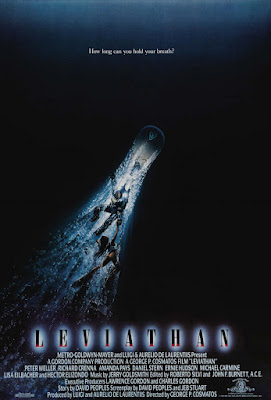
Title: Leviathan

What Year?: 1989

Classification: Runnerup

Rating: For Crying Out Loud!!! (1/4)


As I write this, I’m just past 10 reviews for this feature, and it’s crossed my mind that I haven’t done any that I have given the lowest rating. On consideration, this is in no small part because I set out to cover movies that were already of a higher level of quality than I usually dealt with under my other features. I will also admit that there have been several movies that I went easy on (see especially Congo and Starship Troopers 3) because they hit my soft spots. Starting the double digits, I finally decided I had to review a movie that really deserved the lowest rating, and not just some obscure or infamous piece of kaka I might otherwise ignore. That brought me straight to one that I had already purchased with this feature in mind, only to be baffled and disappointed enough that I set it aside until now. It’s with a genuinely heavy heart that I present Leviathan, a movie that put Peter Weller under the sea.

Our story begins with a quick introduction to a deep-sea facility mining for silver and other precious metals from the ocean floor. We meet the usual motley crew, including a surprisingly authoritative geologist, a crusty doctor, two attractive ladies who clearly aren’t both making it to the end, a familiar-looking irritating comic relief character and a black guy who might have a chance. The story gets in gear as they discover a mysterious sunken military ship, which should either have been there the whole time or hit the bottom on their watch. Aboard the craft, they discover evidence of a genetic experiment that would normally have been defunded with a tactical nuke, without giving it more than a casual mention to their corporate backers. Of course, something gets aboard, a pathogen whose mutating victims don’t stay dead. The geologist’s best plan is to keep it secret from the crew and his superiors until he and the doctor can find a way to stop the creatures. But when the doc becomes the next victim, their only option is to fight their way to the surface, and hope decompression doesn’t finish them off!

Leviathan was a science fiction/ body horror film produced by Aurelio and Luigi De Laurentiis, a father-son team from the clan of Dino De Laurentiis. The film was directed by George P. Cosmatos, a low-budget Italian filmmaker who had broken into the mainstream with Rambo (I know, First Blood 2) and Cobra. It was widely regarded as a knockoff to James Cameron’s The Abyss, which was released the same year, with further ties to Alien and The Thing. In fact, the production reunited at least three figures from the Alien franchise, production designer Ron Cobb (see Dark Star and Robot Jox), effects guy Stan Winston (see Invaders From Mars) and composer Jerry Goldsmith (see Deep Rising and its soundtrack). The film starred Peter Weller of Robocop and Ghostbusters’ Ernie Hudson, with Robert Englund (see Galaxy of Terror) as “Six Pack” and They Live's Meg Foster as the executive Martin. The movie had a limited box office of $15 million. It has been released on VHS, DVD and Blu Ray, as well as digital formats.

For my experiences, this is a movie I long knew of, but only ran down when a correspondent described the film and the talent assembled to me. What intrigued me most was the parallel history with The Abyss, a movie that was among my favorites in the 1990s-2000s. From my own research and experience, deep-sea sci fi was a quite reputable genre that got a head start with 20,000 Leagues Under The Sea and continued with the likes of Arthur C. Clarke’s The Deep Range, Harryhausen’s The Beast from 20,000 Fathoms, and even the Bond outings Thunderball and The Spy Who Loved Me. Given that context, the late ‘80s-‘90s wave was a belated revival, which in further hindsight never really got off the ground. What drove it wasn’t the modest success that came with The Abyss, but the self-fulfilling expectation of a “trend” to be followed. In those terms, Leviathan is perhaps the most instructive example, unfortunately rarely in a good way.

What can be said right off the bat is that the cast is top-notch, perhaps even better than The Abyss for the 1980s landscape. Weller is engaging as always, drawing on Buckaroo Banzai (which I’ve never quite found room for) more than Robocop. Hudson easily runs away with the movie without hamming it up, while Englund proves he can do creepy and funny without murder-based puns. We also get a fine performance from Richard Crenna as the doc. Then the bang-for-the-buck standout is Foster, appearing almost entirely on the undersea habitat’s viewscreens, as ethereal and lethally indifferent as ever. Of course, the real stars for fans of is type of movie are Winston and Goldsmith, who along with Cobb give this the feel of a revival tour. However, it is their contributions that give this movie the unavoidable feel of a second-rank entry. Their work is as good as ever yet not as effective in ways that are difficult to pin down. All in all, the strongest, if perhaps misleading, impression is that they were simply left to their own devices rather being led by creative minds that could take full advantage of their talents.

That brings me to the monsters, and I’m going to have to go longer than usual. What we encounter here are among the most unusual creatures on record. What we see in the first phase of the outbreak are more like zombies than anything else, lending itself to some very creepy moments (including a darkly comical botched burial at sea). As the creatures mutate, they remain effective and interesting, as exemplified by shots of a mouth sprouting like stigmata on a victim’s hand and an unnerving tentacle/ worm with teeth and lips. Coupled with ramped-up paranoia, this leads to the strongest moments in the film’s middle act, with extra fun as the crew arms themselves with power tools. Once we get into the finale, however, it’s a case of each new phase being less interesting, until we end up with a conglomeration of human, fish and invertebrate parts that makes no sense and still isn’t interesting. And don't get me started on the handling of decompression, which at least isn't a unique problem.

Meanwhile, what really bothers me is the weak setup, which is exactly where genre fans may say they don’t care, yet it does make a difference. In The Abyss (see also the novel Sphere, which I don’t rule out as an influence), what we see is a highly specialized team sent to respond to a very unusual situation. Here, what we have are people who make a discovery in the course of their routine duties, perhaps in a nod to the Alien space truckers. The problem is, the logic doesn’t check out even on that debatable level. The Nostromo crew are shown responding to a deliberate communication; here, the crew simply happen upon something that others have tried to hide. (And why wouldn’t the Soviets scuttle their ship somewhere off Siberia where the ice would cover it most of the time?) On a more fundamental level, the whole habitat is the kind of setting that exists for the needs of the story instead of providing its ground rules. A genuine permanent mining facility would be much bigger than anything we see, and if it was run by such a small crew, they would be doing little more than babysitting automated machinery. The alternative would be a mobile base capable of surveying large territories, which is exactly the kind of operation that might uncover an anomaly without looking for it. The lesson is that a few changed details could have given us a much more convincing story without costing time or money; instead, the filmmakers gambled that nobody would think this through further than they did.

That leaves the “one scene”, and I’m going with the one that’s pretty funny. As we approach the midpoint, Six Pack has succumbed to an infection, but the commander and the doctor simply tell the crew that he has been isolated for treatment. However, they haven’t locked the room, which allows Hudson’s character to walk in. There is a darkly comical touch as he gives a reconciliatory speech, and takes it for granted as his crewmate shifts beneath the sheet. As he walks away, something moves much more suddenly and dramatically. Then the blonde half of the female crew enters, looking fatefully despondent. She says almost matter-of-factly, “I’m losing my hair.” And then she pulls back the sheet…

In closing, I come as usual to the rating. Here, the real question is, is this really the worst movie I’ve reviewed for this feature? I will freely admit the answer is no. (If anything, that distinction goes to Godzilla Vs. The Smog Monster, with Congo not far behind.) What sets this one apart is that almost all the movies I have covered before deliver on what they clearly intended to do. This film, on the other hand, is the first to leave me disappointed, and even more frustrated. It’s a subjective call, but it’s a real one, especially when the talent involved is taken into account. With that, I can finally say I found a movie that I can give a 1 out of 4, and I can also say I didn’t set out to find it. Now, I’m done for another day.

Monday, December 13, 2021

Holiday Special: Return of the Xmas playlist!

 I needed a quick blog post for today, so I decided to do what I did last year: Curate one of my Youtube playlists. This is, in fact, a playlist I created before the one I covered last year, and it should be easier to cover. Here's a rundown, and the link for the list itself.

1. Christmas At Ground Zero (Weird Al, 1986): As self-explanatory as they get. It's a Weird Al classic I remember from when I was a kid, and a slice of late Cold War paranoia. Now that I think about it, it's in about the same spirit as Night Of The Comet. The line that still resonates: "If you hear someone climbing down your chimney/ You better load your gun and shoot to kill..."

2. Santa Got A DWI (Sherwin Linton, 1996): I remember this one from the Christmas episode of the late, great Schickele Mix, where the Professor drew liberally from an album called A Bummed Out Christmas.  That was, in turn, a major source for both this and my really "dark" playlist. By that standard, it's middle of the road, cynical but still actually funny. My favorite line: "I can't raise is bail/ No one will believe..."

3. Rusty Chevrolet (Da Yoopers, 1992): I got tuned into this one by a friend. It's still in "dark" territory, without going over the line, and it's actually high-energy. It's as good a point as any to note as a PHX metro near-native, we don't have to shovel heat. Best line: "I light a match to see the dash, and then I start to praayyy..."

4. Grandma's Killer Fruitcake (Dr. Elmo, 1995): Heard this one on 1990s radio, a kind of sequel to "Grandma Got Run Over By A Reindeer", which the same guy recorded as one half of Patsy And Elmo. I personally find it preferable by a wide margin. My favorite line, "Oh no Grandma, please don't send us more!"

5. Putting Up Decorations (Bob Rivers, 2000): Another gem from the radio, where I first heard it played along with the classic 1950s/ '60s rock it parodies. Apparently, it was released as part of an album that also included the titular song "Chipmunks Roasting On An Open Fire," which would definitely be here if I had heard it back then. I remembered it as just funny, yet there's plenty of cynical edge about consumerism, overseas manufacturing and general kitsch. "God appreciates my plug-in tribute to the savior..."

6. You Ain't Getting Diddly Squat (Heywood Banks, 2003): All I will say is that I must have heard this guy live once, because I'm sure nobody else ever wrote a song in tribute to the pancreas.

7. Christmas In Jail (The Youngsters, 1956): A real oldie, this apparently got contemporary notice as a PSA against drunk driving. Given that it comes from an African-American group in the civil rights era, it's a lot darker in hindsight. "Rocks in my head, I wish I was dead..."

8. R2D2, We Wish You A Merry Christmas (Meco, 1980): Simply harmless, for a change. It's from the infamous Meco Star Wars album series, with Jon Bon Jovi somehow roped in. I still have the album this is from, but I don't think I'd have the heart to play it even if we had something to play it on.

9. Dance of the Sugar Plum Fairy (Woody Phillips, 1996): One more from Professor Schickele. The Nutcracker with power tools, what else can I say?

10. The Night Santa Went Crazy (Weird Al, 1996): One more from Weird Al. I have to say, it doesn't hold up as well as "Ground Zero". As often happens with Weird Al, it pulls its punches just a little short of what it advertises. It definitely has more bite with the animation video, especially Santa's "list".

And that's it for another day. It may seem like a "dark" selection in itself, but I was quite carful sorting these out from the ones that ended up on my "depressing" Christmas playlist: No songs about getting dumped, the death of a child, being abandoned on an icy road, etc. (Why not the link for the other one while I'm at it?) I hope your Christmas is merry, whether or not your sense of humor is as warped as mine or these artists. That's all for now, more to come!


Saturday, December 11, 2021

No Good Very Bad Movies 12: The one that was supposed to be the worst kids' movie ever


Title: Pinocchio In Outer Space

What Year?: 1965

Classification: Weird Sequel/ Knockoff/ Irreproducible Oddity

Rating: It’s Okay! (3/3)


In the last few months, the big change on this blog has been that I’m finally doing animation in quantity. As a further consequence, I’ve had to make quite a few judgment calls about what belongs in this feature. At first, I was content with the Gobots movie as representative of the animation category. Then I added The Wild to represent Disney. As a follow-up, I took a look at one more movie as an option for either this or my animation feature. I decided it belonged here, not because it was “bad” but because of its notoriety and sheer strangeness. Without further ado, I present Pinocchio In Outer Space, and the strangest part off the bat is that they get the space stuff mostly right.

Our story begins with a reintroduction to Pinocchio, the most famous character from a book nobody has read. We learn that our protagonist has been a real boy, but got turned back into a puppet for bad behavior. Meanwhile, Geppetto is still running his toy shop even as the rest of the world is in the space race, which technically means at least 25 years passed in real time since the Disney movie. In a new wrinkle, Monstro the whale has returned as Astro, a rocket-propelled space cetacean that is smashing Earth’s spacecraft. On his way to school, Pinocchio meets Honest John, who gives a motivational song and a book on hypnosis, and Nertle, an alien of a species called Twurtles sent to investigate the disturbances in the solar system.  Pinocchio is ADD enough to join the quest, which will take him through space, a lost Martian civilization and an actual nuclear explosion. It all comes down to a showdown with Astro, with the book on hypnosis as the only weapon, and the all-important moral is… don’t skip school???

Pinocchio In Outer Space is a 1965 animated film, nominally based on the 1883 novel by Carlo Collodi. In fact, the movie drew at a number of points on the 1940 treatment by Disney. The film was a collaboration between producers Norm Prescott and Fred Ladd and the Belgian animation studio Belvision, possibly with the original intent of creating a TV pilot. The voice cast was led by Peter Lazer as Pinocchio and stalwart Arnold Stang as Nurtle. Martin Caidin, a novelist and historical writer previously given indirect notice in my Marx Soviet soldier blog for The Tigers Are Burning, was credited as technical advisor. Some have speculated that the animation was done by just two individuals, though IMDB lists a crew of 29, comparable to that of 49 on Disney’s The Jungle Book. The film was released with a reported length of 71 minutes, somewhat longer than the length of available recordings. The film received further notoriety from Michael and Harry Medved’s book Son of the Golden Turkey Awards, where it “won” as “Most Insufferable Kiddie Movie Ever Made”. Prescott continued as cofounder and executive of Filmation, while Ladd became prominent as an importer (and arguable butcher) of anime. Belvision remained best known for their TV and film adaptations of the Tintin comics. The movie was released on VHS and at least once on DVD.

For my experiences, the first thing I will say is that I read the faithful and complete story of Pinocchio as a kid, and I can confidently and absolutely say it is awful. By comparison, I really didn’t know much about the Disney movie until I ran it down as an adult. But then what really weighed on my mind going into this is just how broad and confounding even my early experiences of animation were. By the time I was 12, I had seen Fantasia and the Battletoads pilot (which I kind of owe an apology for comparing to Ingagi). I think that right there is why I may be exactly the worst kind of person to handle a film like this. If you’ve really seen the hellscape of bottom-tier animation, even an amusingly bad entry like the Gobots movie can be a pleasant surprise. When a film exceeds expectations far enough to be impressive, it can be as disconcerting as the “uncanny valley”. I was brought to the point of remembering a line from Heavy Metal; to bowdlerize, you know your perspective is shot, but you’ve got to work the controls like you’re straight.

Moving on to the movie itself, it can be said at the start that even in the 1960s, the absolute kaka of the animation field didn’t get anywhere near theaters, and this presents a case and point. On further consideration, it is at a minimum more tolerable than plenty of live-action kiddie fair, as evidenced by fellow Golden Turkey nominee Santa Claus Conquers the Martians.  Even its notorious musical numbers are in my view far preferable to the alleged rock and roll of many a willfully hip offering. What certainly is jarring is the strangeness factor, which as often happens is magnified by its evident seriousness. The science offered is incongruously good, all the more so when compared to the gaffs and improbabilities of many science fiction shows and movies then and since. (It’s one of several movies I’ve seen recently to make me think of the iconic Galaxy Quest line, “Is there air???”) The monsters are clearly able to do real damage. The characters show understandable emotional reactions. Then there are the jarringly matter-of-fact Cold War references, up to and including a quite realistic mushroom cloud. (I suppose we should be grateful Astro’s rocket is on his fin…) Even more warped to my eye is the final moment of the movie, when a rocket roars past the celestial home of the fairies with no comment from them. Sure, it could be a harmless civilian craft, but I’d definitely be trying to find out…

What really made this movie interesting enough to write about, however, is the rather warped moral. My take on it is that the story, whatever its intentions, almost always puts Pinocchio in the right. Of course, the right answer to his moral dilemmas is to get Nurtle in touch with competent adults, but if the stupid kids in E.T. are supposed to get a pass, Pinocchio certainly deserves a break. He knows of a threat to property and human life; he meets someone who might solve it; and he risks his own neck to help him. Even more importantly, he clearly has empathy and concern for others, plus enough rational foresight to figure out that leaving a space whale to crater itself and a chunk of Earth isn’t going to help anyone. Yet, the dramatic emphasis is still on his breakdown at being scolded by the moralizing fairy who previously gave him humanity and apparently took it back for acting too human. Though I’m usually on Team Authority Figure, I’m definitely siding with the puppet over an entity with small-g god powers who literally knits while a possible ICBM goes through her yard.

That leaves the “one scene”, and for a change, I’m going with a musical number.  10 minutes in, Pinocchio meets the fox Honest John Sharp and his partner the cat, refashioned as Groovy. The pair are friendly to Pinocchio, who reciprocates for no obvious reason given the events of either the original story (which I definitely remember them from) or the Disney movie. When Pinocchio talks about his hope to stop Astro, the pair initially laugh, but then the fox bursts into a song, “Doing The Impossible”, illustrated with the usual examples of bees that can’t fly and spiders with webs stronger than steel. It’s standard platitudes, put to a catchy tune and some of the movie’s best animation. (I especially like the spider snaring the cat’s brief case.) And you know what? It’s a good message for young viewers, which gives a sympathetic  twist on the character to boot. It’s this moment and a fair number like it that redeem the movie, at least enough to be a curiosity worth attention rather than a self-dated relic.

In closing, this is one time I don’t feel a need to explain the rating. It should go without saying that I’m not calling this a great movie. If you go into this movie with the criticisms of its detractors in mind, it will be very clear very quickly that they were not wrong. What the mockery doesn’t capture is what the movie did right, and still more just how much audacity was behind it. The 1960s were in their own way as poor a decade for Disney animation as the 1970s and 1980s, as the already expansive media empire coasted along on old favorites and a few good new ones while the suits snuffled toward live-action films (including some very strong candidates for the “worst” Disney movie!). With that fully in mind, a brazen and reasonably clever knockoff like this was nothing less than a commendable antiauthoritarian gesture. It lost, and it deserved to, but it offered something worth remembering, even if you don’t want to. And with that, I’m done for another day.

Wednesday, December 8, 2021

Rogues' Roundup: Cambrian creatures!


In the time I've been doing this blog, one thing that's been a constant has been a steady stream of posts under the Legion of Silly AWESOME Dinosaurs (the name/ gag I always meant to use). Over time, however, I've reached a point where not everything can fit under even my liberal definitions of "dino". With the present post, I have a case and point, a set of new and old acquisitions from a time long before the dinosaurs and even most of the things that aren't dinosaurs (see the zombie synapsid). These are the creatures of the Cambrian Explosion, over half a billion years ago, when the ancestors of everything were swimming the seas and six inches long was large enough to be a major predator. To kick things off, here's one of the most ionic of all, Opabinia.

I remember this from what was probably the touchstone of a generation, a 1993 issue of National Geographic. Ot the specimens you see, one is a little guy from a line called Prehistoric Panorama from the mid-2000s, which probably will get inducted into the Legion sooner or later. The other is from a lot of hazy origin I ordered recently, traceable to a company called ToyMany. It's an early arthropod estimated to be 1 1/2 to 3 inches long, which is about the size of the little one. Many arguments about classification centered on whether it had walking legs. The old model doesn't have legs at all, while the new one shows a line of little caterpillar feet along the whole body. Neither is well supported by current paleontology. Here's a couple more pics (and while I'm at it a mildly funny Lovecraft parody).


"We all float..."

Continuing the lineup, here's a mixed group. These are Prehistoric Panorama figures of Ottoia and Aysheaia. The first of the little guys is a predatory priapulid worm (possibly the dirtiest scientific name ever, if you know Latin) that played Tremors with the Burgess Shale fauna (see my Deep Rising review). The other is an onychophoran, the intermediary lineage between the earthworms and arthropods. For good measure, I threw in an ammonite, which is actually from a bit later as far as we know.

Next up is the centerpiece, Anomalocaris, advertised by the seller as "The Overlord of the Cambrian". That it assuredly was, though the figure of 2 meters would be news to the paleo guys, who have been arguing between 2 and 3 feet. It was unique among arthropods for its spiked grabby limbs and ring-shaped jaws, which infamously were described separately as a shrimp and a jellyfish before we found the whole thing. By any standard, it was the world's first superpredator, big enough to play cat and mouse with even Ottoia, and still one of the biggest arthropods that ever lived. Here's a pic.

From the latest research, this is a bit wonky; in particular, consensus would make the front limbs proportionately larger (and freakier if you think about it). The paint's also iffy, particularly the mouth, which is off-center from the molded detail. Still, there's no question it's big. Here it is with the Toxo Warriors and the Truckstop Queen for reference.

"Super predator? Maybe okay predator..."

To round things out, from the Toymany group, we have a trilobite, which was also a PP collectible I definitely have around somewhere. Technically, they lived from the Cambrian Explosion to the end-Permian extinction, which killed 90% of everything. Also present are a jawless fish (definitely lopsided) and a eurypterid, which previously appeared in this Halloween's Evil Possum adventure. These creatures, like everything else, had relatives alive in the Cambrian, but didn't reach the form seen here until later. Ironically, the eurypterids reached much larger sizes than Anomalocaris, with the largest bing between 6 and 8 feet long. (I based No-Hands' adversaries mainly on a somewhat lesser-known one called Carcinosoma.) They're all pretty good, not quite up to the PP standard, which has been the high-water mark for a while now.

And with that, I'm done for today. It's one more thing crossed off from my paleo junk collection, and some of the best I have. It's also been a reminder that even when I was a kid, the paleo scene didn't begin and end with dinosaurs, and there were people who knew how to get youngsters interested in the wider field. That's all for now, more to come!

Tuesday, December 7, 2021

No Good Very Bad Movies 11: The one Disney forgot to unmovie


Title: The Wild

What Year?: 2006

Classification: Runnerup/ Evil Twin

Rating: Dear God WHY??!! (1/3)


In the course of this feature, the trickiest part has been deciding what belongs here or under my other features. With the present review, I have an egregious case in point, a slot I intended to fill but had to research or view several different movies to find just what I was looking for. I did this all in parallel with my animation reviews, and I went through about 5 leads before I was sure I had the most egregious example worth the trouble of actually watching. I present The Wild, as nothing less than the “worst” Disney animated movie ever made, and certainly the most completely forgotten and forgettable.

Our story begins with a lion telling his son of his life in the wild, while a crowd of zoo visitors stroll by. In short order, we meet a cast of wacky characters, led by a koala whose accent seems stuck between cockney and British snob, a snake who sounds like Jar Jar Binks, and a friendly squirrel in love with a giraffe. After the zoogoers laugh at the lion cub’s roar (in case it’s not obvious enough, cubs can’t roar), he sets out to prove his worth with an escape attempt, or something. Instead, he ends up locked in a cargo container on a ship carrying rehabilitated animals back to Africa for release, which would actually be interesting. So, we go back to the zoo animals, who essentially walk out into the big city on a mission to retrieve the wayward cub, fully confident in the adult lion born in the wilderness. Just when this also starts to look interesting, the animals board a second ship bound for a generic African island. To make it look like things are actually happening, the characters are bombarded with the likes of psychedelic chameleons, dancing dung beetles, a hyrax who is offended by not being eaten, and a psychotic wildebeest who wants to eat a lion to absorb the strength of a predator, or something. And if you still care what happens, you have this reviewer’s pity!

The Wild was a 2006 CGI animated film by Disney and CORE Feature Animation, with the latter reportedly handling both the animation and most responsibilities for the film. Controversy arose from similarities with Dreamworks’ Madagascar, released the previous year. By consensus, the Disney film was in production before the Dreamworks film, with some accusing Dreamworks of infringement (see Antz). The film boasted a high-profile voice cast headlined by Eddie Izzard as the koala and Kiefer Sutherland as the father lion. Other cast included Jim Belushi as the squirrel Benny, Janeane Garofalo (see Mystery Men) as the giraffe and William Shatner as the villain Kazar. The movie was scored by Alan Silvestri, with Everlife performing the original song “Real Wild Child”. The movie received mixed to favorable reviews, particularly regarding the animation, which some characterized as “uncanny valley”. The film received a box office of $102.3 million against an $80M budget, underperforming both Madagascar and the subsequent Dreamworks film Over The Hedge, which also featured Shatner. It remains available on home video including streaming.

For my experiences, I set out as outlined above on my quest for the actual worst Disney animated movie within the last month. Outside the 2000s direct-to-video sequel boom, there were three that rose to the top very quickly: The Black Cauldron, Chicken Little, and this movie. What set this one apart was just how unknown it is, especially for a film well within the last 2 decades. I knew of it because I saw reviews and mentions of it when it came out, yet I had literally never seen it mentioned spontaneously anytime since. Even other people’s irate lists of worst Disney movies (my main sources for Chicken Little) mostly overlooked it. The only other movie I reviewed with less chatter than this was Two Evil Eyes, a movie that among other things was in the gray area for having a general theatrical release at all. With that kind of Wall of Nothing, I knew a viewing was in order. After going through it, I’m definitely making sure somebody feels my pain.

Moving forward, the central reality of this film is that there’s very little that seems “that bad” at face value. What it presents instead is a wonky, off-center quality that might charitably be granted as unsettling if this was supposed to be a teen-to-adult-oriented satire or dark fantasy, but here feels deceptive and treacherous. Within that, there is way too much that just doesn’t work. Just for example, the movie tries to set up the arc of the lion cub as an analogue for a preteen/ adolescent coming of age, but by actual biology, any cat that far along wouldn’t be that much smaller than an adult. The disparity, in turn, makes the posited humiliation of not being able to roar simply nonsensical, unless the lions are simply reading human amusement as mockery. The issues stretch to the voice work which should have been a redeeming virtue, egregiously Izzard, who seems unable to make up his mind on an accent, and Shatner, whom I literally didn’t recognize. (I could go into a whole other rant about the squandering of Kind, whom I praised reviewing A Bug’s Life, but the fault clearly doesn’t lie with him.) Then there’s more that offers an early preview of the more problematic trends of the modern Disney era: Villains who appear in the final act simply because none was set up (or needed) before; pop-heavy music; multiple “comic relief” characters doing their bits over each other; and logical implications, including what to eat, that are ignored when inconvenient to the story.

Then for the deeper dive, what I can’t avoid is comparison not just with Madagascar but with Over The Hedge. The similarities to Madagascar are really not that remarkable, if one is familiar with the phenomenon of the runnerup, which as I outlined back with The Black Hole has less to do with the creators than the studios who choose where to send their money. That said, it at least bears comment that Madagascar was specifically about the tensions between a domesticated lion and his lifelong friends on being returned to the wild, complete with visions of other characters as dancing steaks. (Yes, I remember that from the theater.) It is by comparison with Over The Hedge, which I went so far as to watch win the course of the present review, that this falls into “Evil Twin” territory. Almost everything about that movie worked, including William Shatner playing himself as the overacting possum. The animation especially bears attention. On that front, The Wild is by any standard the far superior film, but I find it like comparing a still life with a comic book. For the things that really matter- characterization, natural and dynamic movement, even vivid colors- Over The Hedge beats The Wild over the head with a splintered, nail-studded table leg and pisses on it while it’s lying stunned in the gutter.

That still leaves the “one scene”, and that’s annoying me just because I had to go back and look at several scenes. That requires a couple honorable mentions, a couple Italian-stereotype gators that are actually funny (how does the giraffe fit in a sewer tunnel?) and a tribal wildebeest musical number that’s actually good. But the surreal moment I had to give a closer look is the hyrax, voiced by Colin Cunningham. As the father lion looks for his son, he instead discovers a hyrax on an improvised toilet, who promptly shouts a warning (or something) through the plumbing. When the lion insists that his “instincts” led him to prey, his friends get excited to see him in action, until even the hyrax is willing to accept his fate. It goes far enough for the lion to raise the little taxonomic nightmare to his open mouth, but then he drops him. At first, the hyrax assumes this is a literal cat and mouse game, but then becomes explosively indignant when the lion lets him go. In a completely surreal moment, he even extols the health and flavor of his own flesh before storming off. It’s mind-boggling, it’s surreal, and it’s by far the best this movie ever gets.

In closing, the question remains, is this the “worst” Disney movie? The real answer is my standard objection to the whole “worst” concept, which applies even more for an outfit as old as Disney is. I can’t argue that there are movies I didn’t check out that are probably worse, but on the other hand, my experiences are wide enough that I could have pointed to absolutely horrible ones that most people have never even heard of. My key consideration is that there are degrees and kinds of failure, all well-represented in the Disney vault. There are movies that failed commercially in their own time, like no less than Fantasia. There are movies that failed to stay relevant or acceptable with changing attitudes, like Song of the South. There are movies that are flat-out hated, like The Black Cauldron and Chicken Little. What The Wild presents is the center of the Ven diagram of all possible levels of failure, mediocre, unprofitable and forgotten. My final verdict is the same assessment I reached when it was sight unseen: This is the kind of disaster that crashes and doesn’t even have the intrinsic merit to burn. There are worse movies from Disney and elsewhere (see the Gobots movie), yet even they are rarely as forgettable and outright tiresome as this. And with that, I am done.