Wednesday, November 17, 2021

No Good Very Bad Movies 10: The sequel to the one I thought was too bad to review


Title: Star Odyssey

What Year?: 1979

Classification: Ripoff/ Anachronistic Outlier

Rating: Who Cares? (2/3)


In the course of my reviews, something I have been very clear on is that I not only had no desire to list “worst” movies for their own sake, but have specifically declined to review a number of movies I deem “too bad” to review. What that generally means to me is that they are too inept and too uninteresting to offer any further insight on the history of science fiction and other “genre” films. The counterintuitive part with this feature in particular is that there still haven’t been that many movies I have changed my mind about in that regard. What I’ve covered instead are movies that had been on my radar without quite fitting with anything I had done before. With this review, I have an exception to prove the rule, a sequel of sorts to a movie that was itself so terrible I long considered it the worst thing I had reviewed. With that I present Star Odyssey, the fourth entry in a saga that began with War Of The Planets, and if you’re watching it, not paying attention could be your only hope.

Our story begins with the detection of an incoming alien vessel headed for Earth, which blasts or simply ignores every effort to stop it. The occupant proves to be an alien from a distant and more advanced civilization who claims to have purchased the right to rule and exploit Earth in an auction among his peers. He comes to assert his claim with an army of androids, who look like Prince Valiant clones in gold suits and are armed with suspicious laser swords. Earth’s only chance is Professor Maury, a genius who has mastered mind control. With the professor’s powers of persuasion, he assembles a band of heroes, rogues, and comic relief, including a space ace with a mustache that seems to be peeling, a bombshell in leather, and two robot lovers who are just as annoying as their human counterparts. Their one shot is to take the overlord’s slave ship in a commando raid while Terra’s last starfighters assemble for the final battle. Can the misfits save Earth? Is it possible the answer might be no? Did anybody think to bring a gun??? Find out- or don’t!!!

Star Odyssey was the fourth in a series of five low-budget science fiction films by Alfonso Brescia, preceded by War of the Planets and Battle of the Stars in 1977 and War of the Robots in 1978, and followed by the adult film The Beast In Space in 1980. As with other films in the loosely connected saga, the film reused costumes, sets and effects from other entries, particularly War of the Robots, without significant overlap in the story or characters. The cast included Ennio Balbo as the Professor and Yanti Somer in the last of three appearances in Brescia’s films and her second to last film role. An 88-minute cut of the film was reportedly released in Italy in late 1979, while a 103-minute version reached US markets mainly if not entirely through home video.  The US cut is believed to have several scenes out of their original order. Like most of Brescia’s films, it is in the public domain and can be obtained in a range of disc and digital releases. Brescia died in 2001, with 51 directorial credits to his name.

For my experiences, this is a rabbit hole I went down by increments. I first flagged War of the Planets as of interest just looking through public-domain boxed sets in my collection. Once I saw it, as recounted previously, my initial reaction was that it was too bad to review. Meanwhile, I found out a lot more about Brescia’s saga from scholars and collectors far more dedicated and masochistic than me. It was a bewildering rabbit hole I investigated sporadically, with arguments about which films were made first, which other films were ripped off, and even whether one particular film actually existed. The bottom line is that any one of these films is easily among the absolute worst films the ordinary civilian viewer is at all likely to encounter spontaneously. If anything, the present film presented itself as an improvement, with evidently polished production values and a premise that sounds mildly promising on paper. When I decided to move forward with this feature, this one came up immediately, though I still didn’t get to it till I was about to hit double digits. I must say it was a pleasant enough surprise, in about the same sense that you’d prefer a bout of diarrhea over bubonic plague.

Moving onto details, this is a film where almost nothing makes sense, and the whole rarely suffers for it. It’s far more entertaining considered as a semi-random series of scenes and images then the story ever is. There’s the overlord, looking like a cross between Emperor Palpatine and Pinhead, unsettlingly before either of them appeared onscreen, and his more mysterious peers. There are the androids, ludicrous in appearance yet surprisingly nuanced in behavior. There are the laser swords, which at a glance look like light-up plastic toys, and per the lore and closer examination were probably even cheaper than that. There are the glowing eyes of the professor and a rogue with similar powers. There is the peppy soundtrack, which reaches the level of kitschy charm. Then there are the completely random moments, egregiously a wrestling match (kickboxing might be more accurate) between a human ant a robot.

At the heart of it, meanwhile, there is an intriguing story. Central to it all is the auction of Earth and the colonial indignities that go with it. Still more sinister are the overlord’s competitors, who seem to turn to the auction not for any semblance of legitimacy but simply to avoid fighting each other for the same prize. As we move in, the human characters are crowded by the bickering robot lovers, continually arguing over a long-ago suicide pact, who should be even more insufferable than they are yet remain vaguely amusing. (I would love to know more about the butler robot they look down on, which I swear looks exactly like a trash receptacle.) Soon enough, we reach the final battle, which has all the things that we should be able to take for granted but don’t: We can identify the ships of both sides; the stakes are defined; and it’s possible to follow the course of the battle and who’s winning. There’s an extra, ironic poignance in the contrast between the androids, who are pointedly reserved but still unquestioning as their fellows are ordered into a kamikaze attack, and the human space ace, who praises himself right up to the moment of his own death.

That leaves the “one scene”, and as often happens, what stood out to me is right around the middle. For reasons it would be useless to follow, the androids are sent against a human outpost in the middle of a wooded area. The forest is shot with the disconcerting competence of Italian movies, creating an atmosphere that is foreboding with just a hint of animistic nature worship that might put the humans ahead of the machine invaders. Even more impressively, there’s a sense of coordination and even stealth as the androids make their way through the trees, not quite undone by their bizarre appearance. A couple human heroes detect the incursion and prepare an ambush. Notwithstanding my jokes, both sides clearly have guns here. In the ensuing exchange, the robots take significant losses before driving the humans back. A genuine, tense standoff emerges as both sides fire from abundant cover. So, in the best Edgar Rice Burroughs tradition, the androids holster their guns in favor of the laser swords, and the humans do the same. It’s a sequence as ludicrous as it sounds, with just the right illogical flare to work.

In conclusion, I come back to the rating, only here, I find myself back at the whole question of whether a “worst” list is possible. Almost any of the movies I gave the lowest rating for Space 1979 would be among the worst I’ve ever watched, with the triumvirate of shame still being War of the Planets plus Inseminoid and Space Mutiny. (Alien 2 gets dishonorable mention, apt here as the most brazen of Italian ripoffs.) Of those I’ve done for this feature, only Ingagi and Creepers are much worse. By further comparison, this  one gets out of the bottom ranks just for being more imaginative and less annoying than its predecessor. On another level, there is a measure of dishonor. Brescia’s body of work blew out the bottom like no director since Ed Wood, yet after 3 outings, it had still faded down to ordinary mediocrity. Everything is on a curve, and by the time you’re anywhere near the bottom, you’ll be too nose-blind to choose. And with that, I’m done, and hopefully on to better things for a while.

Tuesday, November 16, 2021

Futures past: Camelot 3000 weird-as-Hell comic book


As time goes on, one thing I have had to come to terms with is that the 1980s and '90s are as far in the past as the 1950s and '60s were back then. Something I have pondered further with science fiction in particular is whether we have reached a point where there can be "retro futurism" based on that period as there has been from "golden age" pulp fiction (see my first post of this feature). What that finally brought me to is an artifact I have wanted to do something with for quite a while, quite conceivably the strangest and most ludicrous artifact of a very strange decade. Here is Camelot 3000, and a few pics to dive right in.


Our story, such as it is, begins in the midst of an alien invasion that the humans are losing. A young man fleeing from a raid by the aliens takes shelter in an ancient ruin. In the process, he awakens King Arthur, who rises to aid England in its darkest hour. Then things get weird. For plot convenience and maximum sacrilege, there's reincarnation in this universe, so the knights of the Round Table must be reassembled from a checklist of stereotypes, including a Japanese warrior, a genetically engineered worker-drone, and a woman who chooses between her revealed past self and a man she loved in a handful of panels. With the aid of Merlin, they soon discover that the invasion has been orchestrated by none other than Morgan Le Fey, who has enslaved the aliens' breeder-queen. To stop the invasion and free both species, Arthur and his crew must once again turn to the cosmic power of the grail. But their old intrigues and betrayals are close behind, especially when Lancelot meets Gwenevere and Morgan finds the reincarnated Mordred. And what I can't easily convey is how badly the comic fails to make any of this interesting. 

My own experience with this comic is that my older brother brought the graphic novel home somewhere around 1988. I now know that it was a compilation of a 12-issue comic published from 1982 to 1985, but that's not going to figure any further.  I read it or at least looked through it avidly, without much understanding of the comic or the source material. It definitely left a deep impression on me, to the point that it was probably my introduction to the Arthurian legends and possibly the main reason I took any interest at all in the subject. My memories of the characters and images were vivid and enduring, even for my world's-worst-superpower standards. In early 2017, soon after starting a new job, I finally looked it up, and I was quite happy to find that it was available as a reprint. I read it promptly, and easily recognized many of the scenes and visuals I recalled from way back when. What truly startled me was how little emotional or intellectual depth there is here. Sure, the artwork is good and the concepts are traumatizingly weird, but these are cardboard cutouts in a cardboard world that would have been cliched in the 1950s. Here's a few more pics just to show the level of false advertising.


Naturally, this isn't all bad; with this much random, however, the law of averages was enough to ensure that. Fans will still point to the storyline of now-lady Tristan, who discovers Isolde as also a woman. I can grant that it is at least a non-stereotypical LGBT portrayal. There's a potential for equal pathos in Tristan's ex, who becomes a literal monster in his grief and anger, but it's all as cursory and emotionally thin as everything else. There's somewhat more substance in the arc of the mutated Perceval, who becomes a potent symbol of the downtrodden. Most interesting is Morgan, who is on the verge of decay or worse from a sort of magical disease that breaks out as a creeping corruption without regular regeneration. The most interesting arc comes late when the history between her and the aliens is revealed. It's especially amusing when the sorceress reveals that she felt suppressed their development of magic in favor of science to protect her own power. Here's a couple more pics of the more interesting visuals, including the finale, which was possibly my strongest memory out of the whole thing.


What's most interesting for the purposes of this feature is the mix of new and old cliches. We have an early appearance of the flying car, and buildings that look about a generation past Futurama 2. Also present is the usual World Government, apparently in place for some time before the invasion. The most unique elements are the spaceships and aircraft, clearly influenced by Star Wars, yet distinctive in style. They're streamlined almost to the Art Deco level, noticeably free of pseudorealistic kit bashing convolution, at times almost organic. All in all, it's a bit retro even for the 1980s, done with enough flare to be interesting, which is more than can be said for far too much else.
 
Where my overanalyzing kicks in is the uncritical treatment of the Arthurian "myth". From what we know now, the Arthurian Age is more historically certain than Arthur ever was, and its realities were closer to Mad Max or the Wild West than the dreams of the Medieval and Renaissance poets. The idea that plants in my mind is that this could have worked far better starting with a world where the aliens had already won, leaving only collaborators, isolated holdouts, and bands of hunter-gatherers behind. That would be a world truly worthy and in need of an Arthur, new or old, one that would bring out the conflict of idealism, pragmatism and sheer force of personality. What we get instead is the legend buried in its own hype.

Meanwhile, what really brought me to this is simply how something like this came out of what people remember as a golden age of the medium. I thought of it especially when I reviewed the movie The Rocketeer, which gave me the same soulless vibe. What really leaves me conflicted is that there are plenty of 1980s comics I read then and later that were certainly far better, like Concrete, Dark Horse Aliens, and the original TMNT. Even titles as mainstream as Iron Man and Amazing Spider Man had surprising depth, including nuanced depictions of masculinity at a time when Hollywood apparently decided being smart and being strong were mutually exclusive. One could charitably allow this as an experiment that came ahead of the real breakthroughs. What seems just as likely is that this is simply average, whereas the ones we remember were the very few that set a higher standard. As usual, we can be grateful that this is available at all, if only because it means other, more worthy works of the same vintage also remain accessible, in some cases (certainly TMNT) far more so than they ever were in their own time. The lesson remains that not all things stand the test of time, but even those that don't can make a difference.

Sunday, November 14, 2021

The Legion of Silly Dinosaurs: Capsule toy cartoon dinos


It's another weekend non-review post, so it's time for another dino blog. This time around, I have what is by my standards a recent set of acquisitions, from early to mid-2017. They're also unique in that I got a full run of these things new. Here's a pic of the very first one I got.

"Okay, you go left, I'll go right, and you get put in the Field Museum...."

My first sighting of these guys was at a restaurant across the street from a former workplace. They were sold as Dinosaurs And Fossils, for maybe 75 cents a capsule. I bought one and unpacked it in a breakroom. What I found was a bag of unassembled parts with a text-free instruction sheet. It came together as a cartoony dino with a single point of articulation for the head. As an extra gimmick, there's an extra piece of a different color of plastic, in this case representing the paws of an unfortunate meal. I was impressed enough to spend the next month or so putting way too many quarters in the capsule machine until I had a full set. Here's the second one I got, as far as I recall, and maybe the best.


 This is their Stegosaurus, and the realism is iffy even for this little line. It does show off the two-tone casting; this time around, it looks like it's plants sticking out of the mouth. Again, the one point of articulation is in the neck, allowing the head to swing back and forth. Both the sculpting and the action are quite a bit better, so of course, it's downhill from here. Here's more from the line.

Here we have two copies of a triceratops, plus a wonky ankylosaur. The triceratops is just odd, with a strangely proportioned head and what looks like tail spikes. The ankylosaur is a bit more interesting, if only because you can move the head and the tail, though all the head does is wiggle back and forth a bit. I think I might have had one more trike, but I'm sure I only had one ankylosaur, and I definitely wanted one. Meanwhile, I kept getting a lot of the filler for this line, toy dinosaur skeletons to provide the "fossil" part. Looking through my storage, I found several of these that were still bagged or in in the capsules. Here's a couple of them.

And here's a bagged example with a sample of the printing.


 All of this money and plastic built up to what looked like the most intriguing of the lot on the card, an old-school sauropod. I had duplicates of most of the set before I got one of them, then I ended up with two. Here they are with one more, apparently  a hadrosaur, which I would have had two of except that I got a capsule with the head missing.

The long-necks were a nice note to close on. They look nice, though not quite as good as the card (still visible here) might have led one to believe. The odd part is that there's no articulation like the others, which made me wonder if this was designed separately. There's also some odd sculpting, especially in the tail, which looks kind of scrunched. Once I ended up with two of these, I decided it was time to quit, and I never noticed when they finally disappeared.

All in all, these are toys that have come to impress me more over time. They're certainly among the best capsule toys I've seen, and a cut above average for dinos this small. I thought of them especially when I got to the Lido dinos for Odds And Ends. At this point, they serve as a further reminder of a specific time in my life, and all the good and bad that came then and since. (I've wondered now and then whether there was something that set off the Evil Possum adventure, and never came up with anything except that certain things were going from bad to worse.) With that, I end this little snapshot of collecting life. That's all for now, more to come!

Friday, November 12, 2021

Super Movies! The one with Sylvester Stallone


Title: Judge Dredd

What Year?: 1995

Classification: Runnerup/ Evil Twin

Rating: What The Hell??? (2/4)


As I write this, I’ve been continuing to debate whether to let this feature follow the others of my original 3 into retirement. That has brought me to the question not just of how much I would still want to do, but how likely it is that anything I haven’t thought of would present itself for inclusion here. It so happened that in the lead-up to this review, I had a case in point fall in my lap. It’s a movie that I had seen and given some consideration, but probably wouldn’t have gotten back to if I hadn’t discovered it available for free during a stretch of spare time. That in itself should be enough of an introduction to the movie itself, a very odd film that never quite reached obscurity or infamy, which happens to have ties to my previous review. I present Judge Dredd, the authorized adaptation of a comic that sued the makers of Hardware.

Our story begins with a standard text crawl introducing us to the world of the “third millennium”, where most of the world is a post-apocalyptic wasteland while most of the human population has crowded into enormous city-states. In short order, we meet the Judges, heavily armed enforcers with the means and authority to punish evildoers, with their most distinguished member being Dredd. During the first altercation, Dredd meets a newcomer lady cop named Barbara and Herman, a hapless ex-con who quickly ends up busted again when a band of lawbreakers hole up in his apartment. Meanwhile, a mysterious escaped convict is conspiring with the petty officials of the city to seize greater power than they already have with some long-shelved projects. When the escapee murders two officials with a Judge’s self-arming gun, Dredd is quickly convicted of the crime and sent into exile, where he is stranded in the wastes along with Herman. It’s up to the unlikely pair to make their way back into the city, while the Judges are decimated by an adversary from Dredd’s own past. Can the Judge restore order? And what will be the price?

Judge Dredd was a 1995 sci fi/ action film from Hollywood Pictures, based on characters first featured in the comic 2000 AD. The film was directed by Danny Cannon from a script by William de Souza and Terminator cowriter William Wisher. Sylvester Stallone was cast in the lead role, following successful appearances in Demolition Man and Cliffhanger, with Diane Lane as Barbara, Armand Assante as the villain Rico, and Rob Schneider as Hermann.  The soundtrack was written by Alan Silvestri, known for Back to the Future and Predator (see also… Mac And Me?), after attempts to recruit Jerry Goldsmith fell through. The finished film was distributed in the US by Buena Vista. It struggled at the box office, ultimately earning $113 million against a budget of up to $90M. The film also failed to find “cult” success of otherwise comparable films, including Demolition Man. In 2012, an independent adaptation Dredd was released, featuring Karl Urban and Lena Headey, which many reviewers have preferred for quality and faithfulness to the comic.

For my experiences, what stands out in my memory is that the present film came out at the retrospective peak of the 1990s superhero movie wave, about the same time as Batman Forever, which we really, honestly liked at the time.  The collapse that followed is invariably blamed on Batman And Robin, but on consideration, the present movie did plenty of harm. It’s all the more telling that it had less immediate success and long-term influence  than works with less direct connections to the source material, including not only Hardware but Robocop. Meanwhile, when I did first look at this one, it was around the same time I looked at the 2012 movie, which I considered a little too late and simply too different to compare here. Then for the present review, I watched it first in a binge with other material I was reviewing, then again to adhere to my own rules after it became clear I wasn’t getting this done on the original timetable. My reaction at every turn could be the words on my tombstone: Not bad… but

Moving forward, all the pros come from the well-realized world, which by all means includes the ensemble cast. To begin with, we have an impressive range of settings and environments with characters who are well-matched to them. The most impressive is a detour to the “cursed earth”, where we meet a clan of cyberpunk rednecks complete with an amped-up bruiser with a dial for his modified brain. Close behind is the lab where the finale takes place, stereotypically but effectively white and brightly lit and inhabited by a subtly fearsome scientist. There’s further nice touches with the tech, such as the self-protecting, voice-activated guns, a malfunctioning bike, and the not-quite-comical killer robot. The one thing arguably missing, and the one point I will draw comparison to the 2012 version, is that there are few if any scenes or situations that create a sense of claustrophobia. As a result, the most harrowing possibilities of arcology turned dystopia- criminals and rebels hunkered down in their own apartments, against authorities who control every exit and the utilities- are only explored in the later treatment.

The cons come in for me when I compare it to Demolition Man, something I find much more applicable than any other work to rise from the comics. This also figured directly in my classification; I could count it a “runnerup” to any number of movies, but it is to Demolition Man that I find it a true Evil Twin. I don’t suggest that one influenced the other- the whole point of the Runnerup category is that coincidences do happen- but there is more than enough for comparisons that are almost entirely unfavorable. The instructive contrast is that, outside of a few good one-liners (my favorite, “They got roasted… but the theory is sound…”), the present movie is strangely devoid of humor, even of the “unintentional” variety. Then the common denominator is the presence of Stallone, yet here it is night and day. If there was one thing Demolition Man did right, it was providing Stallone with a nuanced and often vulnerable character. Dredd, on the other hand, rarely if ever manifests emotional depth beyond his fanatical dedication to the law, and ultimately comes out virtually where he started. The strangest part is that Stallone seems to rub off on his costars, especially Assante, who seems to deliberately mimic his delivery, perhaps to foreshadow certain developments, but also with an unpleasant suggestion of mockery.

That already brings me to the “one scene”, and I’m going with one I didn’t really notice until the second viewing for this review. After an opening shootout in Hermann’s apartment (by far the most effective action sequence), Dredd wanders down the corridor with Barbara. They encounter a bot we have already sighted once or twice, an unthreatening nonanthropomorphic mech that mostly rolls along announcing the virtues of “recycled food”. (I’m definitely glad that wasn’t explained any further…) Suddenly, the judge blocks the robot’s path. There’s a surreal clash of personalities between the pair, as Dredd solemnly recites his warning to prepare to be judged, while the bot gives an officious warning that he is obstructing its state-sanctioned duties. The funny thing is, I really didn’t remember exactly how this scene goes, even in the extra viewing, and you can absolutely believe the character would shoot a completely harmless mech for some imagined offense. Instead, he finally pulls open the carapace, for a payoff just a little too good to reveal. It’s by no means atypical for the movie, but still a little better that the movie as a whole ever gets, just another disappointing glimpse of what might have been.

In closing, what I find myself reflecting on is the real nature and shape of the late 1980s-90s superhero “boom”, or boomlet. There’s a case to be made that it was Robocop as much as Batman that started the wave, and one can certainly further consider Judge Dredd as a symptom if not the cause of its end. In full hindsight, the successes of the Batman franchise never benefited anyone but the makers of Batman movies, yet even the illusion of a profitable trend was enough to sustain the ecosystem of superhero movies for a while. On the darker side, there can be no doubt that if Batman And Robin hadn’t burst the bubble, it would have burst nonetheless. (Perhaps, at least, Mystery Men would have made its money back.) The deeper lesson is that while nothing lasts forever, very few things entirely die, either, and that makes my choice perhaps more apt than I planned. If the future of the superhero genre seems uncertain now, history says we have been through worse before. And with that, I’m done.

Wednesday, November 10, 2021

Retrobots Revisited: McDonald's Transformers!!!


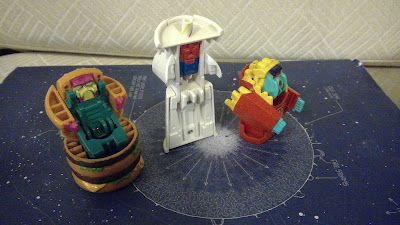
In planning out what I wanted to do this month, my big decision was that it was time to do some robot posts. That left me with a pretty short list of new and old material I hadn't gotten to before. The one that came to the top was old friends from way back. Here are the Changeables, possibly the most awesome Happy Meal toys and among the greatest Transformers knockoffs ever. To get this going, here's a lineup of the ones I actually had back when.


The start of all this is back in 1987, when McDonald's released a series of 6 transforming-robot toys called Changeables. As seen above, they were simple, robust, and boldly simple design. Between my brother and I, we got one or two each of the ones shown here, the McNuggets, the Egg McMuffin and the Quarter Pounder bot. They very quickly became among my favorite bots, often mixed in with other Happy Meal toys. For one reason or another, we missed out on the rest of the original set, though I had looked enviously at the artwork and advertisements for them. (See BattleGrip, previously my best source for Tonka Play People, for a look at the original Happy Meal box art.) What surprises me more is that I didn't get any of the 2nd series in 1988, which featured 6 new bots plus reissues of 2 of the originals (which I will get to in a moment). I did sight these later bots in the second-hand stores, eventually mixed in with the dino-themed Series 3, but I never bought any for reasons I didn't quite analyze. In hindsight, they simply weren't the same. I did remain interested, however, in getting the ones I missed the first time around. Eventually, many years later but still a long time ago, I found all the ones I didn't have all together. Here's the lineup of the rest.

As seen here, the rest of the set were a Big Mac, Fries and a Shake, the first 2 of which were revived with Series 2. What interested me was that, while the Big Mac had pretty much the same "plan" as the ones I had all along, the Fries and the Shake were quite different. The fry bot is just kind of odd, almost troll-like, while the drink bot is downright towering, to the point that it looks even taller than it actually is in a lineup. (What I really can't account for is that the McNuggets bot is taller than all the rest except this one.) I was happy to pick them up, and have continued to revisit them regularly. Here's a lineup of the set in alt mode.

Of course, in rational hindsight, this doesn't really make much sense, if any. They could kind of blend in, if they were full-sized, which is more than can be said for a lot of alt modes. On the other hand, they would still be small. Then the big problem is, they look like things that are edible, which isn't much of a survival trait. That wouldn't be too much of a problem if their adventures were inside a McDonald's; after all, most people who saw unattended food on a table or counter wouldn't just grab a bite. (Clearly, the best disguise of all would be a burger with one bite taken out of it...) Sooner or later, however, either someone is going to try to eat them or just throw them in the trash, though that would certainly make for an adventure in itself.

Meanwhile, there's the further question of how these things age. For the most part, they hold up very well. The arm joints are solid to this day, while the "waist" articulation has gotten a little creaky on the McNuggets. The only one to have trouble from an early date is the McMuffin. For some reason, his design has the body raise only halfway, which looked vaguely cool on the original. On the one I could find, however, it has long since worn out to the point that it simply won't stay up at all. Here's a closeup of how he would have looked in his prime.

And here's a rear view of four of them. It shows certain problematic aspects of the designs, but also just how well-constructed they are.

And why not one more pic with the Truckstop Queen and Ken R. Wampa? As I was saying, looking delicious isn't a survival trait...

With that, I'm ready to bring another meandering memory to an end. As a bonus, here's links for a Toy Galaxy video and a commercial for Series 1. That's all for now, more to come!

Tuesday, November 9, 2021

Animation Defenestration: The one that followed up Toy Story


Title: A Bug’s Life

What Year?: 1998

Classification: Runnerup

Rating: That’s Good! (4/4)


I have previously commented that when I very first tried writing outside my misbegotten fiction, the very first thing I tried was reviewing animation. That makes animation a big part of the DNA of all my various review features. A major reason why I haven’t come back to it is that I have a broad enough interest to cover literally a hundred years of the field, whereas most of my features have remained focus on the relatively narrow timeframe of 1970s-‘80s. I haven’t yet decided if this is the feature that will break that mold, but I do anticipate relative variety. For this particular review (indeed for my lineup for the coming week), I have one of a few movies that popped up incidentally. As a bonus, it just happens that it was about as old when I first tried animation reviews as those mostly lost reviews are now. With that, I present A Bug’s Life, the second Disney/ Pixar movie and the one that made the studio’s reputation without getting thanks for it.

Our story begins with a colony of anthropomorphic ants completing the harvest. In the process, we meet Princess Atta and Flik, a drone with new ideas. Things take a dark turn early as we discover that the harvest is an offering for Hopper, the leader of a post-apocalyptic gang of grasshoppers. When Flik’s new invention knocks the harvest in the drink, the colony must choose between resistance or starvation. Flik gets approval for an expedition to the wider world to look for allies, and to everyone’s surprise returns alive with a motley band of  bugs for hire. But the newcomers aren’t what they seem, and Hopper is out for blood. The drone and the circus bugs must use brains and brawn to save the queen from the raiders. Can they lead the colony to victory, or is it the ants’ lot to serve the larger insects forever?

A Bug’s Life was the second feature film from Disney and Pixar, following the success of Toy Story in 1995. The story was loosely based on the Kurosawa film The Seven Samurai, previously adapted as The Magnificent Seven and Battle Beyond The Stars. It also had controversial similarities to Dreamworks’ Antz, an apparently independent project released the same year. The voice cast was led by Dave Foley as Flik and Julia Louis-Dreyfuss as Princess Atta, with Kevin Spacey as Hopper, David Hyde Pierce as Slim and Phyllis Diller (see… The Boneyard?) as the ant queen. Other cast included the emerging “regulars” John Ratzenberger, Brad Garrett and Richard Kind. The film was a commercial success with a $363 million box office, comparable to the $373M gross of Toy Story, though its much higher $120M budget reduced its overall profitability. It would become the earliest Disney/ Pixar film not to receive a sequel. Critics increasingly characterized the movie as either weaker than other Disney/ Pixar films or less successful with audiences. The characters of A Bug’s Life were featured in a gag reel for Toy Story 2.

For my experiences, what this film has stirred up in my mind is the question, is the “failed” or “forgotten” Disney movie simply a myth? I’ve been doing this long enough to notice that people are always able to point to Disney films that were in some sense unsuccessful in their own time; if you really do the math, even Fantasia was a devastating failure when it actually came out. (See also Allegro Non Troppo…) For the present movie in particular, we have possibly the reverse. I was there; I went to the theater and bought the tape with my own money; I loved it; most importantly, I never heard anyone else say otherwise. So why is this the one with the reputation of a failure? Going in, I went so far as to watch Toy Story 1 and 2 for context, which just made it it more baffling that this isn’t considered one of Pixar’s very best.

Turning to the movie itself, what stands out front and center is the absolutely beautiful visuals, certainly far ahead of the original Toy Story. There’s a sense of vastness that is never quite intimidating, yet there is also attention to small details, from pebbles to blades of grass to beads of dew. What’s most easily underestimated is the attention to scale, which contributes to many of the best moments. The grasshoppers tower over the ants; Dim the beetle is even more enormous; and all are dwarfed by the kaiju-like bird. (And don’t get me started on the babies…)Then there’s two more things that stand out to me. First, human artifacts appear sparingly, usually in settings removed from the colony, just often enough to give some perspective on the bugs’ world. Second, there is the water physics, which should be outright distracting. We repeatedly see things that make absolutely no sense outside the bugs’ scale from dew drops that can be picked up like soda cans to a rainstorm that looks like the asteroid field of Empire Strikes Back. Yet, I have never found it to divert from the story, nor have a seen it raised as a criticism. I find this all the more impressive after doing my own stories of small-sized civilizations. It’s extremely hard to create such a world without either unquestioned assumptions or excessive explanations, yet this movie presents its world on the bugs’ terms without acting like it’s trying.

With all that said, it is perhaps part of the problem that I haven’t said much about the story or characters. The obvious strengths rise simply from the choice of source material, with problems in execution even then. Flik is very likable, enough to heighten the disappointment when he tries to navigate the devolving situation with deceit, while the other ants are suitably uniform in their adherence to tradition and justifiable fear. The grasshoppers, as noted, are suitably intimidating, without ever descending into illogical supervillainy. On the contrary, they are unsettlingly human in their pettiness, with only Hopper offering enough of a long view to justify greater excesses. By comparison, the circus bugs are the weak link, for reasons that are difficult to explain. To me, the most telling issue is that the story plays up the angle that they are failures even as a circus act, where a more nuanced treatment might have shown their skills actually paying off in a combat/ survival situation. In fact, we get a payoff from moments of relative competence, particularly the early confrontation with the bird and the mantis’s magic act performed under Hopper’s scrutiny, but they are exceptions to the comic tone.

That leaves the “one scene”, and the one that is virtually unavoidable is the finale, or rather the lead-in to it. After Flik’s schemes are played out, he is left at the mercy of Hopper and his remaining goons. Of course, there’s a great interplay between the defiant protagonist and the monologuing villain in full view of the colony. To me, at least, it’s the reactions of the onlookers that have the most impact, and ultimately make the story’s point. It’s especially worthwhile to watch and hear the clear anxiety of Hopper’s brother and second-in-command, voiced by Kind, as Flik confronts the leader with the same arguments he made to his own troops. Then what gets this sequence the slot is really just one shot I’ve always suspected most viewers never noticed; As the ants advance, the grasshopper literally leaps out of his own exoskeleton, leaving the translucent husk to bounce over the backs of the charging horde. It’s another moment that should be distractingly odd if you don’t know the Arthropoda, done so naturally it doesn’t stand out at all.

In conclusion, I come back not to the rating but the question of this film’s legacy and especially its bearing on Disney. I could easily go through several posts ranting about the state of Disney and especially the industry “establishment” that keeps giving their weak to middling offerings more money and accolades than the finest work of any other crew. (See Corpse Bride for the first half of that vent.) In the proverbial light of day, the most tenacious piece of hype to attach itself to Disney, and the most dangerous if their own people ever come around to believing it, is that failure is somehow unusual. On discerning analysis, their real record is that of taking real risks, succeeding often enough to take their losses on the chin, and keeping their older works accessible enough for audiences to change their minds. With that context in mind, A Bug’s Life is only a “failure” in the sense that it didn’t leave a trail of merchandise and debatable sequels. (If it comes to that, if you really want to talk about an undeservedly “forgotten” film, look at Antz, which I very much remember seeing.) The real difference was that even at that late date, sequels to Disney movies, however successful, were still very rare, at least outside the direct-to-video market. Perhaps this was a movie that got lost in the transition; perhaps it was just as well that this one last time, Disney left well enough alone. What we should be grateful for is that we have it on hand to watch, instead of waiting 5-10 years for the Disney vault to open. With that, I’m done for another day.

Monday, November 8, 2021

Mystery Monday: Imperial rubber monsters sequel


It's The start of my first full week of the month, and I decided to hold off on the movie reviews. That left this slot for Mystery Monday, and I was reminded it's been a while since I had a "real" mystery (compare the mystery red guy that started all this). It's been quite a while since I covered something that posed a challenge even for my knowledge and investigative abilities. (I will freely admit, there is one case still unsolved!) However, I have said all along that there are mysteries great and small, and it just happens I have a few loose ends from my last dino post, which covered the infamous products of Imperial. In the course of that post, I considered some additional material, far enough in to take a number of pics. I decided, however, that I already had enough, and some of these things didn't quite fit. To get this going, here are the ones that were closest to getting in before, a pair of genuine prehistoric animals including a dino.


Of these two, the dino is by a wide margin the one I've had longest, and I suppose I wouldn't have hesitated to include it with my Imperial lineup if it had been the only one already in my collections. It's essentially the same style and material as other Imperial dinos, usually assigned a comparable date of 1985. The cat, on the other hand, was its own thing. It's made of softer and probably cheaper material, almost on par with a "bigmouth" dino. What was even more striking was the quite late date of 1989. The icing on the cake of wonkiness is those ears, which look like they belong on a dog rather than a prehistoric predator. Here's a closeup.

Meanwhile, the one I've really been holding out for is a find I made at a collectible store that closed a few years back. I long debated putting it in a dino post. Obviously, it's not a realistic dinosaur, but neither were the patchisaurs and generic Godzilla. It's still in the same style as plenty of dinos, particularly the "big mouth" types. The real counterarguent is just how goofy this thing is. By comparison, even the patchisaurs could be vaguely menacing. This guy, however, is so completely unthreatening that the least of the patchis (probably the rust monster) would laugh at him. Here's a few pics of him in full glory, for lack of a better word, with the Imperial Tyrannosaurus.


"Well, at least you didn't get knocked off by the worst GI Joe set..."

This creature was originally made for a knockoff genre I had previously investigated, intended as unauthorized "riding" animals for He Man and other fantasy/ sci fi toys. I further determined that it was part of an actual line, originally dubbed Dragons And Daggers. Somewhat later, they tried to shift to science fiction with Robots, Lasers And Galaxies, which was really many of the same creatures with more technological-looking accessories. (See 2 Warps To Neptune herehere and here.)Here's a pic of the beast with Sidekick Carl and the giant Tonka lady aka the Nine-Foot Woman to show how it would have worked.
"Could you please stop trying to eat my boyfriend? Apart from anything else, he's made from a lot of stuff that's not edible..."

"A king's duty is to command from a safe distance..."

It was this one that gave me an angle on the whole lot. This got me thinking, were any other beasts released as mounts? Were there any repurposed when the fantasy craze died down? I was especially suspicious about the sabertooth, which would have been hitting the shelves just a little after Masters of the Universe went through its prolonged and painful death. Alas, I found no hard data to show it was released in this fashion. The real test, however, was first-hand experimentation. For history, yeah, let's go with that. Here's the beast with a couple of my very few remaining TMNT figures.


Ironically, judging from this test, the dino that was made independent of the "riding beast" niche works about as well at the cat which would have been made at the tail end of it. It's further apparent that late lines like the Ninja Turtles offered decent compatibility with holdovers from He Man's heyday. Here's one more for kicks.

And then there was one more thing to try, a rematch with the Gas Station Duchess and the Imperial tyrannosaur. I think Connie might be ready for a long-term relationship...
"How did T. rex mate? Asking for a friend..."

And with that, I'm wrapping this up. As always, more to come!