Wednesday, March 23, 2022

Featured Creature The Rat File 1: The one with witches


Title: The Witches

What Year?: 1990

Classification: Mashup

Rating: It’s Okay! (3/4)


As I’ve pondered the possibilities for this feature, one thing that’s become clear is that a lot of the material not yet covered could easily fall into their own genres and odder subniches. I already covered some examples of these, like Leviathan and the strange dead end of underwater sci fi, and I tried doing a dedicated spinoff for fantasy movies starting with The Dark Crystal. With this review, I’m going into the middle ground, the kind of offbeat branch of the genre that’s worth more than a representative example but not really enough to sustain a feature of its own. As it happens, the one that I’m kicking off with wasn’t even really on my radar when I first considered the idea, but once it came up in my regular reconnaissance, I knew it belonged here. I present The Witches, as nothing less than a definitive example of the rat movie, and needless to say, it’s the only one under consideration made for kids.

Our story begins with an introduction to a orphaned boy named Luke and his grandmother, who tells terrifying stories of her own encounter with witches. Per the grandmother, witches are neither cultists engaged in black magic and human sacrifice nor misunderstood practitioners of a pre-Christian religious tradition, but mutated humanoids who use their seemingly innate supernatural or psychic powers to kill children out of pure hatred. When the pair go on vacation, Luke quickly recognizes that a number of the guests are witches in disguise as ordinary women. With help from a new friend named Bruno, he discovers that the hotel is hosting an international gathering of witches with a new scheme to wipe out the world’s children  turning them into mice. Before they can act, both boys are captured and transformed. Can the boys turned mice turn the tables on the witches? And if they win, will anyone be left to make them human again? Spoiler- not if you go by the book!

The Witches was a 1990 film based on the 1983 novel of the same name by Roald Dahl, made by Lorimar Films and Jim Henson Productions. The film was distributed by Warner Bros following the dissolution of Lorimar, resulting in a reported delay of more than a year. The film was directed by the late Nicolas Roeg, whose credits included Don’t Look Now and The Man Who Fell To Earth, with Jim Henson credited as producer.  The cast was led byAngelica Huston as the Grand High Witch and Mai Zetterling as grandmother Helga, with Jasen Fisher as Luke and Rowan Atkinson as the hotel manager Stringer. The film’s effects included puppet/ animatronic mice from the Henson crew and further makeup for the true form of Huston’s character. The film was a likely disappointment at the time of release, earning $15 million against an estimated budget of $11M, but gained in popularity on home video. Dahl condemned the film for changing the ending of the book, though he reportedly praised Huston. Jim Henson died immediately before the film's general release, while Dahl died near the end of the year,  Zetterling died in 1994, with over 60 TV and film roles beginning in 1941 and a number of additional credits as director and screenwriter.

For my experiences, I know the original book and some others by Dahl from of old. I recall reading the book in part because the movie raised my interest, but never watched the film. In hindsight, the book is a very dark tale even compared of his adult fiction like “Man From the South”, which also somehow fell into my hands back when (see the Hitchcock anthology post). The villains are terrifyingly powerful and incomprehensible in their motivations, the protagonists remain at an overwhelming disadvantage, and the ending is no better than an arguable Pyrrhic victory. My usual world’s-worst-superpower memory must have kicked in stronger than usual, as I had no trouble looking up scenes I remembered when I picked up a copy sometime around the end of 2021. While that still didn’t motivate me to see the movie, I did end up getting it in my rental queue right when I was making room to read the book. That left me with a fresh perspective as I watched it, with no immediate intention of reviewing it until one or two hilarious failures left me with literally nothing else on deck. So, I went in with only the one viewing a couple days back, and the real surprise is that I’m not having any trouble.

Moving in, the foremost thing to say is that this is the kind of material where rational analysis must be disregarded as the outset. Dahl’s tale, more than usual, proceeds on the half-logic of a child’s nightmare, and it’s impressive enough that the film makes no effort to “improve” the situation. Of course, the witches have no logical motive, or for that matter any backstory that might explain what they are or how they could sustain themselves if the normal reproduction of the human species was ended. Of course, the setting and timing of their scheme is as disastrously ill-advised as selling weed in the middle of the cops’ favorite donut shop. Of course, the villains would be easily exposed or at least put on the defensive if the families of their victims went to the authorities with a prosaic charge of kidnapping or abuse. This is all like saying that if you left for school in your underwear, someone would point it out and send you home long before you got there. Again, it’s an honest approach to the source material. This is as good a point as any to state my further suspicion, that the cop-out happy ending was put in to provide a “good” witch as much as to soften the ending of the book.

After this much space, it might seem like I’m treating the central element that got the movie here as an afterthought. This is in fact a non-trivial problem with the film itself. While I can’t check the exact times, the transformations happen at least a third of the way through a quite short movie. The subsequent adventures are done with a combination of puppetry and live animals, and there’s no serious attempt to hide which is which. Within their limitations, the Muppet mice are always convincing in representing the characters and their emotions even if they don’t seem to try to be “realistic”.  It’s of further interest that the action sequence that really matters in the kitchen is relatively subdued compared to the slapstick of many a cat-and-mouse chase. The hero mostly manages to escape attention as he completes his mission, then when he is detected, the staff remain surprisingly levelheaded as they try to catch him. I was especially amused by a butcher who only stood out on reviewing a few online clips, who simply swings a cleaver without interrupting his work.

Meanwhile, I’m going longer for the witches, who are by all means fitting antagonists. Th as petty and vain in each other’s company as they are inscrutably malevolent in their treatment of the protagonists. In the process, they generate a lot of worthy “one scene” I felt I couldn’t leave unmentioned. There’s the introductory tale of a girl trapped in a painting , which I remembered from the book more vividly than anything else. There’s a minor witch literally incinerated over what amounts to a point of protocol. There’s a transformed witch from within the hotel staff who tries to warn their leader, only to be dispatched without further thought. Then the most mindboggling moment is a chase scene where the witches pursue Luke. In the middle of it, the Grand High Witch pushes a baby carriage downhill, perhaps to force the boy to delay his own escape. If that is the intent, it certainly works, but with this bunch, can we really be sure they understand ordinary human reactions any better than we understand them?

For the “one scene”, though, I decided to go with the ending, which I confirmed was filmed in a different version that got far enough for test screenings, only to disappear. After the defeat of the witches, we find Luke talking to his grandmother while he rides a toy train. Of course, what won me over is that multiple closeups clearly show that it’s from the Lego Space line, which I of course have a misbegotten collection of. The shots make both the toy and the in-scale puppet look very good. There’s one more good line as Luke muses if he will ever get to drive a real car, as the train disappears into a tunnel. It’s a good sequence that really feels like it would be fun for the kid, without downplaying the implications of rodent mortality in the book. I can believe that this was about where the movie was intended to end, and certainly the note I would have said it should have ended on.

In closing, the one thing I find I still want to add is why Dahl’s work was ever accepted for children. It’s long since become axiomatic that his work is extremely dark, with plenty of extra cringe both from the contend and the author’s personal life. (Seriously… don’t look it up.) I think The Witches encapsulates why his work resonates with real children. At face value, it’s a harsh ending, but it’s balanced with an upbeat note if you’re willing to look for it. For me personally, after decades of self-advocacy, semi-employment and generally figuring out who I am, it feels more relevant to my life than it ever could have when I first read the book. There are going to be times when you can’t fix what’s gone wrong, what you’ve suffered and ultimately who you are. But you can still keep going, keep learning, and hunt down your enemies one by one. It may still be a warped message, but it’s just right for a  kid to hear and an adult to remember. With that, I can call it a day.

Tuesday, March 22, 2022

Movie Mania: Willow novelization


It's time for the first post of the second off-week of the month, and for once, I decided I've done enough movie reviews. To depart as little as possible from formula, I'm going to do another novelization review, specifically that of Willow. As a bonus, it happens to be from Wayland Drew, the author of the Dragonslayer novel, which I previously held up (well before posting a review of the movie) as perhaps the finest of its kind. Unfortunately, lightning did not quite strike twice.

For the background, I already covered a lot of this when I reviewed the movie. Willow was the last of the 1980s fantasy wave, and unlike many of its predecessors, it made a lot of money. It also got a lot of merchandising I can vaguely remember, including an NES game and a now-notorious toy line that I would probably have loved if I had gotten any. A novelization was presumably inevitable, though no tale seems to tell how the task fell to Wayland Drew. Per the lore, the novel is based on a script sold to Lucas more than the film, which is really on par for novelizations. As it happened, it was published immediately after a novelization of Batteries Not Included (a movie that never quite fit in my plans so far) in 1987, and the year before his last confirmed novel Halfway Man in 1989.

Going in, what interested me most was that such a comparatively obscure author was chosen to novelize a major film. Sure, vintage novelizations were anything but prestigious, and the semi-respectable novelizers like Alan Dean Foster (see the Aliens novels post) were busy enough that anyone else looking to do a job was unlikely to be turned down. Still, Drew presented an odd choice, an author with a modest profile and output whose work (apparently including Halfway Man) often fell outside the sci fi/ fantasy genre. The obvious connection is that a good part of the ILM crew had worked on the effects for Dragonslayer (and for that matter Batteries Not Included). If just one or a few big names at ILM had read the book, it might well have been enough to give the author an inside track with Lucasfilm and perhaps Lucas himself. Therefore, it's plausible that Drew was approached or even talked into it, at a time when he was by all indications getting out of the business. Whatever the backstory, Willow was his last ride, and certainly interesting on those terms alone. While I'm at it, here's the back cover.


Moving onto the book, I will admit I'm doing this on shorter notice than other posts like this. With other novelizations, I have gone in with at least two readings and normally a block of weeks or even months to think things over before posting about it. This time around, I'm starting the post before I technically finished reading it even once. On the other hand, I had been able to go through the majority of the book faster than any I've read in a long while, which I found more than enough to comment on the quality. As a bit of further context, I finished one more rereading of Dragonslayer not long ago. One more thing I will freely admit is that, if anything, the earlier novelization made me a little more critical of the present book. In those terms, Willow is in some ways more polished, but seems aimed at younger readers, which would certainly have been justified. What's more difficult to account for is that it seems more conventional than the film it's based on, complete with a number of convenient and comforting genre tropes that the finished film was bold enough to move away from.

On the plus side, there is inevitably a lot more worldbuilding and general depth in the novel. There's a lot more backstory for Madmartigan, Bavmorda and Sorsha, including a full account of the villainess's relationship with the father of the princess. There is also a whole story-within-a-story tale of a revered Nelwyn hunter/ warrior who barely gets a name within the film. We also get an expanded view of the powers of the magical infant, who seems to charm animals and the elements just by being what she is. Occasionally, things get more grim and graphic than the film despite the "kid-friendly" tone, conspicuously the implied fate of a group of mothers and children imprisoned by the queen. It's here that things get hit or miss by simple familiarity.  I find this most in the portrayal of Tir Asleen, which in the movie is just a big, distant castle. Here, it's so hidden away by magic that leaves its very existence conceivably in doubt, calling to mind the fairy tale of Sleeping Beauty or the cautionary Lord Dunsany tale "Carcassonne". In addition, the revealed destruction of the castle is attributed to a spell of Bavmorda that you can easily predict will be reversed at her defeat. It's all unquestionably effective, but as already noted, it brings in familiar elements the movie did just fine without.

One more thing on the "con" side is a strange sort of temporal distortion that gets more pronounced toward the end, something I had noticed this before with the Dawn of the Dead novelization. Here, it's most notable with the courtyard fight, which is as far as I got. In the film, it's an almost comically over-the-top sequence with one of the most surreal monsters on record. In the book, the whole battle is covered in 10 pages, including only 3 with the Eborsisk. It's understandable that an author working with only pages in a script would fall short of the vision of a director, yet this is more egregious than usual. There's a further odd touch in the handling of the trolls, who represent perhaps the most intriguing combatants in the film. In the book, they're introduced much earlier, specifically as rather pitiful servants of Bavmorda. In an impressive touch, one of them actually talks, revealing an even more malign personality than might be expected. What gets weird is that the book describes the transformation of a troll into a "gibbering, jiggling mass of shapeless goo", without connecting it with the Eborsisk, which is portrayed as laying in wait the whole time. It removes several of the movie's more striking improbabilities, but on the whole, what we got on screen was more satisfying. One more thing is that the segment in the book ends at page 241 of the novel's 276 pages, and if you know the movie, there's a lot more that must have been crammed into even less space.

On the whole, this remains one of the more surprisingly impressive novelizations to be encountered. For me, it raises the niggling doubt how much of the universally accepted notoriety of 1980s novelizations came from those who had really read a significant number of them. There's no reason to doubt many if not most were as bad as people say, but even in the iffy ones, there's plenty that's interesting, insightful and just plain bonkers. It's exactly why I intend to keep my collection and add to it when I can. With that, I'm done for another day. That's all for now, more to come!

Sunday, March 20, 2022

The Legion of Silly Dinosaurs: Walk on the wild side!


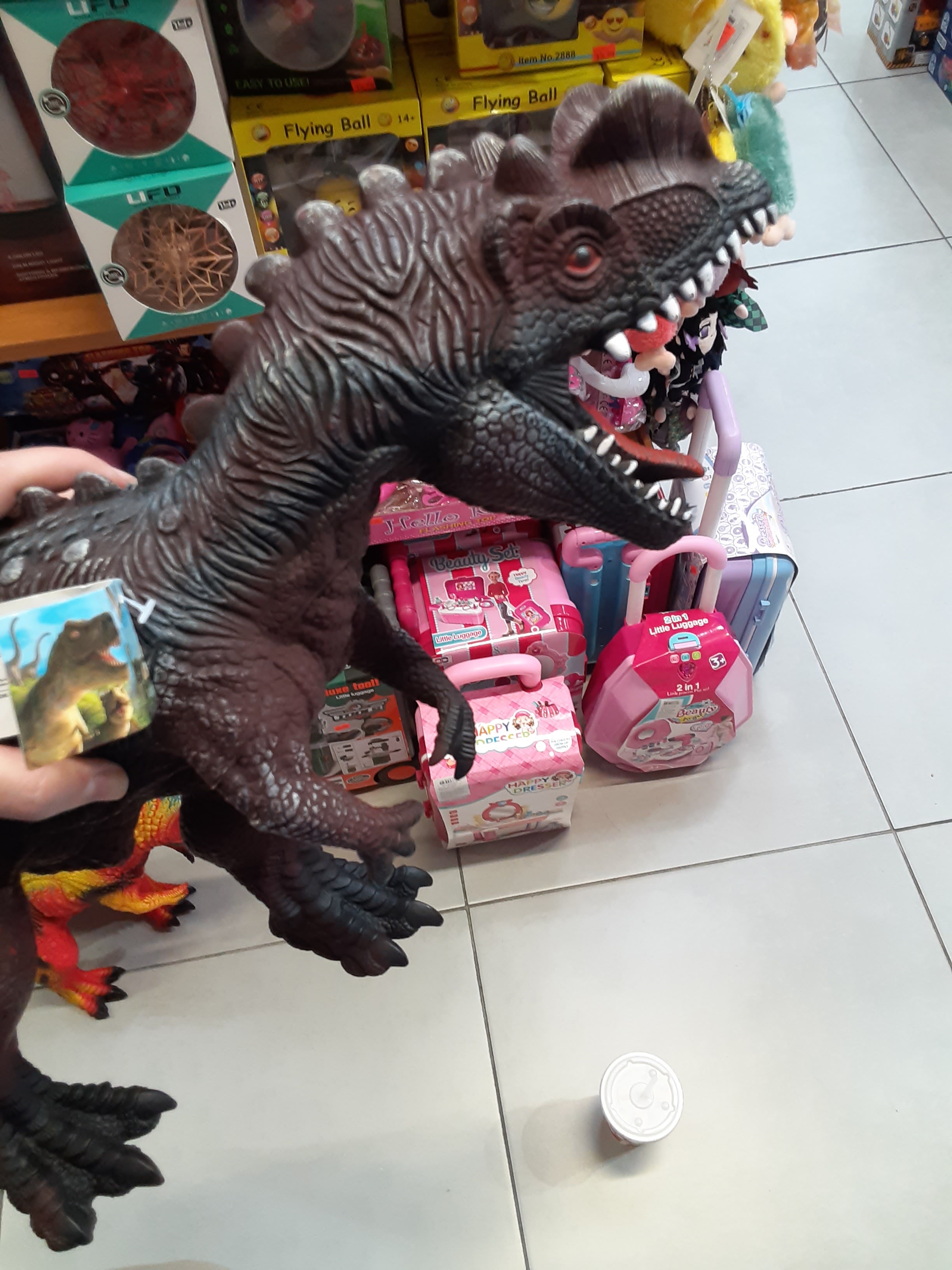
It's time for this month's dino blog, which as always means the most work for the least views. This time around, I'm doing another clearance of the backlogged material, specifically stuff that I didn't buy but still photographed to have proof it exists. And it you've been here long enough to get a feel for what I'll pay money for, you can already guess this is going to be a rough ride. To start with, here's pics above and below from the store where I got the Dragon Knight dinobot.


For contest, these pics are from two different trips. The big brachiosaur in the opening pic is an electronic/ animatronic toy made of foam rubber, I'm sure considerably larger than the Dormei Godzilla. The packaged set immediately above looked like they could be knockoffs of 1980s vintage dinosaurs. The resemblance is especially strong to the Imperial dinos, though not enough to convince me these are direct copies. It's one of the most interesting things I've seen for sale new, and in 20/20 hindsight, I definitely should have gotten this rather than the dinobot. It's the kind of thing that fascinates me just by continuing to exist. While I'm at it, here's another mall sighting, from a semi-classy shop.


What interested me about these is that they are about on the level you might see in a museum gift shop. To me, they really aren't any more interesting than the patchisaurs and other obviously outdated dinos that are still out there. Of course, they're nicer and more polished, but they have their own scientific flaws, as evident especially from the brachiosaur. Next up, here's something that was at the grocery store not long ago.


This one is as far as I can tell a bagged version of the Walmart Marx clone dino set, complete with the patchisaur Pteranodon and the Hideous Abomination. (If it looks like you're seeing a frog foot in the lower pic, that's the Abomination....) The weird part is, they also threw in a uintathere, which almost convinced me to buy this thing. I might have eventually, but the set got sold out. Next, here's a sighting at the unidentified restaurant/ shop where I found Gumby and Pokey. Don't know that I have anything to say...


And to wind things up, here's even more from the store where I got the dinobot.

Apparently, you can make a Carnotaurus look goofier than the real thing.

On the other hand, this looks more realistic than the Dilophosaurus in Jurassic Park.

Why is the bootleg packaging rip off a movie nobody remembers?


And multiple Godzillas!

And with that, I'm wrapping this up. These truly are what I do this featuer and the blog for. I may not get much of my traffic from these posts, but it's always worth it, and sooner or later, I might even turn this into a book. (A reminder, I just got a new ebook out!) And here's one more thing...

That's all for now, more to come!

Friday, March 18, 2022

No Good Very Bad Movies 23: The one by Oliver Stone


Title: The Hand

What Year?: 1981

Classification: Unnatural Experiment

Rating: Dear God WHY??!! (1/3)


As I write this, I’ve been developing ideas for either wrapping up this feature, spinning it off, or both. I got the idea to do a run with a theme: Very weird films by famous or notorious directors. That immediately brought up one film which I’d had in mind all along, and another I had definitely meant to look up sooner or later. The present selection is the odd one, a movie I saw not long after I started doing reviews but never had a use for anytime since, until I thought of doing this. I’m doing it first because it’s the one I had to get on a tight time table, and the one that really makes me mad, in no small part because it’s easily the most polished and professional movie to come up in this feature. I present The Hand, a movie with the talents of Oliver Stone, Michael Caine, and the best practical effects guys who ever lived, and it is… just… stupid.

Our story begins with a quick introduction to an artist named Jonathan Landsdale who does a Conan-like comic strip, and his wife and daughter. The marriage is clearly strained, as the couple get into an argument that ends in an automobile accident. In the aftermath, he is left with his drawing hand severed and never found. As he struggles with his new disability and worsening personal and professional life, he begins to have visions of his missing hand wandering with a life of its own. Soon, strange accidents begin to befall those he believes have wronged him. Meanwhile, he takes a teaching position that comes with a cabin, and soon strikes up romance with a college girl, yet the disturbances soon follow. Is the hand really come to life, is it all in his head, or is it his own subconscious revenge? Can he salvage his old life or the new one? Spoiler- even the people making this movie don’t really care!

The Hand was a 1981 film directed by Oliver Stone from his own screenplay, based on the novel The Lizard’s Tail by Marc Brandel. The film was produced Edward R. Pressman, evidently as a Canadian-American project as the budget was reported as 6.5 million Canadian dollars. It was Stone’s only feature-length directorial credit between his 1974 debut with Seizure and 1986, when he made his mainstream breakthrough with Platoon. The film starred Michael Caine as Jonathan Landsdale, with Andrea Marcovicci as Mrs. Landsdale and Annie McEnroe as his student Stella. Effects for the hand were provided by a team that included Carlo Rambaldi (see Conan The Destroyer, ET), Thomas Burman (Cat People) and Stan Winston (see Invaders From Mars, Leviathan, etc,etc). the soundtrack was composed by James Horner. The film had a reported box office of $2.4 million, less than half its budget. It was also poorly received by critics, with Peter Nicholls describing the film as “deeply confused”. The film was somewhat more successful on home video, and is currently available in digital form. Pressman and McEnroe married, and have a son born in 1987.

For my experiences, I suppose what made me vaguely interested going in was how iconic the premise of the disembodied hand is, compared to how few films really use it, especially on “straight” terms. The definitive treatment was and remains the late-Gothic 1919 horror story “The Beast With Five Fingers” and its 1946 cinematic treatment with Peter Lorre (which I still haven’t seen). Since then, it’s become fairly routine to have undead (not to mention aliens, robots, etc.) whose bits keep coming when dismembered, as in Splinter.  To make the self-driven hand a main antagonist remains far more novel and most obvious in the realm of parody/ comedy, as in Evil Dead 2 and Idle Hands.  With that context, the present film stood out even sight unseen as both earlier than many it could be compared to and seemingly completely serious. With further hindsight, this was all a very strong indication of the problems to come.

Moving forward, the central reality of the film is simply that there is indeed little if anything that can be considered funny, intentionally otherwise. Caine and most of the rest of the cast play their roles very seriously, which brings out a sense of domestic awkwardness in the film’s better moments. The story told is likewise very much in the tragic form as the protagonist goes from troubled to abusive, even if there isn’t much effort to make us like the protagonist or anyone else. In certain lights, this is a big part of the problem, as Caine’s character never pushes the emotional gauge far past neutral. He isn’t sympathetic enough to be a “fallen hero”, not entertaining enough to be a lovable rogue, and without a trace of the gleefully over-the-top villain who would keep us watching just to see his comeuppance. It doesn’t help that he never seems distressed or even disoriented by his supposedly worsening blackouts and dissociations. On that front, I cut off a longer rant just to compare to Bruce Campbell as Ash. He’s obviously no equal to Caine, but the one thing he’s good at is making you like his character and absolutely believe he is in a terrible and terrifying situation.  Here, the vibe is a classy actor trying to play a character who can barely pretend to care, and the result is that we don’t either.

Then what really tugs at my mind is the effects, and this aspect of the film that first got me to its strange vibe: This is not simply a movie that could have been better, but one that could have been more effective if it was worse. The hand looks every bit as good as it should, yet it’s oddly unimpressive. The obvious issue is with the concept; the hand succeeds so well that it looks like any other hand, and it was already clear that it’s hard to make this scary, especially with the surprisingly low body count. What gets strange is comparing it to movies that are by any standard inferior, like the stop-motion finger spider in Bride Of Re-Animator or Winston’s own loose arm in Dead And Buried. The most egregious yet instructive comparison is with Dead Alive, where virtually everything looks like kaka on purpose. What that very odd film succeeds in is creating a sense of the surreal, to go with an already psychotic level of energy. By comparison, the effects here simply feed into a dull linear realism that directly undermines the movie’s already thin pretenses. Then this is as good a point as any to rant about the ending, which is no more or less than a cop-out interrupted by another cop-out.

That leaves the “one scene”, and I really couldn’t come up with anything better than the set-up sequence. A few minutes into the film, Jonathan and his spouse are arguing during a drive through the countryside. In the midst of the quarrel, the lady speeds up and tries to pass a slow-moving truck. Suddenly, they find themselves hemmed in between an oncoming truck and a big brick of a car crowding in from behind. In the most amusing touch, Jonathan tries to wave back the other driver back, and of course he’s having none of it. Naturally, a gruesome collision follows, in which we don’t really see anything though the chain of events is quite clear. The emphasis is on the aftermath, as Jonathan/ Caine rushes out. It’s as grisly, cynical and sleazy as the movie is supposed to be, and in my usual refrain, what follows does not live up to it.

In closing, what I find worth commenting on is my background as a self-advocate, which is certainly a major reason I have gone as I have on this movie. As I keep saying, I have enough problems that I can get the stoned-out-of-your-mind experience going off my meds. Throughout my time doing reviews, I have regularly dealt with movies that try to imply themes of mental illness and sheer unreality by doing weird and random for its own sake. What’s really noteworthy is that the ones that come anywhere close to succeeding wouldn’t really change if  the subtexts were explicit. If The DayTime Ended, House or Death Bed were framed as a schizophrenoid episode or a bad acid trip, they would still be every bit as weird and disconcerting as they already are. These movies may not be that good in their own right, but they have the authenticity that keeps eluding polished mainstream fair. And with that I’m calling this one done.

Wednesday, March 16, 2022

Fiction: The Adventures of Sidekick Carl Part 20!

 It's mid-week, and I decided it was time for more Sidekick Carl, I hope one of a few I will get in before the month is up. This time around, it's just a scene with a couple characters I've been building up more than I planned. I had enough material that I held back some for later. As usual, here's the first and previous installments, and while I'm at it the chapter that introduced these two. I'm at maximum snark with the movie parody angle. Also, there is a line here I really came up with as a kid...


The woman was clearly beautiful and equally clearly in distress. She was tied to an office swivel chair, which was itself lashed to a set of double doors. The view was flattering as she looked straight up. “Nod if you can hear me,” a gruff stage whisper said. Piercing eyes peered out of a vent. “Constructor and Carl are in the building. I talked to them. When they make their move, I’m going to get you out. I just need to know, which doors are the guards at?” The woman turned her wide eyes just off-frame… just as a door opened.

Then the frame froze, as John and Lauren Carter burst out laughing.

* * *

The moon shone brightly on a small but well-furnished room, now and then interrupted by a passing tree. The two agents lay unclothed under the covers, clearly happy. “We should do this more often,” Lauren said.

“It wasn’t anything, really,” John said. “They had to move the VIP train to pick up an ambassador. If we hadn’t gotten aboard, the room would be empty.”

The screen showed a beautiful actress and a handsome, somewhat older actor racing across a rooftop. Behind them, a 7-foot bodybuilder cast as Constructor fought Goliath and his lumbering combat exoskeleton, represented with what was clearly a miniature puppet. The unseen operator alternated slashed at the superhero, then tried again to dislodge the figure of Sidekick Carl, hanging on to the back for dear life. “It’s still better than CGI,” Lauren said. She nestled closer against him. “How many VIPs do you think have done what we did?”

“Ah… more than you might think,” he said. He put an arm around her. “We can skip this if you want to.”

“No,” Lauren said. “I’m all right.”

The heroine raced down a set of stairs, which a medium-distance shot showed leading to the launchpad of a quadruple-fanned VTOL craft, while the hero fired over his shoulder. As he turned back, the lady seemed frozen in her tracks. Then another man pushed into view, in the same blue uniform he wore, with a gun pressed to her head. “Sorry, Jonny,” the villain said. “You had a good run, but I need to catch my flight. And she's coming along for the ride.”

As the actors spoke, John mouthed silently. It was mostly banter that had never happened, as the traitor justified himself, but a few lines had really happened, or replaced ones they had never told.

“This is about me, not her!”

“Anything to say to each other?” (Why don't you tell him who you really are?)

“Don’t worry about me, John…” (I love you! I’ve always loved you!)

“You can’t play hero forever, John-boy!” (You think she really means it?)

“It will be all right…” (Let her go, she’s just scared.)

“You’re not riding off into the sunset…” (Why do you think she tried to get you in bed, love at first sight?)

Then they both howled as the hero said, “If there’s an afterlife, send me a postcard!” And in the next shot, the traitor was falling to his doom.

As the credits rolled, John turned to his wife. “We… we’ve had a good life, haven’t we? 14 years together, 12 years married…”

“Three kids,” Lauren added.

John nodded. “We made it work. I know it’s been hard, but we did it. Have you wondered, though…”

Lauren drew back enough to look him in the eye. “C’mon, John,” she said, “we have this conversation at least twice a year…”

“I know, but it’s important to me,” John said. “Do you really think we would have gotten together if, well, the Raven hadn’t taken over the office?”

She smiled. “You mean, would I have married Agent John Carter, if I hadn’t seen you escape the Raven’s goons through the air ducts, free the office staff, come back in to save me, shoot it out with the dirty security chief who let them in, and hotwire a jumpjet to get out before the building self-destructed?”

“Yeah,” John said. “You know what it was really like.”

“Of course we would have been together, John,” Lauren answered. “It was going to happen. It was happening. We already had a connection. We’d gone on a date. It would have been a lot more than a date, if you hadn’t said no. Hell, there’s your what if of history. Would you have married me, if I had taken you home on our first date?”

“Yeah,” John said, shifting awkwardly. “Of course, it wouldn’t have changed how I felt. Still, it would have been… different.”

“Maybe, maybe not,” Lauren said. “Still, I suppose I’m glad we did it your way. For a while. I just want to know… did you have to tell him about it?”

“We were friends,” John answered. “He asked how our date went. Besides, he wouldn’t have told anyone. He couldn’t have told anyone, or the Raven would have tried to use you to get to me from the start.”

“Yeah?” Lauren said. “So what did he say when you told him?”

“Actually,” John said, “he told me if you asked again, I should say yes.”

“Really,” she said. “Were you going to?”

“I hadn’t decided,” he said with a grin. “You hadn’t asked again.”

“Well,” she said, “maybe I was going to if you asked me on a second date. Maybe I was ready to ask if you didn’t…”

“I thought about that,” he said. “I suppose that was why I didn’t ask.”

She straddled him then. “Let’s get one thing straight once and for all… and don’t act like you can’t listen to me while you’re staring at me,” she said. His gaze shifted enough to see real tears in her eyes. “You didn’t save me that day. You weren’t in any shape to save anybody, you were just waiting for a better way to die, until you found me. I saved you, and that made you mine.” She began to pound at his chest. “You’re mine. Mine. Mine.” She was still repeating it as she pulled up the covers and drew him on top.

A while later, they lay sprawled on the bed. She raised her head long enough to say, “By the way, you know Constructor’s girl lied to you, right?”

“Of course,” he said. “I figured we could give them a head start. They might find out something our agents wouldn’t.”

“John,” she said some time later. “Dammit, John, I had my own gun.” But of course, he was asleep.

Tuesday, March 15, 2022

No Good Very Bad Movies 22: The one where everybody's an idiot


Title: Idiocracy

What Year?: 2006

Classification: Anachronistic Outlier

Rating: Who Cares? (2/3)


As I write this, I’m really getting pretty close to where I already planned to end this feature, or at least change out the format. In the process, I have been making some final decisions on what to include, and what’s been a bit counterintuitive is that most of them are ones I meant to cover all along. What really came as a surprise is that many of these are quite unremarkable at face value, neither notorious nor obscure in general pop culture, yet these are the kinds of movies that stay with me as either unsettling or irritating. In many ways, the most representative and egregious example was the present film, a quite recent one by my standards that’s actually fairly popular but has never sat well with me. I present Idiocracy, a film about a world where dumb people have taken over the world, and it’s a lot more awkward than it sounds.

Our story begins with a grim pronouncement that the human race of the late 20th- early 21st century has just now started rewarding the less intelligent to have more offspring, illustrated by an upper class couple’s faltering plans to have children and several generations of a redneck clan. Meanwhile, a slacker soldier and a sketchy lady of the night are frozen in a military experiment that is covered up and forgotten. Fast forward, and the soldier emerges to find himself in a world where seemingly the entire population has degenerated into debilitating idiocy, which actually doesn’t seem to leave them that badly off except that they can no longer dispose of trash or grow crops. The slacker makes his way from low-end housing and giant Costcos through hospitals, courts and a jail break before being accepted into the very macho president’s cabinet. There, he struggles to convince the government and the populace that their plants will grow better if irrigated with water instead of a sports drink. When his well-meaning interventions cause an economic meltdown, he is sentenced to effective execution in a gladiatorial monster truck rally. It's up to the lady of the 2000s to save him, but will she be too late?

Idiocracy was a 2006 film directed and cowritten by Mike Judge, following work including the film Office Space and the animated series King of the Hill. The movie was widely regarded as an unofficial adaptation of the 1951 story “The Marching Morons” by C.M. Kornbluth. The film starred Luke Wilson as Corporal Joe Bauers, with Maya Rudolph as Rita and Terry Crews as President Camacho. The production received a total budget of up to $4 million, but was only given a limited release by its distributor 20th Century Fox. Contemporary and later accounts noted poor test screenings and concerns that it would be considered anti-Republican. Crews later recounted that companies which had approved the use of their names had tried to withdraw because of the film’s satirical portrayal of advertising. The film became popular on home video, During and after the 2016 election, it was widely referenced by critics of Donald Trump. Judge has consistently denied political messaging in his works.

For my experiences, my central frame of reference is that I’m a virtually lifelong fan of Kornbluth, not so much of what is by far his most well-known story. The one thing that has kept me baffled and vaguely annoyed is how often I run across critics and sometimes fans who seem to take the tale as Kornbluth’s own take on heredity and class division. In reality, the author was first and foremost a satirist who often took on the cliches and conceits of the science fiction genre itself. If his work reads like a fan’s quasi-elitist wish-fulfillment fantasy, an issue that certainly isn’t unique to “Morons”, the very safe rule of thumb is that he recognized that the fantasy was there all along. With that context in mind, Idiocracy feels very much like a treatment that not only misses the point of the story but gets it exactly the wrong way round.

Moving forward, one further comment in order is that the “morons” of the original story don’t really act mentally handicapped so much as prejudiced, resentful, and mean. By comparison, the film offers a surprisingly nuanced vision of an egalitarian society where the simpletons seem to have solved many of our problems in their own way. Male and female sexuality and other biological functions are discussed openly without judgment. A non-white character leads the government (2 years before Obama’s election!) without anyone commenting on it. Citizens criticize the president and other leaders freely and publicly. Even ladies of ill repute face no legal or social consequences, unless they fail to hold up their end a bargain. The real problem is that it gets hard to judge how much of this is intentional irony or just liberal-leaning Hollywood types not thinking things through. As a further consequence, the film offers very little that’s truly political, which is just fine by me, but it pulls short of both its reputation and its full potential.

Meanwhile, the more obvious problems to argue with really distract from the story and characters, and in many ways, this is just as well. On the pro side, we have a likeable main character with a genuinely satisfying self-improvement/ redemption arc. On the con side, and it is definitely a con, he simply isn’t that smart. To start with, he’s shown to be strictly average by present-day standards. By implication, he’s not simply an intellectual type without “real world” experience. What gets problematic is that his social skills, emotional intelligence and overall judgment are still poor even compared to the simpletons.  Then it becomes entirely odd that he ends up becoming an unquestioned authority on farming, something he admits he has never done, and more importantly, something actual illiterate peasants have done well enough for thousands and thousands of years. The strangest part is that the story freely shows him to be gullible enough for the simpletons to take advantage of him, conspicuously in the whole subplot of a supposed “time machine”. This is the point where it would be one thing if he was “book-smart” but socially awkward, but what the story sets up is an artificial problem that exists solely for an artificial savior to solve.

That leaves me with the “one scene”, and there’s one scene that truly amazes me. After Joe is determined to be the smartest man in the world, the president delivers a speech to an assembled crowd. To me, the character is fascinating. He’s belligerently masculine yet also an exaggeratedly flashy dresser of the kind that was being dubbed “metrosexual” at the time the film was made. All of this is played up as he gives his speech. In the midst of it, the audience begins to heckle him, something they clearly believe they can do without repercussion, specifically pointing out that he and others have made the same promises before. He continues without apparently taking undue offence, until the hecklers actually threaten to drown him out. That’s when the mindboggling part starts: He breaks out a semi-futuristic firearm that he has by all appearances had at ready all along, and rather than directly threatening the crowd, he simply fires into the air until they shut up. The impression I get, whether or not it is intended, is a return to the near-tribal conditions of feudal society, complete with the flamboyant male dress that was really the “norm” before the combined forces of puritanism and gay stereotypes were applied. It’s intriguing and un-stereotyped, but it’s also the surest proof that this movie could have done so much more.

In closing, I come as usual to the rating, and if anything, it might seem like a surprise I haven’t given it a lower rating than I have. As with Looker, I was indeed very prepared to give the lowest rating, in no small part because it presents an inexplicably late revival of genre trends that were already scraping the bottom with 1970s trash like ZPG. Ultimately, however, it was this context that convinced me to spare this one. It doesn’t remove the odious racism and class bias that drove the overpopulation panic and eugenics before it, but it’s clever enough to offer terms for honest discussion. The final verdict is that the poor and uneducated have always had more children than the wealthy and learned, and the only real solution is to pay to educate them, and for that matter keep as many of their children as possible alive. The real moral of the present film is that being congenitally dumb still isn’t as bad as being ignorant, and that’s good enough to get a pardon from me.

Image credit IMP Awards.

Monday, March 14, 2022

Miniature Giants: Universal Monsters reissue figure


I'm getting a late start today, and I already had something planned that I could tell myself I can get you freely. It's been a while since I did a giant Marx figure post (apparently the last one was about this time last year), mostly because I haven't had any new acquisitions recently. As it happens, I finally got something around the start of the year that hadn't been on my radar until not long before I got one. Here's a few pics of the new guy.

"Why are you running away? They said you were here for an open house to sell the pyramid!"


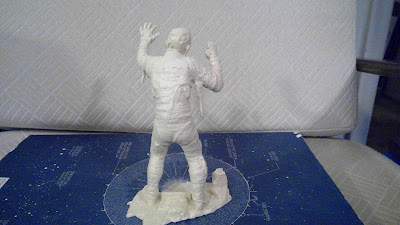
Needless to say, this is a Marx figure based on the Universal monsters (see the Crestwood House post, if anything). There were 6 of them, the Mummy, figured here, Frankenstein, the Phantom of the Opera, the Hunchback of Notre Dame, the Wolfman and the Creature From The Black Lagoon, on consideration a rather random selection. (Was this an editorial about Bela Lugosi appearing in Ed Wood's movies?) The originals were made in orange and blue, followed by reissues that included green and glow-in-the-dark white. 

The present figure turned out to have a more complicated backstory. In the 1990s, a company called Uncle Milton made a reissue set that came with paints to add color. They can be recognized easily by the distinctive white, untextured plastic. From casual research, these account for many if not most on-line listings, and they still go for pretty high prices. I got this one with an uncontested ten-dollar bid, which is better than most of the offers I've seen. Here's a close-up detail pic. That really looks like Boris Karloff! (And why not see my Walking Dead review?)

Another thing you can see is that they messed up the hands on purpose. The obvious part is that the right hand is out of scale with the rest of the figure, presumably to make closeups like mine more dramatic. What's actually less apparent is the other hand, which you would assume is just broken. In fact, they're all like this. Yes, they molded this guy with fingers missing; hey, these are the guys who made the casualty figures. The funny thing is, a lot of Marx figures have unnecessarily delicate separate fingers, but the only original one I've gotten that had them broken off was the Daredevil figure. And here's another closeup. Forget the Mummy; this looks like the guy from Dawn of the Dead.

One more thing to talk about is the plastic, which is what's kept me obsessed with these things  If anything, the detail is sharper than on the originals, which I've seen before with the Mexican Japanese soldiers. Like the Mexican figures, it has a harder feel, though not quite as much, with a clicky sound when tapped. The bandages twang a bit, though again, not as noticeable as the officer's katana from the Mexican set. Now, here he is with the Truckstop Queen! I think she's taller, but not by much.

"Scared? Please, my boyfriend's a Wampa and my ex is King Kong..."

And here's a pic with the original Japanes soldier, who recently became the first one I had to fix. I don't think it was caused by bending the bayonet into a horseshoe, but I'll admit it probably didn't help.

"Just think this through, if the bullets don't stop me, what's the bayonet going to do!"

And how about a couple more pics just for fun?
"This town's only big enough for one Hollywood invention..."

"Yeah, fixing your own lawnmower is never worth it."

And with that, I'm calling it a night. That's all for now, more to come!