Thursday, December 17, 2020

Fiction: Percy the robot cop demo

 It's Thursday and I've got nothing, which has been happening often enough for me to rethink how to do this blog. For now, I decided it was time to try fiction again. Here's something I did last year, in the leadup to the story that kicked off this blog. It's part of a longer work that ground down to notes and vignettes, featuring both No-Hands the Evil Possum and an even older character, Percy the robot cop.  actually thought of reviving Percy first, and as part of that decision scaled him up from No-Hands' original scale to human size. Here he is in the new environment I came up with for them both, doing what he always did best.


Police Robot C, aka Percy, made a minor adjustment to his visor as he stepped inside. What he saw before him was a patch of bare floor 10 meters on a side, walled off from a larger space by stacks of boxes and a few large tarps. More boxes with various goods lay open before him, seemingly scattered at random. Also present were several cages with small animals. It was plain from a moment of further inspection that most of the boxes he saw were only half full, while others remained set aside. He took a pointedly casual look at the goods, and then looked over his shoulder at the pair accompanying him.

“Well, Mister… Peyote, is it?... you certainly have an interesting selection,” he said. He picked up a handful of boxed audiovideo disks, and his face (of course hidden) registered real interest. “Let’s see, London After Midnight, The Werewolf, King Kong, with Spider Pit sequence, Frankenstein… by Thomas Edison, Him… nice, a little Moral Contraband… The Adventures of Buckaroo Banzai 2…”

He looked through a set of bars at a strange hairless jumping rodent, a quarter of a meter tall and covered in folds of fat. “Exotic pets, now that’s a bit of a gamble,” he said casually. “I remember there was a scare a few weeks back over a sea scorpion that escaped from a sea food restaurant. They say a Quarantine special unit destroyed it, but I hear they still don’t know how they got it through customs… And boy, are you ugly…”

The rodent stepped out from behind an empty cage and lifted a hand in an unmistakable gesture. “Frink you, you frinkin’ frinker,” it squeaked, and then bounded away. Peyote, a man with dusky skin and hair peppered gray, chuckled.

“Don’t mind Baldy,” he said. “But it’s best not to call him that, either. And I see you found our high end merchandise…” Percy had reached a crate of weapons. It was an odd selection, from revolvers and derringers to submachine guns and rifles to a handful of more exotic designs. Percy picked up one, an oddly crude tube with a bore wrapped in wire.

“Plasma weapon,” Peyote said. “Harmless to organics, if that’s a concern, but it will knock out a synthezoid for up to fifteen minutes, It won’t permanently damage them, either, if it’s a shielded model.”

“And too bad if he isn’t,” Percy said. “Very ugly.”

“As you can see, we have good merchandise. But of course, we have to have a good source…” He smiled at Percy, and Percy, visible as a humanoid with an ape-like brow, smiled back.

“Of course, the source,” Percy said, “but I don’t suppose you can tell me about that.” He turned his head ever so slightly, looking for the nondescript figure who had accompanied them inside.

“Well… I suppose I can tell you one thing,” Peyote said. As he spoke, Percy’s vision filled with a bright flash, and then went dark. “He ordered us to meet with you.”

Percy’s vision came back slowly and speckled with static. His back was against a steel beam, and a quick tug confirmed he was shackled to it with his own handcuffs. Peyote crouched in front of him, smiling wider than before, and held up Percy’s mask.  Around them, a small crew scrambled to load what appeared to be a 1958 Chevrolet panel truck. “It was a good disguise,” Peyote said. “Even after I made you, I wasn’t sure it was you. We met before, you know, twenty two years ago. I wondered if you recognized me, or even remembered.”

“It took a little time, but I figured it out,” Percy said. It had, in fact, taken 5.76  seconds, which was above average.  “You weren’t as careful back then, but you still got away. Now I suppose you want to get even.”

The smuggler laughed. “What for? I wouldn’t have lasted half as long if it hadn’t been for you,” he said. “And don’t worry, I’m leaving you alive. The only trouble is, there’s somebody who wants to know what you know, though I already told him it won’t be much.” He held up what looked like (and essentially was) a cattle prod for elephants.

“I suppose there would be,” Percy said. There was a whir and a click. Peyote frowned. Suddenly, Percy’s right arm swung free, with his left forearm swinging from the wrist. The smuggler went sprawling, and a revolver clattered out of his coat. Still, none of the smugglers looked until the rodent shrieked. The man who had accompanied Percy and Peyote into the warehouse came barreling into view, wielding a plasma weapon with a bright ball of blue-white fire growing in the muzzle, just as Percy came up with the revolver. He fired five shots without coming close to a hit, but the smuggler’s searing plasma bolt went wide as he instinctively dived for cover. The rodent bounded past, to backflip into the back of the truck as it rolled into gear, and the smuggler followed his example.

A rumble and a clatter echoed through the warehouse as the loading door opened. Percy was already taking aim. With one shot, he shattered one of the rails of the bay door. He pulled the trigger again, and was mildly surprised when another bullet shredded the rear right tire of the truck. The unseen driver accelerated for the partly open door. The cab narrowly cleared the door, scraping paint from the roof, but the cargo box smashed against it, spilling cargo and several of the smugglers. At almost the same moment, there was a metallic screech as a large claw pushed under a smaller loading door.

Within moments, the intruding claw had raised the door enough for more officers came scrambling through, including a squat, long-nosed creature that looked like a root vegetable with arms and a mane of spindly quills. One or two smugglers opened fire, and there was a short answering volley of low thuds from the policemen’s riot guns. The creature swatted at the bounding rodent, but it was already out the door. Peyote rolled over with a groan and muttered, “Lousy rat.” Without looking, Percy kicked him in the head, and then reattached his arm.

As the other officers finished their search of the warehouse, Percy spoke to the root vegetable, in fact a giant long-beaked echidna. “Well, Hector, we got him, but only because somebody else knew we were coming,” Percy said. Hector answered with a few gestures and a low whistle. “No, whoever’s behind it is long gone. But we were close, and we’ll get closer. And in the meantime…” He glanced both ways, and then held up the copy of the 1974 homerotic film Him. “We’ve got Moral Contraband night!”


Wednesday, December 16, 2020

Space 1979: The one the producers of Superman made about Santa Claus


Title: Santa Claus The Movie

What Year?: 1985

Classification: Unnatural Experiment

Rating: For Crying Out Loud!!! (2/5)


Something I’ve commented on frequently in the course of this feature is that I spent the 1980s without a TV. As a result, there have been very few movies featured here that I saw or otherwise noticed at the time (Innerspace being a conspicuous exception). As I have cataloged ‘80s movies, I have more gradually recognized that many of the strongest recollections I do have aren’t about the movies themselves, but the pop culture detritus around them: The toys, the books, the ads in newspapers and comic books, and so forth. In this territory, with my usual world’s-worst-superpower memory, there can still be greatly varying levels of impact. Sometimes, I can recall what I saw or actually had as clearly as the movies I actually watched, but in other cases, even I could easily believe I have simply cobbled together various things into a whole that never existed. This review will be the tale of one of those things. Without further ado, I present Santa Claus… The Movie.

Our story begins with a man with a familiar name trekking through the snow with his wife to deliver hand-carved wooden toys to the children of a pseudo-Medieval town. As he tries to reach the next destination, they get lost, and just when it looks like it’s all over, a glowing magical tree appears. The vision materializes into a compound full of elves, who welcome Santa Claus as their Chosen One. We see the jolly old man and his happy, dancing elves deliver toys to children through the centuries (apparently including the Crusades, the Black Death, both World Wars, etc.), right up to the very hip and modern middling 1980s. Things are changing, and Santa’s top elf wants to introduce modern mass-production methods for their brightly painted wooden toys. Meanwhile, Santa befriends a homeless preteen and a rich girl who has been helping him. Just when it looks like this movie might get hardcore, we then get introduced to an evil toymaker the progressive elf turns to for help, but really hopes to steal Santa’s magic and put the workshop out of business. Hilarious hijinks and heartwarming bonding ensues, and of course the boy comes to live with Santa. Also, the evil toymaker is hurled into space by a miscalculation with a magic candy cane, and that is literally the end of the movie.

Santa Claus The Movie was a production by Alexander and Ilya Salkind, a father-son team who had risen to fame with the Superman franchise (at least until Superman III). The film was directed by Jeannot Szwarc, who directed Supergirl the previous year. David Huddleston was cast as Santa Claus and Dudley Moore as his top elf Patch, with John Lithgow as the evil toymaker B.Z. and Burgess Meredith in a cameo as a being referred to as The Ancient One. The soundtrack was provided by veteran Henry Mancini, who also scored Lifeforce the same year. The theme song and four additional songs were composed by Leslie Bricusse and performed by Sheena Easton, after Paul McCartney and Queen were reportedly approached.  The film’s extensive marketing campaign included tie-in storybooks and a stuffed reindeer toy distributed with McDonald’s Happy Meals. The movie made a $23.7 million U.S. box office, against an estimated budget of up to $50M.

My one clear recollection of this movie was a story book from McDonalds, as well as the reindeer, which I still have. Because such things always crop up around Christmas time, that wasn’t enough to establish the reality of the movie in my mind. In hindsight, this was probably a major reason both for its contemporary failure and its relative obscurity today. Many, many years later, I read about it in a book about movies, but still never read or thought about it again. I suppose it was watching the Superman movies that finally put me in mind to look this one up.

After watching this movie, my foremost reaction was thinking of far better movies, just to get a frame of reference for what this one did wrong. There’s It’s A Wonderful Life, a classic Christmas fantasy that didn’t feature Santa at all. There’s A Miracle On 34th Street, a comedy that got in some good jabs at commercialism. There’s the excellent George C. Scott version of Christmas Carol, made for TV just a year earlier. There’s The Santa Clause almost 10 years later, which tweaked the mythology to appeal to older kids and adults while getting in some serious moments. Hell, if you want  an absolutely “straight” take on Santa, you can look back to the episode “Night of the Meek” of the original Twilight Zone series, which gave a searing vision of a clash between magic and urban poverty in a 30-minute TV time slot.

In this august company, Santa Claus The Movie wavers between tolerable schmaltz and grating cluelessness. The reasonable good moments, mainly in the first hour, are played with nearly humorless sincerity, which judging from the Superman franchise was always the Salkinds’ comparative strengths. Things keep going wrong as soon as they start trying to be “current”, let alone funny. Worse, the story runs away from its most powerful moments when Santa has to face the realities of a homeless child. What gets absolutely insulting is that the posited conflict between Santa and the toymaker which the movie turns to instead depends on ignorance from both sides. Santa is still giving out Victorian-era wooden toys at the peak of GI Joe and He Man (alas, Star Wars was already on the way out), while the toymaker has somehow failed to notice antiquated but still potentially competitive products being given away for free. The one genuinely clever moment is when Lithgow rapturously announces a plan for “Christmas 2”, which would still only make sense if he had no prior frame of reference for how buying patterns work.

So, was there anything that could have been done to save this mess? The best shot was to make it a historical piece; put it in the 1800s, when the transition from craftsmanship to mass production was taking place, or in the 1950s, when modern marketing was still emerging. Failing that, make it a satire of commercialism and go after the real biggest targets, especially the cartoon/ toy positive feedback loop, and show what it was like for the kids who were poor, without a TV or just didn’t like the shows. Then, for a little depth, show Santa having to deal with a wish/ request that goes beyond one gift: A job for a parent, a reunited family, a steady supply of food or a home to come back to. It would have been deeper than the crew’s previous escapist fare, but not totally out of their depth. Even if it wasn’t good, it would have been something more than a mythical elf bringing toys.

For the “one scene”, I’m going to go with one of the briefer moments in the movie, but one of the few within the toymaker’s story arc I found entertaining.  In B.Z.’s very first scene, he is in a congressional hearing investigating his product. He tries to act unconcerned when a doll ignites merrily, forcing an official to beat out the blaze in haste. Then he is confronted with a stuffed panda that seems to tear open of its own accord. The contents are revealed to be literally glass, nails and what looks like sawdust. While the magnate tries to sputter in protest, a congressman declares that anyone buying his products should have their heads examined. And this is where we could have had a discussion. It’s all well and good to say that handmade toys were better and safer than mass-produced toys, when done right. But there were still issues like lead paint, not to mention the fundamental fact that wood is flammable. Then there is also the issue of proportionate risk; He Man’s head might come off more easily that a rocking horse’s, but there wouldn’t be splinters and nails sticking out of the break. Per the movie, however, all modern toys are junk, and we are clearly supposed to take the word of filmmakers and writers who would still have grown up well after companies like Marx and Mattel started churning out factory-made toys by the ton.

With all that said, I was still very conflicted about rating this movie. I came very, very close to giving it the lowest rating, to the point that I revised it in the course of finishing the review. My final decision was that there was just enough good in the movie to bring it up a notch. More importantly, I just can’t bring myself to hate this movie, if only because that would be like kicking a blind man in the shins. Maybe, just maybe, this movie stirs up the Christmas spirit of charity and generosity after all. At least it can be said the people who made it did something nobody had done before and nobody really tried again since. It’s certainly not hard to see why.

Tuesday, December 15, 2020

Planet Puzzle: Am@zon prize puzzle boxed lot


After the last Mystery Monday, I decided it was time for yet another new feature that could keep me going for a very long time, on puzzles. In keeping with the usual subject material of this blog, I'm starting with the cheap and semi-anonymous. This time, however, I'm working with something new that can be purchased online, because as I keep saying, some things are immortal. Here's the lineup.


I picked up this one in the last few weeks, when it started to look like my area would be on lockdown again, along with a five-pound bag of candy. I had looked through a lineup of bulk lots for sale online, mostly from different companies and sellers that were almost certainly getting their stock from the same factories. I chose one that was a little cheaper and had a lot less material that was junk even by my standards. I was a little surprised when it arrived in an actual box. More intriguingly, it had a company name "Hi-Partner", albeit probably a bulk buyer rather than a manufacturer, and packaging that seemed aimed at adults. As seen above, it's labelled "Fidget Toys", which would usually have me at "Fidget", and an extra bit of promotional text, reading in full, "Stress and Anxiety Relief." It left me wondering if the target market is employers trying to reward employees, without having enough money to put the company name and logo on their junk.

In any event, it turned out about half the box were squishy rubber toys I didn't bother to photograph. That still left a good selection of puzzles, without having 10 or 12 each. Of these, the ones I had been after to begin with were a set of puzzle balls and cubes made on the same pattern as a vending-machine toy featured on the Mystery Monday puzzle installment. Per the awe-inspiring resource Rob"s Puzzle Page, the pattern came from a patent by Irving Steinhardt, originally used for a souvenir sold at the 1939 World's Fair. Of course, I wasn't expecting a new challenge, but I like the aesthetics of plastic puzzles well enough to pay for a few more on a different scale. Here's a few pics, including a lineup of the pieces.

We've discovered a planet of strange monuments, all with the inscription "CHINA"....

You should be able to see from the lineup just how consistent the pattern is, even when converted from ball to cube. What you won't see without handling the things is how cheap they look and feel. There's places with rough edges that won't be obvious without very close inspection, and some pieces require a bit of force to go in, especially the first few times putting them together. Even with these allowances, I have literally been afraid of breaking them, especially the spindly bits on the fourth and fifth pieces. An upside, I can still do the gag with the key piece.

The items that quickly proved most interesting were a set of "snake" puzzles. It's supposed to be possible to create your own shapes, but so far I haven't got much past straightening them out or putting them back into the polyhedron they start in. Again, they feel cheap, but the motion is smooth enough that you don't need to push hard enough to risk real damage. They also look very nice. Here's some pics.


On the other hand, the one total washout here are a set of Rubik's cubes. It would seem like a very simple thing to copy the design, but there's complicated mechanics if you think about it. Still, I've seen keychain-sized ones in vending machines that looked decent enough, so it shouldn't be too hard to meet a minimum standard of quality. These, however, are so cheap and loose that the parts almost slide under their own power. What's tricky (and makes me think twice about the capsule toys) is that they come wrapped in plastic that holds them tight. Even on a flat surface, they still look okay, put as soon as you pick them up, it's a horror show. I personally have never been any good with these things, but I liked the idea of having one on hand to play around with. I nd no such pleasure in ones as crude as these. Here's a pic to show just how bad it is.

The rest of the lot are a set of what I think of as "ball bearing" puzzles, which I now know are descended from the original pinball machines. I remember having some of these around when I was a kid. In the 1970s and '80s, they still came elaborate and sophisticated enough to be offered as competition with the Paleolithic handheld video games. As electronic games reached tolerable quality, they faded away into cheap prizes that usually broke quickly. For anyone with my level of experience, these are middle of the road, clearly sturdy but with a tendency  for major components to go askew with a good shake. The one I've really tried out looks like a mound with two spiral ramps; it's a genuine test of problem-solving and dexterity to get the ball to the top, which also takes advantage of the three-dimensional space. There's a seesaw that's worth a second look, though it strikes me as more gimmicky. The other two are simply random, especially the black one, which you just have to shake untilthe ball goes in the single cup in the center. Here's a lineup of the lot.

All in all, it's a bit of a letdown for the relatively high price, but still some good fun. It's of further interest that these are being sold for adults, I suspect in the further hope of appealing to nostalgia. I have to say as someone who grew up with these things, I don't see it apart from the puzzle balls. These are nice to try out, t least for a while, and they were never meant to be more than that.


Monday, December 14, 2020

Space 1979: The one where a girl gets eaten by a piano


Title: House (Hausu)

What Year?: 1977

Classification: Irreproducible Oddity/ Runnerup/ Evil Twin

Rating: Ow, My Brain!!! (Unrated/ NR)


I’ve previously acknowledged that there’s a lot of random in what I review for this feature. The flipside to that is that I have viewed plenty of movies that people might expect to fit in but ended up set aside. Some have simply stayed on the “maybe” list, while a fair number have been reviewed or lined up for other features. Then once in a while, I have run across something that I just couldn’t work with. They didn’t “fit” the idea of the feature, or I couldn’t give them an appropriate classification or rating, or they had themes and content I preferred to avoid. Sometimes, they simply didn’t connect with me, or else I couldn’t find anything to say or comment on that would make it relevant to the genre. Consider this review an example of what happens when I get a movie that shouldn’t work at all, written in no small part because this is one time I’m not ready to walk away with nothing. With that ringing endorsement, I present House… the other one.

Our story begins with a group of girls chattering about school, boys and anything else that crosses their minds. One of the girls becomes distressed when she learns her father is remarrying, and goes on a trip to a beloved aunt’s house to ease the adjustment. She invites the rest of her friends to come with her, in the process recounting the backstory of her aunt’s beloved, who went to war and never returned. After a trip by train portrayed with psychedelic animation for some reason, they meet the aunt, a silver-haired charmer who spends much of her time in a wheel chair she doesn’t seem to need. Soon, the girls begin seeing strange things, and one of their number disappears. As the weird visions continue, the remaining girls find their numbers dwindling as the house and the objects inside appear to come to life to attack, kill and even devour them. Yet, the victims of the house, including the niece, continue to appear as spectral figures or seemingly corporeal and quite lively dismembered body parts, usually to warn them that they are next. Will any of them survive, or will they remain… forever?

House was a production of Toho Studios, produced and directed by avant garde film maker Nobuhiko Obayashi. Per the lore (ie Wikipedia), Obayashi was originally offered the studio’s backing for a Jaws knockoff. He instead developed a supernatural/ psychological horror storyline, with many shots and scenes based on input from his own pre-teen daughter. The movie was filmed over 2 months in 1977, with actual teenage actresses in many of the leading roles. The film made extensive use of animation as well as optical special effects. It was successful in Japan but did not receive a contemporary US release; as a further result, it does not appear to have an English “dub”. In 2009, Janus Films gave the movie a limited United States run. The following year, it was released on DVD and Blu Ray as part of the Criterion Collection.

I only caught wind of this one quite recently, after an uncertain amount of time right at the edge of my awareness. I can particularly recall seeing it listed for sale or rental under fantasy and horror films, I think even among lists of films “recommended” for me. At first, I assumed I was seeing listings for the 1985 American film, though the weird artwork was clearly different from anything I had seen for it. I realized I had something else when I noticed the year, and looked up a few videos about it online. It was clear from preliminary research that this had everything against it in terms of the minimum guidelines for this feature: It wasn’t in the sci fi genre, it was a foreign language film with no contemporary US theatrical release, and it was debatable in my mind whether it qualified as live-action. Still, I’d bent the rules often enough that the most represented year for sci fi from 1975-1985 is 1986, so I dived in.

The most important thing to understand about that movie is that describing the experience of watching it is more useful and certainly easier than trying to explain anything on screen. I personally went through it with several lengthy pauses, which may be the best way to break up the weird. I, the guy who waited for an authorized release of Shanks, found the movie literally jaw-droppingly weird within the first 5-10 minutes, which is before much of anything happens except the title animation. This is about the point where I quit Howard the Duck. By the half-hour mark, this is beyond any frame of reference outside animation, which is entirely appropriate since many of the sequences are either animated or look like stop-motion with magazine cutouts. As things proceed, the movie blows past The Phantom Tollbooth, pulls even with the Transformers movie, and then guns for Jan Svankmajer territory. (If you ever saw a stop-motion rabbit made from an actual rabbit, that is the guy…)

The one thing worth adding about the events in the story is that the movie’s presentation achieves the opposite of suspension of disbelief. The look and style is like what would happen if The Shining was made by the creators of South Park, complete with cutout photos, so far beyond reality that the horror becomes a sort of perverse naivete. (It’s of some further interest that Kubrick was known to follow Japanese cinema, an angle I previously ran across in the legwork for The Green Slime.) The hallucinogenic nature of the animation and effects keep the movie well within “’70s PG”, except for some very cringey nudity. A further contributing factor is that the movie repeatedly uses the same bizarre animation and effects even when nothing is at stake, as well as incongruously bubbly music and several completely irrelevant slapstick sequences. As the movie speeds through the final act, there are several highly graphic deaths (egregiously an attack by a piano come to life), but by then, it’s easy to assume none of what we see is reality even in this movie’s world. It’s only when the departed fail to reappear that the viewer is forced to consider that the characters’ deaths are at least a permanent change in their condition.

For the “one scene”, the only one I find worth the trouble of detailed commentary is a very early scene that comes close to portraying a real situation. Because of the timing of this review, I am piecing this together without a repeat viewing. A girl returns home, to be met by her father, who announces he has an important announcement, well before he gets to it.  He finally explains that he is remarrying, and promptly introduces her new “mother” as she walks in. Things get especially awkward when he tries the pitch that the new lady will help with the sewing and housework the girl has apparently been doing, all while pointedly avoiding any hint of sexuality. The girl clearly isn’t going for it, and her reactions do legitimately foreshadow what’s ahead. In the movie as a whole, it’s like the road sign for the last exit to anything like reality.

Needless to say, a movie as odd as this one is the kind where I prefer not to take sides by rating it. Thus, I finally brought in the “unrated” category I previously introduced for the Revenant Review. The most favorable thing I can say is that it is a “haunted house” movie that really does capture the ambiguity and unreality that movies in the subgenre usually chase after, and it didn’t actively annoy me nearly as much as a lot of more polished films. It doesn’t hurt that it came ahead of quite a few better-known western films, including The Shining, which I won’t pretend to consider a worse film but certainly makes for intriguing comparisons. Whether I would recommend it is where I will politely decline to comment. Still, if what I’ve written makes it sound interesting to you, go for it.

Sunday, December 13, 2020

Legion of Silly Dinosaurs: W@lmart Marx clone dinos?


It's time for another round of silly AWESOME dinosaurs, and this time I'm revisiting some material that's come up before. Back in the patchisaurs post, I covered some dinos in circulation that were clearly based on vintage Marx dinosaurs. The examples I covered then were still mainly from my own childhood collections, but I have certainly continued to make sightings and acquisitions in the wild. With this post, I'll be covering one of my biggest and most recent windfalls, made on the shelves of Walmart. It happened 4 or 5 years ago, when I picked up something I had already seen on the shelves some time before. Here's a pic of the item as I found it, still up on the retailer's website.


As seen above, this little pack was sold as coming with 20 items. By my own breakdown, this consists of 4 large dinos, 1 mid-sized stego, 8 little guys, 4 rocks and 2 tree thingies. The most prominent and interesting is the pterosaur, an unusually large variant of a ubiquitous design. As previously recounted, I believe this originated from the same unknown crew that created the patchisaurs. The big tyrannosaur, already shown above, on the other hand, is clearly of recent origin, conceivably made for the set. Here's a pic of the "large" dinos together, plus a little one that got left out of other pics.

The remaining large dinos are also fairly intriguing. The orange one is a Parasaurolophus (see Definitely Dinosaurs/ Dino Riders), sculpted with incongruous visible teeth to look fierce. It is sometimes classified as a patchisaur, but I believe it is of earlier origin if anything. The one on the far left, which I think of simply as the Abomination; I discussed it very briefly with the patchis, but didn't come close to doing it justice. It is clearly based on a Marx Tyrannosaurus, but equally clearly done disastrously wrong. The obvious mistake was the left foot, not really visible here. In the Marx original (itself introduced to replace a notorious "pot-bellied" early version), the foot was sculpted as raised for a pose that was presumably meant to be dynamic but really looked a little awkward. The imitators (the patchi crew again being prime suspects) managed to make it too hideously deformed to bear any weight. 

That brings us to the remaining dinos, which consist of the stego, a Dimetrodon (really a synapsid from before the dinosaurs), a duckbill/ hadrosaur, a Triceratops and a generic carnosaur usually referred to as an Allosaurus. I am satisfied that all of them are based directly on a Marx design. I had a little trouble sorting out how many of them I still had, as well as which ones really came from the set, but finally accounted for the stego plus two each of the little guys. Other pictured examples show a third duckbill, but that could have varied. Here's a couple lineup pics.


Something that will be apparent on closer examination is that the Marx sculpts were already all over the map in terms of accuracy and quality. The duckbill and Dimetrodon are okay, though the latter looks more like its herbivorous relative Edaphosaurus than the primordial apex predator it was in life. The stego looks a bit wonky, mainly for its strange head, while the allosaur looks bizarrely unthreatening. It's the Triceratops I find inexplicably off. The horns always seem to end up misshapen or askew, a problem that apparently started when Marx altered the sculpt to use less plastic. Even with that factored in, the design still strikes me as archaic and oddly crude. I have wondered if it was based on dinosaur movies, particularly the silent version of The Lost World.

In a new development, I just acquired an original of the stego, joining a Dimetrodon I picked up at a relative's house. Unsurprisingly, the originals are larger than the new(er) bunch. I further compared a stego that I'm sure came with my old batch of patchisaurs, and found it identical in size with the clone but still of better overall quality, with possibly better detail. (If you don't look as good as a patchisaur, that's really saying something.) Here's a few more comparison pics.


In many ways, the most intriguing part of the set to me has been the "landscape" pieces. I have not been able to trace them, and I'm sure I would have succeeded by now if they were copied from Marx or its major competitors, but I suspect they are from some older original. Of these, the plants just look like plastic parsley, too crude for further comment. The rock pieces are more interesting. Two of these are simply boulders or outcroppings, serviceable enough that I've occasionally used them to support figures in pics for this blog. In contrast, the other type seems more like something for a diorama backdrop than a functional play piece. Even as such, they bear little resemblance to any terrestrial geologic feature. Again, they make me think of dinosaur films even older than the Marx dinos, especially The Lost World and King Kong. Here's a pic.

With that, I'm ready to wrap this up for the day. Here's one more pic as a remember what good toy dinos look like.
Reminder, the sailback creature is a closer relative of the sloth than the dinosaurs.

That's all for now, more to come!


Thursday, December 10, 2020

Space 1979: The one with samurai, dinosaurs and Darth Vader


Title: The People That Time Forgot

What Year?: 1977

Classification: Weird Sequel/ Mashup

Rating: Downright Decent! (4/5)


If there’s one thing that might surprise anyone following this feature, especially if you know me or my earlier work, is that I haven’t done many dinosaur movies. To me, however, this was about what I expected. There were never that many dino movies, especially if you don’t count the kaiju genre, and by the 1970s they were getting few and far between. It’s been my inclination to only count the ones with stop-motion animation, which narrows things down to single digits. However, there was one set of films I’m willing to make an exception for, and I was sure I was going to cover at least one. I still put things off a lot longer, in part because I hadn’t watched the one that interested me most. I finally got around to it, and quickly concluded that it was indeed the one to cover. With that, I introduce The People That Time Forgot, the sequel to The Land That Time Forgot, one of the only good dinosaur movies without stop-motion.

Our story begins aboard a ship on an expedition to look for Bowen Tyler, hero of the original movie. We meet the new crew, led by standard-issue hero Ben, with a spunky lady photographer who goes by Charly along for the ride. They try to reach the icebound lost world of Caprona by biplane, leading to the inevitable crash. While they are trying to repair the craft, they run into a cave girl named Ajor, who reveals that Tyler taught her tribe the wonders of advanced technology, evidently including the bodice. Unfortunately, another tribe is on the warpath, killing or enslaving all in their path. Soon enough, they run into the leaders of the rival group, a warrior caste clad in something like samurai armor. The band is captured and brought to their lair, a temple built around a volcano where tribe believes their god dwells and speaks. The crew must race to plan their escape, or be the next offering to the volcano!

The People That Time Forgot was the last of a series of three 1970s films based on the science fiction/ fantasy stories of Edgar Rice Burroughs, following The Land That Time Forgot and At the Earth’s Core. Amicus Productions reported chose the book because they could not obtain the rights for John Carter Of Mars. The film was begun as a co-production between the British studio and American B-movie mill AIP (see Futureworld), but released under AIP’s name alone after the former studio went bankrupt. Patrick Wayne was cast as Ben, with Douglas McClure returning as Tyler in the final act. The roles of Charly and Ajor went to Sarah Douglas of Superman II and singer/ actress Dana Gillespie respectively. The late David Prowse appeared in a minor role, listed simply as the Executioner. Wayne also appeared in Sinbad And The Eye of the Tiger the same year, which was likely filmed first apart from effects by  Ray Harryhausen.

My experiences with this movie go back long before I knew anything about it. When I was a kid, I watched The Land That Time Forgot on TV. I loved it then, and it didn’t surprise me to learn that it has remained an accepted “classic”. However, when I finally picked it up a few years back, I didn’t quite get back into it, and it never felt like a good fit for this feature. I gave stronger consideration to At The Earth’s Core, which is like viewing a Godzilla movie on bad acid (even more so than the 1970s Godzilla movies), but it didn’t quite suit my needs either. My interest stayed on this one, which I had all along on the same disk as the first movie but hadn’t gotten around to watching. I finally watched both movies in a marathon, and while I still argued with myself a little, I knew the sequel was the one that belonged here.

The main thing that stands out about this movie is that it’s quite different in tone from the first movie, and I find it more agreeable. The original movie is startlingly dark giving the concept and genre, with much of the action being human-on-human violence that’s all the more uncomfortable between the stone-age natives and armed explorers. This one is pulp adventure through and through, with more sword fighting than gunplay. It also offers a much simpler story, without the wonky science the first movie carried over from the books. In the bargain, we get two interesting and self-reliant heroines, who only need rescuing once or twice and never quite become romantic interests. Surprisingly, the relative weak point is the lead villain, a glowering, almost silent fellow who looks like a professional wrestler. Fortunately, this is more than made up for by his completely surreal minions. It is surely Prowse who wields the sword in preparation for a sacrifice to the volcano, and he continues to make a good accounting in the ensuing fight if you’re looking for him. The volcano-god gives a nice extra touch. Unlike in At The Earth’s Core, it is never resolved if this is a “real” being, a believed myth or a less tangible animistic force, which works much better.

Naturally, there are the dinos, portrayed entirely with puppets and other “practical” effects. If anything, they look better than in the preceding films, which unfortunately isn’t saying that much. The early high points are a pterosaur and a semi-friendly stegosaurus, leading to some further good fun when the explorers try to get the stego to pull the plane out of the mud. Things take a turn for the worse when a pair of carnosaurs appear, looking like rejects from a Toho movie. Toward the final act, it gets absolutely incomprehensible when the band runs into a beast that doesn’t even look like a dinosaur. In fact, I almost immediately concluded that it looked exactly like a pareiasaur, a sort of proto-lizard that lived and died out before the dinosaurs, easily both the ugliest and the most hopelessly non-threatening  creature on record. (Even more inexplicably, Wikipedia agrees with me!) It’s portrayed with a full-sized rig they really try very hard to make threatening. It does ultimately prove formidable enough to hem the band in by sheer mass, but it acts like a mastiff that thinks it’s still a puppy, literally doing more damage to a sack than any of the people.

For the “one scene, however, my pick is the above-mentioned pterosaur, the very first to appear on-screen. Our very first sight of it is the long head coming into the frame, almost mockingly similar to the shot of the mile-long destroyer in Star Wars. Ben spots it as it circles, referring to it simply as a “pterodactyl”, though the toothy bill belong to the rhamphorhynchid line of the pterosaurs. We get a closeup of its grim visage as it approaches the plane, and the creation could pass muster even today. Further shots make it clear that the creature is much larger than an ordinary bird but still considerably smaller than the plane. It begins snapping and clawing at the plane, tentatively enough to suggest curiosity and confusion as much as aggression, yet even hesitant attacks are clearly taking a toll on wires, wood and canvas. For some reason, it’s the scientist along for the ride who tries to fend off the creature with a machine gun, perhaps succeeding temporarily, but it soon returns. Right about then, it finally strikes at the propeller, with results that are clearly disastrous for the creature and machines. It’s a well-done and effective scene, even compared to stop-motion sequences from masters like Harryhausen and Willis O’Brien, and it’s still one of the only depictions to come to my attention that gives something like a realistic picture of a pterosaur’s size and likely capabilities.

Like Sinbad and the Eye of the Tiger and Planet of Dinosaurs, The People That Time Forgot came out the same year as Star Wars, ultimately a major reason I decided to include it. It is in many ways as good as Eye of the Tiger, let alone the semi-amateur Planet of Dinosaurs, but for whatever reason, this is the one that has been largely forgotten. That’s a shame, because it’s certainly one of the better vintage dinosaur/ “lost world” movies out there. Its most impressive achievement is simply that it feels like an early-1900s pulp story, at a time when plenty of higher-budget movies were trying the same thing and failing. The fact that it wasn’t appreciated then or since is a further sign that the rest of the world was moving on, and worse for it.

Image credit The Telltale Mind.

Wednesday, December 9, 2020

Miniature Giants Part 8: Scooper Mystery?


When I do these posts, there's always quite a bit of serendipity. I was doing some viewings for movie reviews when I decided to catch up with a Youtuber I correspond with. I found out he had cited a couple of my previous posts as sources for a video. I also got a bombshell: Per my very knowledgeable correspondent, a "variant" in my collection of Marx astronauts hasn't been reported to. That inspired me to go back to this feature (which already had a revival on the horizon) and take another look at the space guy I call Scooper. Here's a reference pic of our star with the Gas Station Duchess (aka Connie).
"So they just point and you scoop... um, what exactly?"

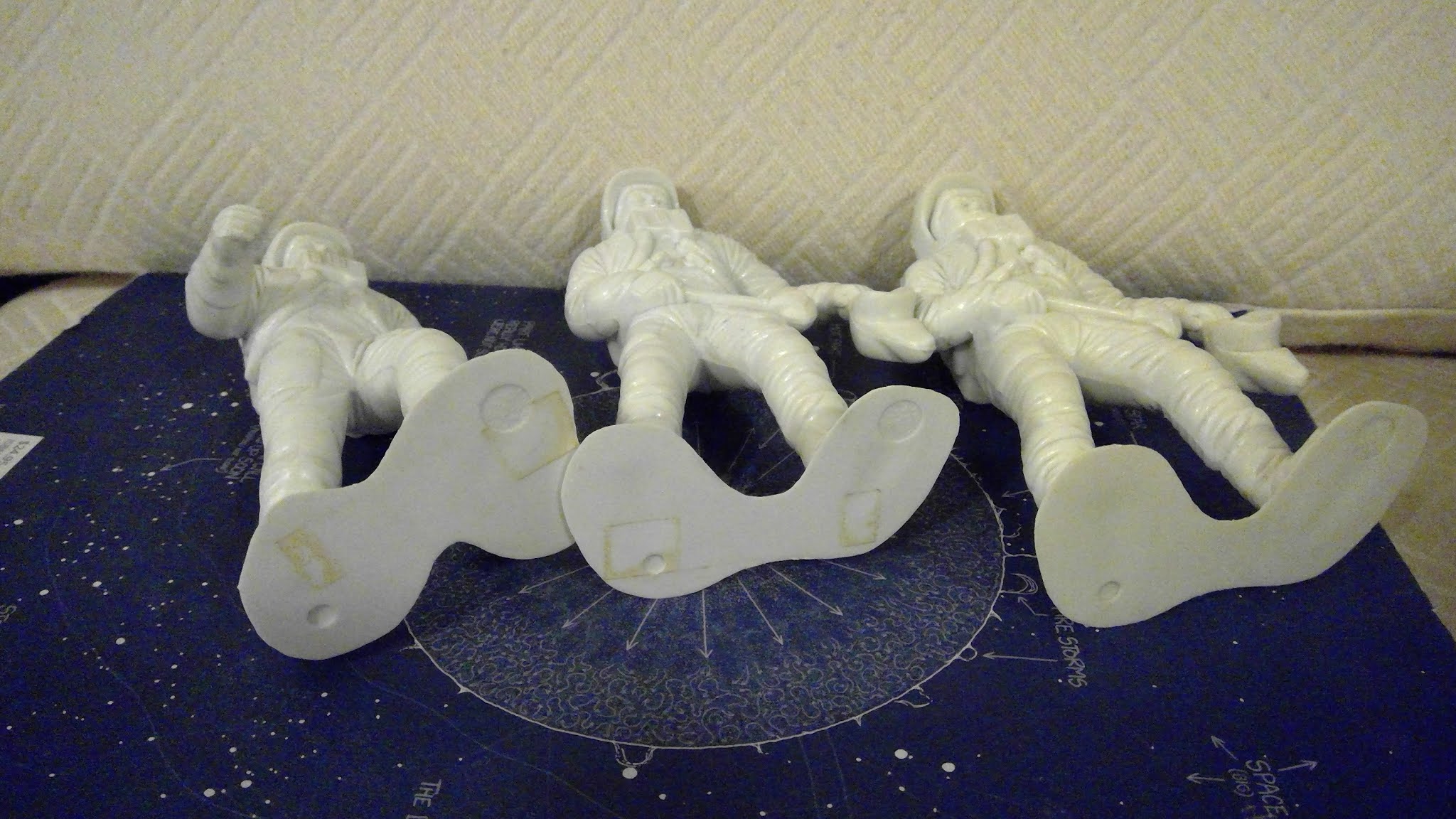
As recounted in my first post on Marx astronauts/ space guys, during my first wave of Marx collecting, I ordered two each of a pair of astronauts I call the Commander and Scooper, which I examined for possible variations in the plastic and mold design. The most conclusive difference was that the second Scooper I received had a life-support pack in a shape I hadn't seen before or since: Instead of slanting, it bulged outward, both in back and to the sides. I mentioned this in a correspondence with Steve Nyland, who has a Youtube channel as well as the Space Trucks blog. According to his latest video, this hadn't been reported by other collectors. As a followup, I took some more photos to show better just how different it is.


In the process, I took a closer look to see if there were other differences. I can already tell them apart well enough by coloration, with the "bulgy pack" variant actually looking lighter and glossier. (This isn't always clear in my photos.) However, I concluded back when that this had more to do with preservation and cleaning than anything else. Mr. Nyland has suggested that there's a difference in the bag shape, so I took the photo above with "Bulgy" on the right. (At least, I'm almost sure...) I can see it, maybe, though I wouldn't count on seeing it in photos.

I must say, at this point, I'm tempted to second-guess myself. My educated guess was that this was an early version of the mold that got changed to save on plastic, something that certainly happened with Galaxy Laser Team. The problem is, if there was a change that profound, somebody "should" have drawn the same conclusion by now. By comparison, there's any number of things that could have happened to change the final shape of the figure: A different kind of plastic, faster cooling, extra air pockets... I still think it looks like a mold variant, but I can't say I can't be wrong. Meanwhile, I took a look at the second Commander figure, which came with the "bulgy" figure. Here's a pic with the Truckstop Queen to lead the set.
"See, a brief case says authority."


This time, there was no question of the source of the difference; this guy is flat-out grimy, which is a disconcerting improvement. (The other one has a defect at the base of the case handle I can pick out independently, right and behind above.) This mostly just proves that he wasn't together with "Bulgy" from the beginning. However, I did discover they both had tape residue on the bottom, which is a strong indication they were in a single collection sometime before they came to me. Here's a pic.

After taking a look at these guys, I decided to take a look at my two blue astronauts introduced in the last installment of this feature, the Flag Guy and one of two of the Cameramen. The Flag Guy in particular is even glossier than Bulgy. On the other hand, the Cameraman a bit dingy-looking whether in either color, which means if the difference is associated with differences in plastic, the change was made while both colors were still in production. Here's a few pics with Bulgy to show what I mean.

Oo, the shiny!!!


Finally, I took another took at the one I call Digger, who came with the head of a shovel broken off. I didn't even mention before that this is the one I'm sure was produced with a different kind of plastic, probably later and cheaper. I've wondered further if this is one of the figures collectors have described as "waxy". To me, he looks like a piece of candy, smooth, featureless and almost but not quite translucent. For this post, I finally tried banging him against other figures, the "clack test" that actually worked for the Mexican and Ukrainian copy figures, and there was definitely something different. (I truly have the worst superpowers.) Here's a pic of him in a lineup.

With that, I wrap this up. As mentioned above, I have an incoming acquisition incoming that will be getting an installment. If I find out any more in the meantime, I may include an update then, or I just might come back for another round. That's all for now, more to come!