Tuesday, December 14, 2021

Featured Creature: The one that put Robocop under water


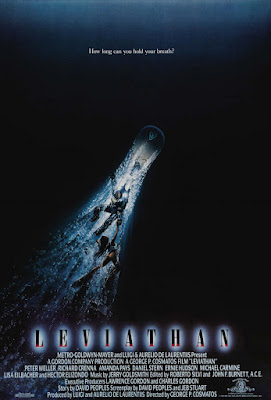
Title: Leviathan

What Year?: 1989

Classification: Runnerup

Rating: For Crying Out Loud!!! (1/4)


As I write this, I’m just past 10 reviews for this feature, and it’s crossed my mind that I haven’t done any that I have given the lowest rating. On consideration, this is in no small part because I set out to cover movies that were already of a higher level of quality than I usually dealt with under my other features. I will also admit that there have been several movies that I went easy on (see especially Congo and Starship Troopers 3) because they hit my soft spots. Starting the double digits, I finally decided I had to review a movie that really deserved the lowest rating, and not just some obscure or infamous piece of kaka I might otherwise ignore. That brought me straight to one that I had already purchased with this feature in mind, only to be baffled and disappointed enough that I set it aside until now. It’s with a genuinely heavy heart that I present Leviathan, a movie that put Peter Weller under the sea.

Our story begins with a quick introduction to a deep-sea facility mining for silver and other precious metals from the ocean floor. We meet the usual motley crew, including a surprisingly authoritative geologist, a crusty doctor, two attractive ladies who clearly aren’t both making it to the end, a familiar-looking irritating comic relief character and a black guy who might have a chance. The story gets in gear as they discover a mysterious sunken military ship, which should either have been there the whole time or hit the bottom on their watch. Aboard the craft, they discover evidence of a genetic experiment that would normally have been defunded with a tactical nuke, without giving it more than a casual mention to their corporate backers. Of course, something gets aboard, a pathogen whose mutating victims don’t stay dead. The geologist’s best plan is to keep it secret from the crew and his superiors until he and the doctor can find a way to stop the creatures. But when the doc becomes the next victim, their only option is to fight their way to the surface, and hope decompression doesn’t finish them off!

Leviathan was a science fiction/ body horror film produced by Aurelio and Luigi De Laurentiis, a father-son team from the clan of Dino De Laurentiis. The film was directed by George P. Cosmatos, a low-budget Italian filmmaker who had broken into the mainstream with Rambo (I know, First Blood 2) and Cobra. It was widely regarded as a knockoff to James Cameron’s The Abyss, which was released the same year, with further ties to Alien and The Thing. In fact, the production reunited at least three figures from the Alien franchise, production designer Ron Cobb (see Dark Star and Robot Jox), effects guy Stan Winston (see Invaders From Mars) and composer Jerry Goldsmith (see Deep Rising and its soundtrack). The film starred Peter Weller of Robocop and Ghostbusters’ Ernie Hudson, with Robert Englund (see Galaxy of Terror) as “Six Pack” and They Live's Meg Foster as the executive Martin. The movie had a limited box office of $15 million. It has been released on VHS, DVD and Blu Ray, as well as digital formats.

For my experiences, this is a movie I long knew of, but only ran down when a correspondent described the film and the talent assembled to me. What intrigued me most was the parallel history with The Abyss, a movie that was among my favorites in the 1990s-2000s. From my own research and experience, deep-sea sci fi was a quite reputable genre that got a head start with 20,000 Leagues Under The Sea and continued with the likes of Arthur C. Clarke’s The Deep Range, Harryhausen’s The Beast from 20,000 Fathoms, and even the Bond outings Thunderball and The Spy Who Loved Me. Given that context, the late ‘80s-‘90s wave was a belated revival, which in further hindsight never really got off the ground. What drove it wasn’t the modest success that came with The Abyss, but the self-fulfilling expectation of a “trend” to be followed. In those terms, Leviathan is perhaps the most instructive example, unfortunately rarely in a good way.

What can be said right off the bat is that the cast is top-notch, perhaps even better than The Abyss for the 1980s landscape. Weller is engaging as always, drawing on Buckaroo Banzai (which I’ve never quite found room for) more than Robocop. Hudson easily runs away with the movie without hamming it up, while Englund proves he can do creepy and funny without murder-based puns. We also get a fine performance from Richard Crenna as the doc. Then the bang-for-the-buck standout is Foster, appearing almost entirely on the undersea habitat’s viewscreens, as ethereal and lethally indifferent as ever. Of course, the real stars for fans of is type of movie are Winston and Goldsmith, who along with Cobb give this the feel of a revival tour. However, it is their contributions that give this movie the unavoidable feel of a second-rank entry. Their work is as good as ever yet not as effective in ways that are difficult to pin down. All in all, the strongest, if perhaps misleading, impression is that they were simply left to their own devices rather being led by creative minds that could take full advantage of their talents.

That brings me to the monsters, and I’m going to have to go longer than usual. What we encounter here are among the most unusual creatures on record. What we see in the first phase of the outbreak are more like zombies than anything else, lending itself to some very creepy moments (including a darkly comical botched burial at sea). As the creatures mutate, they remain effective and interesting, as exemplified by shots of a mouth sprouting like stigmata on a victim’s hand and an unnerving tentacle/ worm with teeth and lips. Coupled with ramped-up paranoia, this leads to the strongest moments in the film’s middle act, with extra fun as the crew arms themselves with power tools. Once we get into the finale, however, it’s a case of each new phase being less interesting, until we end up with a conglomeration of human, fish and invertebrate parts that makes no sense and still isn’t interesting. And don't get me started on the handling of decompression, which at least isn't a unique problem.

Meanwhile, what really bothers me is the weak setup, which is exactly where genre fans may say they don’t care, yet it does make a difference. In The Abyss (see also the novel Sphere, which I don’t rule out as an influence), what we see is a highly specialized team sent to respond to a very unusual situation. Here, what we have are people who make a discovery in the course of their routine duties, perhaps in a nod to the Alien space truckers. The problem is, the logic doesn’t check out even on that debatable level. The Nostromo crew are shown responding to a deliberate communication; here, the crew simply happen upon something that others have tried to hide. (And why wouldn’t the Soviets scuttle their ship somewhere off Siberia where the ice would cover it most of the time?) On a more fundamental level, the whole habitat is the kind of setting that exists for the needs of the story instead of providing its ground rules. A genuine permanent mining facility would be much bigger than anything we see, and if it was run by such a small crew, they would be doing little more than babysitting automated machinery. The alternative would be a mobile base capable of surveying large territories, which is exactly the kind of operation that might uncover an anomaly without looking for it. The lesson is that a few changed details could have given us a much more convincing story without costing time or money; instead, the filmmakers gambled that nobody would think this through further than they did.

That leaves the “one scene”, and I’m going with the one that’s pretty funny. As we approach the midpoint, Six Pack has succumbed to an infection, but the commander and the doctor simply tell the crew that he has been isolated for treatment. However, they haven’t locked the room, which allows Hudson’s character to walk in. There is a darkly comical touch as he gives a reconciliatory speech, and takes it for granted as his crewmate shifts beneath the sheet. As he walks away, something moves much more suddenly and dramatically. Then the blonde half of the female crew enters, looking fatefully despondent. She says almost matter-of-factly, “I’m losing my hair.” And then she pulls back the sheet…

In closing, I come as usual to the rating. Here, the real question is, is this really the worst movie I’ve reviewed for this feature? I will freely admit the answer is no. (If anything, that distinction goes to Godzilla Vs. The Smog Monster, with Congo not far behind.) What sets this one apart is that almost all the movies I have covered before deliver on what they clearly intended to do. This film, on the other hand, is the first to leave me disappointed, and even more frustrated. It’s a subjective call, but it’s a real one, especially when the talent involved is taken into account. With that, I can finally say I found a movie that I can give a 1 out of 4, and I can also say I didn’t set out to find it. Now, I’m done for another day.

Monday, December 13, 2021

Holiday Special: Return of the Xmas playlist!

 I needed a quick blog post for today, so I decided to do what I did last year: Curate one of my Youtube playlists. This is, in fact, a playlist I created before the one I covered last year, and it should be easier to cover. Here's a rundown, and the link for the list itself.

1. Christmas At Ground Zero (Weird Al, 1986): As self-explanatory as they get. It's a Weird Al classic I remember from when I was a kid, and a slice of late Cold War paranoia. Now that I think about it, it's in about the same spirit as Night Of The Comet. The line that still resonates: "If you hear someone climbing down your chimney/ You better load your gun and shoot to kill..."

2. Santa Got A DWI (Sherwin Linton, 1996): I remember this one from the Christmas episode of the late, great Schickele Mix, where the Professor drew liberally from an album called A Bummed Out Christmas.  That was, in turn, a major source for both this and my really "dark" playlist. By that standard, it's middle of the road, cynical but still actually funny. My favorite line: "I can't raise is bail/ No one will believe..."

3. Rusty Chevrolet (Da Yoopers, 1992): I got tuned into this one by a friend. It's still in "dark" territory, without going over the line, and it's actually high-energy. It's as good a point as any to note as a PHX metro near-native, we don't have to shovel heat. Best line: "I light a match to see the dash, and then I start to praayyy..."

4. Grandma's Killer Fruitcake (Dr. Elmo, 1995): Heard this one on 1990s radio, a kind of sequel to "Grandma Got Run Over By A Reindeer", which the same guy recorded as one half of Patsy And Elmo. I personally find it preferable by a wide margin. My favorite line, "Oh no Grandma, please don't send us more!"

5. Putting Up Decorations (Bob Rivers, 2000): Another gem from the radio, where I first heard it played along with the classic 1950s/ '60s rock it parodies. Apparently, it was released as part of an album that also included the titular song "Chipmunks Roasting On An Open Fire," which would definitely be here if I had heard it back then. I remembered it as just funny, yet there's plenty of cynical edge about consumerism, overseas manufacturing and general kitsch. "God appreciates my plug-in tribute to the savior..."

6. You Ain't Getting Diddly Squat (Heywood Banks, 2003): All I will say is that I must have heard this guy live once, because I'm sure nobody else ever wrote a song in tribute to the pancreas.

7. Christmas In Jail (The Youngsters, 1956): A real oldie, this apparently got contemporary notice as a PSA against drunk driving. Given that it comes from an African-American group in the civil rights era, it's a lot darker in hindsight. "Rocks in my head, I wish I was dead..."

8. R2D2, We Wish You A Merry Christmas (Meco, 1980): Simply harmless, for a change. It's from the infamous Meco Star Wars album series, with Jon Bon Jovi somehow roped in. I still have the album this is from, but I don't think I'd have the heart to play it even if we had something to play it on.

9. Dance of the Sugar Plum Fairy (Woody Phillips, 1996): One more from Professor Schickele. The Nutcracker with power tools, what else can I say?

10. The Night Santa Went Crazy (Weird Al, 1996): One more from Weird Al. I have to say, it doesn't hold up as well as "Ground Zero". As often happens with Weird Al, it pulls its punches just a little short of what it advertises. It definitely has more bite with the animation video, especially Santa's "list".

And that's it for another day. It may seem like a "dark" selection in itself, but I was quite carful sorting these out from the ones that ended up on my "depressing" Christmas playlist: No songs about getting dumped, the death of a child, being abandoned on an icy road, etc. (Why not the link for the other one while I'm at it?) I hope your Christmas is merry, whether or not your sense of humor is as warped as mine or these artists. That's all for now, more to come!


Saturday, December 11, 2021

No Good Very Bad Movies 12: The one that was supposed to be the worst kids' movie ever


Title: Pinocchio In Outer Space

What Year?: 1965

Classification: Weird Sequel/ Knockoff/ Irreproducible Oddity

Rating: It’s Okay! (3/3)


In the last few months, the big change on this blog has been that I’m finally doing animation in quantity. As a further consequence, I’ve had to make quite a few judgment calls about what belongs in this feature. At first, I was content with the Gobots movie as representative of the animation category. Then I added The Wild to represent Disney. As a follow-up, I took a look at one more movie as an option for either this or my animation feature. I decided it belonged here, not because it was “bad” but because of its notoriety and sheer strangeness. Without further ado, I present Pinocchio In Outer Space, and the strangest part off the bat is that they get the space stuff mostly right.

Our story begins with a reintroduction to Pinocchio, the most famous character from a book nobody has read. We learn that our protagonist has been a real boy, but got turned back into a puppet for bad behavior. Meanwhile, Geppetto is still running his toy shop even as the rest of the world is in the space race, which technically means at least 25 years passed in real time since the Disney movie. In a new wrinkle, Monstro the whale has returned as Astro, a rocket-propelled space cetacean that is smashing Earth’s spacecraft. On his way to school, Pinocchio meets Honest John, who gives a motivational song and a book on hypnosis, and Nertle, an alien of a species called Twurtles sent to investigate the disturbances in the solar system.  Pinocchio is ADD enough to join the quest, which will take him through space, a lost Martian civilization and an actual nuclear explosion. It all comes down to a showdown with Astro, with the book on hypnosis as the only weapon, and the all-important moral is… don’t skip school???

Pinocchio In Outer Space is a 1965 animated film, nominally based on the 1883 novel by Carlo Collodi. In fact, the movie drew at a number of points on the 1940 treatment by Disney. The film was a collaboration between producers Norm Prescott and Fred Ladd and the Belgian animation studio Belvision, possibly with the original intent of creating a TV pilot. The voice cast was led by Peter Lazer as Pinocchio and stalwart Arnold Stang as Nurtle. Martin Caidin, a novelist and historical writer previously given indirect notice in my Marx Soviet soldier blog for The Tigers Are Burning, was credited as technical advisor. Some have speculated that the animation was done by just two individuals, though IMDB lists a crew of 29, comparable to that of 49 on Disney’s The Jungle Book. The film was released with a reported length of 71 minutes, somewhat longer than the length of available recordings. The film received further notoriety from Michael and Harry Medved’s book Son of the Golden Turkey Awards, where it “won” as “Most Insufferable Kiddie Movie Ever Made”. Prescott continued as cofounder and executive of Filmation, while Ladd became prominent as an importer (and arguable butcher) of anime. Belvision remained best known for their TV and film adaptations of the Tintin comics. The movie was released on VHS and at least once on DVD.

For my experiences, the first thing I will say is that I read the faithful and complete story of Pinocchio as a kid, and I can confidently and absolutely say it is awful. By comparison, I really didn’t know much about the Disney movie until I ran it down as an adult. But then what really weighed on my mind going into this is just how broad and confounding even my early experiences of animation were. By the time I was 12, I had seen Fantasia and the Battletoads pilot (which I kind of owe an apology for comparing to Ingagi). I think that right there is why I may be exactly the worst kind of person to handle a film like this. If you’ve really seen the hellscape of bottom-tier animation, even an amusingly bad entry like the Gobots movie can be a pleasant surprise. When a film exceeds expectations far enough to be impressive, it can be as disconcerting as the “uncanny valley”. I was brought to the point of remembering a line from Heavy Metal; to bowdlerize, you know your perspective is shot, but you’ve got to work the controls like you’re straight.

Moving on to the movie itself, it can be said at the start that even in the 1960s, the absolute kaka of the animation field didn’t get anywhere near theaters, and this presents a case and point. On further consideration, it is at a minimum more tolerable than plenty of live-action kiddie fair, as evidenced by fellow Golden Turkey nominee Santa Claus Conquers the Martians.  Even its notorious musical numbers are in my view far preferable to the alleged rock and roll of many a willfully hip offering. What certainly is jarring is the strangeness factor, which as often happens is magnified by its evident seriousness. The science offered is incongruously good, all the more so when compared to the gaffs and improbabilities of many science fiction shows and movies then and since. (It’s one of several movies I’ve seen recently to make me think of the iconic Galaxy Quest line, “Is there air???”) The monsters are clearly able to do real damage. The characters show understandable emotional reactions. Then there are the jarringly matter-of-fact Cold War references, up to and including a quite realistic mushroom cloud. (I suppose we should be grateful Astro’s rocket is on his fin…) Even more warped to my eye is the final moment of the movie, when a rocket roars past the celestial home of the fairies with no comment from them. Sure, it could be a harmless civilian craft, but I’d definitely be trying to find out…

What really made this movie interesting enough to write about, however, is the rather warped moral. My take on it is that the story, whatever its intentions, almost always puts Pinocchio in the right. Of course, the right answer to his moral dilemmas is to get Nurtle in touch with competent adults, but if the stupid kids in E.T. are supposed to get a pass, Pinocchio certainly deserves a break. He knows of a threat to property and human life; he meets someone who might solve it; and he risks his own neck to help him. Even more importantly, he clearly has empathy and concern for others, plus enough rational foresight to figure out that leaving a space whale to crater itself and a chunk of Earth isn’t going to help anyone. Yet, the dramatic emphasis is still on his breakdown at being scolded by the moralizing fairy who previously gave him humanity and apparently took it back for acting too human. Though I’m usually on Team Authority Figure, I’m definitely siding with the puppet over an entity with small-g god powers who literally knits while a possible ICBM goes through her yard.

That leaves the “one scene”, and for a change, I’m going with a musical number.  10 minutes in, Pinocchio meets the fox Honest John Sharp and his partner the cat, refashioned as Groovy. The pair are friendly to Pinocchio, who reciprocates for no obvious reason given the events of either the original story (which I definitely remember them from) or the Disney movie. When Pinocchio talks about his hope to stop Astro, the pair initially laugh, but then the fox bursts into a song, “Doing The Impossible”, illustrated with the usual examples of bees that can’t fly and spiders with webs stronger than steel. It’s standard platitudes, put to a catchy tune and some of the movie’s best animation. (I especially like the spider snaring the cat’s brief case.) And you know what? It’s a good message for young viewers, which gives a sympathetic  twist on the character to boot. It’s this moment and a fair number like it that redeem the movie, at least enough to be a curiosity worth attention rather than a self-dated relic.

In closing, this is one time I don’t feel a need to explain the rating. It should go without saying that I’m not calling this a great movie. If you go into this movie with the criticisms of its detractors in mind, it will be very clear very quickly that they were not wrong. What the mockery doesn’t capture is what the movie did right, and still more just how much audacity was behind it. The 1960s were in their own way as poor a decade for Disney animation as the 1970s and 1980s, as the already expansive media empire coasted along on old favorites and a few good new ones while the suits snuffled toward live-action films (including some very strong candidates for the “worst” Disney movie!). With that fully in mind, a brazen and reasonably clever knockoff like this was nothing less than a commendable antiauthoritarian gesture. It lost, and it deserved to, but it offered something worth remembering, even if you don’t want to. And with that, I’m done for another day.

Wednesday, December 8, 2021

Rogues' Roundup: Cambrian creatures!


In the time I've been doing this blog, one thing that's been a constant has been a steady stream of posts under the Legion of Silly AWESOME Dinosaurs (the name/ gag I always meant to use). Over time, however, I've reached a point where not everything can fit under even my liberal definitions of "dino". With the present post, I have a case and point, a set of new and old acquisitions from a time long before the dinosaurs and even most of the things that aren't dinosaurs (see the zombie synapsid). These are the creatures of the Cambrian Explosion, over half a billion years ago, when the ancestors of everything were swimming the seas and six inches long was large enough to be a major predator. To kick things off, here's one of the most ionic of all, Opabinia.

I remember this from what was probably the touchstone of a generation, a 1993 issue of National Geographic. Ot the specimens you see, one is a little guy from a line called Prehistoric Panorama from the mid-2000s, which probably will get inducted into the Legion sooner or later. The other is from a lot of hazy origin I ordered recently, traceable to a company called ToyMany. It's an early arthropod estimated to be 1 1/2 to 3 inches long, which is about the size of the little one. Many arguments about classification centered on whether it had walking legs. The old model doesn't have legs at all, while the new one shows a line of little caterpillar feet along the whole body. Neither is well supported by current paleontology. Here's a couple more pics (and while I'm at it a mildly funny Lovecraft parody).


"We all float..."

Continuing the lineup, here's a mixed group. These are Prehistoric Panorama figures of Ottoia and Aysheaia. The first of the little guys is a predatory priapulid worm (possibly the dirtiest scientific name ever, if you know Latin) that played Tremors with the Burgess Shale fauna (see my Deep Rising review). The other is an onychophoran, the intermediary lineage between the earthworms and arthropods. For good measure, I threw in an ammonite, which is actually from a bit later as far as we know.

Next up is the centerpiece, Anomalocaris, advertised by the seller as "The Overlord of the Cambrian". That it assuredly was, though the figure of 2 meters would be news to the paleo guys, who have been arguing between 2 and 3 feet. It was unique among arthropods for its spiked grabby limbs and ring-shaped jaws, which infamously were described separately as a shrimp and a jellyfish before we found the whole thing. By any standard, it was the world's first superpredator, big enough to play cat and mouse with even Ottoia, and still one of the biggest arthropods that ever lived. Here's a pic.

From the latest research, this is a bit wonky; in particular, consensus would make the front limbs proportionately larger (and freakier if you think about it). The paint's also iffy, particularly the mouth, which is off-center from the molded detail. Still, there's no question it's big. Here it is with the Toxo Warriors and the Truckstop Queen for reference.

"Super predator? Maybe okay predator..."

To round things out, from the Toymany group, we have a trilobite, which was also a PP collectible I definitely have around somewhere. Technically, they lived from the Cambrian Explosion to the end-Permian extinction, which killed 90% of everything. Also present are a jawless fish (definitely lopsided) and a eurypterid, which previously appeared in this Halloween's Evil Possum adventure. These creatures, like everything else, had relatives alive in the Cambrian, but didn't reach the form seen here until later. Ironically, the eurypterids reached much larger sizes than Anomalocaris, with the largest bing between 6 and 8 feet long. (I based No-Hands' adversaries mainly on a somewhat lesser-known one called Carcinosoma.) They're all pretty good, not quite up to the PP standard, which has been the high-water mark for a while now.

And with that, I'm done for today. It's one more thing crossed off from my paleo junk collection, and some of the best I have. It's also been a reminder that even when I was a kid, the paleo scene didn't begin and end with dinosaurs, and there were people who knew how to get youngsters interested in the wider field. That's all for now, more to come!

Tuesday, December 7, 2021

No Good Very Bad Movies 11: The one Disney forgot to unmovie


Title: The Wild

What Year?: 2006

Classification: Runnerup/ Evil Twin

Rating: Dear God WHY??!! (1/3)


In the course of this feature, the trickiest part has been deciding what belongs here or under my other features. With the present review, I have an egregious case in point, a slot I intended to fill but had to research or view several different movies to find just what I was looking for. I did this all in parallel with my animation reviews, and I went through about 5 leads before I was sure I had the most egregious example worth the trouble of actually watching. I present The Wild, as nothing less than the “worst” Disney animated movie ever made, and certainly the most completely forgotten and forgettable.

Our story begins with a lion telling his son of his life in the wild, while a crowd of zoo visitors stroll by. In short order, we meet a cast of wacky characters, led by a koala whose accent seems stuck between cockney and British snob, a snake who sounds like Jar Jar Binks, and a friendly squirrel in love with a giraffe. After the zoogoers laugh at the lion cub’s roar (in case it’s not obvious enough, cubs can’t roar), he sets out to prove his worth with an escape attempt, or something. Instead, he ends up locked in a cargo container on a ship carrying rehabilitated animals back to Africa for release, which would actually be interesting. So, we go back to the zoo animals, who essentially walk out into the big city on a mission to retrieve the wayward cub, fully confident in the adult lion born in the wilderness. Just when this also starts to look interesting, the animals board a second ship bound for a generic African island. To make it look like things are actually happening, the characters are bombarded with the likes of psychedelic chameleons, dancing dung beetles, a hyrax who is offended by not being eaten, and a psychotic wildebeest who wants to eat a lion to absorb the strength of a predator, or something. And if you still care what happens, you have this reviewer’s pity!

The Wild was a 2006 CGI animated film by Disney and CORE Feature Animation, with the latter reportedly handling both the animation and most responsibilities for the film. Controversy arose from similarities with Dreamworks’ Madagascar, released the previous year. By consensus, the Disney film was in production before the Dreamworks film, with some accusing Dreamworks of infringement (see Antz). The film boasted a high-profile voice cast headlined by Eddie Izzard as the koala and Kiefer Sutherland as the father lion. Other cast included Jim Belushi as the squirrel Benny, Janeane Garofalo (see Mystery Men) as the giraffe and William Shatner as the villain Kazar. The movie was scored by Alan Silvestri, with Everlife performing the original song “Real Wild Child”. The movie received mixed to favorable reviews, particularly regarding the animation, which some characterized as “uncanny valley”. The film received a box office of $102.3 million against an $80M budget, underperforming both Madagascar and the subsequent Dreamworks film Over The Hedge, which also featured Shatner. It remains available on home video including streaming.

For my experiences, I set out as outlined above on my quest for the actual worst Disney animated movie within the last month. Outside the 2000s direct-to-video sequel boom, there were three that rose to the top very quickly: The Black Cauldron, Chicken Little, and this movie. What set this one apart was just how unknown it is, especially for a film well within the last 2 decades. I knew of it because I saw reviews and mentions of it when it came out, yet I had literally never seen it mentioned spontaneously anytime since. Even other people’s irate lists of worst Disney movies (my main sources for Chicken Little) mostly overlooked it. The only other movie I reviewed with less chatter than this was Two Evil Eyes, a movie that among other things was in the gray area for having a general theatrical release at all. With that kind of Wall of Nothing, I knew a viewing was in order. After going through it, I’m definitely making sure somebody feels my pain.

Moving forward, the central reality of this film is that there’s very little that seems “that bad” at face value. What it presents instead is a wonky, off-center quality that might charitably be granted as unsettling if this was supposed to be a teen-to-adult-oriented satire or dark fantasy, but here feels deceptive and treacherous. Within that, there is way too much that just doesn’t work. Just for example, the movie tries to set up the arc of the lion cub as an analogue for a preteen/ adolescent coming of age, but by actual biology, any cat that far along wouldn’t be that much smaller than an adult. The disparity, in turn, makes the posited humiliation of not being able to roar simply nonsensical, unless the lions are simply reading human amusement as mockery. The issues stretch to the voice work which should have been a redeeming virtue, egregiously Izzard, who seems unable to make up his mind on an accent, and Shatner, whom I literally didn’t recognize. (I could go into a whole other rant about the squandering of Kind, whom I praised reviewing A Bug’s Life, but the fault clearly doesn’t lie with him.) Then there’s more that offers an early preview of the more problematic trends of the modern Disney era: Villains who appear in the final act simply because none was set up (or needed) before; pop-heavy music; multiple “comic relief” characters doing their bits over each other; and logical implications, including what to eat, that are ignored when inconvenient to the story.

Then for the deeper dive, what I can’t avoid is comparison not just with Madagascar but with Over The Hedge. The similarities to Madagascar are really not that remarkable, if one is familiar with the phenomenon of the runnerup, which as I outlined back with The Black Hole has less to do with the creators than the studios who choose where to send their money. That said, it at least bears comment that Madagascar was specifically about the tensions between a domesticated lion and his lifelong friends on being returned to the wild, complete with visions of other characters as dancing steaks. (Yes, I remember that from the theater.) It is by comparison with Over The Hedge, which I went so far as to watch win the course of the present review, that this falls into “Evil Twin” territory. Almost everything about that movie worked, including William Shatner playing himself as the overacting possum. The animation especially bears attention. On that front, The Wild is by any standard the far superior film, but I find it like comparing a still life with a comic book. For the things that really matter- characterization, natural and dynamic movement, even vivid colors- Over The Hedge beats The Wild over the head with a splintered, nail-studded table leg and pisses on it while it’s lying stunned in the gutter.

That still leaves the “one scene”, and that’s annoying me just because I had to go back and look at several scenes. That requires a couple honorable mentions, a couple Italian-stereotype gators that are actually funny (how does the giraffe fit in a sewer tunnel?) and a tribal wildebeest musical number that’s actually good. But the surreal moment I had to give a closer look is the hyrax, voiced by Colin Cunningham. As the father lion looks for his son, he instead discovers a hyrax on an improvised toilet, who promptly shouts a warning (or something) through the plumbing. When the lion insists that his “instincts” led him to prey, his friends get excited to see him in action, until even the hyrax is willing to accept his fate. It goes far enough for the lion to raise the little taxonomic nightmare to his open mouth, but then he drops him. At first, the hyrax assumes this is a literal cat and mouse game, but then becomes explosively indignant when the lion lets him go. In a completely surreal moment, he even extols the health and flavor of his own flesh before storming off. It’s mind-boggling, it’s surreal, and it’s by far the best this movie ever gets.

In closing, the question remains, is this the “worst” Disney movie? The real answer is my standard objection to the whole “worst” concept, which applies even more for an outfit as old as Disney is. I can’t argue that there are movies I didn’t check out that are probably worse, but on the other hand, my experiences are wide enough that I could have pointed to absolutely horrible ones that most people have never even heard of. My key consideration is that there are degrees and kinds of failure, all well-represented in the Disney vault. There are movies that failed commercially in their own time, like no less than Fantasia. There are movies that failed to stay relevant or acceptable with changing attitudes, like Song of the South. There are movies that are flat-out hated, like The Black Cauldron and Chicken Little. What The Wild presents is the center of the Ven diagram of all possible levels of failure, mediocre, unprofitable and forgotten. My final verdict is the same assessment I reached when it was sight unseen: This is the kind of disaster that crashes and doesn’t even have the intrinsic merit to burn. There are worse movies from Disney and elsewhere (see the Gobots movie), yet even they are rarely as forgettable and outright tiresome as this. And with that, I am done.

Friday, December 3, 2021

Super Movies 2-Parter! The one with Andre the Giant in a creature suit


Title: Conan the Destroyer

What Year?: 1984

Classification: Weird Sequel

Rating: That’s Good! (4/4)


With this review, I’m finally pulling the count for this feature to 20, and it’s time for the other half of a two-part review. Last time, I covered the awkward oddity that was Conan the Barbarian. Now, we have the sequel, which was previously the subject of a soundtrack review. To me, it’s not just the one I like better, but what a Conan movie should have been all along, whether or not that was really a good idea. Here is Conan the Destroyer, the one that put Andre the Giant in a suit by the guy who made E.T. and the Alien.

Our story begins with a montage of riders against a red sky, sent to intercept Conan and his companion, a lesser thief named Malak. After Conan decimates the warriors, a ruler named Queen Taramis arrives with an offer (39-year-old spoiler): To raise Conan’s lost love Valeria, if he can retrieve an artifact called the Horn of Dagoth. His quest proves to be more of an escort mission, accompanying the maiden Princess Jehnna and her guardian Bombaata. To unlock the horn, the princess must first retrieve a magic gem from a sorcerer’s island palace, then use it to unlock an ancient treasure house where the Horn is kept. But the Queen’s real plan is to revive a chthonic deity, with Jehnna as the sacrifice, and of course, Conan and his rogues are set up to take the fall. It’s up to Conan to save Jehnna and send Dagoth back to the netherworld, or the god will bring death to the world!

Conan the Destroyer was the 1984 sequel to Conan the Barbarian, again produced by the Dino De Laurentiis Company. Roy Thomas, a writer for the Marvel Conan comics, received credit for the story. Arnold Schwarzenegger returned as Conan, with Mako reprising his role as the wizard Akiro and Olivia D’Abo in her debut as Jehnna. The supporting cast included Sarah Douglas as Taramis, Tracey Walter as Malak, Grace Jones of A View To Kill as Zula, and Wilt Chamberlain in his only starring role as Bombaata. Basil Poledouris returned with an original score including a new theme. The effects crew included the late Carlo Rambaldi, who created a practical-effects suit for Dagoth. Andre the Giant made an uncredited appearance as the creature. The film was released with a PG rating, after controversial cuts for violence and possibly nudity. It received mixed reviews, with critics divided on further comparisons with the first movie. Its profitability remains uncertain; by the most detailed accounts, it received a US box office of up to $31 million against an $18M budget, and may have earned more in other markets. In 1990, Thomas and Gerry Conway published a comic The Horn of Azoth that Thomas maintained was closer to his original story proposal. The movie has remained available on TV and home video. All known video releases are based on the theatrical cut of the film.

For my experiences, this movie, or at least the end of it, was my introduction not just to the franchise but to 1980s epic fantasy in general. What stands out is that I have repeatedly seen it used as an axiomatic example of failure. People say it was inferior to the original. People say it was a box office bomb, an assessment even I casually accepted. I’ve even seen people trash talk the effects, including the Dagoth suit. (One more further recollection I have is posting Mr. Rambaldi’s obituary on social media.) To me, this has come to feel like talking about two different movies. As I acknowledged in the previous review, the original movie had its good points, including elements of Howard’s themes that usually get lost in more routine fair. But this movie has more than enough to stand both on its own merits and as a valid take on the source material.

Moving to the movie itself, it can be acknowledged from the start that the movie is at face value very much in what would conventionally be called “so bad it’s good” territory. The acting is uneven at best. The dialogue hovers between passable and intentionally comical. The straightforward plot still presents several impressive holes, including the undeveloped backstory of a faction that apparently had the central maguffin all along. But these problems correspond to objective strengths. The cast are suited to their roles, with Douglas (see The PeopleThat Time Forgot) and Jones being the strongest performers. The lines that make people laugh, especially from Conan and Malak, are generally intended to be funny. (I’m still not sure what to make of Chamberlain’s absolutely deadpan pledge to defend the princess’s virtue, which I suppose might have been written before the casting was settled.) Most significantly, the story is fast-paced enough that none of it invites overly detailed scrutiny, a difference from the previous film that is far more pronounced than the already substantial difference in running time can account for.

Meanwhile, the part I find stands out after this much time is the effects work. Even for the early to mid-1980s, this looks middling budget and perhaps a bit on the willfully “retro” side. The obvious high point is the Dagoth suit, which I count as easily among the very best of its kind. It’s slow, and the fact that the guy inside was neither an experienced suit man nor a distinguished actor is quite clear. However, the thing is certainly well-used, interacting with the cast and environment on a level that neither CGI nor old-school stop-motion could easily achieve, and the lumbering movements give a real sense both of weight and the disorientation of a being in an unfamiliar environment. On top of that, the  gruesome design and prophesied powers are more Lovecraftian than most actual adaptations of Howard’s most distinguished colleague. But what really sticks and gradually digs in are the palace sequences in the middle act, accomplished mostly with animation, matte paintings and additional optical effects. The part that “works” is the striking level of stylization, which reaches the transcendent level of a different artform rather than outdated technology. It culminates in the surreal hall-of-mirrors fight, augmented by an inspired burst from the score, which I have been very close to giving the “one scene” nod. I pass over it now solely because it is of a piece with events before and after, not something that can be considered easily in isolation.

Now for the “one scene” itself, I decided I had to go a little further into the Dagoth sequence. At the start of the finale, Jehnna is entrusted to place the Horn in the forehead of an idol that embodies the god. The movements of the princess are unsettling in themselves; she seems either hypnotized, drugged, or simply resigned to her fate. Then there is the placement of the Horn, which leads to an uncharacteristically vague scale despite the fact that we have seen the Horn in human hands. The idol seems larger than life-sized, or the horn would fill most of its quite human face, yet the horn still seems disproportionately large. A priest from the cult of Dagoth intones that the sacrifice must take place as soon as the god shows signs of life if it is to be controlled, and the ironic part is that for all we will see, he could be right. Sure enough, the statue begins to move, still all practical, while the priest still takes plenty of time to strike a pose. As the plan goes awry, we get one more glimpse of the idol, already transforming yet all the more hideous for its lingering semblance of humanity. It’s a debatable moment, unquestionable in its overall effectiveness, and in that, it perfectly embodies the film.

In closing, I find myself lingering not on the rating or the present movie but on this feature. It’s now my longest-running feature, which got its first review around Thanksgiving last year. I haven’t done nearly as much with it as I have with my other features, but it has been very meaningful to me. If it comes to that, it’s what brought me to some of the very best movies I’ve reviewed (conspicuously Hancock, Creepshow and They Live). Looking forward, I’m not quite ready to say I’m retiring this feature. I do feel I’ve reached a kind of completeness, enough that any further installments probably won’t come for a while yet. For now, I am once again moving on for another day, and glad to end on a high note.

Wednesday, December 1, 2021

Fiction: The Adventures of Sidekick Carl, Part 16!

It's middle of the off week, and I decided on another installment of Sidekick Carl to wrap up the cliffhanger. As usual, here's the first and previous installments, and how about a link for the Big Red (Robotech) Guy?

Constructor carried Carl in his arms as they emerged from the burning building. It was clear that Carl was grievously wounded. A tear in his suit ran from the neck gasket to the hip. The edges rippled as the nanites struggled to make repairs, but every time the rip started to close, it came open again. “We did it,” Carl said. “We won. We beat Baskiliskus.”

“Yes,” Constructor said. “We beat him, for now. We need to get you help.”

Carl shook his head. “No, it’s… too late. Besides, you have… a new partner now.” Constructor looked to their companion, a clean-shaven man dressed as he was, complete with a silvery construction helmet. “Constructor… meet Constructor.” And the music swelled… until a ricochet destroyed the TV set.

* * *

Agent John Carter rushed toward the convention center, leading a team that had accompanied him to investigate a possible sniper five blocks away. “Talk to me, Lauren,” he said. “What’s happening, and how did we miss it?”

The voice that answered was his wife, who had volunteered to mingle as an invited wedding guest. “We have a superhuman Class 5 or higher, possibly cybernetically based, armed with an advanced plasma weapon,” she said. “The subject made a strong-arm entry, probably after coming down from the roof. We have Heavy teams coming from the south end.”

“Why didn’t we have a Heavy team at the other end?” Carter fumed.

“Because somebody said only a lunatic would come from the north end, and somebody else agreed with her! And we weren’t wrong!”

“Yeah,” Carter said, “that was my fault.” As he spoke, the west side of the convention center came into view. He and his team quickly found cover. “What’s the casualty count?”

“No fatalities… yet,” Lauren said somberly. “Big Red’s down, if you can believe that. Captain Thunder took a hit, too. There’s more that are hurt. Badly. We need a med team, John. Quick.” After a moment’s pause, she added, “I love you.”

* * *


Inside the chapel door, now blocked by a blast shield, Dana finally turned to Carl and spoke. “Is this someone else you know?”

Carl just shook his head. “I don’t know… well, I’m not sure,” he said. “Law of averages, really, it would be somebody from the old days. I can think of one, except I wasn’t even there. I just heard about it, after.”

He looked around. There were at least a dozen others in the chapel, including the prime minister of Bessarabia and his guards. His gaze turned toward the stained-glass window. On examination, it was abnormally narrow, barely wider than his own chest. All the other windows were little more than slits. If you looked through any of them, the view would be cloudy or distorted. If you pointed advanced sensors at one, the readings would be a hopeless jumble, and you would probably set off an alarm. “Whoever’s out there, he would have looked at the window first. Or she, I wondered, and if it’s who I think, so did Constructor. It could have worked, if you didn’t care about hitting anyone else…” He dived to one side as a plasma bolt came through the window.

* * *


The would-be assassin stood amid a scene of chaos and devastation. Flame retardants poured down from the ceiling, adding to a dingy mist that already shrouded the room. Tables lay smashed and smoldering. Guards lay wounded, mostly groaning. Captain Thunder still twitched, with Audrey’s kits gathered keening at his side. A Latin man cursed bilingually from his hover chair. Audrey herself peered out from under her table, growling and occasionally hissing. Her red-pelted mate crouched beside her. Her other mate lay to one side of the chapel door, half his torso seemingly one smoldering wound. That he had a torso at all might have been owed to the remnants of a serving tray almost as large as he was, clutched in one hand. In all likelihood, he owed more to the state of the assassin’s weapon, which had gone from launching fist-sized bolts of plasma to wobbling clouds of gas and sparks. That, in turn, could be accounted for by the sparks and occasional puffs of vaporized fluid that came from a hose that connected the assassin’s weapon to some kind of backpack.

The assassin’s head turned toward a single kit mere feet away, cowering inside a dropped salad bowl. Audrey snarled. The attacker instead leveled a forearm at an emboldened agent and fired one of several visible pods. It launched a spray of tiny, evidently non-lethal darts which sent him sprawling, thrashing and cursing too violently to be fatally wounded.

“We have the whole center on lockdown,” Lauren called out from what remained of a security perimeter facing the chapel door. “Surrender now, and you won’t be harmed.” As she spoke, the assassin turned again, to see the 12-foot-tall battle mech known as Big Red sit up in the outdoor dining area. A coating of melted glass dropped from the sensor array that could be considered his face. There was an almost musical metallic sound as he raised a bright orange scimitar six feet long.

Another man emerged, not tall but stocky and very muscular. His hair was brown, and his eyes were a piercing blue. The slender women named Dana Shelton followed close behind. At his appearance, the assassin’s head cocked attentively. “You had your shot,” he said authoritatively. “It might have worked; that’s luck of the draw. Now, you can shoot it out here, or take your chances outside. But you aren’t getting through that door.”


In answer, the assassin finally slung the weapon. At a twitch of a gloved hand, a glowing upper breastplate dropped to the floor. It broke apart on impact, and set the carpet ablaze. The backpack came off in one hand. The attacker held it up as an unmistakable warning, given more urgency by a visible fluid leak and an assortment of flashing warning lights. Lauren and the agents backed up. That was when a blurred shape literally sent the attacker flying.

All eyes turned to the blur, which resolved itself into the Latin in the hover chair. He held up the backpack, gripped with a bulky metal gauntlet that covered his forearm. “Soy Hombre Acero,” he said through gritted teeth. “Puedo hacer, tonto.”

That was when Audrey rushed to her mate’s side. “You idiot!” she snarled, her words barely recognizable. “You took a plasma ball for Sidekick Carl!!!”

* * *


The bolt hit the chapel ceiling, confirming that the shooter was outside. The window was almost 6 feet off the ground, low enough to look through but too high to leap or vault through, assuming, of course, that the assassin’s abilities were on the level of a human. Carl and Dana huddled together at the sound of metallic scraping. They both looked up in relief as a form did appear in the window. “It was this way or through a wall,” John Carter said. Behind him, Big Red loped past, headed north. “Come through, quickly.”

With Carl’s help, Dana vaulted through the window, carrying her shoes in one hand. “Get to your RV, the path is clear,” John Carter said. As Carl followed, he added, “Get to her, then drive.” Carl only shook his head.

Agent Carter and his team cautiously rounded the corner to the north end. Outside the atrium entrance, at least a dozen agents surrounded the assassin. The intruder was bound in several heavy nets. For good measure, Big Red was applying the force of his right foot, or half of it. Some might have assumed the massive damage was from the battle, but Carl knew it from of old. The mech had never given an account of it in his limited communications, and forensic examination confirmed only that it had been made by something with teeth. Beyond the circle, med teams were evacuating the wounded. He followed a hyperbaric pod that held Audrey’s mate, with Audrey crouched on top. Her eyes met his for a piercing moment before the pod disappeared into the hold of a quad-fan hopper.

Lauren turned as her husband approached. “We secured the subject as best we could,” she said. She tensed but did not comment as Carl passed her. “The Heavies laid down the nets when a command to remove the helmet was refused. I talked them out of taking it off. We might have a tentative ID, but then I’m guessing he can tell you about that…”

Carl took one look, albeit a long one, and nodded. “Borgus,” he said. “Appeared about 12 years ago, got on the map for retiring the fourth Hombre Acero. Ran into a few other supers and one of  the Raven’s crews over the next 8 months. Disappeared after fighting Constructor to a draw. Most people figured it was an out-of-towner who went home. Constructor wasn’t so sure.”

The helmeted head turned as he drew nearer and knelt. There was no sign of anxiety, nor any further effort to escape. “What do you think?” John Carter said. “Can we take that helmet off?”

“I wouldn’t,” Carl said. “It might kill her.” He rose and turned to walk away.

“Then who is `she’?” Carter called out irritably.

“I don’t know `who’, but I’m pretty sure `what’,” Carl said. “It’s another patient of Dr. Hydro’s.” And with that, he did walk away.