Wednesday, November 24, 2021

Featured Creature: The one where Godzilla turns environmentalist


Title: Godzilla Vs The Smog Monster aka Godzilla vs Hedorah

What Year?: 1971 (Japanese release)/ 1972 (US theatrical release)

Classification: Weird Sequel/ Mashup

Rating: What The Hell??? (2/4)


As I write this, I’m reaching 10 reviews for this feature, and almost up to 180 for this blog. I decided it was time for something a bit different, and to that end, I looked at a few different movies. That brought me to a whole genre I have somehow missed, the Godzilla/ kaiju movies. That still left me with a few choices, including some good ones within the 1980s-‘90s timeframe I have mostly adhered to so far. But the one that had been at the top of the pile since long before I started this feature was from further back, at the transitional period of the very early 1970s. Here is Godzilla Vs. The Smog Monster, and this is one time you want the English dub, just for the hysterical opening musical number.

Our story begins, after a cheery montage of scenes of pollution, with a child playing with his Godzilla toy. This isn’t “meta”, however, as both the boy and the adult authority figures refer to the big guy in the factual present tense. Meanwhile, scientists discover strange tadpole-like creatures that appear to be generated spontaneously from polluted water. Inevitably, these congregate into one kaiju-sized mess referred to as Hedorah. This entity proves to be able to change its shape, mostly alternating between a vaguely humanoid form and a sort of flying saucer of muck. The people of Tokyo are terrorized more graphically than usual as the creature smashes ships and sprays the city with a gas that reduces people to skeletons. Even Godzilla is unable to score a decisive victory over the slime monster. It’s a fatherly scientist, injured in an earlier attack, who makes a breakthrough, demonstrating that the creature can be dried with an energy weapon. The military sets up the superweapon for a last stand, in defense of an encampment of hippies who definitely deserve to be eaten. It just might be the army who saves the day, but only if Godzilla can keep Hedorah from smashing their machine first!

Godzilla Vs. The Smog Monster was a 1971 film from Toho, the 11th to feature the title character Godzilla. The film was directed and co-written by the late Yoshimitsu Banno, as what he maintained to be a return to the serious environmental themes of the original film Godzilla King of the Monsters. The film featured veteran Haruo Nakajima (d. 2017) in his second-to-last outing as Godzilla and Kenpachiro Satsuma as Hedorah, with Akira Yamanouchi as Dr. Toru Yano. It was released in Japan in 1971 and in the US by AIP (see Futureworld, Meteor, etc.) under its given title in 1972. The AIP version included a new theme song “Save The Earth!”, consisting of English lyrics set to the music of the Japanese theme “Give Back The Sun!”. While the film was evidently profitable, it drew negative reactions from critics, fans, and Toho management, leading to Banno’s dismissal from the studio. Michael and Harry Medved included the film in their 1978 book The 50 Worst Films of All Time. Banno and Satsuma would return for the 1980s incarnation of Godzilla. Godzilla Vs. The Smog Monster remains reasonably available on DVD and Blu Ray, featuring a Toho dub with the original theme song in Japanese only.

For my experiences, I have already written plenty about my conflicted experiences with Godzilla in my toy blogs (see especially the patchisaurs and generic Godzilla). It will suffice to say that I loved Godzilla as an idea through my childhood, but on the few occasions I was able to watch the movies, I was either confused or underwhelmed. It was only in my adulthood that I really got a look at a representative sample of Godzilla/ Toho/ kaiju movies, which quickly convinced me that the best of the genre were the ones that didn’t have the big guy. (At one point, I traded in a copy of Godzilla Vs. Biollante, a tragedy I may recount at another time.) As for the present film, I certainly knew of its notoriety, but I didn’t watch it or look for it until I happened to find it on the used shelves. It immediately struck me not as better or worse than other kaiju movies, but as wildly weird even by genre standards. It’s certainly not the worst Godzilla movie (I have other candidates in mind for that), but it could very well be the strangest.

Going on to the movie, what’s noteworthy is that how much of the strangeness has little if anything to do with the monsters. The obvious and egregious example are the animated sequences, in hindsight a preview of the traumatizing weirdness of House. On the same vein, there’s the montage of TV-screen images literally bombarding the viewer, until the transformation to a cartoon comes as a relief. Then there are the musical numbers, somehow more bizarre in the US cut, and the overlapping the “party” sequences, which are so laughably tame nobody bothers to tell the kid to leave, yet still as freaked out as the real deal. To me, the most incongruous moment is the previously noted presence of a Godzilla toy. I’m sure nobody really thought this through further than convincing kids to buy more toys. Still, having Godzilla merchandise in the monster’s own assumed universe is a level of fourth-wall irony that western media didn’t get to until far more recently. There’s an extra odd yet poignant note in the familiarity with which the kid treats the toy, pushing it down the slide no differently than a flesh-and-blood friend. It’s just enough to wonder about the reality of what follows, without the pretentiousness that such subtexts often bring.

Meanwhile, what’s front and center is Hedorah, and it is truly nightmarish as well as nauseating. Things get off to a good start with the tadpole stage, with an extra cringey moment when the doctor handles one with his bare hands instead of a remote-control robot claw. Once they assemble, the resulting creature is easily among the most formidable on record. What’s especially unsettling is that the monster doesn’t seem to pay much attention to humans except as a source of the pollutants it feeds on (see also The Green Slime), raising the indignity as it decimates the population with what amount to excretory byproducts. Only Godzilla appears to register as a threat, ultimately distracting the creature from the humans’ belated response. The most surreal part is that the two opponents are legitimately well-matched. While Godzilla is hard-pressed to do more than temporarily disable the sludge creature, it takes visible effort for it to do any harm to him. What makes or breaks the whole setup is our default hero’s clear disgust at his adversary’s oozy attacks. The overall feel is like Rocky fighting a hobo with an unidentified skin disease; Big G can hold his own when he puts in the effort, but what he really wants is to deal with the amalgamation at arm’s length. It all builds to the film’s most effective moments, as Godzilla first tries to fling the whole mess away, then ends by wading into its desiccated mass to stamp out any remnants of life.

That leaves the “one scene”, and while there’s a lot to choose from, there’s one sequence that’s strikingly random even for this movie. After the first round or so between Godzilla and the slime monster, the youth of Tokyo gather in a nightclub you know is hip because the kid actually isn’t present as far as I can tell. Someone projects Jackson Pollack splatters on the walls while a woman in a skintight suit sings the theme song. Many of the patrons wear fish masks as they dance along, for reasons that might well make sense if you know any Japanese. In the middle of it all, one of our protagonists sits and broods. He becomes anxious, or else realizes how weird this really is. Meanwhile, a stream of ooze flows stealthily down the stairs. When someone finally notices, the sludge comes down faster, without overtaking any of the partygoers. Our gallant hero puts himself between the singer and the slime. Just when there’s real tension, the slime retreats as quickly as it came. Then we see the one actual victim, a sodden kitten still mewing pitifully. Where did it come from? Why is it even alive? Like almost everything else, it makes no sense, and works nevertheless.

 In conclusion, the one thing still lingering in my mind is the Medved brothers’ book. Now, it is itself an easy target of ridicule, particularly in light of Michael Medved’s subsequent politics. What I have repeatedly pointed out (see my own Plan 9 review) is that even in the 1990s, it was quite difficult to access older movies, and harder still to get a good sampling of movies from another country. With regards to this movie in particular, what I distinctly recall is that the Medveds presented it as no more or less than an “egregious” example of its genre, and that’s still a quite reasonable assessment. With the resources of the age of the internet, it’s easy to see that there are both better and far worse movies from Godzilla, Toho, and Japanese cinema in general. What this movie offers in spades are the things that made the series and genre memorable, for better or worse, and on the whole, it’s fun even if you’re just looking for things to laugh at. That’s enough to keep a space on my shelves, and a passing grade. With that, I’m done.

Tuesday, November 23, 2021

Rogues' Roundup: 1980s super tank toys


I'm aiming for a full lineup this week, and I decided it was time to cover another of my minor collections. We've already seen how the action figure boom pushed army men and other smaller toys to the edges of the market. But it wasn't all gloom and doom for small-scale toys, as Micro Machines hit the market in the late 1980s, and at least a few other manufacturers looked at competing products. The present lineup is perhaps the pinnacle of the minor trend, a line that used the small scale for very big ideas. Here's a pic of the first specimen I acquired of Mega Force.

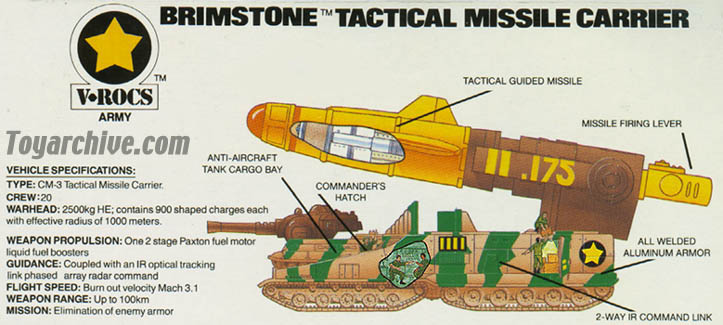
This all started in perhaps 2015 when I found this at collectibles shop that's long since closed (also where I found the Imperial rubber dragon). It's a plastic tank a bit bigger than a tow car, with a spring-loaded missile and a smaller vehicle that fits in a sort of bay in the front. I quickly figured out that it was from a line called Mega Force (see Super Toy Archive). This particular entry is called Brimstone, further described as a "Tactical Missile Carrier". A schematic card describes its payload as "900 shaped charges each with effective radius of 1000 m". (Surely I don't need to point out that shaped charges are built to bore holes in things rather than area effect.) It's also stated that the little tank, apparently smaller than certain others, is an antiaircraft vehicle, with the ability to stand on its tail to no practical benefit. It belongs to a faction called the V-Rocs, one of two that are posited apparently without any accompanying mythology to settle who would be the "good guys". Here's a few more pics.


What stood out about this was that, behind the gimmicks and the bright colors of the missile, this is a pretty sensible vehicle. It looks to come out at maybe 50 feet long, about twice as long as most tanks. The secondary tank is clearly styled as a light vehicle (borne out by others from the line that I've seen but don't have), probably more suited to reconnaissance than actual defense. What's debatable is the lack of any secondary armament. If you're carrying a primary weapon like that missile, staying 10 kilometers or even 50 behind the front lines won't matter. (The stats give the range as 100 km, which is very conservative.) On the other hand, you certainly have the room for enough armament to repel or slow down an enemy advance. A lot would depend on whether that launcher could fire any smaller munitions. What it really looks like is a greatly magnified version of the infamous Davy Crockett, which turned a relatively conventional recoilless artillery piece into a nuclear spigot mortar. For further perspective, here it is with a model of a Karl self-propelled mortar (actual length 36 feet), almost certainly the largest and heaviest vehicle ever used in real-world combat.

Next up is my recent acquisition, called the Crossbolt, representing the opposing force known as Triax. In a common denominator for this line, it doesn't exactly "look" like anything. Still, it's built on reasonably functional lines, at least from the outside... and as we'll see momentarily, the inside is another matter entirely. Here's some pics.


The posited purpose of this contraption is to launch aircraft, a concept that just about reaches the benchmark of remotely sane. Per my research, it would have originally come with a helicopter; this one has a jump-jet that would serve equally well. The trouble is the launch method, which is exactly the kind of play gimmick that would make no real sense even if the thing didn't weigh 1,000 tons minimum.


Yeah, the tank would be crushed, but it makes more sense than anything else.

And here's a lineup of the vehicles viewed from below.


That brings us to the last of the lineup, which I picked up after the first one but still a while ago, a combination sort of thing where the parts work, but don't quite add up to a whole. It's called Strikemaster, and also belongs to Triax, which seems to be winning the super-vehicle arms race. It's a launch platform for a shuttle with berths for two vehicles. As it turns out, the shuttle holds the tank better that the missile platform ever did (the square socket in the bottom matches the clamps in the shuttle bay), but I just couldn't make it work with the jump jet. Here's the lineup of pics I took.

Awesome!

Wait, what???

...Huh?...

Nope, not getting in there.

And rather than labor the point, how about a little mixing and matching? I'm embarrassed how much more sense this makes.

And now it's time to wrap this up. It will suffice to say that Mega Force didn't last past 1989. Despite the short lifespan, they still don't command high prices.  In further hindsight, it was a product for a market that didn't yet exist, one that would aim at adult collectors as much as kids. It was at least a worthy effort from a great company, which just might have done better at a later date. That's all for now, more to come!

Monday, November 22, 2021

Animation Defenestration: The one that could have killed Disney


Title: The Black Cauldron

What Year?: 1985

Classification: Runnerup/ Irreproducible Oddity

Rating: For Crying Out Loud!!! (1/4)


As of this writing, the big development has been that I’m working on a “worst” movie feature. As a further consequence, I have several times had to make a judgment call what belongs in that feature as opposed to elsewhere. With the present review, I have a movie that’s a case and point. It’s exactly the kind of movie I meant to cover when I started this feature, from the heart of the strange doldrums that were the 1980s animation “Dark Age”. On the other hand, it’s also one of the most notorious failures in the history of the medium, and still controversial at best and heavily criticized at worst. I debated where it would go right through an actual viewing which just left me more ambivalent. Nevertheless, I’m forging ahead, under the feature that first led me to consider it. Here is The Black Cauldron, a movie based on a beloved YA fantasy series that became the biggest money loser in Disney’s history.

Our story begins with an introduction to Taran, a boy apprenticed to a magician whose main need is someone to take care of a magical pig named Hen Wen with the ability to predict the future (which mostly made sense in the books). Naturally, Taran dreams of being a warrior, and he gets his chance when the prophetic porker is captured by the Horned King, a possibly undead warlord with a face as threatening as a Halloween mask. With no particular effort, he infiltrates the Horned King’s castle and frees the pig, only to be captured himself. In the dungeons, he meets up with a bumbling minstrel, a standard-issue spunky princess, and an annoying half-sentient creature who followed him in. Together, they stage a jailbreak, freely using a magic sword that nobody can draw in the books, but discover a much greater threat: The Horned King is after an artifact called the Black Cauldron, which can resurrect the dead as invincible skeleton warriors. After losing the Cauldron themselves through every fault of their own, they must go on another daring raid to destroy it once and for all. But to do it, one of them must give up his life!

The Black Cauldron was an animated adaptation of Lloyd Alexander’s series The Chronicles of Prydain, mainly The Book of Three and the following novel of the same name, made by Walt Disney in collaboration with Silver Screen Partners II. The movie was made mainly from 1980 to 1984, following preproduction as early as 1973, with the involvement of such personalities as Frank Thomas, Ollie Johnson, Jeffrey Katzenberg and Ted Berman, the last of whom was ultimately named as director. The production budget reached an estimated $44 million, making it the most expensive animated film up to that time, far exceeding the $9.3M budget of Heavy Metal. The film’s voice cast included John Hurt (see The Plague Dogs) as the Horned King, Nigel Davenport as Fflewddur Fflam and Freddie Jones of Krull as the magician Dallben. The soundtrack was composed by Elmer Bernstein. The film fared poorly at the box office, earning an estimated $22M, potentially due in part to declining interest in fantasy films. It has remained available on home video, and is currently included in the Disney Plus library.

For my experiences, what stands out strongest in hindsight is that I read two of the Prydain books as a kid, but knew virtually nothing about the movie beyond its existence. Meanwhile, I got my first impressions of the movie reading the books of Thomas and Johnson, both of whom were friends of my extended family, and their very unfavorable view of the film in The Disney Villain. Eventually, I read the full series in college (and concluded the ones I read back one were the ones worth reading), but it was still many years before I saw the film. My immediate reaction was merely baffled. When I got back to it for this review, however, after trying to sort out what I could remember of the books, I very quickly got angry.

Moving forward, what this movie represent first and foremost is an egregious case where mediocrity is far more frustrating than “bad”. At one time or another, I’ve covered a good part of the 1970s-‘80s fantasy boom, and I would be the first to concede that there were many that are no better than this. Yet, even the most ridiculed examples (Krull and Conan the Destroyer are right up there) are far more original and entertaining than this. The most exasperating part is that this film was in production long enough that it’s very likely other animated and/ or fantasy films were greenlit just to meet the expected competition, but it still came in last and least. Then the overriding common denominator is everything is made generic, toned down and tame even factoring in significant censorship I’m well aware of. If anything, I take far more issue with what’s added or overplayed, especially the “comic relief” characters. In the novels, the likes of Fflam and Gurgi serve to lighten the quite serious tone, but here, even the outright lethal witches are played for laughs (with virtually misogynistic crudeness at that). The end result isn’t even “Disneyfied”, but a moral guardian’s selective memory of older and better Disney films that endured precisely because they were allowed to be “dark”.

Even with that rant out of the way, there are still severe problems with how the movie handles the source material. It’s bad enough that whole arcs are mangled or ignored, conspicuously the challenge of drawing the magic sword. What’s far more problematic is the consolidation of several major and minor villains into the figure of the Horned King. A lot of further controversy has centered on the character, whom Frank and Ollie considered “as ordinary as the leader of a street gang”. I can muster a better opinion, mainly in light of Hurt’s fine voice work. On the other hand, I find the skeletal face and especially the clearly mobile jaw simply distracting; it makes it clear he is not meant to be human, without making him any more threatening. But the most fundamental issue is that the single villain takes away the most fascinating aspect of the books. Perhaps the most impressive thing about the series is that most of the characters have their own angle. Those who are neutral or “dark” can still unwaveringly oppose the main villains, while those who start among the good guys can become a menace if they recognize an opportunity (a major plot point of The Black Cauldron in particular). It was a gritty, morally ambiguous world of a quite different character than the usual youth-oriented fantasy, in some lights even exceeding Tolkien, and the film all but willfully insults it.

That leaves the “one scene”, and there is truly one that pushed me over the edge. Around the middle act, Taran and his party discover the Fair Folk, which I didn’t remember being in the book or not. After reading a synopsis or so, I confirmed that they are present, in the same form most common in actual lore (and the occasional “sighting”!): Human-like entities shorter or more slender than mortals, still within “normal” human size. Of course, what appear are tiny winged pixies of the type Disney helped popularize far beyond their importance in authentic folklore. We get some sense of individual personalities as we see children and grouchy bearded elders, every one in psychedelically bright colors. Then, just when you might be thinking this could be interesting (see Wizards, and how is that the good example???), they assemble into a friendly swarm to amuse the princess. It’s truly a defining moment for the movie, turning a complex work based on ancient folklore into a cliché of other cliches. And it might have gotten this movie on my “worst” list, because that would have given me the option to quit watching and write about it anyway.
In closing, I come back to a question I was tempted to tackle earlier: Is this the “worst” Disney movie? And if not, what is? I was already considering that question when I reviewed A Bug’s Life, which made this review a continuation of the same train of thought. My verdict is that this was definitely on the “short” list, and perhaps even the worst I have personally seen. I still have to say it probably doesn’t belong in the top spot, simply because it is still reasonably well-known. By comparison, I had no trouble coming up with plenty more contenders that most people would probably say they never even heard of, even if they came out well within my and their lifetime. To investigate those leads can wait for another day. For now, the present movie will do well enough as proof that Disney can fail hard, and that on the whole, they are better for it.

Saturday, November 20, 2021

The Adventures of Sidekick Carl, Part 14!

 Rounding out the off-week with Sidekick Carl. No commentary, just links for the first and previous installments.


The figure did not look human. It looked too big to be human. It was in fact Dr. Hydro’s combat exoskeleton, encasing his already heavily armored body. It advanced with strides that looked ponderous but quickly covered the distance. A clawed arm swung, and met a large rake. Both deflected from each other. The tines slashed again, shredding a hydraulic line. Then the handle of the rake struck the tinted dome that covered the villain’s head, leaving a small but visible spider web of fractures.  The next swing, however, sent Constructor sprawling. The view shifted to show a metal ring seven feet wide, glowing with an oddly dull silver-gray light.

It was Carl cried out, “Doctor, you have to shut down the machine now! You don’t know where it goes, or what could come out! The other end could be at the bottom of an ocean, or the heart of a star! They’re going to blow you off the map if we don’t stop you first!”

“No,” Hydro answered. “What I begin, I will finish.”

“Yeah? Then what about me?” Carl said. “You saved my life, when it wasn’t even your fault I got hurt. You wouldn’t have done that if it didn’t mean something to you! So stop this, before anyone get hurt!”

The doctor drew back with a noticeable limp. “You don’t understand, you never could,” he said. “I thought I could better this world, but I am in it, not of it. If there is a place for me, it is on the other side.” At the flip of a switch, the armor broke apart, launching the occupant into a summersault, straight into the ring.

…And that was when the TV exploded. The slim, black-clad figure let the smoking weapon clatter to the floor. “Yeah, see where that got you,” the androgynous voice said. Then the speaker rose and stalked out the door.

* * *


It was 4 months later, and Carl and Dana were at a convention in Trans-Pecos. They sat together at ease with three other couples, including Captain Thunder and his wife. The other pairs were a man and a vaguely feminine furry creature, and a dapper gray-haired Latin in a chair that hovered just above the ground next to a woman perhaps 10 years younger. Audrey was moderating from atop her stool. Carl clasped Dana’s hand as he spoke. “So, yeah, for us it was fast,” he said. “I don’t think either of us would tell anyone else to do it this way. You do what’s right for you.”

“Well, it was my idea,” Dana chimed in with a laugh. “I’ve been around long enough that when you know, you really know.”

Audrey grinned at that. “Yeah, you said that to me,” she said.  “I’m glad I settled down. Why, I’m practically an old lady.” She flashed her teeth at her two mates and restless kits in the audience.

They got through questions and answers, half of them directed at the man in the hoverchair, none other than the first of a line of heroes named Hombre Acero. Most of the rest were directed at Carl, Dana or both, and about half could be begged off as classified. As the audience dispersed, they walked out together. “Are you ready for tonight?” Dana asked in amusement.

“As ready as I can be,” Carl said. “Carter said they have agents in place…” That had been a concern throughout the intervening time. In fact, the only further incident had proved to be from a fan he was already well-acquainted with.

In the corridor, they were met by a small contingent of guards who cleared the path for a man who greeted Carl warmly, the leader of a small republic that had once been ruled by a mutant who split off from Basiliskus. Carl glanced in the direction of the main entrance. It was enough to confirm the presence of the convention’s real muscle, a red combat mech 12 feet tall, armed with a 3 cm revolver and a scimitar a little longer than Carl was tall. He looked the other way, and froze. Dana had noticed and was close to believing they would be in danger when he said, “Dana.” Suddenly, he was going the other way, straight through the thickest of the gathering crowd. Dana loped after him, in long strides that immediately convinced the onlookers to clear a path as best they could.

It was bare moments before she caught up, to find Carl embracing a short, slim woman in a red pantsuit, perhaps in her early 20’s, perhaps younger. It would have been the stuff of jokes, except that even a glance would have made it clear that they were anything but romantic. Carl belatedly looked back and said, “Dana, this is… well… Dana. Constructor was her father.”

They found as much seclusion as was possible back in the enormous RV. The other Dana, who agreed to be addressed as Ms. Shelton, was slight even compared to Carl, and was entirely dwarfed by the vehicle’s massive scale. That suited her oddly well, as she curled up effortlessly next to Carl on the short leg of the dinette. “Well, I did go on a couple missions,” she said in amusement. “Nothing like on the show, though. The first time, I found the blueprints for one of Audrey’s hideouts, but Dad still needed me to find the secret entrance. I waited outside, until I figured out they were in trouble. He was nervous the whole time. The second was, well, after Carl retired.”

“So you don’t have, you know, powers?” Dana asked. “I mean, you couldn’t have been born after…”

“Actually, I do,” Shelton answered. “Nothing special, maybe five times normal strength. And, no, I wasn’t born after. They still don’t know how it happened to me. It was hard enough for the scientists to accept that the organic energizer could have hereditary effects. They did everything they could to say it was something else. The best they came up with was that I got just enough of the blast that hit Dad for the effects to show. It did happen, to people even further away than I was. They suggested that there’s a genetic factor. Then there was a guy with a supervillain brain who flat-out said that something passed from him to me, something about DNA resonance. We still know so little about the energizer, nobody can say.”

By then, Dana was stretched out. Shelton and Carl continued to talk, mostly about their lives since what they both called “retirement”. She revealed that she was close to finishing a degree in nanotechnology (she was 25), a field still trying to catch up with the work of Dr. Hydro. She also casually mentioned her own fiancée, a fellow researcher working for the agency, and also commented in passing about a mutual acquaintance she referred to as Andy. They were still talking when Audrey knocked at the door. “They’re ready,” she said. She was dressed in a plain but glossy black jumpsuit. “In fact, they’re waiting. If you’re really doing this the old-fashioned way, come with me.”

Carl glanced questioningly at Dana. “Go, I’ll get dressed and catch up,” she said. “There’s one thing, just so it won’t be a surprise…” Carl leaned in as she beckoned. She whispered, “I have a pair of high heels.”

“That was fast,” Audrey said as Carl followed her back to the convention center. He had changed into a navy blue leisure suit that fitted over his inner suit.

“Yeah, I needed a walk,” Carl said.

“Are you ready for this?” she said.

“Yes,” he said. His voice was confident. “In fact, I think I’m as ready as I’ve been for anything…”

They emerged into a space as big as a medium-sized conference room. Three rows of chairs held about four dozen guests. Audrey’s mates and their four oldest kits filled out a fourth row. The party on stage included Captain Thunder, the prime minister of Bessarabia, and Hombre Acero. Big Red stood to one side, instinctively hunched though even his height only reached two-thirds of the way to the ceiling. Carl took his position, helmet in hand. He glanced over his shoulder at a stained-glass window with an abstract pattern. “It gets used quite a bit,” Audrey said from atop her podium. “Lots of people meet at cons, lots of them decide it’s a good idea…”

Carl nodded. “Some day, you need to tell me how you got ordained.”

She flashed her teeth. “You could do it if you put your mind to it.”

Then the door opened. Three women entered, tall and very attractive, if you could look past the fact that they were absolutely identical apart from hairstyle. Behind them came Dana. Her white dress was simple and form fitting, long enough to reach to her knees. Then there were her shoes. It briefly crossed his mind that they were more like clogs than high heels; a true stiletto would have either snapped like a twig or punched a hole in the floor. The heels themselves were easily 7 inches high, albeit at least two thick. With the added height, she came close to if not over 9 feet high. “You’re beautiful,” he said as she reached the base of the chapel steps.

“I knew there was a reason you were marrying me,” she said.


And on a rooftop far away, a crosshairs locked on the stained-glass window.

Wednesday, November 17, 2021

No Good Very Bad Movies 10: The sequel to the one I thought was too bad to review


Title: Star Odyssey

What Year?: 1979

Classification: Ripoff/ Anachronistic Outlier

Rating: Who Cares? (2/3)


In the course of my reviews, something I have been very clear on is that I not only had no desire to list “worst” movies for their own sake, but have specifically declined to review a number of movies I deem “too bad” to review. What that generally means to me is that they are too inept and too uninteresting to offer any further insight on the history of science fiction and other “genre” films. The counterintuitive part with this feature in particular is that there still haven’t been that many movies I have changed my mind about in that regard. What I’ve covered instead are movies that had been on my radar without quite fitting with anything I had done before. With this review, I have an exception to prove the rule, a sequel of sorts to a movie that was itself so terrible I long considered it the worst thing I had reviewed. With that I present Star Odyssey, the fourth entry in a saga that began with War Of The Planets, and if you’re watching it, not paying attention could be your only hope.

Our story begins with the detection of an incoming alien vessel headed for Earth, which blasts or simply ignores every effort to stop it. The occupant proves to be an alien from a distant and more advanced civilization who claims to have purchased the right to rule and exploit Earth in an auction among his peers. He comes to assert his claim with an army of androids, who look like Prince Valiant clones in gold suits and are armed with suspicious laser swords. Earth’s only chance is Professor Maury, a genius who has mastered mind control. With the professor’s powers of persuasion, he assembles a band of heroes, rogues, and comic relief, including a space ace with a mustache that seems to be peeling, a bombshell in leather, and two robot lovers who are just as annoying as their human counterparts. Their one shot is to take the overlord’s slave ship in a commando raid while Terra’s last starfighters assemble for the final battle. Can the misfits save Earth? Is it possible the answer might be no? Did anybody think to bring a gun??? Find out- or don’t!!!

Star Odyssey was the fourth in a series of five low-budget science fiction films by Alfonso Brescia, preceded by War of the Planets and Battle of the Stars in 1977 and War of the Robots in 1978, and followed by the adult film The Beast In Space in 1980. As with other films in the loosely connected saga, the film reused costumes, sets and effects from other entries, particularly War of the Robots, without significant overlap in the story or characters. The cast included Ennio Balbo as the Professor and Yanti Somer in the last of three appearances in Brescia’s films and her second to last film role. An 88-minute cut of the film was reportedly released in Italy in late 1979, while a 103-minute version reached US markets mainly if not entirely through home video.  The US cut is believed to have several scenes out of their original order. Like most of Brescia’s films, it is in the public domain and can be obtained in a range of disc and digital releases. Brescia died in 2001, with 51 directorial credits to his name.

For my experiences, this is a rabbit hole I went down by increments. I first flagged War of the Planets as of interest just looking through public-domain boxed sets in my collection. Once I saw it, as recounted previously, my initial reaction was that it was too bad to review. Meanwhile, I found out a lot more about Brescia’s saga from scholars and collectors far more dedicated and masochistic than me. It was a bewildering rabbit hole I investigated sporadically, with arguments about which films were made first, which other films were ripped off, and even whether one particular film actually existed. The bottom line is that any one of these films is easily among the absolute worst films the ordinary civilian viewer is at all likely to encounter spontaneously. If anything, the present film presented itself as an improvement, with evidently polished production values and a premise that sounds mildly promising on paper. When I decided to move forward with this feature, this one came up immediately, though I still didn’t get to it till I was about to hit double digits. I must say it was a pleasant enough surprise, in about the same sense that you’d prefer a bout of diarrhea over bubonic plague.

Moving onto details, this is a film where almost nothing makes sense, and the whole rarely suffers for it. It’s far more entertaining considered as a semi-random series of scenes and images then the story ever is. There’s the overlord, looking like a cross between Emperor Palpatine and Pinhead, unsettlingly before either of them appeared onscreen, and his more mysterious peers. There are the androids, ludicrous in appearance yet surprisingly nuanced in behavior. There are the laser swords, which at a glance look like light-up plastic toys, and per the lore and closer examination were probably even cheaper than that. There are the glowing eyes of the professor and a rogue with similar powers. There is the peppy soundtrack, which reaches the level of kitschy charm. Then there are the completely random moments, egregiously a wrestling match (kickboxing might be more accurate) between a human ant a robot.

At the heart of it, meanwhile, there is an intriguing story. Central to it all is the auction of Earth and the colonial indignities that go with it. Still more sinister are the overlord’s competitors, who seem to turn to the auction not for any semblance of legitimacy but simply to avoid fighting each other for the same prize. As we move in, the human characters are crowded by the bickering robot lovers, continually arguing over a long-ago suicide pact, who should be even more insufferable than they are yet remain vaguely amusing. (I would love to know more about the butler robot they look down on, which I swear looks exactly like a trash receptacle.) Soon enough, we reach the final battle, which has all the things that we should be able to take for granted but don’t: We can identify the ships of both sides; the stakes are defined; and it’s possible to follow the course of the battle and who’s winning. There’s an extra, ironic poignance in the contrast between the androids, who are pointedly reserved but still unquestioning as their fellows are ordered into a kamikaze attack, and the human space ace, who praises himself right up to the moment of his own death.

That leaves the “one scene”, and as often happens, what stood out to me is right around the middle. For reasons it would be useless to follow, the androids are sent against a human outpost in the middle of a wooded area. The forest is shot with the disconcerting competence of Italian movies, creating an atmosphere that is foreboding with just a hint of animistic nature worship that might put the humans ahead of the machine invaders. Even more impressively, there’s a sense of coordination and even stealth as the androids make their way through the trees, not quite undone by their bizarre appearance. A couple human heroes detect the incursion and prepare an ambush. Notwithstanding my jokes, both sides clearly have guns here. In the ensuing exchange, the robots take significant losses before driving the humans back. A genuine, tense standoff emerges as both sides fire from abundant cover. So, in the best Edgar Rice Burroughs tradition, the androids holster their guns in favor of the laser swords, and the humans do the same. It’s a sequence as ludicrous as it sounds, with just the right illogical flare to work.

In conclusion, I come back to the rating, only here, I find myself back at the whole question of whether a “worst” list is possible. Almost any of the movies I gave the lowest rating for Space 1979 would be among the worst I’ve ever watched, with the triumvirate of shame still being War of the Planets plus Inseminoid and Space Mutiny. (Alien 2 gets dishonorable mention, apt here as the most brazen of Italian ripoffs.) Of those I’ve done for this feature, only Ingagi and Creepers are much worse. By further comparison, this  one gets out of the bottom ranks just for being more imaginative and less annoying than its predecessor. On another level, there is a measure of dishonor. Brescia’s body of work blew out the bottom like no director since Ed Wood, yet after 3 outings, it had still faded down to ordinary mediocrity. Everything is on a curve, and by the time you’re anywhere near the bottom, you’ll be too nose-blind to choose. And with that, I’m done, and hopefully on to better things for a while.

Tuesday, November 16, 2021

Futures past: Camelot 3000 weird-as-Hell comic book


As time goes on, one thing I have had to come to terms with is that the 1980s and '90s are as far in the past as the 1950s and '60s were back then. Something I have pondered further with science fiction in particular is whether we have reached a point where there can be "retro futurism" based on that period as there has been from "golden age" pulp fiction (see my first post of this feature). What that finally brought me to is an artifact I have wanted to do something with for quite a while, quite conceivably the strangest and most ludicrous artifact of a very strange decade. Here is Camelot 3000, and a few pics to dive right in.


Our story, such as it is, begins in the midst of an alien invasion that the humans are losing. A young man fleeing from a raid by the aliens takes shelter in an ancient ruin. In the process, he awakens King Arthur, who rises to aid England in its darkest hour. Then things get weird. For plot convenience and maximum sacrilege, there's reincarnation in this universe, so the knights of the Round Table must be reassembled from a checklist of stereotypes, including a Japanese warrior, a genetically engineered worker-drone, and a woman who chooses between her revealed past self and a man she loved in a handful of panels. With the aid of Merlin, they soon discover that the invasion has been orchestrated by none other than Morgan Le Fey, who has enslaved the aliens' breeder-queen. To stop the invasion and free both species, Arthur and his crew must once again turn to the cosmic power of the grail. But their old intrigues and betrayals are close behind, especially when Lancelot meets Gwenevere and Morgan finds the reincarnated Mordred. And what I can't easily convey is how badly the comic fails to make any of this interesting. 

My own experience with this comic is that my older brother brought the graphic novel home somewhere around 1988. I now know that it was a compilation of a 12-issue comic published from 1982 to 1985, but that's not going to figure any further.  I read it or at least looked through it avidly, without much understanding of the comic or the source material. It definitely left a deep impression on me, to the point that it was probably my introduction to the Arthurian legends and possibly the main reason I took any interest at all in the subject. My memories of the characters and images were vivid and enduring, even for my world's-worst-superpower standards. In early 2017, soon after starting a new job, I finally looked it up, and I was quite happy to find that it was available as a reprint. I read it promptly, and easily recognized many of the scenes and visuals I recalled from way back when. What truly startled me was how little emotional or intellectual depth there is here. Sure, the artwork is good and the concepts are traumatizingly weird, but these are cardboard cutouts in a cardboard world that would have been cliched in the 1950s. Here's a few more pics just to show the level of false advertising.


Naturally, this isn't all bad; with this much random, however, the law of averages was enough to ensure that. Fans will still point to the storyline of now-lady Tristan, who discovers Isolde as also a woman. I can grant that it is at least a non-stereotypical LGBT portrayal. There's a potential for equal pathos in Tristan's ex, who becomes a literal monster in his grief and anger, but it's all as cursory and emotionally thin as everything else. There's somewhat more substance in the arc of the mutated Perceval, who becomes a potent symbol of the downtrodden. Most interesting is Morgan, who is on the verge of decay or worse from a sort of magical disease that breaks out as a creeping corruption without regular regeneration. The most interesting arc comes late when the history between her and the aliens is revealed. It's especially amusing when the sorceress reveals that she felt suppressed their development of magic in favor of science to protect her own power. Here's a couple more pics of the more interesting visuals, including the finale, which was possibly my strongest memory out of the whole thing.


What's most interesting for the purposes of this feature is the mix of new and old cliches. We have an early appearance of the flying car, and buildings that look about a generation past Futurama 2. Also present is the usual World Government, apparently in place for some time before the invasion. The most unique elements are the spaceships and aircraft, clearly influenced by Star Wars, yet distinctive in style. They're streamlined almost to the Art Deco level, noticeably free of pseudorealistic kit bashing convolution, at times almost organic. All in all, it's a bit retro even for the 1980s, done with enough flare to be interesting, which is more than can be said for far too much else.
 
Where my overanalyzing kicks in is the uncritical treatment of the Arthurian "myth". From what we know now, the Arthurian Age is more historically certain than Arthur ever was, and its realities were closer to Mad Max or the Wild West than the dreams of the Medieval and Renaissance poets. The idea that plants in my mind is that this could have worked far better starting with a world where the aliens had already won, leaving only collaborators, isolated holdouts, and bands of hunter-gatherers behind. That would be a world truly worthy and in need of an Arthur, new or old, one that would bring out the conflict of idealism, pragmatism and sheer force of personality. What we get instead is the legend buried in its own hype.

Meanwhile, what really brought me to this is simply how something like this came out of what people remember as a golden age of the medium. I thought of it especially when I reviewed the movie The Rocketeer, which gave me the same soulless vibe. What really leaves me conflicted is that there are plenty of 1980s comics I read then and later that were certainly far better, like Concrete, Dark Horse Aliens, and the original TMNT. Even titles as mainstream as Iron Man and Amazing Spider Man had surprising depth, including nuanced depictions of masculinity at a time when Hollywood apparently decided being smart and being strong were mutually exclusive. One could charitably allow this as an experiment that came ahead of the real breakthroughs. What seems just as likely is that this is simply average, whereas the ones we remember were the very few that set a higher standard. As usual, we can be grateful that this is available at all, if only because it means other, more worthy works of the same vintage also remain accessible, in some cases (certainly TMNT) far more so than they ever were in their own time. The lesson remains that not all things stand the test of time, but even those that don't can make a difference.

Sunday, November 14, 2021

The Legion of Silly Dinosaurs: Capsule toy cartoon dinos


It's another weekend non-review post, so it's time for another dino blog. This time around, I have what is by my standards a recent set of acquisitions, from early to mid-2017. They're also unique in that I got a full run of these things new. Here's a pic of the very first one I got.

"Okay, you go left, I'll go right, and you get put in the Field Museum...."

My first sighting of these guys was at a restaurant across the street from a former workplace. They were sold as Dinosaurs And Fossils, for maybe 75 cents a capsule. I bought one and unpacked it in a breakroom. What I found was a bag of unassembled parts with a text-free instruction sheet. It came together as a cartoony dino with a single point of articulation for the head. As an extra gimmick, there's an extra piece of a different color of plastic, in this case representing the paws of an unfortunate meal. I was impressed enough to spend the next month or so putting way too many quarters in the capsule machine until I had a full set. Here's the second one I got, as far as I recall, and maybe the best.


 This is their Stegosaurus, and the realism is iffy even for this little line. It does show off the two-tone casting; this time around, it looks like it's plants sticking out of the mouth. Again, the one point of articulation is in the neck, allowing the head to swing back and forth. Both the sculpting and the action are quite a bit better, so of course, it's downhill from here. Here's more from the line.

Here we have two copies of a triceratops, plus a wonky ankylosaur. The triceratops is just odd, with a strangely proportioned head and what looks like tail spikes. The ankylosaur is a bit more interesting, if only because you can move the head and the tail, though all the head does is wiggle back and forth a bit. I think I might have had one more trike, but I'm sure I only had one ankylosaur, and I definitely wanted one. Meanwhile, I kept getting a lot of the filler for this line, toy dinosaur skeletons to provide the "fossil" part. Looking through my storage, I found several of these that were still bagged or in in the capsules. Here's a couple of them.

And here's a bagged example with a sample of the printing.


 All of this money and plastic built up to what looked like the most intriguing of the lot on the card, an old-school sauropod. I had duplicates of most of the set before I got one of them, then I ended up with two. Here they are with one more, apparently  a hadrosaur, which I would have had two of except that I got a capsule with the head missing.

The long-necks were a nice note to close on. They look nice, though not quite as good as the card (still visible here) might have led one to believe. The odd part is that there's no articulation like the others, which made me wonder if this was designed separately. There's also some odd sculpting, especially in the tail, which looks kind of scrunched. Once I ended up with two of these, I decided it was time to quit, and I never noticed when they finally disappeared.

All in all, these are toys that have come to impress me more over time. They're certainly among the best capsule toys I've seen, and a cut above average for dinos this small. I thought of them especially when I got to the Lido dinos for Odds And Ends. At this point, they serve as a further reminder of a specific time in my life, and all the good and bad that came then and since. (I've wondered now and then whether there was something that set off the Evil Possum adventure, and never came up with anything except that certain things were going from bad to worse.) With that, I end this little snapshot of collecting life. That's all for now, more to come!