Wednesday, December 9, 2020

Miniature Giants Part 8: Scooper Mystery?


When I do these posts, there's always quite a bit of serendipity. I was doing some viewings for movie reviews when I decided to catch up with a Youtuber I correspond with. I found out he had cited a couple of my previous posts as sources for a video. I also got a bombshell: Per my very knowledgeable correspondent, a "variant" in my collection of Marx astronauts hasn't been reported to. That inspired me to go back to this feature (which already had a revival on the horizon) and take another look at the space guy I call Scooper. Here's a reference pic of our star with the Gas Station Duchess (aka Connie).
"So they just point and you scoop... um, what exactly?"

As recounted in my first post on Marx astronauts/ space guys, during my first wave of Marx collecting, I ordered two each of a pair of astronauts I call the Commander and Scooper, which I examined for possible variations in the plastic and mold design. The most conclusive difference was that the second Scooper I received had a life-support pack in a shape I hadn't seen before or since: Instead of slanting, it bulged outward, both in back and to the sides. I mentioned this in a correspondence with Steve Nyland, who has a Youtube channel as well as the Space Trucks blog. According to his latest video, this hadn't been reported by other collectors. As a followup, I took some more photos to show better just how different it is.


In the process, I took a closer look to see if there were other differences. I can already tell them apart well enough by coloration, with the "bulgy pack" variant actually looking lighter and glossier. (This isn't always clear in my photos.) However, I concluded back when that this had more to do with preservation and cleaning than anything else. Mr. Nyland has suggested that there's a difference in the bag shape, so I took the photo above with "Bulgy" on the right. (At least, I'm almost sure...) I can see it, maybe, though I wouldn't count on seeing it in photos.

I must say, at this point, I'm tempted to second-guess myself. My educated guess was that this was an early version of the mold that got changed to save on plastic, something that certainly happened with Galaxy Laser Team. The problem is, if there was a change that profound, somebody "should" have drawn the same conclusion by now. By comparison, there's any number of things that could have happened to change the final shape of the figure: A different kind of plastic, faster cooling, extra air pockets... I still think it looks like a mold variant, but I can't say I can't be wrong. Meanwhile, I took a look at the second Commander figure, which came with the "bulgy" figure. Here's a pic with the Truckstop Queen to lead the set.
"See, a brief case says authority."


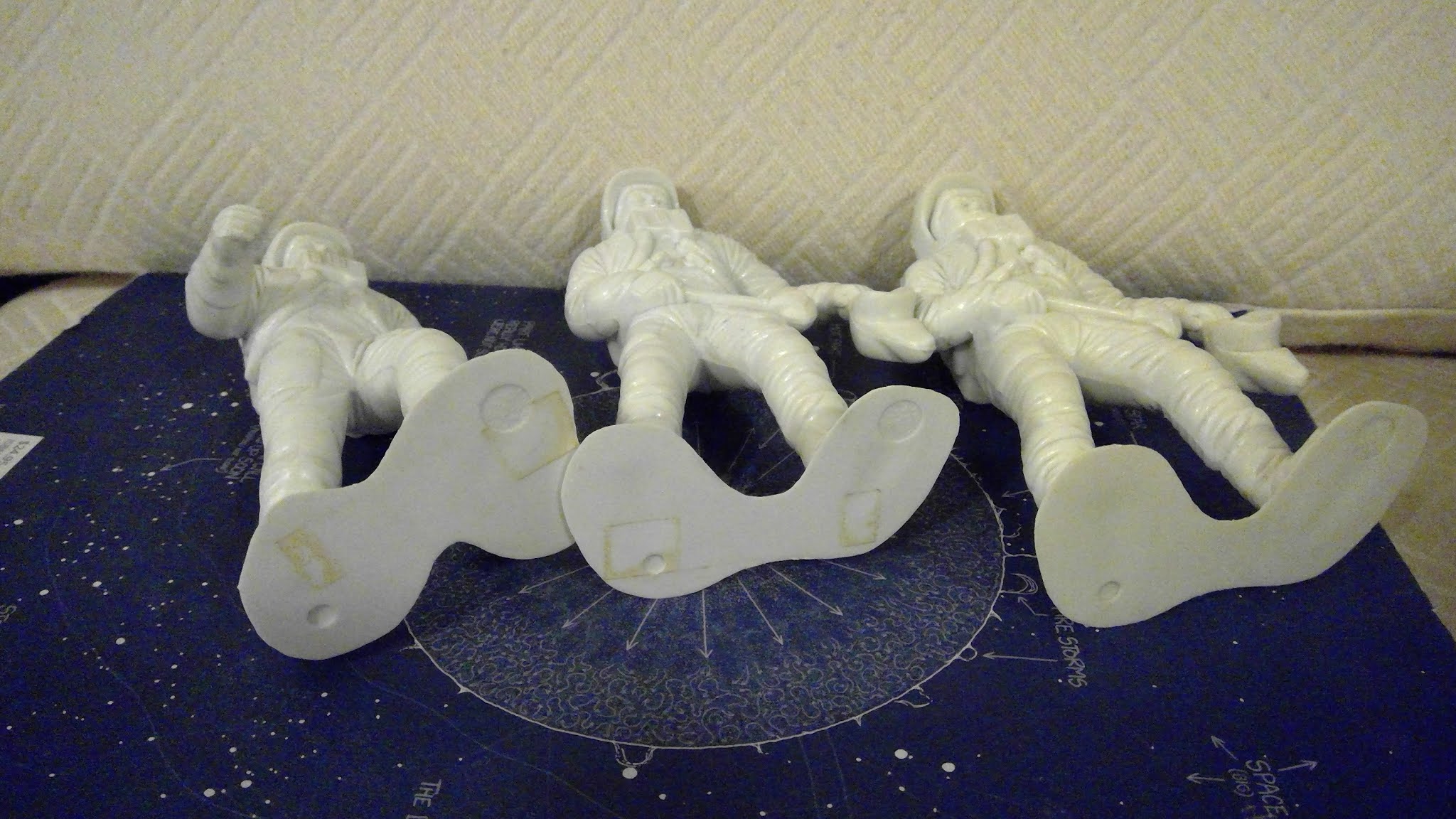
This time, there was no question of the source of the difference; this guy is flat-out grimy, which is a disconcerting improvement. (The other one has a defect at the base of the case handle I can pick out independently, right and behind above.) This mostly just proves that he wasn't together with "Bulgy" from the beginning. However, I did discover they both had tape residue on the bottom, which is a strong indication they were in a single collection sometime before they came to me. Here's a pic.

After taking a look at these guys, I decided to take a look at my two blue astronauts introduced in the last installment of this feature, the Flag Guy and one of two of the Cameramen. The Flag Guy in particular is even glossier than Bulgy. On the other hand, the Cameraman a bit dingy-looking whether in either color, which means if the difference is associated with differences in plastic, the change was made while both colors were still in production. Here's a few pics with Bulgy to show what I mean.

Oo, the shiny!!!


Finally, I took another took at the one I call Digger, who came with the head of a shovel broken off. I didn't even mention before that this is the one I'm sure was produced with a different kind of plastic, probably later and cheaper. I've wondered further if this is one of the figures collectors have described as "waxy". To me, he looks like a piece of candy, smooth, featureless and almost but not quite translucent. For this post, I finally tried banging him against other figures, the "clack test" that actually worked for the Mexican and Ukrainian copy figures, and there was definitely something different. (I truly have the worst superpowers.) Here's a pic of him in a lineup.

With that, I wrap this up. As mentioned above, I have an incoming acquisition incoming that will be getting an installment. If I find out any more in the meantime, I may include an update then, or I just might come back for another round. That's all for now, more to come!


Tuesday, December 8, 2020

Space 1979 Phase 2: The one with Freddy Kreuger and My Favorite Martian


Title:
Galaxy of Terror

What Year?: 1981

Classification: Runnerup/ Anachronistic Outlier

Rating: For Crying Out Loud!!! (2/5)          


I’ve now been doing this feature long enough to pass what I originally considered a possible end point. To mark the transition, I’ve been considering some movies I either put off or didn’t find suitable previously. It was only fitting that the first up would be the one movie everyone was probably expecting me to do all along, but one which I was never convinced belongs here and definitely was skittish about watching again. So here is Galaxy of Terror, usually considered one of the most infamous knockoffs in history… but as in the movie itself, not all is as it seems.

Our story begins with a standard setup of an ill-fated expedition whose last member is done in by an unseen force. Then in a real twist, we meet a mysterious figure called the Master, seemingly something between a mystic and a monarch, who takes enough interest to send a second team. We then meet a mixed bag of a crew with more than its share of paranoid military types, including the survivor of another ill-fated expedition. Our established protagonist is Cabren, second or third in command, supported by his lady love Alluma, the solemn ship’s cook Kore, and a familiar-looking crewmen named Ranger. After a very rough landing, they discover the previous crew already dead (after shooting one of them anyway), but still venture out to explore a huge alien pyramid nearby. The body count quickly goes off as they are picked off, not by a single or consistent monster but a series of unlikely apparitions. As the crew dwindles down to the final few, Ranger theorizes that the pyramid itself is creating their attackers as projections of their own fears. Then Cabren discovers that Kore is more than he seems, and possibly the greatest threat of all.

Galaxy of Terror was produced by Roger Corman, part of a string of Star Wars and Alien knockoffs and “runnerups” that included Starcrash, Battle Beyond the Stars and Forbidden World. The story was evidently influenced by early versions of Dan O’Bannon’s script for Alien, which per the lore was offered to Corman before being snapped up by 20th Century Fox. The finished film was directed and cowritten by Bruce D. Clark, with James Cameron as production designer. Veteran Edward Albert, known for the crypto-biography The Greek Tycoon among others, was cast as Cabren, with Ray Walston of My Favorite Martian as Kore and Robert Englund before his Nightmare on Elm Street break as Ranger. Taaffe O’Connell was reportedly sought out for a possible nude scene, which became an infamous attack sequence. The movie made an estimated $4 million at the box office, a little more than twice its $1.8M budget. It did not receive an authorized disk release until 2010, but has been available on digital video, including free streaming on Netflix and Amazon Prime at various times.

My history with this movie has to a very large extent been avoiding it. I knew of it for a very long time, and watched clips from it, but only got through the whole thing quite recently. When I thought of this feature, I considered it on my earliest lists, but I found myself resisting its inclusion, in part because of the problem of classifying it. I was never satisfied with its usual classification as an Alien ripoff/ knockoff, but it didn’t easily fit my concept of a “runnerup”, which I previously defined as a movie very similar to but independent from a more famous one. In contrast to the likes of Starcrash or Inseminoid, there was no question that Corman “copied” Alien. After learning a little more about the history, however, I decided it still fit the “runnerup” description. What this movie really is, and the way it always felt to me, is an honest “redo” of Alien, run back to its beginnings and played out on a road not taken. Unfortunately, as already seen with Inseminoid, being cleared is not the same as being good.

One thing that has never been in dispute is that the movie has excellent production values, certainly as good as Battle Beyond the Stars and arguably better than Forbidden World the following year (when Corman was already cannibalizing sets, props and actual footage from the previous film). This is borne out in the especially strong opening act, which seems eerily close to Aliens as much as the Alien. (Incidentally, I cannot credit this to Cameron’s involvement alone.) Things get most intriguing as the openly armed and militaristic crew find themselves against a threat that cannot be seen or easily identified; in that respect, it calls to mind the “bug hunts” hinted at by the space marines. The atmosphere of frustration and ambiguity continues through the first few deaths, at least one of which can be attributed to outright “friendly fire”. If one were to look for “one thing” that sends the movie off-course, it’s the outlandish and outrageous demise of O’Connell’s character, which could easily kill many a viewer’s mood by offensiveness alone.

To me, however, that notorious scene is only a symptom of a deeper problem: The story never quite decides between being a relatively orthodox “monster movie” or accepting the potential ambiguity of the horror genre. It can be said in fairness that just considering the latter possibility puts the movie well ahead of its time. While the combination of science fiction and psychological horror was tried as early as Forbidden Planet, the next “modern” movie that stands out as handling it successfully is Event Horizon, almost into the current millennium. As anyone familiar with that production will know, the movie was still plagued by both studio interference and disappointing box office returns, and arguably never saw the light of day in the form its creators intended.

Even with that context in mind, however, Galaxy of Terror mostly just gives up on its own idea. On its terms, the deadly manifestations might be hallucinations, physical shapeshifters, or some kind of holographic projection. But for every scene that could have multiple explanations, like a crewman who gets attacked on a catwalk, there are several more that leave little or none, including a jumpy crewmember who becomes the first victim. What makes matters worse is that the introduced explanation of materialized fears does little more than blame the victims, and even then, there are still only a few attacks that really “fit” anything we learn about the character, notably a bit-part character played with almost no dialogue by Sid Haig. The biggest copout is that it is Ranger who finally bests one of the apparitions, a genuinely menacing doppelganger that further highlights the physical presence of the actor, but he still gets literally ignored for the remainder of the movie. No wonder Englund settled for playing Freddy the next 20 years…

That brings us to the “one scene”, and I had a lot to choose from. For once, my choice is going to be the one that is the most graphic and flat-out brutal, and it’s not the one those familiar with the film will be thinking of. While Ranger is facing off with his double, Cabren and Alluma try to reunite. Alluma goes down a passage that’s downright inviting by the standards of the production, a simple tube with white walls and winding black filigrees that might represent vines. Suddenly, the lights dim, and she discovers that one of vine-things has snared her foot. More follow, and she screams for the unseen force to let her go. She is quickly wrapped up, and one might half-expect a monster to appear and have its way with her. Instead, the things draw tighter and tighter, to clear and gruesome effect. She continues to scream for Cabren long after she is clearly beyond help, until a tendril wraps around her head for the most grisly effect of the film. It is only then that the cameras turn to Cabren as he arrives, just in time to see the aftermath. It's horrifying, but the one thing it's missing is a sense of a universal fear, which is the same problem this movie has run into again and again. 

All I can say in closing is that writing this review at all is the closest decision so far. While I have covered plenty of movies that are obviously not appropriate for the young and/ or impressionable, I have genuinely tried to draw the line at the most “extreme” films of the era in question, especially when it comes to anything to do with sexualized violence. I will also admit I have tried to hold off on anything I feel genuinely conflicted about, which is why I very seriously considered finally bringing in an “unrated” category which I have by now used for other review features. This is a movie with a lot of good, a lot of weird, and a lot that is obviously intended to be uncomfortable for viewers of any age or era. With all that under consideration, I still find it has flaws too fundamental to forgive entirely, which is why I settled for the next to lowest rating. I may not actively hate this movie, but it is still an experiment that failed, then and now.

Monday, December 7, 2020

Mystery Monday: Puzzle party favors


I'm starting a new week, and I decided it was time for a mystery piece. For this installment, I'll be bringing in material I've been working on for a little while. As a new twist, I won't be doing one piece but several, all certainly of separate origin. For this and other reasons, I seriously considered just creating a new feature, which I may still do in the long run. But for today, I present the mystery of the immortal puzzles, with the real mystery being how long and why people have kept making them.

The best place to begin is with the first piece to come into my possession, the green cube. I got it at my birthday party in the late 1980s. I'm sure there was also a ball version that I think my brother got. As usual, I held onto it ever since, long after many of the gifts I got were broken or given away. I'm sure here was a long stretch when it ended up  its separate pieces, but eventually I thought to gather them together and worked out how to assemble them. In the process, I discovered a configuration I have seen many times since, which I call the "H puzzle" for the shape of the two largest pieces. The lineup featured here includes two more examples, the wood barrel and the larger ball. The barrel was a gift from a friend of the family who had a much larger collection; it's stamped from Japan, and I believe it dates from the 1960s. The ball came as part of a larger lot I ordered online around 2011. While the barrel is literally the same, the ball has some significant differences that simplify the overall pattern, though the number of pieces is greater. Here's the two plastic puzzles disassembled.

I got the smaller ball from a vending machine in the early to mid 2010s. It has a different pattern than other puzzles I had become familiar with. In the course of research for this post, I realized that it is in fact identical to a puzzle first sold as a souvenir for the 1939 World's Fair, making this even more unkillable than the patchisaurs. Here's some more pics.


As an extra bit of fun, I figured out early on that I could put the "key stone" piece in backwards. It actually stays in position somewhat better that way. It also makes the ball look somewhat like a face, to me akin to a puffin. Here it is with eyes drawn in, something I've done before. Somehow, even Sharpie "permanent" markers wear off the plastic.
I know my drawing is terrible. I can do better next time.


Finally, here's an extra pic of the set the big ball came with, plus a couple more puzzle balls. It came with 4 different designs and at least 3 of each. I gave most of them away at self-advocacy conventions or as "white elephant" gifts. I have included one of the last still in the bag, and my favorite of the bunch; I am sure I have another in loose condition, so I held off on opening this one. (Not pictured is one I can't put back together.) To me, these puzzles have been an alternative to the symbol of a certain organization; by their design, every piece is an essential part. But that's just me.

With that, I will wrap this up. I have plenty more where these came from, but they can wait for another day. Certainly, more to come!


Sunday, December 6, 2020

Revenge of the Revenant Review: The one with a zombie ex-girlfriend


Title: Life After Beth

What Year?: 2014

Classification: Unnatural Experiment

Rating: It’s Okay! (3/4)


After doing my “main” list for Halloween, I’ve been debating what I want to do with this feature. In the process, I’ve continuing looking at more movies I didn’t get to or simply didn’t think of the first time around. This time, I’m back with a movie that I already waited longer than usual since my most recent viewing to review. What’s even stranger is that I genuinely didn’t even think of it when first planning the feature. (Compare with Splinter, which I noted as the latest under consideration at that point.) It will stand out further as the first movie I’ve covered here from after 2010, in fact possibly the first time I’ve reviewed any movie less than 10 years old since my doomed efforts at animation reviews. Finally, it represents possibly the most conceptually sophisticated, well-cast and genuinely heartfelt treatment of genre among any films under consideration, which unfortunately says more about its disappointments than its success.

Our story begins with our protagonist Zach mourning the death of his girlfriend Beth Slocum, whom we learn had broken up with him or at least gone on break before her demise. He still gets support and sympathy from her father, Maury, but not so much from his own parents and his paranoid brother Kyle. Soon, however, the Slocums become secretive, and when he makes his way in, he discovers Beth alive and well, seemingly unaware that anything has happened to her. Her parents insist that she has returned from the dead through what they accept as a miracle, though they are clearly unwilling to let it be investigated by others or even known to Beth herself. Soon enough, it becomes clear that Beth is not quite herself and already going downhill. At the same time, she demonstrates disconcerting feats of strength, usually too absent-mindedly to notice the consequences, even as her outward appearance deteriorates. Meanwhile, other deceased people begin reappearing, including Zach’s own grandfather, and the living prove unprepared to deal with undead who don’t quite understand what the fuss is about.

Life After Beth was written and directed by independent filmmaker Jeff Baena, with his partner Aubrey Plaza of Parks And Rec as the title character and Dane Dehaan as Zach. The star-studded supporting cast included John C. Reilly as Maury, Molly Shannon as Beth’s mother Geenie, and Matthew Gray Gubler of Criminal Minds as Kyle, with Paul Reiser and Cheryl Hines appearing as Zach’s parents and Anna Kendrick as rebound romantic interest Erica. The movie was filmed in late 2013 and released in limited theatrical distribution and disk the following year. Most reviews were mixed.

This movie is one that I have a very immediate history with. I first heard of it during its limited run, which must have included some local theaters because the newspaper reviewed it. It came out just before Halloween that year, and as far as I can recall, I bought it as soon it was available in stores with what I considered the last of my money. Shortly after that, I showed it to a group of very close friends, one of whom had just gone through a breakup. At the time, I was very impressed with the movie, while those who watched it with me seemed to like it well enough. However, I eventually discovered another friend I was sure had watched it with me has no memory of the movie, which just might be getting to the heart of the problem.

What I can still say after years of repeat viewings is that this movie excels as long as it works at all. Its take on the genre wasn’t quite as original as the creators seem to have thought, with notable similarities to Dead of Night and Shatterdead (both strongly considered but deferred for inclusion here). However, any further comparisons are certainly in its favor, especially considering how jaw-droppingly strange the other films already were. It takes the zombie apocalypse out of the well-worn metaphorical framework of social breakdown and turns it into an equally potent representation of personal grief, all with the full support of top-notch acting and dialogue. Even its awkward or clunky moments (definitely including the handful of scenes between Zach and Erica) generally feel like universal human experiences gone further awry in the film’s assumed world.

Inevitably, the naturalistic approach brings further hits and misses. Maury is charming in his despondency, with a darker controlling streak that predominates toward the end, while Geenie is energized in her excitement and growing denial over Beth’s return. By comparison, Zach is mostly self-centered; he is thoughtful enough to look deeper into the phenomenon but still mostly preoccupied with whether Beth will try to eat him. That leads to his and the movie’s low point, when he seeks out a minor character solely for her ethnic/ cultural background. The sucker punch surprise is Gubler’s horrifying yet delightful turn, beginning as an ordinary obsessive-compulsive and transforming quite enthusiastically into an unhinged survivalist. In many ways, the movie’s greatest weakness is that this all comes naturally enough not to notice just how far it goes beyond the usual horizons of the genre. However, there is also a potentially variable but real point where all the manic energy starts to cancel itself out, and where that falls for the individual viewer is likely to determine whether one can stay with the story to the end.

On closer analysis, the weak link Beth herself. To begin with, we never learn much about her life prior to reanimation, so we don’t have a lot to go on for the speed and degree of her transformation. She also tends to come across as oddly passive, easily controlled most of the time and entirely incurious about her predicament, which isn’t solidly explained and simply doesn’t fit Plaza’s usual style or evident personality. A further consequence is that the events of the story tend to happen around her, driven more by others’ reactions to her than anything she does. One further problem is that the movie makes her degeneration too straightforward to be as potent as it could be. Her earlier scenes will ring all too true to those who have dealt with mental illness and dementia firsthand, but apart from a jealous turn when she perceives Erica as a threat, we never see the spiteful and manipulative behavior that the afflicted can still be capable of. Instead, she descends straight to the level of a standard cannibalistic revenant, which still leaves some very effective moments (especially when Geenie desperately tries to feed her) but nothing new for the genre.

It should therefore be telling that my choice for the “one scene” is the one that has the least to do with Beth. On returning from the escalating drama at the Slocum household, Zach enters his own home, only to find that his departed grandfather has returned. Kyle (clad only in a towel) is ready to shoot him (again!), while their parents try to talk him down. It’s here that Reiser, still best known for Mad About You and his villainous turn in Aliens before that, finally gets enough room to display his undoubted talent. All the while, the grandfather (played by the late Garry Marshall in his final screen appearance) is merely indignant at the behavior of his grandchildren, whom he quite casually addresses by childhood nicknames. When he announces his intent to retreat upstairs, Zach casually comments, “They like attics.” Then, at the peak of the madness, they are interrupted by the arrival of the house’s former owners, who loudly declare that they paid $28,000 for the place. At that point, Reiser responds with perfect deadpan delivery, “When?”

Overall, this is a movie I still personally like. However, even I can no longer regard it as highly as I once did, to the point that I came close to giving it a lower rating than I did. The most useful service movies like this offer is as a reminder that home video is still a relatively new development. Before that paradigm-shifting breakthrough, the best any movie could hope for was one indelible impression on the viewer, and perhaps independent films still do that better than “mainstream” counterparts. If even a film as thoughtful as this one doesn’t hold up so well after repeated viewing, perhaps the lesson is that some movies shouldn’t have to.

Thursday, December 3, 2020

Movie Mania: Science fiction movie books


Once again, I've been needing something for a quick post today. I decided it was time to try something that might or might not work out, but which I've definitely been wanting to do. In the course of my movie reviews, I have been reminded that a lot of what I know started with old-fashioned books. Before the internet, the best way to learn about what was out there, or identify what the Hell you had watched, was trying to find it in the books at the library. I personally stuck with it well into college. In the process, I read a lot of books at one time or another that are now even more elusive than the movies I was reading about. However, there were two that influenced me more than any others, and I now have both of them in my personal collections. Here are my guidebooks to weird movies.

The first under consideration is one I've mentioned before, Science Fiction Movies by Philip Strick. It will be clear from the title that it comes from a time when the genre wasn't as lively as it is now, though you wouldn't know that from the book itself. It was published in 1976, a year before Star Wars. I have always cherished it as the one where I first heard of Dark Star and Westworld (and probably Duel also). Naturally, I forgot the book itself long before I thought to look for it. What finally drove me to seek it out was that I remembered it had a summary of a very bizarre animated short I had searched for on and off. I can't quite piece together exactly how, but after some online sleuthing, I identified the book, based in part on a shot of a two-page spread from inside, and ordered it a year or so ago. Here's a pic of the inside of the book.

The second book was a film reference book I read from heavily in the college library. Its mark in my memory was that it was where I finally identified Krull. It was also one of the first places I found out about quite a few horror movies, including Dawn of the Dead. It was more elusive, except that I had a clear enough memory to narrow down when it was written. It turned out to be a book called The World of Fantastic Films by Peter Nicholls (sometimes just Fantastic Films), published in 1984. I finally tracked it down in the last month or so. Here's a closeup of the cover and a bit of the interior.


Having had the chance to look through these books as an adult and now a seasoned film hound, they both feel odd in hindsight. Strick's profusely illustrated book is clearly more "popular" and potentially kid-friendly, though it covers plenty of very adult movies. It tries to organize movies based on themes, but in practice it just feels random. I personally still haven't made much headway re-reading it. Nicholls' book is more scholarly, covering science fiction, fantasy and horror both by era and individual film makers. It's been much easier to get back into, but it does suffer from a tendency to be self-datingly topical, especially in its treatments of then up-and-coming filmmakers.  It does at least absolve itself of being hard on anything "new", providing favorable comments on originally controversial films like The Thing and Evil Dead.

In writing this up, I looked into the history of the writers. Nicholls was an academic who did a number of works on the science fiction genre, including The Encyclopedia of Science Fiction in 1979. Strick was a bit more colorful. Per a bio at SF Encyclopedia, he was a teacher and lecturer who branched out into criticism and writing. His body of work including both works on science fiction and films in general. Intriguingly, he also edited an anthology of humorous science fiction stories titled Antigrav. By the way, I found out the short film I was looking for is called Scarabus... and it's not great.

I must admit, these are two acquisitions I still have yet to fully assess. Nicholls' book has been interesting as a reminder how I first heard about many films. If I had to choose, however, I still would probably still take Strick's book, if only because it has a much higher density of genuinely obscure films, possibly even more so for the time it was originally published. I still would genuinely recommend both books. Each offers a snapshot of the genre at a pivotal time, especially Strick's. They are also genuinely impressive compilations of information on a wide range of movies. Even a well-versed film fan will probably run across at least a few movies you haven't heard of. The books should serve as a further reminder that reading about movies can be at least as fun as watching them. With that, I wrap this up. More to come!


Wednesday, December 2, 2020

Space 1979: The one with Jane Seymour, John Wayne’s son and a stop-motion baboon


Title: Sinbad and the Eye of the Tiger

What Year?: 1975 (pre-production and filming)/ 1977 (release)

Classification: Runnerup/ Anachronistic Outlier

Rating: Pretty Good! (5/5)


We’re now at review 50, which I had considered as an end point for this feature or at least a phase of it. I’m not there yet, but I have gotten to a point where I’ve covered almost all of the ones I had in mind at the beginning. However, there’s been one more still on hold, in part because it’s the one I have the strongest feelings about. I’m covering it now because I’ve finally been in the right mood to get back to it, and I  wanted something to mark the occasion. So come along with me and take a look at Sinbad and the Eye of the Tiger.

Our story begins in the grandeur and ceremony of an Arab court, gathered for the crowning of a monarch. Something goes awry, and the scene ends with a scream and a shot of flames. Skip forward, and we meet Captain Sinbad and his crew, who are perplexed to find the city locked down. They become more concerned when a shadowy figure unleashes a trio of semi-humanoid creatures to kill them. After surviving the resulting action sequence, Sinbad meets up with his lady love Princess Farah, who explains that her brother and would-be caliph Kassim has been transformed into a baboon. Everyone suspects their stepmother Zenobia, a powerful sorceress who wants her son Rafi on the throne. Their best chance is a legendary scientist named Melanthius, whom they find living as a hermit with his beautiful daughter Dione. The crew set out for the lost civilization of Hyperborea, with the scientist, the transformed prince and the ladies in tow. Romance blooms between the baboon and Dione, who also charms a friendly giant Troglodyte. But Zenobia and Rafi are close behind, aided by a gigantic golem called the Minoton. It all comes together inside a pyramid that is the source of the lost world’s magic, and only one can live to take the throne!

Sinbad and the Eye of the Tiger was the second to last of the science fiction/ fantasy films made by stop-motion titan Ray Harryhausen and producer Charles Schneer. The production was initiated by Columbia Pictures after the commercial and critical success of their previous film, The Golden Voyage of Sinbad, based on a plot arc originally used in an early version of that movie’s script. The cast included Patrick Wayne, son of John Wayne, as Sinbad, with recovering Bond girl Jane Seymour as his love interest and Taryn Power as Dione. The supporting cast included Patrick Troughton and Kurt Christian, previously featured in Jason and the Argonauts and Golden Voyage respectively, and Margaret Whiting as Zenobia. Peter Mayhew made an uncredited appearance as the Minoton, portrayed both with a live-action suit and stop-motion effects by Harryhausen. The film was commercially successful but drew criticism from reviewers and fans alike. It received a novelization by John Ryder Hall and a comic adaptation released in the UK. In June 2020, Power died after an extended bout with leukemia.

For my own experiences, this was one of the first Harryhausen movies I saw, and one I’ve written about before (see the original Revenant Review and my tribute to Ray at Exotroopers). From my further recollections, I rented it while looking for what I figured out was Golden Voyage, in part because the box had a still from the famous Shiva/ Kali statue fight in that movie (one more thing I remembered seeing without any idea what it was). I liked it well enough at the time, and I remained impressed with it as I continued to look up other Harryhausen movies, including the other Sinbad films. In many ways, what interested me most is that this the one even Harryhausen’s fans are reserved about, and I have rarely if ever seen anyone try to say why. Its problems are typical of Harryhausen and other genre movies, and not much more or less serious than usual. On the other hand, its strengths are quite unique, particularly the unusually focused story and some of Harryhausen’s finest and most character-driven effects, especially for the sympathetic Kassim. Compare this to Mysterious Island, my pick for Harryhausen’s weakest film, or the haphazardly episodic story and sequences of Golden Voyage, or (dear Logos) Planet of Dinosaurs, and you have a fine entry that considerably improves on its predecessors.

On closer analysis, what really defines the film are the players cast as protagonist and antagonist. Unfortunately, each goes of the rails in their own ways. Patrick Wayne (replacing John Philip Law, who would sink all the way down to Space Mutiny) is the easy target, looking good but delivering dialogue that is stilted at best. In contrast, Margaret Whiting (born 1932 and still alive at this writing!) seems to ham it up, delivering all her lines in a bizarre accent that literally sounds like it belongs in a Rocky And Bullwinkle cartoon. Yet, there are good points that build if one can get into the proceedings at all. Wayne at least feels sincere in his commitment to the role, and if it comes to that, he looks halfway convincing as an Arab, especially compared to Kerwin Mathews from 7th Voyage of Sinbad. Meanwhile, Whiting careens along with impressive momentum, literally plowing through any obstacles (and people) in her way. It’s all the more remarkable when her plans go awry, not just from setbacks and miscalculations but literally tragic turns you wouldn’t wish on anyone. At her character’s low points, the actress is heart-wrenching to watch, without ultimately proving any less cunning and dangerous.

 Then there are the supporting characters, both human and stop-motion. Kassim, as noted, is compelling, visibly struggling and increasingly failing to hold onto his intellect and humanity. Melanthius is just the kind of genius who could solve any problem while still being no match for the basest conman. His lovely daughter is obviously charming with a touch of the ethereal courtesy of Power’s screen presence. Jane Seymour manages to be downright okay as the princess, without that much screen time. The Troglodyte shows up a little late to match Kassim, but still proves intriguing. On the other side, the “ghouls” of the opening (which I theorize to be based on the “Beetle Men” test reel from Harryhausen’s mentor Willis O’Brien) are suitably eerie as well as physically menacing. Then there is the Minoton, an impressively elemental force with just a hint of contempt for any human adversaries. He’s a not-really guilty pleasure to watch, though I have never mourned the fact that he doesn’t make it long enough for the battle that was planned for.

Any weaknesses not covered so far mostly lie in the final act. By the time the cast reaches the lost world of Hyperborea, things are already starting to feel rushed. Matters aren’t helped by the appearance of a giant walrus, one of the few absolute duds of Harryhausen’s career; it’s technically capable, and made somewhat more interesting by driving snow, but a tragic waste of talent compared to other creatures that were proposed, notably an Arsinotherium based on O’Brien’s unmade Creation. We get some good visuals of the icescape, particularly a tunnel used by Zenobia, and a few good visuals of the distant pyramid with its aurora overhead. However, there isn’t enough time to get much sense of the environment before getting to the pyramid. Along the way, there are some more painful effects moments for Harryhausen’s matte work, none of them especially bad in themselves, but so far below the master’s usual standards that they literally compare unfavorably to 7th Voyage from 20 years earlier. It all adds to a feeling of haste and lost opportunities, unfortunately entirely in line with the actual history of the production.

That brings us to the “one scene”, the finale, which I choose in part because it is one of the relatively few I haven’t already written about at one time or another. In the midst of a confrontation in the pyramid interior, Zenobia disappears into a glowing mist; I have always considered it ambiguous whether this represents her death from a mortal wound, an astral projection of her spirit or a direct transformation. The mist enters an ancient creature frozen in ice, which bursts out as a giant sabertooth tiger. The model looks like it could be a plush toy, but the design rings true and its motions are all too lifelike as it sends the crew scattering. Trog steps in, and the following fight is literally savage and bloody to boot. It’s enough time for Sinbad to grab a lance and draw the beast up a huge and treacherous set of stairs. The true showdown comes as the man and beast maneuver, highlighting both Harryhausen’s animation and Wayne’s surprising coordination and physicality. There are two distance shots where I believe a stop-motion manikin stands in for Sinbad, but I’m honestly not certain. Finally, the beast bats the weapon to one side, and then all is decided in one leap.

The one thing I can add to wrap this up is that I have always almost wished that this had been Harryhausen’s last film. In hindsight, it’s all the more fitting that it came out the same year as Star Wars, the last of one era passing the first of a new wave. In the aftermath, Clash of the Titans was great fun, but it could never be the same. Fantastic films were finally moving beyond the old craftsman’s trade, and increased budgets and big-name actors only made this more apparent. In further hindsight, it’s just as well that Harryhausen bowed out gracefully and apparently willingly. That is how I will remember him, graciously sharing his experience with the world. Rest in peace.

Tuesday, December 1, 2020

Timmee Tuesday: Battle Mountain!


For today's post  I felt like doing some Tim Mee. That reminded me that a lot of my material with the reach of this feature is stuff I already covered in other posts. On the other hand, a reprise can be nice, so I decided to go with something that's already appeared often, the Tim Mee battle mountain. Here's a few more pics of it with the Truckstop Queen.


For the history lesson, the battle mountain was first made sometime in the 1970s, possibly to imitate the even more enormous Marx "Battle of Navarone" playset. It was  sold primarily with Tim Mee's army men, and also surfaced in dinosaur playsets. Surprisingly, no evidence exists that it was associated with Galaxy Laser Team, one of Tim Mee's most successful lines and certainly the most notorious in hindsight. This has fed my suspicion that it was retired relatively early, possibly around the time Legendary Battles came along in 1986. There can be little doubt that other manufacturers copied the design, with or without Tim Mee's permission, but by the 1990's, it would have been an uphill battle to sell them. With the army man-scale playset format largely extinct, and the army men themselves pushed back to bargain bags, it would have been too much and not enough. Still, it was big and durable enough to have soldiered on as a set piece for out-of-scale Star Wars and GI Joe figures.

For my personal experiences, I first heard of this one during the 2010's wave of Tim Mee reissues. I was interested, but I didn't see any immediate value. One thing that kept it in mind was that I saw one regularly for a while at a grocery store play area near a previous workplace. The store closed, and I moved on to another job. Then about a year ago, I had bonus points and a gift card balance to spare, so I finally ordered the battle mountain. My first impression was that it was huge. As seen above, it's slightly bigger than generic Godzilla, though still shallow enough to fit on top of a stacking book case. It also had enough variety of surfaces to hold a range of figures. Here's a pic of the thing from behind.


The downside I quickly discovered was that it's not that stable, to the point that I was getting pelted by space guys for a while. What I settled on was keeping a few figures on the mountain at any given time, and setting up larger groups temporarily if I wanted a pic. I suppose that was a big part of how the blog was born. Here's a demonstration pic with the Truckstop Queen, Bossk, the clubtail patchisaur, a Marx 3 inch space guy, a Legendary Battles ogre/ troll, a bansai bear not previously covered, and some GLT figures, including the mini/ prototype commander.


For the wrapup, I decided this was the best place to say a little more about the one I saw in the grocery store. As mentioned, it was not for sale but in a play area for families of employees, exactly the natural habitat for items like this. I can't say if it was a Tim Mee original, but it was a dark brown color, certainly different from the reissues I had seen online. The area was near the front of the store but cordoned off from casual viewing, as would be expected, and I never saw it in actual use. I stopped going to the store as often after my own work hours changed. I finally stopped in a few more times as the store was closing down, but I can't recall trying to figure out what happened to the toys in the play area. Was it thrown away, sold, or given to someone to take home? There's no way to know, but the odds are if it escaped the junkyard, it and others like it will keep turning up. And while we're at it, here's one more pic of the Truckstop Queen.
Honestly, this way was easier.

That's all for now, more to come!