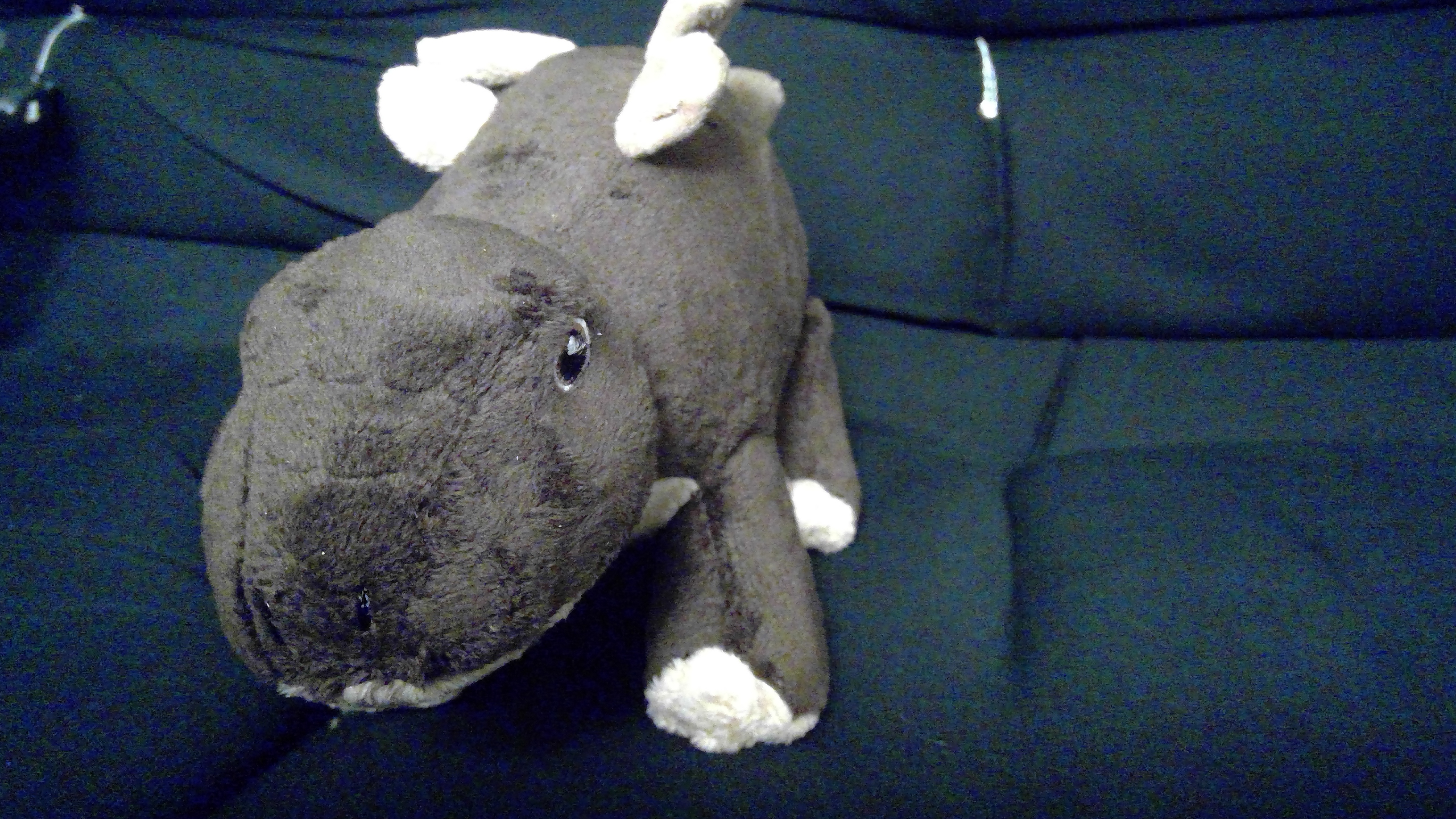
So it's the last night of the year, and I've gone two months without a blog post, and you might think I would just bow out, but I decided it wasn't too late for a dino blog. It just happens I have something very special I've been sitting on, two specimens of the patchisaurs that started this whole thing. To dive right in, here's possibly the first patchi whose origin is entirely accounted for!
Sunday, December 31, 2023
Legion of Silly Dinosaurs: Giant patchisaurs!!!
Tuesday, October 31, 2023
The Legion of Silly Dinosaurs Halloween special: Scary cute stego!
Now for the story, I made this acquisition late last month at the Arizona Museum of Natural History, which I volunteered at back when it had the much cooler name Mesa Southwest Museum. Of course, I had a long history here. This is where I picked up the actually good Prehistoric Panorama Cambrian creatures, an okay pachycephalosaur I can't confirm I featured before, and my second worst dinobot. This little guy was part of a lot that appears to have flooded the shop, with several whole boxes discretely positioned under shelves and tables. His tag identifies him as made by the prolific company Aurora (maker of my first and only Valentine's Day gift), per the data entirely from recycled bottles. He's obviously a cute little guy, and pretty soft. Here's a few closeups.
So that's enough for a quick post. As usual, this feature is always worth the time, and finds like this make things easy when I'm in a hurry. I definitely expect a longer installment soon. And here's some more pics from the trip...
And why not one more in the bag?
Sunday, October 29, 2023
Adaptation Insanity: The one that's the best Stephen King adaptation
Title:
Misery
What Year?:
1990
Classification:
Mashup
Rating: That’s
Good! (4/4)
As I write this, I’m in an unplanned breather from my Halloween lineup, and the big change this time around is that I haven’t been leaning on movie reviews to fill it out. Now, I’m ready to get out one more, and I decided to go with more movies based on the works of Stephen King. And there was no better place to start than my pick for the best one of all. I speak of none other than Misery, as at a minimum the one that does the most to improve on the book.
Our story begins with a writer named Paul finishing his latest novel at an isolated cabin. He starts for home to a jaunty musical number, only to take a tumble on an icy mountain road. He wakes up to find himself being looked after by a matron named Annie who introduces herself as a nurse and his biggest fan. She assures him that the proper authorities and his agent have been notified, but proves evasive as he asks how soon they will come to pick him up. Soon enough, she lays out the truth: She has kept his rescue secret, while the wider world thinks he is dead. Annie wants Paul to herself, and when she finds out he has killed off the character that made him rich, she demands that he write a new adventure to bring her back. The author must write his own escape plan, if the nosey sheriff doesn’t get to him first- but the nurse is even deadlier than she seems!
Misery was a 1990 psychological horror film directed by Rob Reiner, based on the novel of the same name by Stephen King. It was the 17th theatrical film based on King’s work, though only the 7th based on one of his full-length novels. Development reportedly began after producer Andrew Scheiman personally recommended the book to Reiner. William Goldman, a veteran screenwriter and the author of The Princess Bride, wrote the final script. The late James Caan was cast as Paul Sheldon and Kathy Bates as Annie Wilkes, after the roles were offered to actors including Warren Beatty and Bette Midler respectively. The soundtrack was composed by Marc Shaiman. Few changes were made to the story, the most significant being the addition of the sheriff Buster played by Richard Farnsworth (d. 2000) and (spoiler…) the removal of an arc in which Paul publishes the final Misery novel after destroying a fake manuscript. Several early advertisements referenced a scene in which Annie severs Paul’s foot, which was altered in the final film. The film was a financial and critical success, earning over $60 million against a $20M budget, and won a Best Actress Oscar for Bates. James Caan died in June 2022 at age 82.
For my experiences, this is one where I’m foggier than usual. I distinctly recall seeing this movie on network television, and I can remember reading bits of the novel in the early 2000s, but I’m not quite certain which one came first. What I do recall is that I read the novel much later, somewhere in the 2015-2016 window, and very quickly concluded that the movie was if anything a substantial improvement. Sure, the book isn’t “bad”, but under scrutiny, it’s one of his more self-indulgent experiments, with a lot of on-the-nose venting that often seems to be at other writers’ expense. (Apart from anything else, Stephen King still hasn’t done a “real” sequel outside of the Dark Tower series…) By comparison, the movie improves as much as its medium can improve on a literary source, greatly aided by two superb actors. (And I meant to say a lot more about the soundtrack...) The one thing missing is the author’s searing hatred for his own character, which the novel transforms into revealed hypocrisy, but the difficulty of conveying that on-screen is obvious enough that the effective omissions of the ending are understandable.
Moving forward, I’m already feeling like this is a case in point of a movie “too good” for me to review in my usual format. What I find most worthy of comment is how easy it is to underestimate the rest of the cast in the face of Bates’ performance. Caan/ Paul himself is effectively turned into a supporting player, in itself a perversely effective subversion of the “damsel in distress” and the gender-role baggage that goes with it. That, in turn, pays off with real growth as the victim recovers and begins to develop his own plans. The big surprise is Farnsworth, whose only counterpart in the book is a nameless casualty of Annie’s wrath. He becomes an effective third player in the story, in the process adding a police-procedural element to the genre mix. It’s most intriguing to see his outside view of Paul Sheldon’s works. Finally, as with a number of things, his abrupt end is in its own way at least as brutal as anything in the book. (And dear Logos, I think I must have heard of the lawnmower scene when the movie was in theaters…)
Then, of course, there is Annie. What’s most striking is how easy it would have been for the filmmakers to compromise with an attractive or even “Hollywood unattractive” actress. Instead, we get a performer every bit as ungainly as King’s descriptions, without the script and cameras going into “fat-shaming” either. We simply have a plus-size, middle-aged performer playing a character we could pity under any other circumstance. That is only the bedrock of her performance, which somehow gets more disturbing the more we can laugh. Then what I find most interesting is that her character becomes more sympathetic than the character in the original, and I have never been satisfied that this is simply because her bloodiest acts are removed or (arguably…) toned down. The screen version of Annie certainly tends to be absent-minded rather than actively sadistic, yet this is not played into a redeeming quality. It merely makes her less like Sid from Toy Story and more like Elmyra from Tiny Toons; she may not intend evil, but she is no less destructive for it. (Now I’m getting anger flashbacks to those idiot kids in ET…) To me, the difference is that it makes her more believable, and by implication not so different from any of us. And that brings me to a thought I had on my very first viewing, that her character would have been more disturbing and ultimately more frightening if the “backstory” had been cut entirely. All she needed to be was an outlier of toxic fandom that the wider world was still oblivious to. Portraying her otherwise was pretty much the same as making the big reveal in The Shining that Jack was a murderous wifebeater all along.
And that gets to the “one scene”, and there’s one that always stood out in the movie and the book. After Paul’s first attempt to revive Misery on demand, by rewriting the final scenes of his book, Annie simply says it’s “all wrong”. Paul is polite in asking for her input, with a level of returning assurance that will grow. To illustrate, she goes into a story of her childhood (which Paul questions in the book) of going to the serials, and an especially contrived resolution of a cliffhanger. Bates delivers it in top form, if anything with surprising restraint. She concludes, in a line that seems to be unique to the film, “Misery was buried in the ground at the end, Paul, so you’ll have to start there.” It’s all great, and it not only checks all the boxes of “AU” and “canon” that I can now hate that I know but does sound very much like me on one of my rants. This is what fandom is and was like, though I maintain that even then, we still understood that the point was to have fun. And I can give no better defense of the critique I laid out above than this, that if this sequence was the only time we learned anything about Annie’s past, the story wouldn’t be the least bit worse for it.
In closing, what I come
back to is what I really think of Stephen King. I’ve been very sparing in covering
his work, but I have still covered a good sample: Creepshow, Maximum Overdrive,
Sleepwalkers and most recently Trucks. (See also The Signal, kiiind of...) These definitely give a
representative sample of what I find good in Mr. King’s work. I can add that
what I find bad, I cannot find in any story or book I have read through. My overall
policy with King has been to sample cautiously, and either read what engages
with me or respectfully set aside what doesn’t. The end result is that I have
read some of what is agreed to be his best work, skipped a number of his “classics”
and come to greatly appreciate some of his works that remain decidedly offbeat.
(Again, how in Cocytus did we not get a Rose Madder movie?) The
present film similarly shows how to get a good movie out of King’s material:
Don’t worry about what’s most popular, or his “best”, but just run with
something that’s different. It’s a lesson Hollywood may not learn anytime soon,
yet there are enough quirky projects out there to have hope for the future. For
now, we can appreciate what we’ve got. “Isn’t that an oogie mess…”
Sunday, October 22, 2023
Fiction: The Adventures of Princess Sarah, Part 2!
Sarah’s first sensation
was falling. The next was landing on her face. She skinned her knees in gravel,
and one of her teeth came out against the rock. She started to cry, before she
remembered she was a big girl now. She raised her head, and found Prince Robert
looking down at her, his frog pack on his back and his beloved toy Frog Frog in
hand.
“Sarah
fall down,” he said. “Sarah ow ow?”
“Oh,”
said a distant, murmuring voice, “look at them!”
“Oh,
don’t talk like a baby,” Sarah said. She scrambled to her feet, briefly looking
left and right. There was another murmur, as if one voice pressed another to be
silent. They were in what was clearly a streambed, empty but still damp. Her River
Cow bag had landed in a murky puddle beside her. She snatched it up and
absentmindedly used her skirt to wipe it off. “Oh, poor Missus Cow… I mean, I
hope it’s not wet.” She reached into an outer pouch and pulled out a jar of
salve. Robert helped rub it on her knees.
“Ooh,”
came the distant voice. “Look, the little one’s helping the big one!” The other
voice rumbled louder than before.
“Well,”
Sarah said, “we must have opened a magic door. Father said that was how he met
Mother.” She smiled at Robert. “It will be an adventure, just like in the
Guidebook! Ooh! I hope it didn’t get wet!”
She
pulled out the book, and sighed in relief to find it dry. Indeed, she could
feel no dampness at all on the inside of the bag. That was because it was, in
fact, lined with real Water Cow hide, something Mother and Father had so far
neglected to explain. She half-spoke the table of contents: Cartography, Topography,
Geology, Botany, Zoology, Ethnography, Diplomacy, Polity. She flipped to the
second chapter, then the third.
“`In
your surroundings, you can see the past, present and future,`” she read. “`If
there is a clamshell in desert sand, then it must once have been an ocean. If
there is a tree or the cornerstone of a house still rooted in a riverbank, it
must once have been dry ground. If there are stones that look round and smooth,
then they must have been worn down by slow and gentle currents water or other
elements. If there is gravel and large stones with sharp edges, then stronger forces
may be in effect…’”
She
looked up and down the channel. There were indeed a number of angular rocks.
Then, half-buried in the gravel, there was the keel of a capsized boat. “Oh,
dear,” she said. “`…If you see evidence of floods or falls of rock, vacate to
higher ground as quickly as possible.’”
“Frog,”
Robert said. He pointed to a purple toad with oddly long legs. It was struggling
to climb up the steep edge of the bank, without appreciable success.
They
quickly scrambled up the streambed. “Aren’t they adorable?” said the distant voice.
“I just want to hold them! Those packs! Aww, look at the little boots! Really,
can’t we help them?”
“Now,
now,” came the lower voice. “We can’t interfere. Besides, if they have our
smell, their parents may not take them back…”
They
reached a hilltop where a tree grew from an outcropping. Sarah declared they would
have lunch. She poured them each a glass out of Dink. She took out a safety
knife and cut up the roll. She tried spreading the pomegranate jelly on a small
piece, but she spat it out as soon as she tasted it with the hard and sour
bread. Instead, she cut up the cheese and half of the sausage and served them
on the bread. “`A lady in the wilderness should encourage the gentlemen with food
prepared well and served with aesthetics and good cheer,’” she recited from
memory. She offered the stacked slices to Robert.
“Frog,”
he said. He opened Frog Frog, and the purple toad hopped out.
“Robert,
Mummy and Mother told you, you can’t take anything real for your collection,”
Sara said. The Prince offered a crumb of the bread to the creature, which
showed no interest.
“Help
frog,” he said. He tried again with a sliver of sausage, which the toad
swallowed.
“Oh,
he is kind!” cooed the voice. “And so brave!”
As
the Princess and Prince ate, the sky grew overcast. Before they had finished,
it began to rain. Robert opened the umbrella to deflect what the branches of
the tree did not. The toad hopped about on the dry ground, which it evidently
preferred to the rain. Sarah flipped open Dink’s top and leaned out, collecting
a smattering of rainwater. When she looked downhill, she saw that the streambed
was already half full. She again took out the Guide, and opened it to the
fourth part.
“`To
travel and survive in an unfamiliar land, the first priority must be to
identify and harvest edible plants,’” she read. “`There is no better
preparation than learning the flora of the known realms, yet this is but the
first step. It is essential above all not to let familiar appearances lead to
false conclusions. Even the most learned and experienced have perished because
they took a deadly plant for an edible one, or disregarded a source of valuable
nutrition because it resembled a noxious weed…’”
She
flipped through a series of illustrations that filled a good part of the guide,
pausing occasionally to consider the plants around them. None of them looked familiar
or welcoming in the first place, and several that had looked at least vaguely
similar to ones in the book proved to be among the strangest of them all. She
reached out and pulled down one of the very branches overhead. The leaves, on
examination, were strings of separate fronds. What looked like a single flower
was similarly a cluster of tiny blossoms. She examined one of number of white
globes that she had taken for fruit. Its surface proved papery and translucent.
She found that it had no stem, but bulged directly from the branch. At a gentle
poke, it split, revealing a pallid worm that hissed at her. She squealed and
let go of the branch. As it snapped upward, the grub went flying.
“Let’s
go,” Sarah said as soon as the rain cleared. “We need to find a safe place.”
Robert shrugged and shouldered his pack. The long-legged toad clung to one
strap. His sister read as they walked from an earlier chapter. “`When possible,
follow waterways. They will lead to centers of agriculture, population and even
government…’” When they reached the streambed, now full of coursing, muddy
water, she turned upstream.
“Oh,
no,” said the distant voice. “We can’t let them go that way…”
“Now,
dear,” rumbled the answering voice, already grudgingly, “it’s going to be a
bother…”
Sarah
tramped along the bank, Robert following behind her. Something almost but not
quite like reeds grew along the edges, sometimes well back and sometimes so far
forward they had to push through it. Ahead was a stand of trees like the one
they had sat under. She read aloud from the fifth part of the Explorer’s Guide,
on zoology. “`The next and most vital step in understanding an unknown land is
to catalog its animal life,’” she said. “`Consider the size, shape and habits of
each creature. Does it consume plants, meat or a combination of both? Is it
alone, or does it gather and travel in groups? Are its colors and mode of life
a match for its surroundings, or could it be a traveler from elsewhere like
yourself?” As she spoke, she took a closer look at the strange toad. They were
mere Cubits from the edge of the trees when the creature stepped into their
path.
It
was three Cubits high and utterly massive. It had scales on its belly and
limbs, and long, fibrous quills on its back. It seemed to have no neck, only a
massive head that protruded from between its hunchbacked shoulders. Its face
was dominated by a long, stout beak, a helmet-like carapace and two red eyes.
“Please,”
she
said, carefully enunciating, “you must go back. I will show you…”
Sarah
froze and stared. Robert huddled behind her. The squawking cries hurt her ears.
It was like the roar of one of the engines Father’s craftsmen wouldn’t stop tinkering
with, drawing out every note with prolonged reverberations. But what she found
most disconcerting was that its cries sounded almost like words. She hastily
consulted the Guide.
“`If
intelligence is unknown, treat a creature as you would a strange dog or a menagerie
beast outside its cage,’” she quavered. “`Maintain an upright posture, firm eye
contact, and an authoritative voice. If possible, withdraw deferentially,
without haste or any sign of panic…’”
As
she edged deeper into the almost-reeds, she straightened and called out, “Leave
us alone, we don’t want trouble!” She added, “I’m a princess, not a little
girl! I’m six, almost six and a half!”
Suddenly,
a second and even larger creature burst out of the trees, as tall as the armoire.
“No, no!” he bellowed. “Stay away, see!”
Sarah
and Robert both shrieked, and immediately turned and ran. The girl took her
brother’s hands, though within moments, it was he who pulled her forward. As
they disappeared, the larger creature embraced his mate. He groomed her mane as
she shook with honking sobs. “Ohh,” she said, “did we have to do that?”
“There,
there, he said. “I’m sure they’ll be all right…” He gave a honk that made the
children run faster still.
Friday, October 20, 2023
Adaptation Insanity: The one that readapted Maximum Overdrive
Title:
Trucks
What Year?:
1997
Classification:
Weird Sequel
Rating:
Ow, My Brain!!! (Unrated/ NR)
As I write this, I’m trying to scrape together a lineup for Halloween, and that brought me back to this so far barely started feature on adaptations. That, in turn, brought me to a whole lot of maybe pile material from everyone’s “favorite” author, Stephen King. (See Sleepwalkers, fungghh.) As I surveyed the material at hand, one stood out that would otherwise have gone under my even more abortive feature on TV movies. It’s one King adaptation that has stayed obscure even though it’s been readily available for a very long time, and as a bonus, it’s based on the same source material as the only film the author directed. So do we have undiscovered gold, or a buried cat spoor? Would I be writing about it if it was that simple? Here’s Trucks, a made-for-TV film that has just a little more under the hood than one might think.
Our story begins with an old jalopy that takes out its owner. We then move to a little townlet with a truck stop and a lodge for a sightseeing tour, where a man and his son, a veteran and his spunky daughter and a vaguely mysterious lady guide meet up. While the domestic awkwardness unfolds, they notice several vehicles moving around strangely, with no explanation or context beyond vague official broadcasts about chemical spills in the area. They soon find themselves under siege by trucks that have no drivers, seemingly led by a meat truck that locked its driver in the freezer. The dad becomes the leader of our little band as they plan to fight back. But soon it becomes clear that the machines don’t just want the humans dead- they want to be their masters!
Trucks was a 1997 made-for-television movie aired by the USA cable network. It was the second adaptation of Stephen King’s short story of the same name, following the 1986 theatrical film Maximum Overdrive directed by King. The film was produced by Trimark Pictures, a company also responsible for distributing Dead Alive, with New Zealand film maker Chris Thomson as director. King and screenwriter Brian Taggert (see… Of Unknown Origin???) shared credit for the script. The cast was led by TV/ character actor Timothy Busfield as the dad Ray and Brenda Bakke as the guide Hope. Unusually, the film was rated by the MPAA, which gave it PG-13. The movie was released on VHS. It is currently available for free streaming on Tubi and Amazon Prime.
For my experiences, I watched this one as a video rental around 2005, after reading the story but before watching Maximum Overdrive. At the time, I regarded it positively, even finding favorable comparisons to the theatrical film once I had seen both. Since then, I have come back to both at irregular intervals, and what I have come to see is equal and opposite extremes. Maximum Overdrive was an exercise in big-budget 1980s excess, exacerbated by a creator with no experience and unlimited creative control. The present film, on the other hand, is a clearly competent production restrained for better or worse by sub-B production values and “mainstream” network sensibilities. In many ways, the most appropriate frame of reference is the remake of Night of the Living Dead, which can only highlight the futility of comparison. What we have is truly a case of two films with nothing in common except source material, and it’s impressive enough that both have retained some measure of relevance.
Moving forward, the most significant further comparison between Maximum Overdrive and Trucks is that the former was action/ adventure where the latter is unequivocally horror. By any appraisal, what modest merit the present film has is owed to this decision. There is no vision of a wider apocalypse here; indeed, from what we do know, the authorities of the wider world are either unaware of the unfolding situation or so far able to contain it. This allows the focus to remain even more than in the original story on characters in isolation and growing despair. What’s different is that the individual buildings are not particularly claustrophobic. Space is ample, and there are windows that give a good view of the surroundings. On the other hand, the structures are so old and dilapidated that the trucks easily smash through whenever they try, quickly removing any appearance of safety. The key ingredient, of course, is human characters we can like or at least find believable. In those terms, this comes close to trying too hard. The characters are more fleshed out then the ciphers of the story, yet the drawn-out backstories do not make them any more vivid or sympathetic than the rogues’ gallery of Maximum Overdrive. On the balance, we at least have competent actors delivering decent dialogue, greatly helped by Busfield. I have to give a particular shoutout for his performance in the final shot of the film (definitely up for the “one scene”). In a more routine film, the unsurprising reveal could have led to a freeze frame of a shrieking scream queen; from our lead, we do not see fear or even surprise, only resignation.
Then, of course, there are the machines, and this is where the most definite improvements emerge. The goofy gimmick of the goblin truck is replaced by ordinary, working machines that are vastly more frightening. One can draw some sense of personality out of the individual machines, strikingly varied in size, age and roles, though none can match the sheer malevolence of the beat-up old clunker in Duel. It’s most intriguing to see the group playing literal cat and mouse. The usual trade-off is that it quickly becomes obvious when the machines are just messing with someone they have no intention of killing, and the cop-outs avoid the kind of gore that might push the limits of television. (And this was cable, dammit…) By my long-running rant, however, the nuance of a “monster” is potentially unnerving in itself, and the payoff here is better than usual as their ultimate plan becomes clear. Then there are moments of pure brutality, egregiously the surreal attack of a toy dump truck on a mailman (yes, you read that right) and a final kill where the lead truck wipes out a building as collateral damage. We get one more inscrutable moment in the finale when the same machine tries to wipe out the protagonists for no strategic reason, as if willing to destroy out of pure spite. This is what you get when variable behavior is used for more than plot armor.
Now it’s time for the one scene, and this is where I’ll mention that I went through a whole viewing in the course of this review just to stick to my own rules. Right about the middle, I was actually waiting for the sequence that was always going to be here, and still taken a little by surprise. We see two cannon-fodder government types who have already popped in and out, on their way to a chemical spill that might otherwise be written off as a cover story. One decides to put on his hazmat suit, a piece of gear that looks for all the world like a human-shaped padded envelope, leaving his companion in the cab. As the other guy finishes some inconsequential task, a second suit starts to inflate. Sure enough, when fully inflated, the suit starts to move of its own volition. The guy in the cab doesn’t seem to notice, until he sees his colleague outside. There’s just a moment to be surprised before the animated suit strikes with an axe already on hand. We then cut to the suited goon as he returns to the rear of the truck. He looks up at the bloody apparition, and promptly asks what he is doing. Of course, he gets the axe, and there’s a certain impressiveness as the phantom dispatches him, with far more force than strictly needed yet no sign of savagery or sadism. And then the suit returns to its place. Even compared to Maximum Overdrive, it’s a bizarre and totally random moment, neither foreshadowed nor figuring in any subsequent event, which is exactly how a movie like this stays in your memory two decades later.
In closing, I come to the
rating. What it really comes down to is that this is one I would simply ignore
under normal circumstances, especially in a feature with my “revised” rating
scale in effect. Even with the points I have laid out in its favor, this is just
plain cheap. On top of that, its greatest significance in genre history is to
show just how far feature-length TV movies had fallen after peaks as recent as 12:01.
Yet, as I postulated at the beginning, it still manages to be just a little
more than it should have been, and it is clear that I’m not the only one who
remembers it. For that, I can give it my attention and just a little respect. Forward
until dawn!
Tuesday, October 17, 2023
The Anthology Anthology: The very modern horror of Ambrose Bierce
As I write this, I’m looking at another week of posts, and I’m far enough ahead that it is still technically the weekend.
As it happens, I was already working on something that spun off into another
post, the fiction of Ambrose Bierce, which was transformed into the “true” tale
of Oliver Larch. Here, I’m giving a wider, still anecdotal survey of his work.
For introduction, I’m not going to
try to cover the author’s life or his place in American literature. What I was
interested enough to run down is the background of the two collections I consulted,
The Ghost And Horror Stories of Ambrose Bierce, which I bought in ebook
form, and the more luridly named Terror By Night. The former has an
introduction by one Dan Hawks, the latter by David Stuart Davies. Both
otherwise appear almost identical (I’ll get to that…) both to each other and to
the 1964 publication The Ghost And Horror Stories of Ambrose Bierce, edited
and introduced by E.F. Bleiler, a scholar of science fiction and fantasy. On
working this out, I was immediately satisfied that the 1964 book was one which
I had read during college. (I distinctly recall reading it the same night I saw
the end of Eight Legged Freaks on TV, because my superpower is my torment.)
So, here’s a rundown of the ones that have stayed with me all this time.
“Moxon’s Master”- This is the most
historically significant story by Bierce, a proto-science fictional tale about
a chess-playing automaton that takes losing badly. In an unfortunate common
denominator, it’s not really his best work. A good chunk of it is a monologue
that lays out a kind of pantheism as a rationale for machine intelligence. The
actual bout between man and machine is well-paced and intriguing, but there
just isn’t much here.
“A Vine On A House”- This is an
example of the formulaic side of Bierce’s work, done better than usual. On
stopping at a crumbling and ill-reputed house, two travelers notice a vine shaking
without explanation. An investigation leads to a grisly discovery. Surely based
on the actual case of Rhode Island founder Roger Williams, it’s another story
with overtones of animism, quite effective and still understated.
“Stanley Fleming’s Hallucination”-
This is perhaps the most oddly prescient of Bierce’s stories, concerning a man
who is threatened by nightly visions of a menacing hound in his bedroom. His
roundabout confessions reveal a darker backstory that will end in supernatural
revenge. One can find in it the conceptual bedrock of the Nightmare On Elm
Street franchise (which I had previously traced through the work of Robert E.
Howard). In a running theme, it feels underwhelming placed in context, which here
more than usual is clearly our fault, not Bierce’s.
“A Fruitless Assignment”- Now we
have Bierce’s true masterpiece, a brief misadventure of a journalist sent to
investigate a supposed haunted house where mysterious yet decidedly unghostly
figures come and go. It’s startling for how weak it should be on paper, less
than 3 pages with a buildup that’s too long and never makes sense. But there is
an incalculable impact in the utterly savage climax and the even more
frustrating aftermath, with a deceptively well-realized and decidedly
unsympathetic protagonist. On top of everything else, it’s a chillingly early
treatment of PTSD. Here, the greatest horror is to live and learn nothing.
“The Spook House”- A longer piece
by Bierce’s standards, another pair of travelers venture into a deserted house
whose original owners disappeared. Only one will come out. It’s more of the economical
savagery that the modern reader could easily overlook in familiarity, both
atmospheric and gruesome. What impresses even now is the “ambiguous” ending,
which Bierce truly excelled at.
“The Suitable Surroundings”- Here,
we see Bierce in full-blown deconstructionism, tweaking the Gothic horror genre
still in its prime. A writer challenges a reader to read his latest story under
uniquely unsettling conditions, with deadly and comical results. I freely admit
I didn’t try to re-read this one; what I remember is enough.
“The Difficulty of Crossing a
Field”- A much better entry in Bierce’s cycle of eerie disappearance tales, a
man disappears without a trace just outside his own front door. Again, the
deeper horror is the exploration of the aftermath.
“A Jug of Sirup”- An entry in the
“disappearing shop” niche genre as much as anything else, a storekeeper returns
from the grave, so much himself that it takes a while for his old customers to
notice. It’s another satire, not quite as subversive as “Suitable Surroundings”
but correspondingly more unsettling. This is incidentally the epitome of
Bierce’s view of the revenant dead, neither angelic nor vengeful, but merely acting
the parts they did in life.
“Visions of the Night”- And this
is the one that was only in the ebook, which I remembered from the 1964
edition. The author narrates a series of visions supposedly from his own
dreams, the last being a seemingly whimsical encounter with a talking horse. One
can take the authenticity with a heaping helping of salt, yet it is a
convincing picture of the world of dreams that lays out a path for much to
follow. (Fine, I’ll mention House…)
And that’s enough for me. Needless
to say, there are many, many more that I am passing over, including supposed “classics”,
but these are by all means representative of the stories that have impacted me.
It should be obvious that I hold this author’s work in the highest regard,
where it truly deserves it, and equally obvious that I am well aware of the
flaws. In the proverbial light of day, Bierce stands out first and foremost as
an author who didn’t and perhaps couldn’t pick a lane between satirizing what
was wrong with a genre and actually doing it well. He also gives an early
preview of the cycles of excess, self-parody, and revitalizing deconstruction
that have afflicted horror fiction. But he also does offer some of the very
best genre tales of his own or any other time, which are even now a breath of
fresh air for anyone who has truly gone through the trash heap of history. Read
him with my highest recommendation, perhaps ideally in small doses. The one
thing you will not do is forget.
Image credit ISFDB.
Sunday, October 15, 2023
Fiction: The Adventures of Princess Sarah demo!
As I write this, I've been trying to work up a weekend post while it is still the weekend. After trying to build on other stuff, I finally admitted I wasn't going to do better than yet another demo I worked up as a spinoff of my retro gaming novel. It actually is an idea I've had for quite a while (see my Troll review), fleshed out with a couple characters I already had a lot of fun with. It also crossed my mind that just about everything good I've ever done has been on the fantasy/ mythology vein. So, here goes...
Princess
Sarah and Prince Robert were the children of High King Hector and Queen
Daffodil of the Aquamarine Isles and the united Kingdoms of the sea. Sarah was
the second oldest of three little Princesses, and Robert was the youngest and
the only Prince. Sarah was frustrated and suspicious that the King and Queen
would not say if there would be another Prince or Princess. In the summer, when
the High King liked to take his Queen on a tour of the Isles and the eldest
Princess Lily was away at camp, Sarah and Robert and their sister Bell went to
stay with their Grandmother, a Dowager with a great palace on the sea to the
east. They loved spending time with Mummy. When they were not with her, they
went on long adventures through the Palace grounds, which were full of all
manner of wonders. A day came when Sarah announced that they would explore a
more secluded part of the Palace.
She
held up an old book with a map of the Palace. “Look,” she said, pointing at a
turret on the far end of the grounds. “This is the Old Royal Bedroom. Grandma
says it’s just a storeroom now. But the location is all wrong. I think there’s
something interesting. Anyway, we covered the west wing already. Did you gather
our provisions?”
“Frog,”
Prince Robert said. He was still just beginning to talk, at an age when Sarah
had already had an extensive vocabulary. He held out a purse shaped like a
frog, which their mother had fitted with straps to wear on his back. Sarah sorted
through the contents. The first was his favorite story book. Next were an umbrella,
a tin of soup crackers and a tiny jar of pomegranate jam. Then there was a smaller frog-shaped coin
purse that had been his beloved toy before he inherited the larger one. It
rattled with his Collection, a shifting assortment of objects he picked up. It
held about a dozen small rocks, three marbles and a pretty seed pod. She opened
a compartment in the roof of its mouth with a key Mummy had entrusted to her. It
held three candies. Sarah sighed.
“Robert,”
she said, “I told you, we need food, not treats….” She relented when she pulled
out a sack on the bottom. It held a large roll, a lemon, two peaches, an eighth
of a cheese wheel and half a sausage. Robert held out another item. It looked
like another toy, shaped like a saurian with a stubby tail and a large, round
head. In fact, it was a pitcher, with a lid that formed the saurian’s upper
jaw. In the purse were two cups.
“Dink,”
Robert said.
“Okay,”
Sarah said. She shouldered her own bag, shaped like a Water Cow. “This is good.
Now, let’s go.”
She
led the way. She wore a simple checkered dress, because only little girls wore
overalls like boys did. On her feet, she wore perfectly sized and entirely
functional hiking boots that clomped loudly on the palace floor. Robert wore
her old pair, which were dyed a salmon pink that had worn and faded down to
white spots. As they proceeded, the Palace attendants discretely stepped aside.
They paused when they found Mummy in their path, innocently playing with her
pet ferret. “Hello, children,” she said. “Are you exploring today?”
“Yes,”
Sarah said. “We’re going to survey the West Tower.”
“I
see,” Mummy said. “Are you sure you want to? It hasn’t been used in a long
time, it must be awfully dusty.”
“Yes,”
Sarah said. “I bet the catalog is out of date. We can clean up.”
“If
you say so,” Mummy said. She gestured to an attendant, who brought her a comb
to groom the ferret. “Do be careful. Be sure to be back by tea time.” She waved
as they entered the tower stairway.
“Bye
bye,” Prince Robert called back.
The
stairway proved to be a long climb. They paused at a chamber a third of the way
up. It was configured as a sitting room, with a small table that held a chess
board complete with pieces. Sarah measured out half the crackers, and filled
their cups from Dink. While Robert munched his share, she examined the table.
“I knew it,” she said, lifting the red king. “There’s no dust. Someone has been
using this section recently.”
“Dink?”
Robert said, holding out his cup.
“We
need to conserve our water,” Sarah said, then relented and filled his tumbler
halfway.
They
were winded as they reached the top. It was a high-ceilinged octagonal chamber
that echoed with the sound of their boots. The better part was filled by a
great bed ringed by curtains. Facing it was a painting of a woman who looked
like their mother. Sarah frowned as she looked up. It showed her from behind,
in the act of emerging from her bath. Her head was turned back, throwing a sly
smile over her shoulder. When the Princess saw Robert at her side, she said,
“Go play play. Over there.” She redirected him from the bed to a celestial globe
to one side. He giggled as he spun the concentric brass rings.
“Wait,”
Sarah said. Her brother froze with a puzzled expression. “You weren’t being
bad,” she assured him quickly. She showed him how to turn the knobs and dials
properly. She frowned again. “This was tuned, recently.”
She
went out onto the balcony. She opened the main compartment of her bag, which formed
the belly of the Water Cow. The buckles of the strap were anchored on the tip
of the tail and between its horns. She brought out her field glasses and her
favorite book, the Royal Explorers’ Guidebook. “`First, survey the area from an
elevated position,’” she read. She looked out with the glasses. It was, of
course, all familiar landscape, though she discovered that she could see the
Royal Flamingo Preserve. She helped Robert up and held the glasses for him.
“Birds,”
he said.
“`Next,
sketch a chart of the terrain,’” she read. She set down the glasses and took
out a drawing pad. She scribbled an outline of the lagoon. “`Make particular note
of usable caves and shelters, navigable waterways, and any structures of
artificial origin.’” She put an X on a canal that ran back to the Palace. “`Catalog
the birds and game…’” She watched the flamingos as they milled about the
lagoon.
“Well,”
she said with a sigh, “I guess we’ve surveyed this area.” She was mildly
surprised to find that Robert was no longer at her side. She was momentarily
alarmed when she did not see him behind her either. She circled the bed before
she panicked, as Mother told her. Sure enough, her brother was on the other
side, looking up at a large armoire.
“Leave
it alone,” she said, walking to his side. “I’m sure it’s locked, anyway.” He
pulled at a handle that was just within his reach. The left door came open.
“Oh. Well, I’m sure there’s nothing interesting…” She opened the door, and then
the other.
The
armoire was in two parts. The right side was a set of drawers with a cabinet on
top. They were locked, except for a pair of drawers just under the cabinet
door. She pulled one out, and found it disappointingly small. The left side was
an open space as large as her closet, where a suit, a fur wrap and a greatcoat
still hung. Sarah tugged at the coat, and found it stiff with age. Robert
pointed and whimpered. She followed his pointing finger to a curled up beetle
at the back. “I see it,” she said. “Poor little bug.” He whined expectantly.
She
sighed and climbed into the armoire. It seemed larger inside than outside, tall
enough for Mummy or Mother or even Father to stand upright. She drew a
handkerchief and carefully picked up the beetle. “There,” she said, holding up
the kerchief. “We’ll give Mr. Beetle a funeral.” She shrieked at a buzzing from
under the cloth. She shook out the kerchief, and the now-squirming beetle tumbled
out. Before it hit the ground, it spread its wings and flew out through the
open door.
“Well,”
she said, smoothing her dress, “Mr. Beetle must have gotten stuck inside. It’s
a good thing we opened the door, or he might never have gotten out. Let’s go
back to the other room.” She climbed down, and started to push the right door
shut. She paused, frowned, and opened the drawer again.
“This
is too small,” she said. “It’s shallow, do you see? It can’t go all the way to
the back. Not even halfway…” Robert looked intently, and nodded in seeming
agreement. She opened the other drawer. From it, she pulled two keys. One was
weathered brass, the other mirror-bright silver.
She
went back inside the armoire. Robert followed, holding his little frog. She ran
a hand along the wood paneling. The joining was artful, but could not be hidden.
She knocked twice, producing a hollow rattle. She found a decorative panel that
slid to one side. Behind it was a keyhole. Robert tugged at her sleeve. “No,”
he said solemnly. “Frog Frog say so.” The eyes of his frog swiveled and
blinked.
“Don’t
worry,” Sarah said. “It’s just a trick door, like Mother’s magic drawer. Look.”
She turned the brass key in the lock. The door swung open. It revealed a set of
shelves. It was mostly books, most of them in strange languages and letters. On
the top shelf were a bottle, a jar, a knife and a strange skull. “See? Just
grown-up stuff.” She shut the door and locked it. Only when it clicked did she
realize that she had used the silver key.
“Huh,”
she said. “They both fit the same lock. I wonder why…” She turned the key
again. The door opened…
“Sarah!”
Robert called out. He grabbed for her skirt.
The
hidden door clicked shut.
And
slowly, the ponderous doors of the empty armoire swung shut.