Wednesday, August 19, 2020
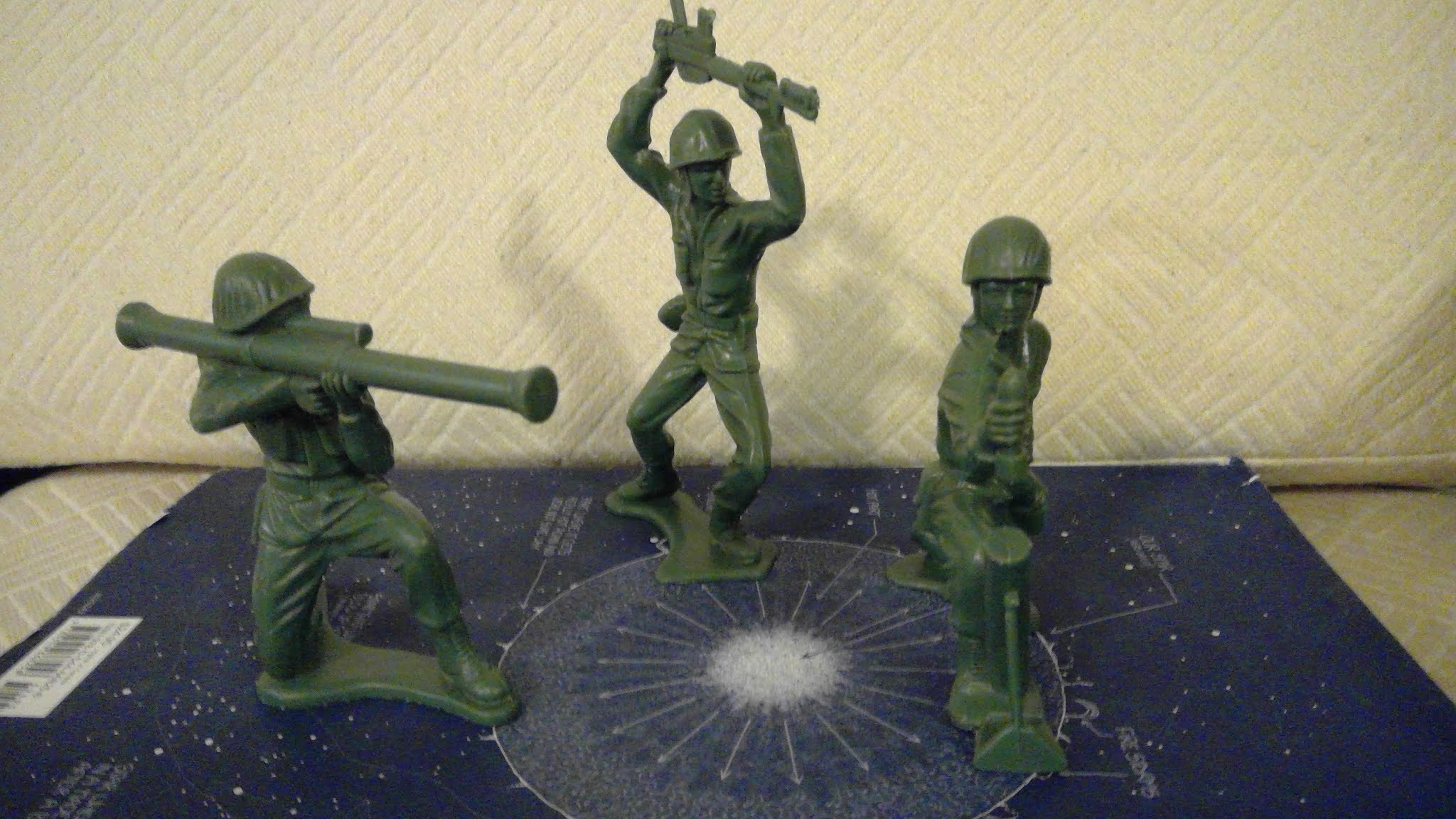
The Legion of Silly Dinosaurs: Walmart Megafauna!
Tuesday, August 18, 2020
Space 1979: The one where brain slugs crash a frat party
Title: Night of the Creeps
What Year?: 1986
Classification: Parody/ Mashup
Rating: Pretty Good! (5/5)
In planning this feature, my hardest decisions have been whether to
cover horror, especially zombie movies. As I have recounted elsewhere, I got
into zombies back when most of what was out there was movies from the 1970s and
1980s, exactly the period I’m trying to cover here. (I also wrote my novel Walking Dead before the show came out.) For the
most part, however, these are not the kind of movies I want to cover here. At
the same time, there are definitely a few I have wanted to make an exception for, particularly
those with a science fiction element. For this review, I’m finally getting to
one of the very best, the romp known as Night of the Creeps.
Our story starts as usual in space, with a short sequence of an alien
with milk-white eyes running through the corridors of a spacecraft with a
strange canister. The canister is launched into space, to land on 1950s Earth,
where it intersects with the stories of a young woman, her date, her police
officer ex and an axe murderer. That episode is promptly followed with a jump
to 1986. We meet two nerds who break into a lab on campus as part of a frat
initiation, under instructions from a jock who freely tells his soon-to-be-ex
girlfriend that he won’t admit them even if they succeed. They find a freezer
with a body that proves not quite as dead as it appears. In fact, it’s one of
the gentlemen from the 1950s, infected by alien slugs that can control the
bodies of the living and the dead. While the slugs multiply, a romance is
sparked between the jock’s ex and one of the nerds, and we also meet a
hardboiled detective who was the other man in the ill-fated trio shown at the
beginning. When a bus crash leaves many of the frat boys dead or maimed, the protagonists
and a swarm of the reanimated gather for a final siege at a sorority house.
Night
of the Creeps was
the first feature by director Fred Dekker, whose subsequent films would include
Monster
Squad released the
following year. The cast included Jason Lively of TV’s original 21 Jump Street as the lead/ nerd Chris, Steve
Marshall as his crippled companion JC, Tom Atkins of The Fog and Lethal Weapon as the detective, and veteran cameo actor Dick Miller as the custodian
of a police arsenal. Two endings were filmed, of which I consider the
theatrical ending superior. The movie had an estimated budget of $5 million,
and made less than $600,000 at the US box office.
For zombie movie connoisseurs, Night of the Creeps stands out mainly for its high budget, production values and strong
cast. By comparison, Reanimator was made for $900,000, while the original Dawn of the Dead cost $500,000 to make. Atkins stomps
the scenery as the detective and clearly has a blast doing it. His one-liners grow
increasingly nonsensical yet no less entertaining, while his big reveal about
the fate of his old flame has genuine depth. By comparison, the rest of the
cast mostly register as uniformly competent (which is impressive enough). Jill
Whitlow gives a decent turn as a damsel who turns Ellen Ripley in the final
scene (the same year Aliens came out!), while Dick Miller supplies his usual gritty charm in a
tense scene that doesn’t quite provide a resolution. My pick for the best performance
is Marshall. He conveys genuine vulnerability without overplaying the role as
tragic victim. His performance culminates in perhaps the most surreal moment of
the movie, as he narrates his own infection and death on tape.
The humorous yet subtly disturbing tone of the movie comes through with the undead and the slugs that create them. A number of gags come from unobservant characters casually encountering the zombies, most memorably a bloody and unclothed corpse that gets an inane pleasantry from a police officer as they pass each other. On a deeper level, these undead really are unnervingly good at blending in; their only equals in this regard are the thoroughly domestic revenants of Life After Beth and the cosmic repo men of Sole Survivor (reviewed on my old blog). Without the usual hunger for flesh, they mostly seem to wander around until the incubating parasites are ready to emerge. As a bonus, we also see several infected animals, including a very creepy dog that figures prominently in the theatrically released ending.
The slugs themselves have always fascinated me as much as the zombies. I
commented in the Critters review that even very good practical-effects creatures often struggle to
convey speed and agility. These are at the opposite extreme, almost comically low-tech
in appearance but zippy as roaches on skates. When they emerge, they either launch
themselves from a host’s mouth or erupt en masse. In the finale, we see the remaining
slugs gather in a swarm that orients toward any prey like iron filings toward a
magnet. I have never been satisfied exactly how these creatures were created.
Some shots (including ones removed from the theatrical release) look like stop-motion,
others are clearly practical effects. Normally, I would long since have looked
up the details, but this is one time I am more satisfied with not knowing all
the details.
This brings us to the “one scene”, and I had a harder time than usual. Still,
there was one that stood out all along, and it is again supplied by Marshall.
Around the midpoint, JC is in the bathroom in a building where several of the
infected have been wandering. An establishing shot finds him casually examining
graffiti on the walls of the stall. The camera then gives us the character’s
viewpoint as he opens the door, revealing a collapsed victim with his head split
open. There are glimpses of several slugs darting around before JC shuts the
door. He then takes out a book of matches and sets the whole thing alight with
one of the few matches remaining. As soon as he sets the book on the tiled floor,
a slug instantly strikes. The flame incinerates the creature but burns itself
out. JC must crawl for safety without the braces he uses to walk. The scene
ends with a floor-level shot of a slug zipping straight for his mouth.
Like Critters, Night of the Creeps marked both a high point and the end of an era for its genre, except that it did not get the benefit of a profitable release or sequels. It came out at the tail end of a wave of relatively big-budget zombie movies (notably Reanimator and Return of the Living Dead), and there can be little doubt that its failure contributed to the decline of the genre thereafter. Fortunately, it did not fall through the cracks as many vintage zombie movies have. Through the more recent booms and busts of public interest, this movie has remained reasonably easy to find, and even influenced “new wave” zombie movies like Slither. If you haven’t seen it, it won’t be any trouble to obtain. If you have, it’s well worth watching again. In that respect, at least, it’s fully comparable to other movies I set out to celebrate with this feature, and that was reason enough to work it in.
For links, the image credit goes to JoeBlo. I recommend the Brandon's Cult Movies review; I am literally in awe of the channel's creator. As usual, see the Introduction for details of the ratings scale, classification system and inspiration of the feature.
Monday, August 17, 2020
Crypto Corner: The boy from nowhere, or anywhere
I decided it was time again for
something new on this blog, and this time it’s something I wanted to do from
the beginning. I have a life-long interest in cryptozoology and other Forteana
that has frequently featured in my own writing, but I’ve never gotten around to
writing down many of my ideas on the subject. I decided to start with one of
the most famous mysteries of all, the case of Kaspar Hauser.
This is a story that has been told
often enough not to require much retelling. In 1828, a disheveled young man
appeared in the town of Nuremberg. He appeared disoriented, ignorant of his
surroundings, and barely able to speak. He also showed signs of abuse or
imprisonment, including bleeding feet and abnormal development of the knees
that many attributed to limited exercise. The only clue to his origins was a
pair of clearly forged letters that claimed he was the son of a cavalry
officer. As time went on, he showed a growing command of writing and speech,
enough that he was able to tell an extraordinary story. Prior to his
appearance, he had been confined in a cramped and squalid room without any
direct human contact except for bread and water left at the door and
rudimentary lessons in writing. His sudden appearance led to speculation that
he was an illegitimate child of a nobleman. Those who were in close contact
with him quickly became far more concerned with his mental health. He often
behaved in bizarre ways, which many attributed to the trauma and isolation of his
upbringing. He also showed a less benign tendency toward narcissism that was
made worse by his fame. These problems culminated in a series of injuries that
he claimed were inflicted by one or several attackers, the last of which ended
in his death at the end of 1833.
This is a tale were the retellings
were far more instructive than any of the events. In the 19th
century, most of those interested in his
case were fixated on a search for royal scandal, while in the 20th
century, anomalists sought to place it in the realm of the paranormal. In
hindsight, both angles were wildly misguided and ultimately narrowminded. It’s
especially easy to see that the notion that an unidentified waif might be heir
to a throne was strictly a romantic conceit, one which received notably little
encouragement from Kaspar himself. The definitive rebuttal to that diversion
was offered by Colin Wilson, who observed, “Kaspar’s strange and inhumane
treatment sounds more typical of ignorant peasants than guilt-stricken
aristocrats… The theory that (he) was the stepchild of some wicked Grand Duke
seems on the whole less likely than that he was the illegitimate child of some
respectable farmer’s daughter terrified that her secret would become local
gossip.”
Unfortunately, even researchers as
normally critical as Wilson missed (or
declined to address) what now seems the “obvious” solution: Kaspar’s account of
his imprisonment was itself an invention, and his motive was always to win
sympathy and support from the public and especially the nobility. This is the
theme that I quickly discovered in more recent scholarship, and unfortunately,
it presents the most direct answer to any number of questions and doubts
already raised. The letters he carried were quickly discredited by contemporary
investigators, while many then and since openly held that his stories of being
attacked were simply self-inflicted injuries. There were also many accounts of
former benefactors denouncing him as unstable if not dishonest. Why not allow
that the bizarre story of his origin was his own fabrication?
It is at this point that
skepticism, long absent entirely, starts to overreach. There is a sensible
outline for why his story could not be true: In the absence of proper diet,
exercise, normal education or sunlight, he would easily have ended up far more
debilitated than he was, if he survived at all. However, there was certainly
independent evidence that he was neglected and abused, including the
abnormality of his knees and more ominous scars from injuries. There were also
plenty of anecdotal accounts of strange speech and behavior consistent with
social isolation and sensory deprivation. Finally, the very precise
descriptions of the room in which he was confined remain the most lucid and
convincing element of his tale. Even granting that it is impossible that he
could have spent his whole life in such a space, it is easier to allow that it
existed and was sometimes used as he described than to believe that nothing
untoward happened at all. Given his subsequent behavior, it must be further acknowledged
that his caretakers could easily have found confinement necessary for his own
and others’ safety.
With this in mind, the truly
unbelievable element of Kaspar’s story is that he knew nothing about his family
or where he had been imprisoned. However, we can now work in the realm of
rational calculation. If Kaspar’s family and guardians treated him a tenth as
badly as he would claim, he had every reason to fear being returned to his
original home (unfortunately a common outcome for “real” victims of abuse). Another
immediate possibility was that testimony about his real past would have
resulted in him being locked up as a self-destructive lunatic, which in
hindsight would have been the ideal outcome of his case. He may have further
obscured his place of origin simply by walking further than strictly necessary,
which could at least partly account for the extent of his apparent injuries.
Once he reached relative safety, it would not have taken long to recognize that
it was easier to get sympathy and attention as long as his past remained a
mystery. Thus, what began as a semi-instinctive survival strategy could easily
have evolved into more calculated exploitation, and from there to the deterioration
that ended in his own self-destruction.
The real lesson of Kaspar Hauser’s case is just how dangerous the appeal of mystery can be. It’s easy to laugh at the 19th-century rumor mongers who wanted to believe a wandering lunatic was a nobleman fallen from grace, but the 20th-century efforts to find even a hint of the paranormal in his case were even more pitiful. The real horror is that if Hauser had not told his tale well enough to capture the imagination of his upper-class benefactors, he would most likely have either been locked away or allowed to wander off with no more notice than when he arrived, which beyond doubt has been the fate of any number of persons no less worthy of sympathy. And if this seems short (certainly shorter than others I have in mind), it’s because I don’t feel a need to add any more. More to follow, hopefully a happier tale.
For sources and links, Wilson's essay on Hauser can be found in The Mammoth Encyclopedia of Unsolved Mysteries, available in ebook form. Other articles I recommend as insightful are available from LiveScience and Factinate.
Saturday, August 15, 2020
Space 1979: The one where the monster hacks the computer
Title: Forbidden World aka Mutant
What Year?: 1982
Classification: Knockoff/ Evil Twin
Rating: What the Hell??? (3?5)
This feature has been going for a while now, so I recently decided to
look back at a list I compiled when I first though of this. I determined that I
had reviewed 11 of the movies on my original list, while a total of 8 reviews
were of movies I hadn’t originally included. The big difference was that I
hadn’t gotten to a number of Alien
knockoffs I had originally considered, including a few I still haven’t made up
my mind about. For review number 20, I am getting back to one that’s been in from
the beginning, a specimen called Forbidden World.
Our story begins with a man floating in space, haunted by visions of a
hideous monster (and for some reason women in the shower). It is unclear
whether these are meant to be flashbacks or premonitions, but after a
completely gratuitous space battle, we see him arrive at a research lab on an
uninhabited planet, accompanied by a bot that looks like an offbrand stormtrooper.
The staff reveal the results of their work, a genetically engineered organism
initially encased in a suspended cocoon. While the crew are occupied with
various hijinks, the creature gets loose and kills off a few of the staff.
While the surviving crew hunt the monster, the protagonist learns darker
details of the lab’s research and the demise of another of the staff. As the
final act approaches, the creature makes itself at home in the lab. The two
female crew members hatch a plan to attempt to communicate with the creature
(hashed out while they are both in the shower), and a dying senior researcher
comes up with a more desperate scheme to fight the monster with his own
diseased cells.
Forbidden World was made by the egregious Roger Corman, using sets originally created
for Galaxy of
Terror as well as
spaceship effects from Battle Beyond The Stars. Like Galaxy of Terror, it was widely regarded as an Alien
ripoff, with even more justification given the strong likeness of the creature
to the Alien. The cast included June Chadwick, best known for TV work including
the series spinoff of V,
and career offender Jesse Vint as the lead. Its release and titles ended up
being a saga in itself. Posters featured two versions of the artwork, one with
a still of the creature from the movie and the other featuring an entirely
fanciful beast. Curiously, while this is one of quite a few movies to feature a
creature clearly based on Alien,
it is the only one to come to my attention that included an image of one in the
movie poster. The alternate title Mutant appears notably but not exclusively on German-language posters. An
unrelated 1984 film originally titled Night Shadows was also known as Mutant
in its home video release. In an ironic twist, the previously sighted knockoff The Falling was sometimes known as Mutant 2; which movie this was supposed to
tie into is lost to history.
In the course of these reviews, I have several times acknowledged
movies I wanted to like. This, on the other hand, is a movie I would have loved
to tear apart. This is a knockoff that seems determined to do everything wrong
that its source material did right. Where Alien looked and felt ahead of its time, this movie looks like it was shot by
Dario Argento in actual Technicolor. Where Alien’s
camerawork and editing clearly and coherently show what is supposed to be
happening, many of this movie’s sequences are as choppy as a descent-into-madness
horror movie. Where Alien
was quite straightforward in its biology, this movie buries itself in
convoluted pseudoscience. Where Alien
was surprisingly subdued in its violence and almost free of explicit sexuality,
this movie goes full frontal and over the top. Yet, these are by all
indications conscious choices. This is the surprisingly rare movie that really
tries to be “so bad it’s good”, and even more uniquely, it succeeds without
descending into outright parody.
Any chance of further redeeming qualities clearly lie in the monster.
This is at face value the one part of the production that misses the point of Alien rather that defying it. The Alien
suit (made by practical-effects master Carlo Rimbaldi from Giger’s designs)
looked complicated, but its basic outline is quite elegant, a fact reflected in
the range of motion achieved onscreen. The creature here is a mishmash of fangs
and limbs that requires highly selective camerawork just to appear mobile. It
is certainly a creepy creature, however, with the cartoonish but no less
menacing qualities of one of the Dark Horse Aliens comics. It also offers a reasonable range of behavior that suggests
intelligence and a certain amount of vulnerability. It hides or retreats from crew
members who are armed, and at one point leaves a decoy in the form of a
discarded cocoon. It navigates the lab without difficulty, at one point cutting
off a fleeing human. In the movie’s most surreal moment, it even uses the lab’s
computer equipment to communicate with the crew, albeit just long enough to
lure the heroine within range.
Some further comment is in order about the two women in the crew. The
movie’s male characters already bounce between annoying, creepy and bland, and
its women suffer far more, especially in comparison with the standard set by Alien. Even here, however, the movie
sidesteps the most obvious causes for offense. To start with, there is at least
none of the hypocritical moralizing of a slasher entry. When the women’s
adventures are shown, it is clear that they are enjoying themselves as much as
the audience is expected to, without the immediate punishment of violent death.
The gender roles are a bit iffy, with Chadwick being clearly competent while
her coworker played by Dawn Dunlap tends to hang around without obvious duties
or functions. Their big plan to reach out to the monster is particularly
problematic; on this point, they are arguably made to appear naïve, but still
not stupid, particularly since the creature actually responds. The one true
“cringe” moment is the death of Chadwick’s character. If the implied fate of
Lambert in Alien was discomforting, the exit wound
shown doesn’t leave much room for a reconstruction that isn’t from the bottom
up.
For the “one scene”, the best of many absurd scenes is the creature’s
first attack. At this point, it is in by far its creepiest form, the suspended
cocoon which resembles a nest of tent caterpillars. A crewman who seems to be
the space janitor sees the cocoon pulse (very!) menacingly. When something oozes
out, he reports that the creature is doing something strange and prepares to
shut the glass case holding the creature. Because sensible behavior certainly
isn’t going to move this story along, something like a living fruit rollup
springs and latches onto his face. The victim proceeds to destroy seemingly
every piece of equipment in the room as he flails about in agony, only
occasionally making a visible effort to remove the creature from where it has
been all along. Eventually, the creature eats in far enough that blood starts
to spurt. The gore literally begins to cloud the camera, which is revealed to
be a security camera feed. A final cutaway shows the rest of the crew, who have
been specifically warned to check on the creature, paying absolutely no
attention whatsoever.
Overall, this movie is one of the best Alien knockoffs, which is the reason I didn’t get to it much further. I seriously considered rating it higher than I have, but there was way too much that personally annoys me to get off that easy. Compared to The Falling, this is clearly superior in production values, but the nonsense factor brings it down where the other was bonkers enough to get up to the middle of the scale. This is the type of film that never tried to be anything but what it is, and for that I can leave it be.
Thursday, August 13, 2020
Bigger than Godzilla! Walm@rt Alien Queen
Wednesday, August 12, 2020
Space 1979: The one I quit watching
Title: Howard the Duck
What Year?: 1986
Classification: Parody
Rating: What the Hell??? (3/5)
One thing that should be clear about me from this feature is that I
have a cast iron stomach when it comes to movies. I’ve sat through some of the
most legendarily horrible movies ever made, and when I start a movie, I really
sit through it, especially if I’ve spent any amount of money on it. It takes
something really exceptional for me to stop watching a movie. It’s one thing if
I get bored or lose interest, usually if it’s a romance or drama that would be
hit or miss with me anyway. It’s another matter for me to quit something
because it’s flat-out bad. Then if I give up because it’s too weird, we are really into extreme
territory. For this review, I’ve gotten to the one that did it for me, in the
first ten minutes.
Our story opens with a view of another world where birds instead of
primates are the dominant intelligent species (with a civilization seemingly
built on bad puns). We follow one particular seemingly average bird named
Howard to his apartment. As he sits down with some (ahem) recreational reading
material, he is suddenly sucked into a wormhole that leads to Earth. After a
rough landing, he meets up with an unlucky musician named Beverly and a
scientist who hasn’t risen above intern. As his misadventures continue, he
gradually finds out about an experiment that created the wormhole. He soon
realizes that another being known as the Dark Overlord has come through,
masquerading as the scientist’s boss. In the final showdown, he must choose
between saving the Earth. And if the outcome was meant to be in doubt, they
wouldn’t have put the final musical number in the TV spots.
Howard the Duck has been remembered as the creation of executive producer George Lucas,
though differing accounts have emerged of his involvement. Per the lore, Lucas
may have been interested in making a movie using the character, introduced in
Marvel Comics in 1973, before Star Wars was released. The eventual production was a joint venture between
Universal, Lucasfilm and Marvel. Lucas reportedly argued for producing it as a
live-action film rather than an animated feature. The ILM crew provided
animatronics and effects, including multiple puppets and suits to represent
Howard and a stop-motion creature by Phil Tippett as the Dark Overlord’s true
form. The final budget reached an estimated $36M. Unfortunately, the finished
film failed to resonate with critics or audiences, earning only $16.3M in US
box office. Worldwide receipts may have brought the gross to $37M, presenting a
relatively early example of a movie that earned more in foreign markets than in
the US.
My own experience with this film was vague awareness without much
further interest, going back to ads for its occasional airings on 1990s TV. I
finally gave it a try on Netflix streaming, but didn’t get past its opening
sequence, which I still reckon the most strange and risqué in a movie with
plenty of competition. Eventually, I ordered it on disc, and in the last year
or so, I finally bought it on Blu Ray. That finally gave me the opportunity to
fully appraise the film.
The main thing to stand out about the movie is Howard himself. The
practical effects are used to genuinely good effect, as is the voice work of
Chip Zien. It’s all the more impressive that the lines were put in after
filming. Any problems with the effects are of the “uncanny valley” variety,
particularly the very anthropomorphic eyes; after seeing that singled out by
none other than James Gunn, I began to wonder if that was part of what threw me
off way back when. Overall, Howard is a likeable if sometimes disreputable
character. Most of his jokes really aren’t that funny, but feel like a natural
response to his predicament. There is better payoff from his moments of
indignation at human treatment of birds. The human characters are well-cast.
Lea Thompson gets the most attention as Howard’s question-mark love interest,
though her scenes include some major “cringe” moments. Harold Robbins is more
impressive as the scientist, in one of his earlier roles.
The other major creature is the Dark Overlord, played by Jeffrey Jones
and voiced in part by Brian Steele. Jones delivers an entertaining and
increasingly menacing performance, noteworthy for apparently total indifference
to what human bystanders know about him. His transformation is augmented by
some impressive practical effects, including an unnerving tentacle. By comparison,
the stop-motion incarnation is disappointing, which is positively heartbreaking
for me to say. The model seems like a deliberate downgrade from realistic
creatures of Star Wars and Dragonslayer, and even more at odds with the effort put into Howard. The creature
design is almost distractingly strange, something like a mashup of an angler
fish, a scorpion and a Rancor monster. I was particularly jarred by a prominent
set of fangs that look almost like mandibles, a year before Predator was released.
For the “one scene”, my pick was inevitably going to be a diner scene
that leads into the final act. Howard and Beverly make a stop with the
metamorphosing lead scientist. While they order a meal, the Overlord quite
freely announces his identity and his further plans to wipe out humanity,
seemingly unconcerned if anyone tries to stop him. Meanwhile, Howard gives the
best of his fits when the waitress serves him eggs, then gets into a rapidly
escalating dispute with a band of duck hunters who begin to consider putting
him on the menu. It’s a great and surprisingly low-key bit of comedy, much
better than a simple summary can convey. However, it serves all too well as a
reminder what the whole movie should have been like.
On a deeper level, my strongest reaction to this movie is that of looking
at a test reel for a movie that was never made. In my own judgment, it “should”
have been animated all along. I am tempted to say it might have been better
still if the movie had gone far enough for a straight-up R rating.
Unfortunately, I’m equally satisfied that the actual production date is either
10 years too early or 10 years too late for that to have worked. In the 1970s, such
a film could have stayed in the underground scene with the likes of Fritz the Cat, while in the1990s, it could have taken
its pace as the west’s answer to the anime revolution. The 1980s, on the other
hand, were a low point for the acceptance of adult-oriented animation, despite (if
not because of) the successful example of Heavy Metal. Being associated with a name as prominent as Lucas could have easily
proved a lightning rod for further censorship and general meddling from the
studios and the “moral guardians” in the general public. On watching the
inuendo between Howard and Beverly, I must add that I’m glad nobody pushed that
envelope any further.
In the end, the lesson of history will always be that we have to judge what is rather than what could have been. In those terms, this was at the least a worthy and creative experiment. Even if you’ve seen it before, it’s worth trying again, and like me, you just might change your mind.
For links, all I have this time is the feature Introduction. More to come tomorrow.