Tuesday, August 11, 2020

Timmee Tuesday! Giant army men


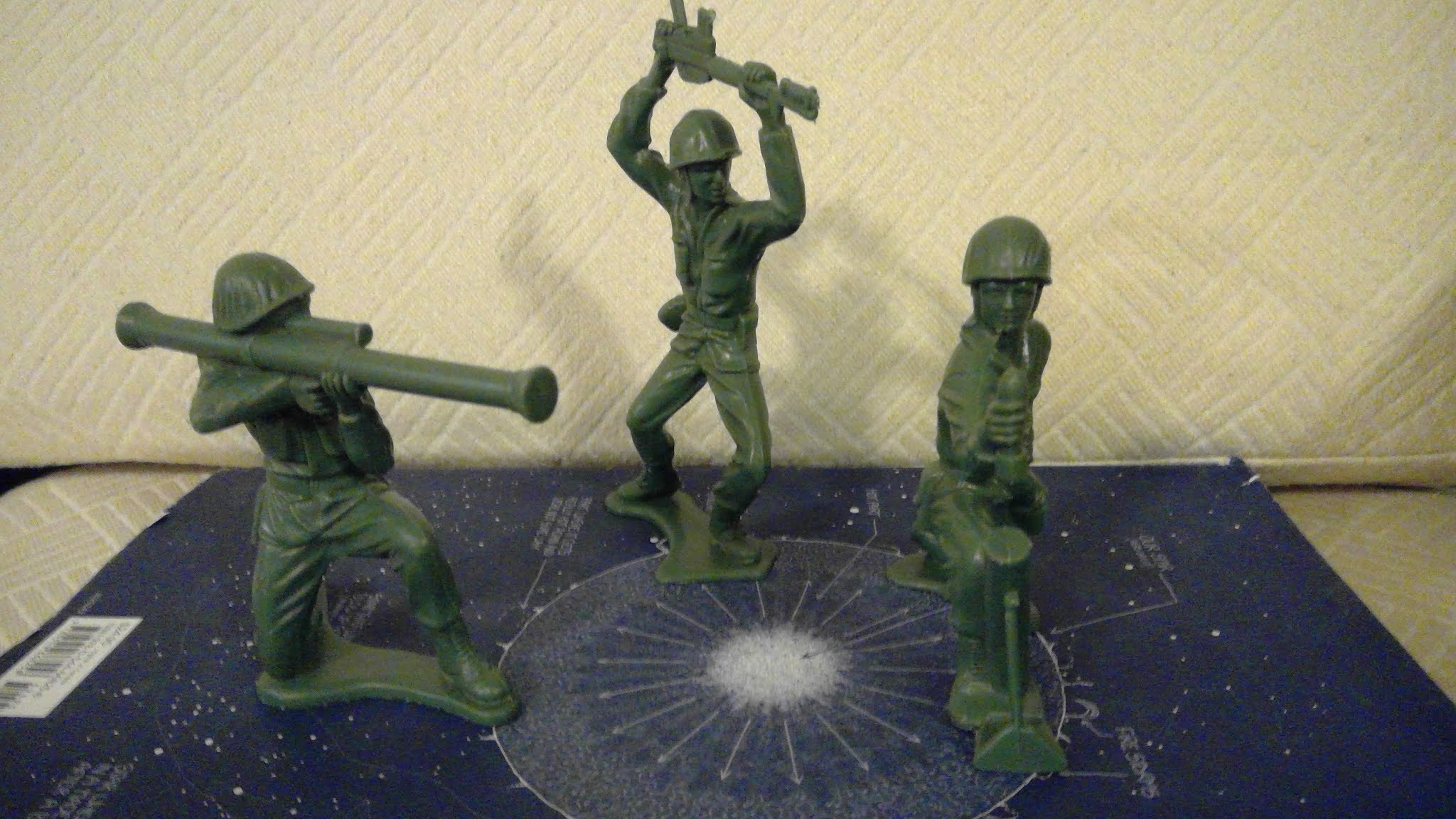
I'm back with another acquisition I've been holding onto for a while. I was a bit young to have seen Marx army men the first time around, but I definitely remember having a few Timmee soldiers around growing up. I never got around to buying any of them along with other Timmee reissues. However, I got interested when I found out that Timmee had made some large-size army men. On further investigation, I determined that it wasn't hard to get a set for a low price, so I ordered a small group online. Here's a few shots of what I got for the money.
"Yeah, talk to me about not having a big enough bayonet."

The first thing that will be apparent is that the figures are based on Vietnam rather than WW2 uniforms and equipment, though the only member of this group to show this is the guy with the M16. (Of course, the gun is damaged, which the weapon's critics would undoubtedly argue to be entirely realistic.) They also clearly demonstrate Timmee's preference for stylization over detail. It's of further note that these are larger than the "large" Galaxy Laser Team figures but still somewhat smaller than the Marx 6-inch line, putting them at a straight 5-inch scale. Here's a lineup to show what I mean, featuring the GLT astronaut and the Marx Japanese officer.

The ones that interested me most were the guys with the bazooka and mortar, which I absolutely remember having as a kid. As seen previously, these static poses are more dynamic than attempts at "action" poses. The downside is that this made for more anatomical complexity than the molding process could handle, especially for the bazooka man. Then there are some things that are just weird.
"It's not really a bazooka, it's a plasma cannon with a direct neural interface. And it's still more futuristic than the one in Laserblast."

The sculpt that has the biggest problems is the trooper with the gun over his head. (For some reason, army man makers loved this pose.) Viewed from either side, he looks fine, but if you take a close look at the face, the two sides don't match up. The result looks like Two Face or the Phantom of the Opera. Here's a few closeups, though even these shots don't really capture how messed up he looks.


All in all, these are a good addition to any Timmee collection. They mark an important transition in army man design, and they still look pretty good. For a closing, here they are with the ultimate Vietnam figure, the Lido draft dodger.
"All I'm saying is, give desertion a chance."

That's all for now, more to come tomorrow!


Monday, August 10, 2020

Space 1979: The other one with a green killer space germ


Title: The Andromeda Strain

What Year?: 1971

Classification: Prototype/ Anachronistic Outlier

Rating: Downright Decent! (4/5)


I have previously mentioned that I grew up on movies from the 1970s more than any other time. On further reflection, I suppose this might give the impression that I’m a lifelong enthusiast for all things psychedelic and/or disco, which is really the wrong idea. Of course, as a kid, I didn’t have a frame of reference to sort out cultural references, so it was easy to accept 1970s culture as just “normal”. Even allowing for that, however, the kind of Seventies movie I watched weren’t the kind of movie that flaunted how Seventies they were. It was less Grease and Happy Days, more Star Wars, Jaws and Dirty Harry. With this installment, I’m getting to the prime example, the one that happens to have introduced Michael Crichton to the big screen.

Our story begins with a pair of expendable crew sent to retrieve a crashed space probe. One might expect either zombies or a terrifying ET ripoff, but instead they see vultures, just before their transmission ends with a scream. In the next few scenes, we are introduced to a hastily gathered band of scientists, a highly secret lab designed to keep the smallest germ contained, and an extraterrestrial plague that wiped out most of a town’s inhabitants within minutes. The emerging leader is a surgeon who is also entrusted with the means to disarm the lab’s nuclear self-destruct mechanism, with helpers including a female researcher who inexplicably isn’t young, attractive or explicitly single. They eventually realize that the probiotic germ, visible in their most powerful microscopes as a green goo, is immune to radiation and may multiply if nuclear weapons are used against it. Of course, soon after, something activates the self-destruct mechanism, setting up a race to stop the detonation in time.

The Andromeda Strain was based on a 1969 novel of the same name by Michael Crichton, which Universal optioned for a tidy sum. Veteran Robert Wise signed on to direct, special effects duties went to 2001’s Douglas Trumbull, and TV actors Arthur Hill and Kate Reid were cast in the lead roles. The character of Dr. Leavitt played by Reid is noted to have been male in the original novel. The effects included computer-generated images, mainly projections of the mutation and spread of the disease. The movie was made for $6.5 million, making it one of the most expensive science fiction films up to that time, and earned a US box office of $12.4M. Contemporary posters made a selling point of its 2 hour 11 minute running time. Michael Crichton went on to write and direct 1973’s Westworld (and completely bail on Futureworld), while Wise and Trumbull teamed up again for Star Trek: The Motion Picture in 1979. 

I remember seeing Andromeda Strain as a video rental sometime in the early 1990s, then again around 2000. For the viewing that led to this review, I had to wait literally months, or else I probably wouldn’t have considered covering it at all. When I first saw it, I was duly amazed, and readily accepted it as a classic. When I got back to it, I still liked it but noticed speculative science that had gotten either dated or “fringe”, including possible underpinnings of the “aliens brought life to Earth” hypothesis. By the time I got hold of it again, I was going in with a small but discernible bit of dread.

Fortunately, the movie does hold up quite well. The story, production values and acting are all quite good, not that that was in doubt in my mind. The closest thing to a weakness is the long run time, where a more conventional movie then or now would probably have aimed for a much punchier 90-100 minute time. However, this was clearly an honest choice, and the production makes the best of it with a unique balance between speculative exposition, clinical atmosphere and a few action sequences that really try to earn their payoff. More importantly, it’s free of the kind of “cringe” moments that haunt films far more recent than this. The casting of Reid (age 40 at the time of release) in particular is all too forward-thinking even by modern standards. The one thing that is mind-boggling is that the whole thing got a “G” rating, despite prominent and perfectly gruesome scenes of the plague’s victims, the tense finale and even a fair amount of nudity.

Needless to say, time has not been as kind to the science. The idea of life in the depths of space was clearly speculative even for the time. It has in fact been born out that some basic organic compounds do occur in space or on certain moons and asteroids, keeping the spaceborne germ within the realm of minimal plausible. On the other hand, some of the effects assigned to it just seem random, particularly the literal dehydration of its victims (which really ought to reduce their remains to badly contorted mummies). The more central premise that the germ could feed on energy is especially improbable (not to mention suspiciously close to The Green Slime); an organism able to survive in space would be resistant to radiation, but surviving a nuclear blast would be another matter. The more fundamental problem is that there’s no convincing middle ground for the protagonists to work in. In reality, anything this deadly and contagious would either go worldwide within days or simply burn itself out.

What does work then and now, and in many ways feels all the more chilling, is the lab. The most effective and entertaining sequences of the movie are the elaborate sterilization procedures the crew are required to go through, including the incineration of their clothes and the outer layers of their skin. It has the feel of a more lethal version of the opening of Get Smart (something else I can remember watching back in the day), humorous at face value but increasingly disturbing. Everything comes together in the final act, as the chief protagonist runs a gauntlet of the lab’s own defenses to prevent disaster. Exactly why he can’t use one of the multiple stations supposed to  positioned throughout the facility is difficult to follow and clearly beside the point. Watching it with the full benefit of hindsight, I quickly wondered if this was the inspiration for the self-destruct sequence in Galaxy Quest.

But for the “one scene”, my pick is an early sequence of short vignettes where the protagonists are summoned by the authorities. There is a wife who answers the door during a party, to be met by two very persistent visitors who must see her husband. There is Reid/ Leavitt, who initially insists that she must finish an experiment in progress. Then there is a hapless researcher wakened in the presence of his family. In the midst of it, an excited child declares that there are men outside, “And they have guns!” It all serves as a reminder that the level of paranoia shown throughout the following film never required a plague to take root.

By the final verdict, this is another movie that suffers from its ambitions more than its flaws. It sill remains a good movie well worth the expense of a rental, if not a purchase. One more thing to bear in mind is that being available to the masses decades later was much further beyond the imaginations of the film industry than any of the visions of science fiction. Nobody expected to make movies for generations to come, any more than the pulp writers expected to be reprinted decades later. The fact that any of them succeeded should remain an impressive feat worthy of respect.

For links, the image credit goes to Drive In Review. As usual, you can see the series Introduction for an overview of the feature, classifications and rating system.

Sunday, August 9, 2020

Mid-Sized Marx: King Hippo!


I wanted to get something in before more movie reviews, so I'm bringing something a little more random than usual. After gathering the 6-inch figures featured in the Miniature Giants series, I've been searching the online sales for more worlds to conquer. Not long ago, I found something that caught my interest. I had long been convinced I played with a Marx jungle animal set (undoubtedly bootleg/ knockoff) as a kid, including a hippo. I caught wind of a release of Marx animals in a much larger scale. After looking into it further, I found one particular item that I was willing to pay for. What I got was this.


"Mention marbles, and this is the last thing you will ever see."

Per my usual authority Marx Wild West, Marx made jungle animals in ca 60mm/ 2.5 inch scale from the early 1950s onward. In the 1960s, they made a number of animals in large size out of hard plastic. These were described as "hollow", which left me honestly unsure what to expect. I half-expected the specimen I ordered to be the same solid "soft" plastic as the 6-inch figures, which at this size would qualify as a murder weapon. The alternative that crossed my mind was that it would be one of those cheap monster figures with a giant open cavity where the underbelly would be. What I actually got was made on the same lines as the (barely remembered) He Man Battle Cat, two molded halves joined together in the middle (in this case with visibly discolored glue).

On the question of size, it was noted in advance that the animals were not consistent in scale. It was also reported that this particular beast was about 6 inches long. Independent measurements proved difficult due to the dramatic pose, which actually shortened it overall. Still, I came up with 3 inches at the shoulder and at least 7 inches long (perhaps 8 if the head and neck were level). That became my main reason for including the beast here, as these figures put it at about the right scale for the 70mm or 4 inch figures. With this as a frame of reference, the size comes out in the neighborhood of 5 or 7 feet tall and 10 to 15 feet long, figures that are realistic though a little bit small (!) in length. Here's a couple reference photos with the space guys.
"Size matters, but so does a nuclear warhead parked in orbit."
"Great, an alien hippo. I suppose it's going to tear me in half and eat my head."

Beyond this basic information, there isn't much to add. Contrary to certain reports, the large sized animals were not part of any paysets, and it is not obvious how they could have been. Along with the 6-inch figures, they represent an attempt to expand beyond the army man/ playset scale figures. As with many Marx experiments, they feel both too late and too soon. In the 1950s, they could have been revolutionary.  In the 1970s, they would have been fine companions to 3.75-4 inch action figures (particularly the Adventure People line). But in the 1960s, they were just a bit odd, which certainly wasn't bad.

And now, story pictures!
"I told them I needed a ray gun!"
"Sorry, Kenny. This is what happens when you bring a thermometer instead of a gun."
"If thou wilt recall, the recruiting poster said we wouldst slay dragons. There was nothing about a 2-ton hippo!"

For links, you can see earlier installments on the 4-inch and 3-inch space guys as well as the knights. While you're at it, see the Exotroopers Xmas demo for more about hippos in about 500 words than you ever wanted to know.


Thursday, August 6, 2020

Space 1979: The one with a cyclops, Liam Neeson and a giant spider


Title: Krull
What Year?: 1982 (pre production and filming)/ 1983 (release)
Classification: Irreproducible Oddity/ Runnerup/ Mashup
Rating: Downright Decent! (4/5)

In the course of this feature, I have already frequently mentioned my ability to remember movies as the world’s worst superpower. This time, I’m really going to illustrate why. Because of my uncanny abilities, many of my experiences with pop culture have involved trying to hunt down things normal people would probably have assumed never existed. But if I can remember seeing something, I know I saw it. The worst part is, there’s still plenty of things I remember that I still have never found a trace of, yet I haven’t given up, because when I have found anything at all, it usually turns out I was right all along. My strangest and most random experience of all was relatively late, in high school. My brother and one of his friends were watching a movie that I saw maybe an hour of. What I remembered was that there were bad guys with ray guns, a teleporting sentient fortress, flying horses, a cyclops that gets squashed by a door, a guy who turns into a tiger, and a witch living in the middle of a giant spider web. And that was all I had to go on to find Krull.

Our story begins with the appearance of a huge object floating through space while the very heroic score plays. As the credits end, the object touches down tail-first on the titular planet Krull, to become a giant tower that seems to have been formed directly from crystals and coral reefs. In the next scene, we meet a princess named Lyssa waiting for the arrival of her groom Colwyn, the prince of a once hostile kingdom, who must travel through a countryside where mysterious Slayers roam at will. The prince arrives, but so do the Slayers, stormtrooper types that appear to be alien crustaceans inside a biomechanical armored shell. They quickly overrun the castle and capture the princess for their master, the Beast, leaving Colwyn for dead. The prince is discovered by Ynyr, a mystic who prophesies that it is his destiny to defeat the Beast with a magical weapon called the Glaive. Soon enough, they gather a band of outlaws and misfits, including a semicompetent sorcerer and a cyclops whose race was cheated by the Beast on another world. But to rescue the princess, they must find the location of the Beast’s mobile lair, known only to Ynyr’s old flame, the Widow of the Web.

Krull was first developed in 1980 as part of a wave of early 1980s fantasy films that also included Dragonslayer in 1981 and Conan the Barbarian in 1982. It received an official budget of $27 million, mainly for sets and effects. The cast included stage actor Ken Marshall as Colwyn, Freddie Jones as Ynyr, Liam Neeson in an early role as one of the outlaws, and Bernard Bresslaw as the Cyclops.  The soundtrack was composed by James Horner, fresh off the success of Wrath of Kahn. The studio apparently sought to expand the movie’s footprint with tie-in merchandise, most significantly a video game for the Atari 2600. Alas, the final box office receipts were well under $20 million.

This is the kind of movie I have always wanted to like, and I certainly like it very well. What has most interested me is that its detractors and some of its fans have assumed it to be an imitation of other films while rarely offering a clear or chronologically convincing argument what the production was ripping off. Of course, other fantasy films were being made at the time, but many of them came out while this movie was already in production. More importantly, any intentional references to other sci fi and fantasy films (especially in the design of the Slayers) are limited and often creative in their own right. The culminating irony is that the one thing that was really like Krull was the He Man/ Masters of the Universe franchise, which nobody has noticed. However, any analysis of either property will make it clear that this was simply a case of independent development. What’s truly interesting on this vein is that kids were happy to accept exactly the kind of mashup of sci fi and fantasy that Krull had tried and failed to sell to adult audiences.

Meanwhile, considered on its own merits, what stands out about Krull is just how bleak it is. For once, the legions of evil prove effective and competent both in individual combat and strategic planning. The Slayers are silent at all times, with a further gift for emerging or simply appearing in improbable and inaccessible places. While the heroes prove able to best them in close combat given the opportunity, they take steady losses in a series of ambushes and sniping attacks, while at least some of the Slayers appear to survive the destruction of their humanoid forms. The usually unseen Beast almost always stays a step ahead of the heroes, particularly when it comes to hiding the location of his fortress. The fortress itself easily supplies the most effective moments of the movie. The sense of malignant sentience from its shifting biomechanoid forms is so strong that the appearance of the Beast himself is anticlimactic by comparison.

The movie also offers plenty from its heroes and their world. The Cyclops is easily the most interesting, as stealthy and elusive as the Slayers, yet charming and articulate when he chooses to speak. He is also given a compelling and tragic backstory that figures in the plot without being overplayed. The outlaws are uniformly well-cast, enough so that Neeson does not outshine the rest. The enchanter Ergo is perhaps the most nuanced character, serving the assigned role of comic relieve while showing well-honed survival instincts and stretches of competence. The movie’s varied terrain greatly adds to the sense of depth, particularly the lava-filled cavern where Colwyn retrieves the Glaive and the dismal swamps. The most astonishing setting is the Web, a thoroughly menacing environment that remains quite distinct from the forces of the Beast. The Widow and the creature that seems both to guard and imprison her may be evil, but they are evils born of their own world and in their own element, not intruders from elsewhere.

Unfortunately, even praise gets to the core problems of the movie. The first half of the movie is one big pacing problem, with some of its most interesting events and episodes passing without further development while others drag on far longer than necessary. In a more modern movie would probably have thrown in a half-baked revelation that Colwyn was left alive so the Slayers could steal the Glaive, except he has it for most of the movie, and does so little with it that the forces of evil might have suffered greater losses trying to use the death-frisbee themselves. The movie’s problems become a perfect storm with Colwyn and the casting of Marshall, otherwise best known as the insufferable Eddington on Deep Space Nine. I have thought about this a very long time, and the best way I can put it now is by comparison with Sam Jones in Flash Gordon. The latter could at least be accepted as good-natured and kind, while Colwyn far too often comes off as self-centered even in his virtue. Whether this is because the clearly superior actor wasn’t right for the role or simply brought out the more irritating qualities of the character is ultimately a chicken/ egg paradox I don’t care to give more time to.

It should be clear that none of this is meant to say the movie doesn’t “work”. On the contrary, its greatest strength is taking scenes that sound almost comical in cold blood and making them convincing and moving. The strongest example is my pick for the “one scene”, the ride of the fire mares. After discovering that the fortress is in a distant land, the band of heroes must capture a herd of magic horses to cover the distance. The Cyclops announces he must remain behind to await his anticipated fate. The following sequence is uncharacteristically weak in its effects, with matte work no better than Harryhausen did in the 1950s and 1960s. But the Clydesdales serving as the herd are beautiful, and accompanied by the most epic segment of Horner’s excellent score. (Someday I may tell of my own adventure obtaining the soundtrack.) The sequence leads seamlessly into an especially tense confrontation with the Slayers, who hold the high ground from the portals of the fortress. When all seems lost, the Cyclops arrives, defying his destiny and quickly demonstrating the price.

With this review, I have gotten to the one I have the strongest feelings about. I have tried to be honest about its flaws, which is the main reason I haven’t rated it higher. I still consider all of them  (including my issues with Marshall) to be quite forgivable compared to what the movie does right. Above all, it deserves more than due credit for its audacious creativity in blending genres. In that respect, it was a brave experiment that could only have been done at one time, and it is still unmatched. So let’s hear it for the whole crew, and sing a lay for the Cyclops. We will not be moved.

For links, one of the first and most insightful reviews I turned ups is still available at badmovies.org.  An overview of my classifications and rating system (and preliminary comments about this movie) is available in the feature Introduction. For a little extra random, there's an AVGN/ Cinemassacre video about the Atari game.

Wednesday, August 5, 2020

Rogues' Roundup! Kate and Ken (the Wampa)

I needed something a bit short today, so I decided to go with one who's already appeared frequently: The Truckstop Queen, aka Cordelia, aka per the comments, Kate! She's been my "model" since long before I started this blog, and it was about time she was front and center. This time, she's together with her boyfriend, Ken R. Wampa. Here's s few pics of the Happy Couple with some of the more recently featured figures, including the mystery red guy.

"Short by that much..."

All things considered, the Truckstop Queen's story is simple enough. Sometime around 2012 or 2013, during the darkest days of chronic unemployment, I was at the local used bookstore with friends when I saw her available for maybe 2 or 3 dollars. I had no idea what she was or who she was, but the price was good even by unemployed-me standards, and I decided she would be a friendly face to have around. After I brought her home, I figured out she was Cordelia from (edit) Moore Action Collectibles' Buffy/ Angel line. I also found out she would have originally come with a purse and some weapons, which I definitely didn't miss. I liked her because she was different from what I usually get, which I suppose is why I started to work her into my pics of other toys.

That all led to a long series of posts in social media and online forums that evolved into this blog. Along the way, I recognized how much taller she was than other figures, something like 6 and a half inches when I finally measured. That presented a problem when I had the idea to set her up with a boyfriend. I tried a range of figures before it occurred to me that the one toy that would equal or exceed her height was a Kenner Wampa I had picked up to replace one I had had as a kid. (It was him or the big red Robotech guy.) The one further issue that emerged was that the rather infamous arms were articulated with a piece of elastic that that's tricky to work with. This is why many of the pics to appear here have the Wampa directly behind her. On the other hand, the Truckstop Queen is indecently mobile, while Ken's arms can go every which way whether you want them to or not. With a little experimenting, I got an array of... interesting poses, Here's some pics, new and old.
"I'm going to slap you if you don't stop acting like a gentleman..."

"You can drag me to your cave and hang me from the ceiling anytime you want..."
These things happen. Then it takes me twice as long to do it again.

There's not much more to add here. The Truckstop Queen is staying on my shelves with Ken, when I don't need her elsewhere for my morale. She remains a friendly face, and everybody needs that sometimes. That's all for now!

Tuesday, August 4, 2020

Space 1979: The one where stop-motion dinosaurs face off with a slasher movie cast


Title: Planet of Dinosaurs

What Year?: 1977

Category: Runnerup/ Anachronistic Outlier

Rating: For Crying Out Loud!!! (2/5)


When it comes to reviewing movies, my first love is stop-motion dinosaur movies. In the far-off days, the technology behind Gumby and Pokey was big-budget special effects for classic movies like King Kong and Jason and the Argonauts. Even in those days, there was only a small cadre of animators who could do it well, led by Ray Harryhausen and his mentor Willis O’Brien. I have had to point out all along that the movies that featured their fine work almost always had relatively good production values and overall quality for their era. The cost, time, and sheer obsessive self-discipline of positioning miniatures frame by frame by frame was normally out of reach of the worst low-budget fair. (As a further consequence, there was a virtual genre of movies that cannibalized the original One Million BC for “dinosaur” footage.) The conspicuous exception is the present movie, which I regarded for some time as the worst I had ever seen.

Our story begins (after the absolutely bonkers credits) with a shot of a starship in space. It’s pretty good, so of course, it’s revealed the ship is about to blow up. A small party, consisting of the captain Lee, engineer Jim, 5 crewmates and exactly two passengers included their employer, escapes on a sort of shuttle. They lose that vessel, their communications equipment and one of the crew ditching in a lake. The castaways soon realize that they are on an Earthlike planet inhabited by dinosaurian creatures that are absolutely immune to gunfire. The band is lunched one by one, while Lee and Jim quarrel for the right to command the dwindling group. When they discover their efforts to escape the dinos have brought them into the territory of the biggest predator of all, Jim calls on the group to join together and kill the creature.

Planet of Dinosaurs was officially released in 1977, the same year as Star Wars as well as the Harryhausen production Sinbad and the Eye of the Tiger. The lead roles of Lee and Jim were given to B-movie actors Louie Lawless and James Whitworth; the only other cast member to have a significant  career was Michael Lee, a briefly seen child actor who went on to a series of ads for Dunkin Donuts. The real talent went into the stop-motion effects, under lead animator Stephen Czerkas with credited assistance from the senior craftsmen Doug Beswick and Jim Danforth. Much of what can be known of the movie’s production and release comes from Czerkas, whom I personally encountered in the middling 2000s as the revered elder in a discussion forum on stop-motion animation. Of most significance, the animator specifically recounted attending public screenings of the film, contradicting certain reports that it did not receive a theatrical release.

Moving on to my own experiences with this film, this was one of the first stop-motion dinosaur films I acquired my own copy of. After learning far more about the genre, my foremost impression is that this was the last and most disastrously mistimed of the breed. It was clearly made as a well-intentioned homage to earlier films, especially by O’Brien and Harryhausen. The problem was that Harryhausen was already at work on what would be his final film, Clash of the Titans, while the last to feature dinosaurs was Valley of Gwangi from 1969. The outdated nature of the movie was simultaneously exacerbated and obscured by the many posters and video covers that tried to link it with Star Wars. As with the more egregious case of Laserblast, this simply made it look like a ripoff of something it really had almost nothing in common with. 

Anything good to be said about this movie will come from the dino effects, and I must depart from my usually format to say enough about them. Some of the best to be featured are smaller dinos that appear incidentally, notably a pair of dueling ornithimimids, which adds to an unusually well-developed picture of a functioning ecosystem. There are nice further touches in sound effects, including an eerie shriek far more effective than T. rex roar in Jurassic Park, and a comical potato-chip crunch when a lesser predator gets chomped by the big one. But there are also moments that don’t ring true, like a bow-legged sauropod, a stegosaur with plates that bend, and a heavily armored ankylosaur that goes down from a blow of a rock like a cow in a slaughterhouse. The one that has always stood out to me is an otherwise commendable seen where the crew’s jerk boss raids a dinosaur nest. Of course, mama shows up, a ceratopsian, noteworthy as the only dino to attack with a clear provocation. When it charges, it moves with a very strange gait that I find akin to a windup toy at triple speed, marring one of the movie’s most effective (and quite graphic) attack sequences.

On the other hand, the weaknesses are all too freely supplied by the human cast. To begin with, the quality of the acting is mediocre at best, laughably bad on average and painful at its lowest points, but that alone doesn’t account for how stupid almost all of them are. The decision-making of the crew is on a level not normally seen outside of teens in a slasher movie repeatedly endangering not only their own lives but vital gear everyone else needs to survive. My favorite is a guy who tries to fight the big bad dino while standing next to a carcass specifically left out as bait for it. In many ways, the biggest idiot is Jim. He makes me think of Mr. Scott going native among the Klingons; on consideration, he’s even more like David from Shaun of the Dead, with far fewer redeeming qualities. He talks tough and increasingly demeans Lee and other members of the crew, but he is absolutely no smarter or more qualified to lead than anyone else. When he does finally get a chance to try his own plan, it’s pure luck he or anyone else survives, which doesn’t stop the story from presenting him as the one in the right.

I also have to give a rant about those laser guns. Long before and after this movie, it was a cliché for dinosaurs to be virtually invulnerable to guns. I have been annoyed enough with this to take it head on in my own fiction, but this movie is an egregious example. What’s uniquely irritating is that the movie had a ready rationale for inadequate weaponry: Actual astronauts have sometimes been issued rifles and shotguns for hunting small game in the event of a crash in a wilderness area, but nobody would figure on facing something as big as a rhino or elephant (though a few 12-gauge slugs would do the job well enough). Instead, the crew are given ray guns that are advertised to “kill almost anything” yet never do more than vaguely annoy the creatures. As a bonus, while “real” energy weapons have the specific advantage of not requiring openings for the muzzle or magazine, these are so oversensitive that Jim declares one ruined after being dropped in the water for a few moments (not that we’re obliged to take his word for it). The core problem is that we have no frame of reference to be impressed by either the monsters or the guns. We haven’t been told how powerful the weapons are compared to contemporary firearms, nor do we seen them slay any lesser beasts. Without that kind of proportion, it appears either that the beasts are armored like Abrams tanks (except for the ankylosaur that’s actually armored) or that the weapons are about as effective as a laser pointer.

For the “one scene”, however, I have to go with the opening scene that set this up. As mentioned, the briefly featured spaceship looks quite good. The scene proceeds at a good clip, without dwelling on the cause of a reactor meltdown that destroys the ship. (From what we see later, the jerk boss might have diverted the coolant to keep his wine bar chilled.) We then see the launch of an escape craft that actually looks quite functional, with an extra shot from the rear as it descends toward the planet. Jim announces that their power reserves (or at any rate reserves of something) are low, while copilot Nyla announces they must make a water landing to stay intact. Alas, when they splash down, it quickly sinks, forcing the crew to bail out in such a hurry they forget most of the equipment that would do them any good.

But this is where I say, not so fast. A functioning space craft that can hold in air in the vacuum of space can certainly keep water out, and it’s the one thing a search-and-rescue party should be able to find, especially in a shallow body of water that survivors could be expected to seek out. If the hull is leaking due to damage, as Jim announces, there could still be an air lock or cargo bay that one or two could take shelter in. Then there would surely be at least one space suit aboard, and once again, if it works in space, it will work in water. Even if the rest of the crew had to bail out, one guy could stay behind in the ship for anywhere from a few hours to several weeks. (Even by the standards of this crew, most of the men are clearly more expendable than any of the women.) Then if he got to the end of his air supply, all he would have to do is grab any equipment with salvage value and walk to shore.

Needless to say, this is the kind of overanalysis that is only possible with frequently repeated viewings. By any standard, this movie is “so bad it’s good” in the best kind of way. I personally have had way too much fun to give this movie the lowest rating, yet even productions of this caliber have done a far better job with character development, worldbuilding, and internal logic (see Dark Star). If there had been even a little more work put into these areas, I could easily have raised the rating to 3, 4 or even 5. As it is, go in for a good laugh, and you certainly won’t be disappointed.


For links, the image credit goes to Space 1970 (again). My favorite reviews are still from Million Monkey Theater and Stomp Tokyo. For more on the feature, the rating scale and classifications, see the Introduction.
Monday, August 3, 2020

Mystery Monday: The guy it took 30 years to identify


I'm introducing annother feature, and it's what this blog has been about all along: Identifying mysterious toys. I have bought a lot of things without knowing what they are, but I am also usually good at figuring out what they are. Therefore, this will focus on the ones that gave me real trouble, and I will be starting with my greatest challenge of all (at least after the Spiff ship), a figure I had for 30 years before figuring out what he was. Here's a few more pics of the guy:


I first picked up this guy sometime in the late 1980s. To my recollection, I payed 50 cents for him at the comic book store, and didn't think to ask what he was. He looks something like a cross between a stormtrooper and a Cylon with a touch of wrestler, and is just a little taller than a Star Wars figure. I noticed early on that he had an asymmetrical head and strange articulation in the arms. As with many figures, I kept him around as  generic bad guy, sometimes the lead villain and at other times a robot minion/ henchman. As far as I remember, he came looking about as roughed up as he does now. There's a couple places that may look scratched in the pics that are actually cracks in the apparently hollow body. I'm sure I never did anything that could have put them there.

Even as a kid, I gave thought to investigating what he was.  It was clear he was neither GI Joe nor Star Wars, and even I didn't think he could be Robotech. On inspection, I found a copyright that said "W.E.P." and gave a year 1984. And that was where the trail ended for a very, very long time. As the age of the internet went on, I tried now and then to enter search terms for 1980s action figures, with no luck whatsoever (though I think that may have been how I identified T-Bob from MASK). A few times, I thought I might have lost him, but he always turned up. Then one day in maybe 2018, I watched a video on 1980s toys nearly at random, and... Eureka.
After such a long search, the reality was quite anticlimactic. My mystery bot had been a Voltron figure, made by one of several companies to license the franchise. I wasn't that surprised to find that it was widely regarded as one of the worst not only of the Voltron line but of all 1980s action figures. It was one of two figures released to represent the Robeasts of the show, the other being Scorpious (by my reckoning worse by far). By all accounts, neither was specifically based on a character from the series, but may (as suggested with the Robotech red guy) have been composites of multiple creatures. Their infamy was surely sealed by the fact that the actual Robeasts were kaiju-type creatures that fought Voltron. I previously theorized that the Generic Godzilla was made and marketed as an adversary for Voltron and other giant-robot toys, whereas this guy would have been the right size to get kicked into orbit by accident.

This doesn't mean I'm not happy to know who this guy is, or to still have him. The whole point of playtime is to make your own story, and not knowing much (or anything) about who a figure is just makes him more versatile. I will always remember this guy as a veteran of many a campaign. That's enough for me. Before I wrap this up, here's a few more pics with some old playmates.
"Come on, boss, just call it even, that's Sidekick Carl we're up against."
"Okay, let's talk this out."

That's all for now, as always, more to come!

For links, the image credit goes to FigureRealm. You can also see (terrible) reviews of this and Robeast Scorpious at CollectionDX.